rile*books

Search books

Search books by title, author, publisher, keywords...

Cover of on the future and the artist-run spaces

Self-Published

on the future and the artist-run spaces

Club Solo

€19.50

Artists, curators and writers describe their vision on the role of artist-run spaces for the future and discuss their own position in the world of art. The authors weigh in on the importance of artist-run spaces and reach out to anyone looking for alternative ways of thinking, working and living together.

Language: English

recommendations

Cover of More Than Chilli

Self-Published

More Than Chilli

Rossy Liu

Cooking €21.50

Chilli is one of the most popular food ingredients in contemporary China, and symbolic of modernisation. More Than Chilli goes beyond its trendy façade to explore Chongqing, known for its tradition of spicy food. From the perspective as a local, Rossy Liu reflects on her own personal memories associated with chilli. A combination of fragmented scenes, objects, dialogues, movements and sounds are drawn on to unravel the locality of culinary identity. While chilli has become a ubiquitous flavour in today's global society, the book emphasises the hidden intimacy that still exists between Chongqing locals and their unfiltered connection to chilli.

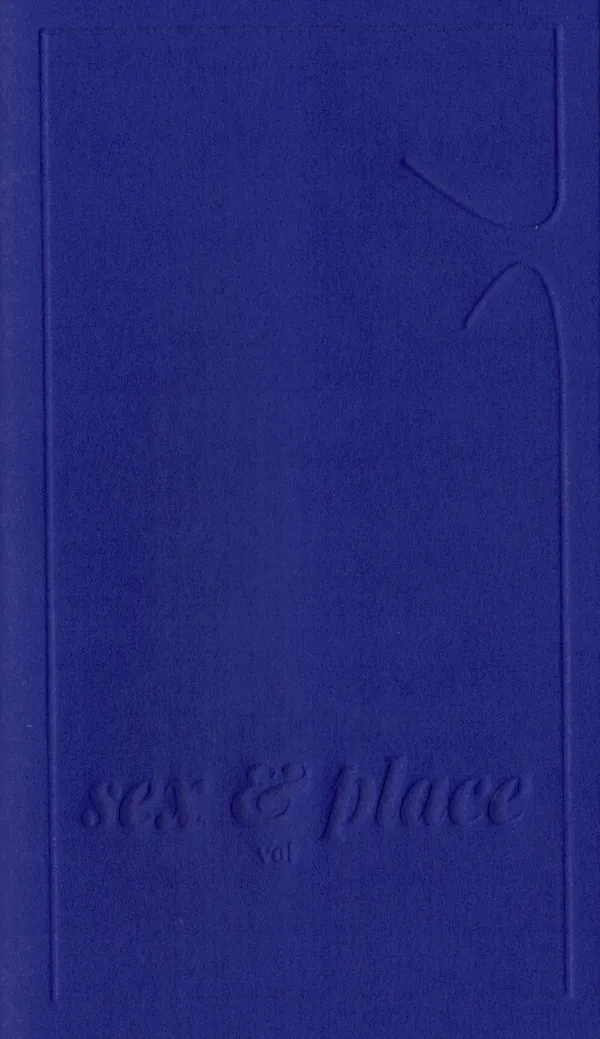
Cover of sex and place vol 1

Self-Published

sex and place vol 1

Adriano Wilfert Jensen, Andrea Zavala Folache

sex and place is a series of workshops and publications exploring score-based and semi-anonymous writing as a tool for articulating shared concerns.

Vol. 1 ‘preliminiaries’ is written by Andrea Zavala Folache and Adriano Wilfert Jensen. In the midst of (learning) child care, (unlearning) performance and (experimenting with) sex, the publication interweaves three registers of writing as analogies and interruptions of each other.

The ‘sex and place’ series is part Domestic Anarchism, a project devoted to coalition-building beyond biological, chosen, or national conceptions of family. Dance serves as a set of tools and knowledge that can be applied beyond “the spectacle” to collectively study, write, and move. 

Andrea Zavala Folache and Adriano Wilfert Jensen are choreographers and they co-parent three-year-old Penélope Cleo. Andrea and Adriano use dance and choreography to think about the distribution of care and solidarity beyond ‘the family’, and in turn consider how such a distribution could inform their dance practice. Inevitably themes like sex, economy, gender, and class get activated. But also notions such as prefiguration, anarchism, clitoridian* thinking, zones of non-domination and coalition building. They see dance as a knowledge that can be applied to different practices. Some of these include: co-habitations, score based writing and dancing, self-organised study groups and publications, workshops and dance performances. 

Cover of Elizabeth in the Woolds

Self-Published

Elizabeth in the Woolds

Jennifer Brewer

Fiction €22.00

Elizabeth in the Woolds is the product of two superimposed compositional strategies; a thematic aggregate based on notes dating back to 2008 and an epic prose narrative. Elizabeth is the device through which this simultaneous register moves. Screen writing provides a model for multiple voices. In a film script, the narrator can be the camera; there’s a machine at the centre of the story structure which figures a demand for resolution of plot; a contrario, the thematic approach (S, U, N, as electric light) obliterates chronology, and enumerates an atemporal topological figure, or the way the world is built.

(730pp., self-published first edition of 50, Kortrijk, 2021) 

Cover of Stili Drama XIII-XXI / La Giostra di Lulu XLI-XLIV

Self-Published

Stili Drama XIII-XXI / La Giostra di Lulu XLI-XLIV

STILI DRAMA

The materials collected in the publication have been developed departing from the documentation, transcription and translation of textual, visual, sculptural and audio materials produced between March and November 2021 for STILI DRAMA. 

STILI DRAMA is an open-ended episodic para-cinematographic project, which functions as a spontaneous expression of MRZB research. STILI DRAMA XVIII-XXI and LA GIOSTRA DI LULU XLI-XLIV are the two first fragments of the work.

Language: English, Italian
Edition of 100 copies

Cover of In Perpetuity

Self-Published

In Perpetuity

Ivey Wawn

In Perpetuity is part of Ivey Wawn’s project of the same name. With contributions from those involved in the making of what would have been the live performance, it is an accumulation of thoughts, reflections and associated pieces of work that give some idea of what the work could, would, or may in the future come to be. 

In Perpetuity is an ongoing project that has taken a variety of forms, from publication, through video and into live performance.

Cover of Great is the Power of the Name

Forlaget Emancipa(t/ss)ionsfrugten

Great is the Power of the Name

Signe Frederiksen, Anne-Mette Schultz

Great is the Power of the Name considers the works of authors Elena Ferrante, Pauline Reáge, Karl Ove Knausgård, Colette and artist Lee Lozano

In 2016, when Anne-Mette had invited Signe to take on the role as editor of her text The Institute of Applied Speech, they both began reading Elena Ferrante's The Neapolitan Novels. They were specifically fascinated by the author’s use of pseudonym. Anne-Mette's Institute of Applied Speech was a tale of a fictive place, a pseudo-topos, and Elena Ferrante’s ideas about the pseudonym as a space for the writing itself was useful in thinking about fictive authorship. In a number of written interviews, Elena Ferrante unfolds the feminist perspective of her use of pseudonym. They were attracted by the idea that the author could avoid the biographical question; that she could disappear behind her own writing. 

To them, the artist Lee Lozano is the ghostly presence of hard-core moralist and humorous fuck-off art from another decade. During the course of her life, Lozano continuously reconfigured and gradually dissolved her own name, starting from Leonore Knaster ending up with E. Her work Boycott Women, in which she decides not to have any contact with women, expands the notion of feminist critique. 

Great is the Power of the Name publishes a readership interested in the position of the artist, and how it conditions the way we make art.

Cover of Pervert or Detective?

No Place Press

Pervert or Detective?

Reba Maybury, Lucy McKenzie

Artists Reba Maybury and Lucy McKenzie dissect power and desire in a provocative conversation that probes the material erotic, appropriation, and sex. 

In Pervert or Detective?, artists Reba Maybury and Lucy McKenzie dissect power, desire, and subversion in a provocative conversation. Maybury, who integrates her work as a political dominatrix into her artistic practice, manipulates dynamics of control, compelling her male submissives to create art under her direction, only to claim it as her own. Through confession and humiliation, she dismantles notions of authorship, masculinity, and labor. McKenzie, known for her intricate trompe l’oeil paintings and conceptual installations, similarly blurs boundaries—between art and commerce, and authenticity and illusion. Her work challenges power structures and exposes the unstable nature of representation.

Maybury and McKenzie, through an expansive discussion with French art critic Marie Canet, interrogate the logic of seduction and domination, pushing against rigid binaries to probe the material erotic, appropriation, and transformation. With an introduction by curators Fredi Fischli and Niels Olsen, an afterword by writer Susan Finlay, and extensive reading and viewing lists, Pervert or Detective? offers a compelling exchange between artists committed to unsettling the familiar and redefining artistic agency.

Introduction by Fredi Fischli and Niels Olsen
Afterword by Susan Finlay

Cover of Germaine Kruip: Works 1999-2017

KW Institute for Contemporary Art

Germaine Kruip: Works 1999-2017

Germaine Kruip

Over the past two decades, artist Germaine Kruip has steadily developed a practice, which merges time, space and perception. Like an anthropological stage director, she investigates, simplifies and presents her observations in a subtle manner often through architectural interventions. In each of these interventions, she changes a location into a stage, with the audience as actors in a play of substantive absence. By doing so, she activates both physical and mental awareness.

This publication presents an overview of the Kruip’s practice since 1999, two years prior to her engagement with the art context. Presenting over 40 works, the publication reflects on three periods in the artist’s practice, each accompanied by an essay contributed by Anna Gritz, Eva Wittocx and Stephanie Bailey. The idea of a catalogue raisonné came out of a conversation that followed Kruip’s ambitious project Geometry of the Scattering, which was presented at de Oude Kerk in Amsterdam in 2015 2016.