rile*books

Search books

Search books by title, author, publisher, keywords...

Cover of Dregs, Beacons

Self-Published

Dregs, Beacons

Anna-Rose Stefatou

€22.00

Poems on light and remnants. Light as mordant, as acid that etches through surface, as something that wraps itself around and between things, revealing form. The writing touches on dregs, remnants, residue and how we make sense of them, by making constellations and navigating through those diagrams. 

Anna-Rose Stefatou (b.1996, Athens) is a Greek-British artist based between Athens and London, working between moving image, installation, photography, and writing. Stefatou’s interdisciplinary works attend to stories attached to place and beginning to exist through writing, whether they become a structure to hold it, or whether language simply runs through them. Language is used both as an outset and as a distillation mechanism for ideas, with materials and imagery in visual works responding directly to the text. Gathering and repositioning knowledge guides her creative process: research includes archival footage, taking interviews, collecting objects, and location visits. This process is made visible through her material approach to the photographic image, transformed through different materials, forms and uses, as it unfolds and re-invents itself within new contexts. Stefatou graduated from the Slade School of Fine Art in 2019. Recently, she undertook a residency at Hospitalfield House, Scotland in 2023.  Upcoming projects include an exhibition at Pharmakeion, Athens in 2025 as well as a publication Dregs, Beacons that will be realised in 2025.

Published in 2025 ┊ 30 pages ┊ Language: English

recommendations

Cover of MW Collected Texts (Bootleg)

Self-Published

MW Collected Texts (Bootleg)

Monique Wittig

This bootleg edition collects scanned copies of Monique Wittig's writing. It includes; The Lesbian Body, Les Guérillères, The Opoponax, and Lesbian Peoples: material for a dictionary— In true bootleg style, punk enough to carry the truly radical words of Wittig: scans, a little grainy, with marginalia of unknown origins. Now, we can dress ourselves in the ravishingly erotic, violent splendorous brilliance to become baby Wittigs.  

This edition was assembled out of a deep love of Wittig's work by Chloe Chignell.

Monique Wittig was a French author and feminist theorist particularly interested in overcoming gender and the heterosexual contract. She published her first novel, L'opoponax, in 1964. Her second novel, Les Guérillères (1969), was a landmark in lesbian feminism.

Cover of Kamer I - Oesters

Self-Published

Kamer I - Oesters

Katinka van Gorkum

‘Kamer I - Oesters’ is een kort verhaal geschreven in het kader van het kunstproject Beste Anna,. Hierin fungeert de figuur van de openlijk lesbische Rotterdamse schrijfster Anna Blaman als motor voor vragen, gesprekken en correspondenties rondom feminisme, schrijvende vrouwen en de canon, anders zijn, eenzaamheid en vriendschap.

Ook verkent Katinka met dit onderzoek Anna Blaman als personage voor een toekomstige roman. In ‘Kamer I - Oesters’ betreedt de hoofdpersoon Anna’s met een rolkoffer vol boeken van andere schrijvers, fluistert ze hun woorden in de kieren in Anna’s muren en verleidt ze Anna met een pauwendans.

Anna Blaman (1905-1960) was openlijk lesbisch, in die tijd een groot taboe, maar zag zichzelf niet als voorvechter van een beweging. Een belangrijk thema in haar werk is de vraag of we een ander werkelijk kunnen kennen. De personages in haar romans zijn vaak alleen en verlangen naar een ander, die altijd onbereikbaar blijft. In 1948 publiceerde Blaman de roman Eenzaam Avontuur, die erg veel stof op deed waaien vanwege enkele (homo-)erotische personages die in het boek voorkomen. 

Cover of Economy as Intimacy (vol.1)

Self-Published

Economy as Intimacy (vol.1)

Eric Peter

Poetry €8.00

A series of choreopoems by Eric Peter. Published at the occasion of 'Assemblages of Intimacy' a group exhibition in a Tale of a Tub, Rotterdam in 2018. 

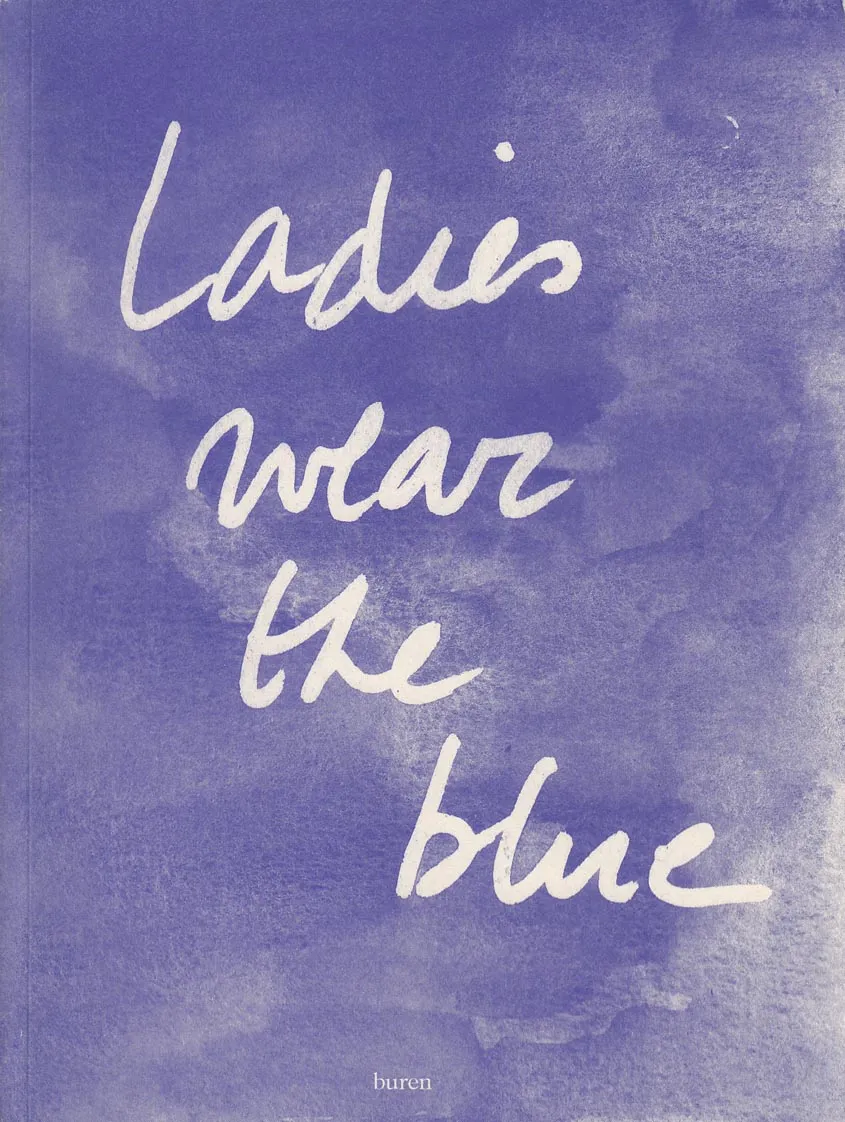
Cover of Ladies Wear the Blue

Self-Published

Ladies Wear the Blue

buren

Ladies wear the blue is a collection of watercolour drawings by the hand of Melissa Mabesoone and Oshin Albrecht. The blue watercolours portray women from different moments in time. The adjacent texts describe these women's existence, roles, desires or ideosyncrasies deriving from the 'blue' in their lives. From the first female police officers and Alices all around, to Courtney Love's blue baby dolls and the girl with the blue tattoo Olive Oatman, this publication is an ode to women venturing into the world, and a way to continue telling their herstories.

Cover of Hortus

Self-Published

Hortus

Lilia Luganskaia

Photography €35.00

The Hortus  project is an open investigation into the nature of seemingly common objects through 'Floriography', urban gardens, and the history of female rights. Hortus was inspired by urban gardens in West Amsterdam and created with its plants by Lilia Luganskaia. 

Joanna Cresswell about the 'Hortus':

History teaches us that a language of flowers can communicate endless things about the culture in which it emerged, and herein lies Lilia Luganskaia's interest. Taking inspiration from the world of 19th Century sentimental flower books, Hortus presents itself as a set of notes towards a modern handbook for contemporary floriography, considering what the discipline might look like today. By collecting common flora across one year in the urban gardens around her home in Amsterdam and cross-referencing their meanings with publications from the past, Luganskaia reflects on their natures, their roles, and the symbolic familiarity they might hold for the communities living with them. A female artist and reader of the twenty-first century, she seeks out the essence of modern life through her lens, and through flowers, just like the women who came before her. 

Lilia Luganskaia (1990) Russian - Dutch multidisciplinary artist and author, based in Amsterdam. In her artistic practice, Lilia uses her background in documentary techniques to focus on what she calls ‘investigating reality’.  Her practice is research-based, Lilia decodes abstract notions such as love, tourism, bureaucracy, politics, and feminism through the use of constructed images, sculptures, videos, and installations. One of the key elements of her work is to understand multiple aspects of the photographic image.

Cover of A book with a hole in it

Wendy's Subway

A book with a hole in it

Kamelya Omayma Youssef

Poetry €18.00

Kamelya Omayma Youssef’s A book with a hole in it uses the poetry of the fragment and the language of everyday survival to gesture towards the fallibility of language at the juncture of the multiple, intersecting wars on women, on "terror," on the non-White body, and on people and language in diaspora. Drawn from a set of journals written over a four-month period, A book with a hole in it throws the formal, official work of poetry into relief, asking what knowledge exists beyond knowledge, which silences are too deep to be surfaced on the page, and how to pierce through trauma and violence to approach a politics of redemption.

Cover of Aftershow

Sternberg Press

Aftershow

Pauline Boudry/ Renate Lorenz

Monograph €25.00

A monograph / artists' book that engages with the recent film installations of Pauline Boudry / Renate Lorenz. Installation shots, research material, scripts, and film stills give an insight into the artists' investigation of performance in film and their dense net of references to experimental film, the history of photography, sound, and underground (drag) performances.

The book's title alludes to an interest in opaque events that are belated, left backstage or off-screen. A number of (fictitious) letters to friends and collaborators such as Sharon Hayes, Yvonne Rainer, Ginger Brooks-Takahashi, and Jack Smith place the work of Boudry & Lorenz in a context of debates around temporalities, activism, the archival, decolonizing practices, and queer histories. Published following the exhibition “Patriarchal Poetry” at the Badischer Kunstverein, September 27– November 24, 2013.

Cover of Women in Concrete Poetry: 1959-1979

Primary Information

Women in Concrete Poetry: 1959-1979

Mónica de la Torre, Alex Balgiu

Poetry €30.00

An expansive anthology focused on concrete poetry written by women in the groundbreaking movement’s early history. It features 50 writers and artists from Europe, Japan, Latin America, and the United States selected by editors Alex Balgiu and Mónica de la Torre.

Women in Concrete Poetry: 1959-1979 takes as its point of departure Materializzazione del linguaggio—the groundbreaking exhibition of visual and concrete poetry by women curated by Italian feminist artist Mirella Bentivoglio for the Venice Biennale in 1978. Through this exhibition and others she curated, Bentivoglio traced constellations of women artists working at the intersection of the verbal and visual who sought to “reactivate the atrophied tools of communication” and liberate words from the conventions of genre, gender, and the strictures of the patriarchy and normative syntax.

The works in this volume evolved from previous manifestations of concrete poetry as defined in foundational manifestos by Öyvind Fahlström, Eugen Gomringer, and the Brazilian Noigandres Group. While some works are easily recognized as concrete poetry, as documented in canonical anthologies edited by Mary Ellen Solt and Emmett Williams in the late ’60s, it also features expansive, serial works that are overtly feminist and often trouble legibility. Women in Concrete Poetry: 1959-1979 revisits the figures in Bentivoglio’s orbit and includes works by women practicing in other milieus in the United States, Eastern Europe, and South America who were similarly concerned with activating the visual and sonic properties of language and experimenting with poetry’s spatial syntax.

Artists and writers include Lenora de Barros, Ana Bella Geiger, and Mira Schendel from Brazil; Mirella Bentivoglio, Tomaso Binga, Liliana Landi, Anna Oberto, and Giovanna Sandri from Italy; Amanda Berenguer from Uruguay; Suzanne Bernard and Ilse Garnier from France; Blanca Calparsoro from Spain; Paula Claire and Jennifer Pike from the UK; Betty Danon from Turkey; Mirtha Dermisache from Argentina; Bohumila Grögerová from the Czech Republic; Ana Hatherly and Salette Tavares from Portugal; Madeline Gins, Mary Ellen Solt, Susan Howe, Liliane Lijn, and Rosmarie Waldrop from the US; Irma Blank and Ruth Wolf-Rehfeldt from Germany; Chima Sunada from Japan; and Katalin Ladik and Bogdanka Poznanović from the former Yugoslavia.

Cover of Midwinter Day

New Directions Publishing

Midwinter Day

Bernadette Mayer

Poetry €17.00

Midwinter Day, as Alice Notley noted, is an epic poem about a daily routine. A poem in six parts, Midwinter Day takes us from awakening and emerging from dreams through the whole day-morning, afternoon, evening, night-to dreams again:...

a plain introduction to modes of love and reason/ Then to end I guess with love, a method to this winter season/ Now I've said this love it's all I can remember/ Of Midwinter Day the twenty-second of December// Welcome sun, at last with thy softer light/ That takes the bite from winter weather/ And weaves the random cloth of life together/ And drives away the long black night!

Cover of Ruins and Other Poems

World Poetry Books

Ruins and Other Poems

Samer Abu Hawwash, Huda J. Fakhreddine

Poetry €20.00

In these poems, Samer Abu Hawwash stands upon ancient and modern ruins, engaging with the archetypal Arabic qasida and its echoes in the present, set against a backdrop of exile, displacement, and genocide. The site of the ruin, the journey, and the return home are the three movements of the archetypal Arabic form with which Samer contends in his book-length poem. 

Writing in and from the moment of crisis, the poet keeps returning to ruins, forfeiting the journey and the hope of return and resolution, rearranging the elements of poetry in the Arabic tradition in search of closure or consolation—in a gesture, a shadow, a memory, an object. The five poems that follow “Ruins” in this book root themselves in monumental loss. When “it no longer matters if anyone loves us” and “we will lose this war,” nothing remains but the poem, the witness, the signpost in the wasteland of history.