rile*books

Search books

Search books by title, author, publisher, keywords...

Cover of My Body Is a Reincarnated Population

Bored Wolves

My Body Is a Reincarnated Population

Oscar CHAN Yik Long

€20.00

Heart. Compass, radar detector. Lost and anxious. Parents divorce. Respect the rhythm. Fallen angels, now my stomach is all butterflies.

In his artist’s book My Body Is a Reincarnated Population, Helsinki-based Hong Kong artist Oscar CHAN Yik Long (Melted Stars) embraces the pantheon of reincarnated souls embedded within him through ink-and-wash paintings and distilled capsule texts.

His process was guided by the rolls of a die used to connect individuals he has known and encountered in past lives—parents and siblings, relatives and ancestors, friends and enemies, lovers—to his present-life body. Who formed his throat? Who grew into his tongue? Who paired as lungs? Who became skin, muscle, bone, or blood?

The artist’s efforts were ultimately about a form of spiritual atonement in pursuit of physiological harmony for a body facing numerous afflictions: “Through my artwork, I wanted to let the people within me know that, regardless of the tragedies or conflicts that divided us in the past, I have come to terms with everything that happened between us. I sincerely apologize, I express gratitude, I forgive and send love.”

Published in 2024 ┊ 176 pages ┊ Language: English, Chinese

recommendations

Cover of I Was Going to Work

Bored Wolves

I Was Going to Work

Nourhan Maayouf

Sci-Fi €20.00

“Invest in a floating city or gentrify a submerged one.”

Nourhan Maayouf’s I Was Going to Work is a hybrid sci-fi picture book by the Cairo-based artist, in which the proto-cyborg citizens of Happy Land Nation establish new-fashioned diurnal rhythms against the ever-present backdrop of a monorail to nowhere and its pillars, idle and idolatrous.

Across forty-four spreads of what might be thought of as a picture book for adults, Maayouf delves into every aspect of a deeply familiar society in which retrograde devolution is billboarded as reinvention by Orwellian technocrats and speculators.

And yet pockets of the cyborg population continue striving, dreaming, craving, protesting, gleaning, and inventing. For a situation to be bleak, some notion of beauty must remain tenaciously rooted where it matters most.

Cover of   Hands & Feet of Friends & Family

Bored Wolves

Hands & Feet of Friends & Family

Helen Korpak

Hands & Feet of Friends & Family is a weave of Helen Korpak’s photocollages and locket-sized literary captions recording closely observed familiar and familial gestures. Granular renderings tenderly taped, Korpak’s collages meld the touching and the wryly humorous, balancing throughout the vulnerability of artist and subjects bonded by essential fondness.

Beginning to look 
I started to notice 
the older I get 
the more I notice 
studying the reproductions 
separating this from that 
noticing the gestures 
feeling the movements 
of the joints—

Designed and typeset with haptic craft by Samuli Saarinen.

Cover of Nawar's Sketchbook

Bored Wolves

Nawar's Sketchbook

Noura Alsouma

Zines €8.00

I am not deep, although my eyes are, like a black sea that has been forgotten, as many have told me.

Noura Alsouma’s zine “Nawar’s Sketchbook” is a liquid lament by the Berlin-based Syrian visual artist and printmaker, riveted to eyes that see and therefore shed tears, channeling the heartfelt exposure of the sketchbooks Noura fills to the bleed.

With a moving text by the artist in the original Arabic, reproduced in her handwriting, as well as in English translation by Suja Sawafta.

Cover of REMMUS

Bored Wolves

REMMUS

Mikołaj Moskal

When living things bloom & molder all in a heartskip, when they expand toward death, this is what worms hear.

Artist’s book of paintings by Mikołaj Moskal: gouache, archival paper elements, simple & meaningful captions. REMMUS is a graft of Podlasie earth-water-sky and Mikołaj’s pigments, heart, and intuition. Designed in close collaboration with graphic artist and designer Kaja Gliwa.

The paintings are bracketed by a poem each by Kuba Niklasiński (“Flows | Flaws”) and Stefan Lorenzutti (“What Worm Heard”), handwritten by Mikołaj in English and Polish.

Cover of Sleigh Ride

Bored Wolves

Sleigh Ride

Joe Fletcher, Mikołaj Moskal

In Sleigh Ride, a kinetically wondrous prose tale from poet Joe Fletcher, a father and his convalescing son plunge in carpentered, stallion-drawn sleigh slashing through lush forest, advancing through a sequence of diorama-like settings. The books ten chapters are interspersed with gouache collages by Kraków artist Mikołaj Moskal (REMMUS), rooted and riverine, functioning as curtains swept aside to reveal each chapter of Fletcher’s exhilarating nocturne.

There was a sleigh: jet black and gleaming.

The long steel runners curved at their termini like arabesques of ice. It was too dark to clearly discern the design on its side, but it was intricate, ornate, suggestive of cuneiform and the minarets of Cairo. Two orange lanterns mounted above the driver’s chair were each encircled by a cloud of gnats and moths. Draped in fabulously embroidered saddlecloths, Ajax and Hector stomped the earth.

Given that the only exit from the cellar was the door, hardly wider and taller than a man, I marveled at how father could have extracted his creation from his smithy and pointed it at the forest. But I said nothing as I climbed unaided onto the purple velvet couch.

Cover of I am Four Quartets by T.S Elliot

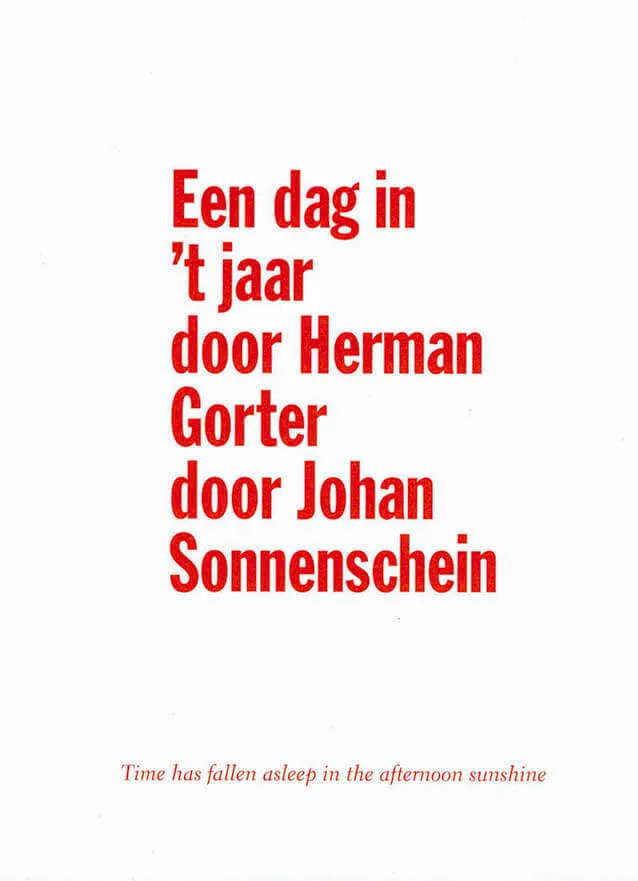
Time has fallen asleep in the afternoon sunshine

I am Four Quartets by T.S Elliot

Sébastian Hendrickx

For the project Time has fallen asleep in the afternoon sunshine a group of people/ performers memorize a book of their choice. Together they form a library collection consisting of living books. After years of learning by heart and reciting for readers, some of the books have now been written down from memory to create new editions, versions resulting from this process. This book is one of those books, chosen by one person, learned by heart and recited many times, and now written down again from memory. This edition is not a re-edition of the original text. It is a re-writing of the text after the process of reading, memorizing and reciting, with all the alterations that might have occured in the course of this process.

www.timehasfallenasleepintheafternoonsunshine.be

Cover of I Want

Sternberg Press

I Want

Pauline Boudry/ Renate Lorenz

I Want reviews the eponymous duo's double-projection film installation examining issues of gender, sexuality and performativity—and inspired by the words of punk poetess Kathy Acker and convicted whistle-blower Chelsea Manning. This publication documents the major film installation I Want (2015) by collaborative artists Pauline Boudry and Renate Lorenz, which was presented at their 2015 solo exhibitions at Kunsthalle Zürich and Nottingham Contemporary.

The double-projection film installation is based on a script that borrows texts from American punk-poet Kathy Acker (1947-1997), as well as chats and materials by convicted whistle-blower Chelsea Manning that speak of her reasons for revealing nearly one million secret military and diplomatic documents through WikiLeaks, at the same time exposing her transgender identity to her superiors.

Through poetic gestures of appropriation and recombination, Boudry and Lorenz examine issues around gender, sexuality, the performance of identity, and the nature of collaboration. Alongside generous color documentation, written contributions by Gregg Bordowitz, Laura Guy, Dean Spade, and Craig Willse unpack and reflect upon both the historical context and contemporary significance of this multivalent work.

Cover of Exercises of Poetic Communication with Other Aesthetic Operators

axis axis

Exercises of Poetic Communication with Other Aesthetic Operators

Ernesto de Sousa

Ernesto de Sousa (1921–1988) was a major and multifaceted figure from the Portuguese avant-garde—artist, poet, critic, essayist, curator, editor, filmmaker, and a promoter of experimental ideas and artistic expressions. 
Reflecting questions of hierarchy, authorship, and the complexity of framing or dividing within the multiple and complementary practices of Ernesto de Sousa—whose motto “Your Body is My Body, My Body is Your Body” serves as a poetic manifesto—this publication explores the various aspects of his oeuvre (visual, poetical, and theoretical) and his outstanding inventiveness of concepts.

The volume brings together a selection of works, unpublished archives and their translations, and theoretical texts by Ernesto de Sousa, including the first complete translation in English of «Orality, the future of art?» (1968). Richly illustrated, the book reunites an introductory text by Lilou Vidal, two new essays by Paula Parente Pinto and by José Miranda Justo along with a text by Hugo Canoilas.

"There was a time when bread was sacred; and in a general sense, all fabricated objects deserved the respect that resulted from (for the conscience of those who used them) concretely diving into their own motivations. Human gestures, like aesthetic objects, were inseparable from their relevant functions. Naturalism prompted us to look at natural and fabricated objects with a vision that was cosmic and indifferent at the same time. The objects, today, object. In the future, objects and gestures will perhaps clothe themselves once again in their lost dignity. The word love, a bit of bread, the letter A will stop being mortal accidents of daily life. Desacralized, they will once again be as decisive as the tiniest brushstroke the painter made on his canvas. And each of these brushstrokes will reveal the structure of the world. Life can then be compared to a vast work of art. Everything will be absolutely aesthetic.."
— Ernesto de Sousa

Contributors: Hugo Canoilas, Ernesto de Sousa, Tobi Maier, José Miranda Justo, Paula Parente Pinto, Lilou Vidal