rile*books

Search books

Search books by title, author, publisher, keywords...

Cover of REMMUS

Bored Wolves

REMMUS

Mikołaj Moskal

€14.00

When living things bloom & molder all in a heartskip, when they expand toward death, this is what worms hear.

Artist’s book of paintings by Mikołaj Moskal: gouache, archival paper elements, simple & meaningful captions. REMMUS is a graft of Podlasie earth-water-sky and Mikołaj’s pigments, heart, and intuition. Designed in close collaboration with graphic artist and designer Kaja Gliwa.

The paintings are bracketed by a poem each by Kuba Niklasiński (“Flows | Flaws”) and Stefan Lorenzutti (“What Worm Heard”), handwritten by Mikołaj in English and Polish.

Published in 2021 ┊ 44 pages ┊ Language: English, Polish

recommendations

Cover of Nawar's Sketchbook

Bored Wolves

Nawar's Sketchbook

Noura Alsouma

Zines €8.00

I am not deep, although my eyes are, like a black sea that has been forgotten, as many have told me.

Noura Alsouma’s zine “Nawar’s Sketchbook” is a liquid lament by the Berlin-based Syrian visual artist and printmaker, riveted to eyes that see and therefore shed tears, channeling the heartfelt exposure of the sketchbooks Noura fills to the bleed.

With a moving text by the artist in the original Arabic, reproduced in her handwriting, as well as in English translation by Suja Sawafta.

Cover of I Was Going to Work

Bored Wolves

I Was Going to Work

Nourhan Maayouf

Sci-Fi €20.00

“Invest in a floating city or gentrify a submerged one.”

Nourhan Maayouf’s I Was Going to Work is a hybrid sci-fi picture book by the Cairo-based artist, in which the proto-cyborg citizens of Happy Land Nation establish new-fashioned diurnal rhythms against the ever-present backdrop of a monorail to nowhere and its pillars, idle and idolatrous.

Across forty-four spreads of what might be thought of as a picture book for adults, Maayouf delves into every aspect of a deeply familiar society in which retrograde devolution is billboarded as reinvention by Orwellian technocrats and speculators.

And yet pockets of the cyborg population continue striving, dreaming, craving, protesting, gleaning, and inventing. For a situation to be bleak, some notion of beauty must remain tenaciously rooted where it matters most.

Cover of Sleigh Ride

Bored Wolves

Sleigh Ride

Joe Fletcher, Mikołaj Moskal

Fiction €20.00

In Sleigh Ride, a kinetically wondrous prose tale from poet Joe Fletcher, a father and his convalescing son plunge in carpentered, stallion-drawn sleigh slashing through lush forest, advancing through a sequence of diorama-like settings. The books ten chapters are interspersed with gouache collages by Kraków artist Mikołaj Moskal (REMMUS), rooted and riverine, functioning as curtains swept aside to reveal each chapter of Fletcher’s exhilarating nocturne.

There was a sleigh: jet black and gleaming.

The long steel runners curved at their termini like arabesques of ice. It was too dark to clearly discern the design on its side, but it was intricate, ornate, suggestive of cuneiform and the minarets of Cairo. Two orange lanterns mounted above the driver’s chair were each encircled by a cloud of gnats and moths. Draped in fabulously embroidered saddlecloths, Ajax and Hector stomped the earth.

Given that the only exit from the cellar was the door, hardly wider and taller than a man, I marveled at how father could have extracted his creation from his smithy and pointed it at the forest. But I said nothing as I climbed unaided onto the purple velvet couch.

Cover of Terminal Boundaries and A natural water course diverted reduced or displaced

Primary Information

Terminal Boundaries and A natural water course diverted reduced or displaced

Lawrence Weiner

Made in 1969 but never published, Terminal Boundaries is an artist book by Lawrence Weiner, a sculptor whose medium was language. The manuscript for the publication, which was recently brought to light, contains two related bodies of work represented as typewritten statements on paper that Weiner pasted to the pages of a small composition notebook. The book’s absence from Weiner’s oeuvre plagued him as it marked a terminus of his relationship to the physical construction of his artworks, and illustrated the principle of “specific” and “general” which he applied to his art.

Created from a standard notebook purchased in a stationery store, the manuscript is two books in one: Terminal Boundaries and A natural watercourse diverted reduced or displaced. A tête-bêche with two front covers, the book can begin from either cover by turning it upside down.

Weiner was a traveler by nature and the materials he refers to in these works are those that one can encounter on a road trip. The artist was traveling across Europe when this manuscript was composed. Struck by the tumultuous times and the critical illuminations about the climate from the Club of Rome discussions, the works in this book are in Weiner’s words, “concerned with the relationship of natural resources in relation to human beings.” Distinct from his contemporaries associated with the Land Art movement, in Terminal Boundaries and A natural water course diverted reduced or displaced, Weiner constructs his landscape interventions in language—the specific and/or general act and the location are stated—offering the reader/viewer the opportunity to consider each work’s existence, to build it in their mind’s eye. One can only wonder what Weiner did to divert, reduce, or displace a natural water course in Saltsrumen, Norway, the location of the world’s strongest maelstrom, or in nearby Bodø at the site of Svartisen glacier. A work in Terminal Boundaries titled The joining of France Germany and Switzerland by rope demonstrates the geopolitical perspective of Weiner’s land art. Requiring physical and mental borders to be transgressed in performing this work; how and where could this happen?

Terminal Boundaries finds Weiner just off the cusp of his decision to make art that lived centered in language, emphasizing the viewer’s responsibility to engage with it to make it whole. The book marks a crucial inflection point in the artist’s practice, defining his direction to make work that “attempts to present something to people that is not just about me,” but about materials and the world we find ourselves in here and now.

Cover of This Is Not a Memoir

Montez Press

This Is Not a Memoir

Janette Parris

What do you call a memoir that isn’t? In This Is Not a Memoir, Janette Parris incisively narrates a journey through lost high street landmarks of East and South London in a series of detailed artworks blending map, archive and anecdote with deadpan humour. Part graphic novel, part recollection, and accompanied by an in-conversation between Janette Parris and Gilane Tawadros, this is an intimate exploration of what it means to have ownership of public space, from Wimpy to Woolworth’s via Canning Town. And somewhere in the gaps, in absent moments caught gazing at the sky or a kerbside, an impression of a life emerges–or is that just what she wants you to think?

“This book by Janette Parris tells a deflationary yet expressive coming-of-age story in the East End of London. While it may seem fun and superficial, its considerable power lies in how it moves through memories and moments in a witty and light-footed way presented as a roman-à-clef. This Is Not a Memoir is particular in the way it conjures a world of the 1970s and 1980s that is lost to most of London, yet still resonates with what it means to grow up as a working class young woman who ends up at art school and becomes an artist. It is a brave book to make, but one that will be remembered.”
Rachel Garfield, artist, Professor of Fine Art at the Royal College of Art and author of Experimental Filmmaking and Punk: Feminist Audio Visual Culture in the 1970s and 1980s (2021)

Janette Parris is an artist who investigates the contemporary urban experience, using narrative, humour and popular formats including soap opera, stand-up comedy, musical theatre, pop mu-sic, cartoons, comics and animation. Parris has exhibited widely nationally and internationally for 25 years at spaces including TATE, The New Art Gallery Walsall, ICA, Kunsthaus Zürich, Hay-ward Gallery Touring, Art on the Underground and Royal Academy of Arts.

Cover of Reseeding the library, gleaning readership

Afternoon Editions

Reseeding the library, gleaning readership

Jeroen Peeters

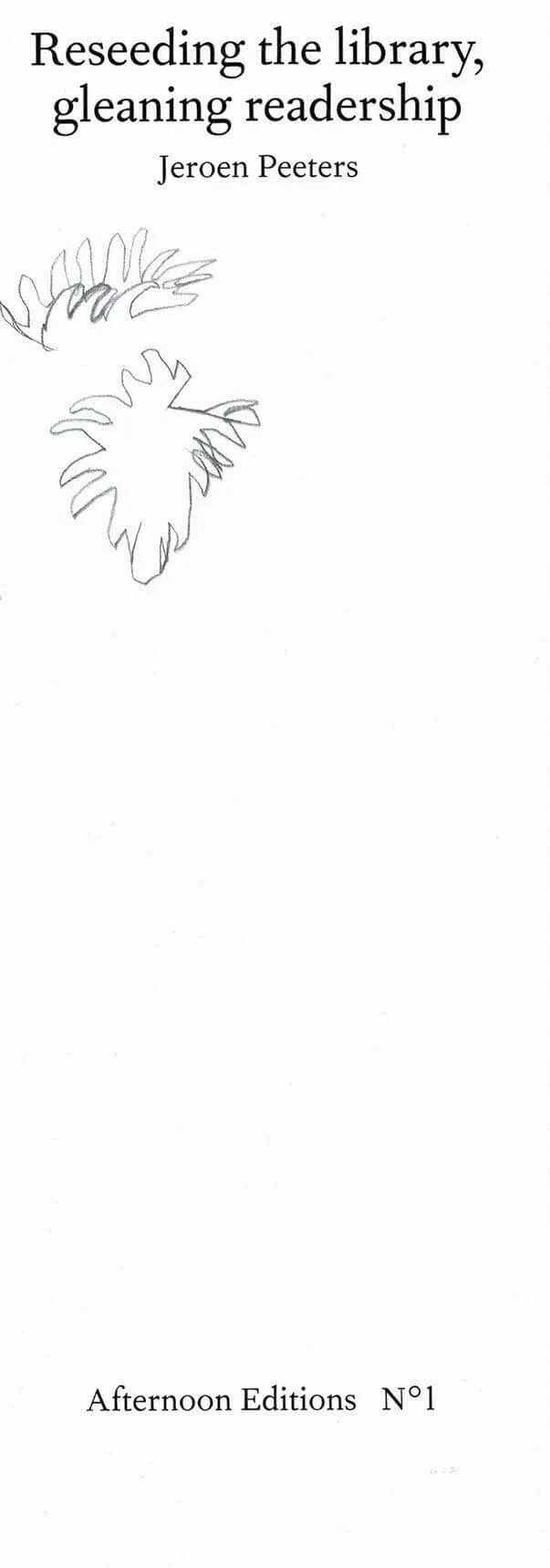
Afternoon Editions no. 1: an essay by Jeroen Peeters titled Reseeding the library, gleaning readership. In May 2017, Time has fallen asleep in the afternoon sunshine settled during three weeks in the Ravenstein Gallery in Brussels as part of the Kunstenfestivaldesarts. Invited as a writer in residence, Jeroen Peeters visited the library of living books on a daily basis and recorded his observations by hand in a notebook, which formed the basis for Afternoon Edition #1. Reseeding the library, gleaning readership is an essay on the seed library, on the dispersion of literature through wind, water and animals, on biodiversity and commoning at the heart of readership. On the cover a drawing by Wouter Krokaert of a Philodendron Xanadu. Published May 2018.

Cover of The Trial

Mousse Publishing

The Trial

Rossella Biscotti

The Trial is an extensive publication chronicling the decade-plus-long evolution of one of Rossella Biscotti's seminal works, focusing on the trials of members of the revolutionary left-wing movement Autonomia Operaia in the early 1980s, an emblematic judicial drama of Italy's Years of Lead.

The core of the book is the English transcription of a six-hour audio piece, originally composed from hundreds of hours of the trial's archival recordings broadcast by Radio Radicale. Edited like a theatrical script, The Trial becomes a polyphonic narrative that foregrounds the political voices of defendants in opposition to the structure and language of the legal machine: prosecutors, judges, lawyers. The transcript is accompanied by critical texts by Michael Hardt, Daniel Blanga Gubbay, and Giovanna Zapperi, as well as a conversation between the artist and philosopher Antonio Negri, one of the trial's key defendants. It investigates how political memory is carried, translated, and embodied across time.

Featuring visual documentation and multilingual excerpts from performances staged across various institutions and countries, this publication traces the work's ongoing reactivation through translation, collaboration, and context-specific interventions.

Cover of Publiek Park

Grenswerk vzw

Publiek Park

Jef Declercq, Anna Laganovska and 2 more

The third Publiek Park publication – Walking Guide – combines essays, archival fragments, and artistic voices to trace both the exhibition route at Plantentuin Meise and the historical path that led from the creation of the Jardin Botanique in the heart of Brussels to its relocation outside the city. Following the logic of a quilt, layering different perspectives, textures, and timelines, the book connects artistic narratives with history and reflections on urban gardens, public space, and botanical imaginaries. Just like the exhibition, the publication offers not merely a portrait of a place, but a reflection on the multiplicity that defines it.

Alongside documentation of the exhibition and contributions from the participating artists, this year’s Walking Guide features writings by Nikolaos Akritidis, Denis Diagre-Vanderpelen, Koen Es, Lana Jones, François Makanga, Noam Youngrak Son, and Jean Watt. The two parks are portrayed in photographs by Michiel de Cleene, with book design by Victor Verhelst and Corbin Mahieu bringing all of these elements together.

This publication is made with the generous support of Plantentuin Meise and all partners.