rile*books

Search books

Search books by title, author, publisher, keywords...

Cover of Greasepaint

Nightboat Books

Greasepaint

Hannah Levene

€18.00

Set against a backdrop of 1950s New York, this experimental novel follows an ensemble cast of all-singing, all-dancing butch dykes and Yiddish anarchists through eternal Friday nights, around the table, and at the bar. 

In one of many bars, Frankie Gold sings while Sammy Silver plays piano after a day job at the anarchist newspaper. The Butch Piano Players Union meets in the corner next to the jukebox. Laur smokes on the back steps, sweaty thigh to thigh with Vic. Frankie's childhood sweetheart, Lily, turns up at yet another bar to see a second Sammy play every Friday night. And before all that, there's always dinner at Marg's. Fabulated out of oral histories, anthologies, as well as the fiction of the butch-femme bar scene and Yiddish anarchist tradition, Greasepaint is a rollicking whirlwind of music and politics—the currents of community embodied and held inside the bar.

Published in 2024 ┊ 172 pages ┊ Language: English

recommendations

Cover of The Faggots and Their Friends Between Revolutions

Nightboat Books

The Faggots and Their Friends Between Revolutions

Larry Mitchell

Poetry €17.00

The Faggots and Their Friends Between Revolutions is a beloved queer utopian text written by Larry Mitchell with lush illustrations by Ned Asta, published by Calamus Press in 1977. Part-fable, part-manifesto, the book takes place in Ramrod, an empire in decline, and introduces us to the communities of the faggots, the women, the queens, the queer men, and the women who love women who are surviving the ways and world of men.

This new edition will feature essays from performance artist Morgan Bassichis, who adapted the book to music with TM Davy in 2017 for a performance at the New Museum, and activist filmmaker Tourmaline.

Cover of The Nightmare Sequence

Nightboat Books

The Nightmare Sequence

Omar Sakr, Safdar Ahmed

An extraordinary collaboration by an award-winning duo—poet Omar Sakr and visual artist Safdar Ahmed–that bears witness to the genocide in Gaza.

The Nightmare Sequence is a searing response to the atrocities in Gaza and beyond since October 2023. Heartbreaking and humane, it is a necessary portrait of the violence committed by Israel and its Western allies. Through poetry and visual art, Omar Sakr and Safdar Ahmed capture these historic injustices, while also critiquing the role of art and media—including their own—in this time. Born of collective suffering and despair, their collaboration interrogates the position of witness: the terrible and helpless distance of vision, the impact of being exposed to violence of this scale on a daily basis, and what it means to live in a society that is actively participating in the catastrophic destruction of Arabs and Muslims overseas. With a foreword by Palestinian American poet George Abraham, this book will serve as a vital record in decades to come.

Cover of Memories That Smell Like Gasoline

Nightboat Books

Memories That Smell Like Gasoline

David Wojnarowicz

LGBTQI+ €23.00

David Wojnarowicz, one of the most provocative artists of his generation, explores memory, violence, and the erotism of public space—all under the specter of AIDS.

Here are David Wojnarowicz’s most intimate stories and sketches, from the full spectrum of his life as an artist and AIDS activist. Four sections—”Into the Drift and Sway,” “Doing Time in a Disposable Body,” “Spiral,” and “Memories that Smell like Gasoline”—are made of images and indictments of a precocious adolescence, and his later adventures in the streets of New York. Combining text and image, tenderness and rage, Wojnarowicz’s Memories That Smell Like Gasoline is a disavowal of the world that wanted him dead, and a radical insistence on life.

The new and revised edition features a foreword by Ocean Vuong and a note from the editor, Amy Scholder.

Cover of Love Is Colder Than the Lake

Nightboat Books

Love Is Colder Than the Lake

Liliane Giraudon

Poetry €18.00

Searing in its energies and mysterious in its icy depths, Love is Colder than the Lake is a tour-de-force of the experimental French poet Liliane Giraudon's power and range. 

Love is Colder than the Lake weaves together stories dreamed and experienced, fragments of autobiographical trauma, and scraps of political and sexual violence to create an alchemical and incantatory texture that is all Giraudon's own. In its feminist attention and allusive stylistic registers, Love is Colder than The Lake claims a unique position among contemporary French literature. The heroes (or anti-heroes) in this collection include Rainer Werner Fassbinder, Lorine Niedecker, Emma Goldman, Chantal Akerman, the Marquis de Sade, and the unnamed lake itself. Giraudon's writing, editing, and visual work have been influential in France for decades, and English-speaking readers will thrill to this challenging, important voice.

Liliane Giraudon was born in Marseille in 1946. She continues to live and work in Marseille, and her writing is inseparable from the place, shaped by the vibrant community of poets and writers and artists Giraudon has herself shaped, as well as by the city's gritty and diverse cosmopolitanism. Giraudon's many books have, since 1982, been primarily published by France's P.O.L. editions. Giraudon has also been instrumental as an editor for influential reviews such as Banana Split, Action Poétique, and If. She performs and collaborates widely, including with Nanni Balastrini, Henri Delui, Jean-Jacques Viton, and many others. Two of her books ( Fur and Pallaksh, Pallaksh) were published in English by Sun & Moon Press in 1992 and 1994, respectively. She lives in Marseille, France.

Lindsay Turner is the author of the poetry collections Songs & Ballads (Prelude Books, 2018) and The Upstate (University of Chicago Press, 2023). She has twice received French Voices awards for her translations from the French, which include books of poetry and philosophy by Stéphane Bouquet, Souleymane Bachir Diagne, Anne Duforumantelle, Ryoko Sekiguchi, and others. She is Assistant Professor of English and Creative Writing at Case Western Reserve University in Cleveland, Ohio.

Sarah Riggs is a poet and multivalent artist. Her most recent book The Nerve Epistle appeared in 2021. Translation is one of her arts, for which she received a Griffin prize with Etel Adnan, and Best Translated Book Award, also for Adnan's Time (Nightboat, 2019). Riggs lives in Brooklyn, after many years in Paris. Author residence: Marseille, France.

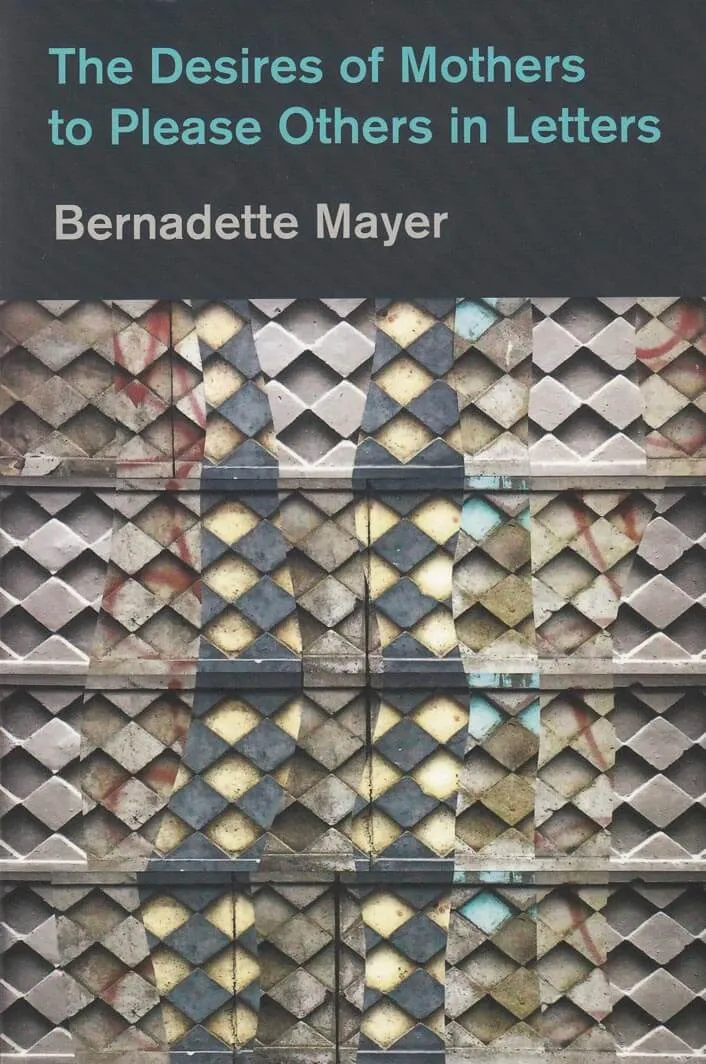
Cover of The Desires of Mothers to Please Other in Letters

Nightboat Books

The Desires of Mothers to Please Other in Letters

Bernadette Mayer

A reissue of Bernadette Mayer's classic fugitive intergenre text. Endlessly inclusive, The Desires of Mothers to Please Others in Letters, first published in 1994 and long out of print, evokes the complexity of real persons as it simultaneously reinvents multiple genres: epistle, prose poem, and memoir.

Written between 1979 and 1980 while pregnant with her third child, Mayer extends her imaginative letters into meditations for us all on life as it is lived in real time, with its responsibilities and manifold desires. Fierce, lyrical, intimate, and wise, both new and familiar readers, both mothers and non–mothers, will find this book beckoning again and again to offer delicious writing, timely information, consolation, and advice.

With Introduction by Laynie Browne

Cover of Conflict Is Not Abuse

Arsenal Pulp Press

Conflict Is Not Abuse

Sarah Schulman

From intimate relationships to global politics, Sarah Schulman observes a continuum: that inflated accusations of harm are used to avoid accountability. Illuminating the difference between Conflict and Abuse, Schulman directly addresses our contemporary culture of scapegoating. This deep, brave, and bold work reveals how punishment replaces personal and collective self-criticism, and shows why difference is so often used to justify cruelty and shunning.

Cover of In Thrall

Divided Publishing

In Thrall

Jane Delynn

Fiction €16.00

Dear Miss Maxfeld . . . What I’m really afraid of is that I am a homosexual human being. I wish you were one too but I don’t think it’s possible there could be so many in one school, do you? Probably there is only one person who is homosexual in one place at one time and that one person (I am afraid) is me . . .

After sixteen-year-old Lynn writes her thirty-seven-year-old English teacher a letter they embark on one of the funniest and saddest love affairs in fiction, shrouded in secrecy and guilt. Set in the year Kennedy was shot, all Lynn knows about “lezbos” is that they wear their hair in crew cuts, buy suits like her father’s, and sprout mustaches over their upper lips. Trying to pass, Lynn continues to neck with her boyfriend and make bigoted jokes with her friends. Feigning innocence with her parents, each night she checks the mirror for tell-tale signs of perversion. Profound, witty, poignant, and highly charged, In Thrall is the first in Jane DeLynn’s trilogy of novels on sexuality and authority. It is as believable in its depiction of a closeted teen as it is heartbreaking.

With an introduction by Colm Tóibín

Flawless comic timing. —Colm Tóibín, from the Introduction

All Lynn’s phobias, aversions and hang-ups make her exaggerated but real . . . The great triumph of this novel is that DeLynn has captured the way adolescents felt, talked, and behaved during the early 1960s. —San Francisco Chronicle

A dazzlingly gritty exposure of a girlhood experience usually neglected by both private and public consciousness. —Reba Maybury

Cover of The Time of the Novel

Wendy's Subway

The Time of the Novel

Lara Mimosa Montes

Fiction €18.00

A disaffected young woman seeking self-estrangement and withdrawal from the world decides to quit her day job as a bookseller to live out, or live in, an experiment: to become a full-time narrator. She moves through sentences, afternoons, a rented apartment, an artist’s studio, a party, the post office with the flowering focus of a realist novel, transposing physical and social life to the space of fiction. As she chronicles the process of becoming a subject in writing, the narrator confronts her fantasy of uninterrupted interiority—and its limits.

What is “fiction” and how does one “enter” into it? Composed in the tense of Literature, Lara Mimosa Montes’s The Time of the Novel is a book about detours, psychic swerves, and surprising encounters with the Real as it converges with the written.

Cover of Ana Patova Crosses a Bridge

Dorothy, a publishing project

Ana Patova Crosses a Bridge

Renee Gladman

Fiction €16.00

“Ana Patova Crosses a Bridge is the third volume of Renee Gladman’s magnificent, melancholy series about the city-state of Ravicka, or about the architectures of its absence. It is tempting to read the Ravickian books as an extended allegory—of architecture itself, perhaps, except that architecture is already half-allegorical, its every element raised to prefigure whatever meanings can make their way to them. If any can. In Ravicka, meanings—indeed most contact of any kind—remain in abeyance, building, in absentia, the constitutive negative spaces of the narrative. There is a plot; it lays out zones of sheer ambience. Experiences, of which there are many, unfold as a redolent lingering in the structures of immateriality, the radical realities of the insubstantial. Gladman is a philosopher of architecture, though not that of buildings. Rather, she thinks (and writes) the drifts, partitions, and immobilities of identity, affect, communication, the very possibility of being human. Profound, compelling—haunting, even—the story of Ravicka is astonishingly ours.” - Lyn Hejinian

Cover of The Activist

Krupskaya Books

The Activist

Renee Gladman

Poetry €17.00

The Activist begins in the middle of a revolution. There is a protesting group of commuters with a missing leader. There is a bridge that may or may not have been bombed. People speak in nonsense and cannot stop themselves. In the midst of all this, the language of news reporters mixes with the language of confession. The art of this beautifully written book is in how it touchingly illustrates that relations between humans and cities are linked in a more complex interface than most realize. The book is full of entrances and exist, alternate routes and incommensurate geographies. The Activist does not analyze or explain the hopeful desires of protest at the turn of the century, but it does enable us to see them differently. — Juliana Spahr

"Whether this is a dream in which I'm captured or I've been captured and made to think I'm in a dream, I can't figure." Apropos to the rapturous tension The Activist evokes. A covert narrative operating as an event disguised as a repot. A grass trap glimpsed through the lashes of a sleepwalker. Topography of disrupted positionality, reflection girders flaccid memory against the romantic high up. Flea-bitten news and neuralgic placards. You are here**. Is dreaming the medium for crossing the ambiguous borders of talk, responsibility, collectivity, solitude? Or does reading anatomize a phantom bridge that carries you over to an unmappable reality and calls you by your secret name? Root, plan and faction, armed with tongue-tied intensity. You may ask how Renee Gladman knows that this city of slippage is your city, how she holds you within it, riveted. And therein lies the magic of this book. — Tisa Bryant