rile*books

Search books

Search books by title, author, publisher, keywords...

Cover of F.R. David - Zeros And Ones

uh books

F.R. David - Zeros And Ones

G. Leung ed., W. Holder ed., A. Gritz ed., K. Bentele ed.

€10.00

Riffing off the title, this volume includes an interview with Carolyn Lazard – an artist whose conceptual and often spare videos, sculptures, installations, and performances explore the full amplitude of relation – by Catherine Damman, plus a feature on New York-based contemporary artist Tishan Hsu, whose practice examines the “embodiment of technology”, and contributions by time-based media artist Silvia Kolbowski, for whom political resistance, the unconscious, and structures of spectatorship are a central concern of all her projects; choreographer and dancer Yvonne Rainer; and science fiction author Octavia Butler.

Retroactively compiled from the curators*’ footnotes to the exhibition handout of the 2021 exhibition Zeros and Ones, at KW Berlin.

Dedicated to the Sadie Plant book of the same name (Zeros + ones: digital women + the new techno culture, 1997), the issue embodies a (cybernetic) reading & writing machine, as it co-authors artists’ work.

* Edited with Kathrin Benthele, Anna Gritz, and Ghislaine Leung - the edition has 180 pages, 4 colour plates, two bookmarks, an otherwise unavailable postcard donated by the Stanley Brouwn estate, and… SIXTEEN possible covers, reproducing a work by Lutz Bacher.

Published in 2023 ┊ 180 pages ┊ Language: English

recommendations

Cover of Homophone Dictionary

uh books

Homophone Dictionary

Sue Nixon

Homophone Dictionary was originally a file that is compiled by the now 96-year-old former schoolteacher Susan Nixon. She has build up many collections throughout her life, almost all of them exist out of objects, except one: after her retirement she compiled a word document that by now exist out of almost 1000 homophones; two, or more words that you pronounce similar but have a different meaning, often the spelling is also different.

The document is structured as a dictionary and the homophones are illustrated with examples that are based on autobiographical information. The structure of Homophone Dictionary also refers to speech therapy exercises and concrete poetry.

“As a student nurse learning medical terminology, I became fascinated with understanding the roots of words. When I had a young family, words were a principal source of entertainment: it was not unusual for one of the children to slip from their chair at the dinner table and fetch a dictionary in order to settle a dispute or satisfy someone’s curiosity. Then I became a teacher and brought this love of words into the classroom. My habit of word collecting became the children’s habit – my pupils became ‘word-lovers’ and ‘list-makers.’

I casually collected homophones for years. When introducing homophones into the classroom, the kids found definitions dull; the typical reaction was, ‘Yes, but give me a sentence using the word!’ and this idea emerged: a book of sentences demonstrating the meanings of homophone pairs or sets.”

Offset print
20,4 × 12,4 cm
edition of 500

Cover of Postcommodity, Alex Waterman and Ociciwan: “in memoriam…”

uh books

Postcommodity, Alex Waterman and Ociciwan: “in memoriam…”

Ociciwan Contemporary Art Collective

Eighty-page programme book score, and libretto, for performances by Indigenous musicians of in memoriam…Mary Cecil,Victoria Callihoo (née Belcourt), and Eleanor (Helene) Thomas Garneau and Robert Ashley’s in memoriam... Curated and edited by Ociciwan Contemporary Art Collective.

[from back cover] …in memoriam Mary Cecil,Victoria Callihoo (née Belcourt), and Eleanor (Helene) Thomas Garneau adds a new score and production by Postcommodity and Alex Waterman to a suite of four early scores by the American composer Robert Ashley. The fifth score honours the lives of Mary Cecil, Victoria Callihoo (née Belcourt), and Eleanor (Helene) Thomas Garneau, three Indigenous women from territory at the turn of the Century as it became the province of Alberta. This significant addition continues Ashley’s project investigating the connections between musical forms and constructs of historicization, opening a conversation regarding whom and how we memorialize individuals and inscribe their legacies.

[from essay by Candice Hopkins] What histories are remembered and who is doing the remembering? What form do these rememberings take? It is not as simple as taking down one monument and replacing it with another. We need to ask more questions, take note of the voids that stand in for the past, and actively make way for other voices, particularly those are trapped under the ‘sea ice of English’. “Listen for sounds”, writes the Tlingit poet and anthropologist Nora Marks Dauenhauer, “They are as important as voices. Listen. Listen. Listen. Listen.”

Cover of The Complete Text Would Be Insufferable / Language as Prosthesis

uh books

The Complete Text Would Be Insufferable / Language as Prosthesis

Chloe Chignell

Poetry €15.00

We begin with the image of an idea in ruin. A small field of assumptions disassembled. A question no longer in need of its mark. A thought not sure where it began. It starts from the body and language. The debris of these three words, crumbling already at and, did not break apart but congealed the separations once made. We start from a research (project) undone and just beginning. 

Typesetting and design: Will Holder
Produced by: A.pass

Chloe Chignell works across choreography and publication taking the body as the central problem, question and location of the research. She invests in writing as a body building practice, examining the ways in which language makes us up.

Cover of A Book Knot Book

Body Text

A Book Knot Book

Sara Kaaman

Performance €20.00

A Book Knot Book is a 208 pages long performance, the first from the research and publishing initiative Body Text. In this study of language in action systems of meaning-making crash, sparkle and swoon. In a playful voice over A Book Knot Book self-reflects on the materialities and choreographies of publishing, reading and writing. With guest stars in fragments; Monique Wittig, Yvonne Rainer, Cristina Rivera Garza, Amiri Baraka, Will Rawls, David Abram, Thich Nhat Hanh and more. 

Edited and designed by Sara Kaaman. Published with the support of Stockholm University of the Arts.

Cover of Aftershow

Sternberg Press

Aftershow

Pauline Boudry/ Renate Lorenz

Performance €25.00

A monograph / artists' book that engages with the recent film installations of Pauline Boudry / Renate Lorenz. Installation shots, research material, scripts, and film stills give an insight into the artists' investigation of performance in film and their dense net of references to experimental film, the history of photography, sound, and underground (drag) performances.

The book's title alludes to an interest in opaque events that are belated, left backstage or off-screen. A number of (fictitious) letters to friends and collaborators such as Sharon Hayes, Yvonne Rainer, Ginger Brooks-Takahashi, and Jack Smith place the work of Boudry & Lorenz in a context of debates around temporalities, activism, the archival, decolonizing practices, and queer histories. Published following the exhibition “Patriarchal Poetry” at the Badischer Kunstverein, September 27– November 24, 2013.

Cover of Andrea Geyer: Dance in a Future with All Present

Dancing Foxes Press

Andrea Geyer: Dance in a Future with All Present

Andrea Geyer

Performance €30.00

This most substantive monograph yet published on the work of German-born, New York–based multimedia artist Andrea Geyer focuses on her recent explorations of the marginalized yet pivotal role that women have played in the formulation of American modernism, tracing and honoring the ephemeral acts, initiatives, and stories that shaped it. Featuring full-color images of Geyer’s artworks and research materials, including documents, found photographs, and previously unpublished photographs by the artist, Dance in a Future with All Present offers insight into Geyer’s art and the multiple histories of modernism.

Includes texts by Matthew Jeffrey Abrams, Andrianna Campbell, Juli Carson, Barbara Clausen, Lynne Cooke, Dean Daderko, Saisha Grayson, Sharon Hayes, Megan Heuer, Danielle A. Jackson, Alhena Katsof, Kristan Kennedy, Thomas J. Lax, Ralph Lemon, André Lepecki, Renate Lorenz, Josiah McElheny, Fred Moten, Kristin Poor, Yvonne Rainer, Gabriela Rangel, Jeannine Tang, and Soyoung Yoon.

Copublished with Portland Institute of Contemporary Art in 2019.
Edited by Alhena Katsof, Karen Kelly, and Barbara Schroeder. 
Design by Dante Carlos.

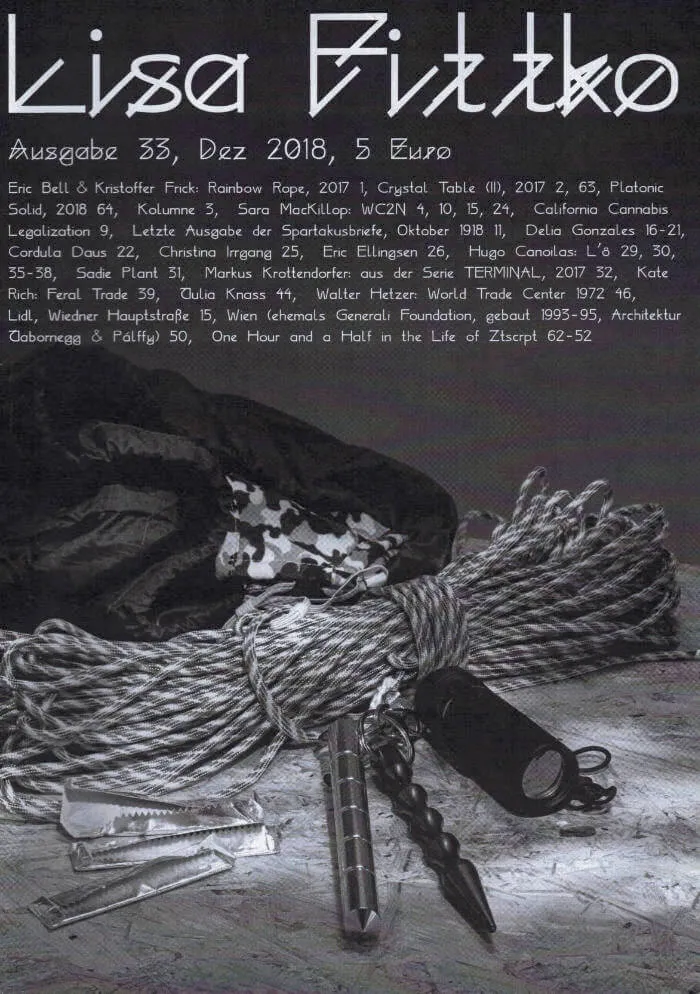
Cover of ztscript 33 : Lisa Fittko

ztscript

ztscript 33 : Lisa Fittko

ztscript

Typeface by Bea Schlingelhoff, from the Project "Women against Hitler"

Eric Bell & Kristoffer Frick: Rainbow Rope, 2017 1, Crystal Table (II), 2017 2, 63, Platonic Solid, 2018 64, Kolumne 3, Sara MacKillop: WC2N 4, 10, 15, 24, California Cannabis Legalization 9, Letzte Ausgabe der Spartakusbriefe, Oktober 1918 11, Delia Gonzales 16-21, Cordula Daus 22, Christina Irrgang 25, Eric Ellingsen 26, Hugo Canoilas: L’ô 29, 30, 35-38, Sadie Plant 31, Markus Krottendorfer: aus der Serie TERMINAL, 2017 32, Kate Rich: Feral Trade 39, Julia Knass 44, Walter Hetzer: World Trade Center 1972 46, Lidl, Wiedner Hauptstraße 15, Wien (ehemals Generali Foundation, gebaut 1993-95, Architektur Jabornegg & Pálffy) 50, One Hour and a Half in the Life of Ztscrpt 62-52

Cover of Mousse #94

Mousse Publishing

Mousse #94

Periodicals €16.00

Petrit Halilaj and Danh Vo in conversation; Forensic Architecture (Eyal Weizman, Nour Abuzaid, and Elizabeth Breiner); Gabrielle Goliath; Edward W. Said; Shumon Basar; Dani Blanga Gubbay; Yvonne Rainer; Thomas Eggerer and Jochen Klein; Tobias Pils; Travis Jeppesen...

Collective intelligence (along with its wildly popular counterpart, brain rot) is a recurring subject of late. This issue is woven together through reflections on methodologies of the collective, larger-than-ourselves dynamics and "what goes unuttered (of, perhaps, what is painfully unutterable)," as Zoé Samudzi writes about Gabrielle Goliath—whose project for the South African pavilion at the upcoming Venice Biennale has been cancelled by the Arts and Culture Minister of her country for being "divisive." We stand in solidarity with the artist. Forensic Architecture's Eyal Weizman speaks of new ways of detecting "hyper-relations" as strategies to confront systemic violence. Edward W. Said, in his crucial 1993 essay "Speaking Truth to Power" (reprinted here), argues that "the intellectual's voice is lonely, but it has resonance because it associates itself freely with [. . .] the common pursuit of a shared ideal." And in our Curators section, Shumon Basar memetically reaffirms that now more than ever, "Comment is king."
Let's not shy away from commenting.

This issue comes with different covers, randomly distributed.