rile*books

Search books

Search books by title, author, publisher, keywords...

Cover of Crue

Dépense Défensive

Crue

Théo Robine-Langlois

€12.00

L’Île-de-France a été engloutie. Submergée par de l’eau liquide. C’est à peu près tout ce que l’on sait. Crue est un long poème construit sur un rythme ternaire, une suite de tercets libres entrecoupés de symboles typographiques étranges dont la signification exacte semble avoir été perdue dans l’inondation. Il y a dans le va-et-vient soutenu du texte comme dans celui de la mer, ses gestes répétés, toujours successifs, quelque chose de l’automation ; l’acceptation sans révolte d’une nouvelle nature sous-marine hybride, plus uniquement humaine, à la langue noyée, gorgée de néologismes, méthodique, néanmoins sentimentale. Car ici la cruauté sinistre de la nature fait écho aux émotions du narrateur. Le paysage-état d’âme est désolé, apocalyptique mais comme résigné, nu. Crue sonde les abysses de la civilisation et des comportements humains. Peut-être un des textes les plus personnels de Théo Robine-Langlois.

Published in 2026 ┊ 144 pages ┊ Language: French

recommendations

Cover of Secrèt

Dépense Défensive

Secrèt

Théo Robine-Langlois

Fiction €12.00

Mystique des rues vides et peu éclatantes des banlieues pavillonnaires, ce court poème en prose interpelle par sa langue sombre. Dans une parodie de messe noire – beigeasse comme le crépis des façades –, Théo Robine-Langlois dépeint le monde mystérieux des maisons individuelles, du repli sur soi démonique, et des vieilles qui marmonnent entre leurs gencives au retour du marché, le panier plein de gros sel et de radis noirs en guise d'hostie. Les mots occitans qui ponctuent le texte comme des conjurations en accroissent l’escur.

Cover of New York Temps

Dépense Défensive

New York Temps

Aurelia Guo, Salomé Burstein

Poetry €15.00

Composé à la fois de récits personnels, de citations et de collages provenant notamment du New York Times, New York Temps suggère une discontinuité des états intérieurs, accentuée par la multiplicité des orateur.ices : les voix se succèdent à elles-mêmes, sont à chaque moment ce qu’elles n’étaient pas celui d’avant, apprenantes et à l’écoute de tout ce qui n’est pas elles. À travers des questions d’intertextualité et de sampling en poésie, le texte porte en lui une violence immanente – rendue plus intérieure, faite sienne –, une gêne, non seulement ressentie, mais aussi imposée, comme une protestation.

Titre original : NYT. Publié pour la première fois chez Gauss PDF en 2018. Traduit de l’anglais par Salomé Burstein.

Aurelia Guo est écrivaine et chercheuse à Londres. Elle est également l’autrice de World of Interiors (Divided Publishing, 2022).

Cover of Oraison funèbre pour Zelda1990

Dépense Défensive

Oraison funèbre pour Zelda1990

Romane Constant

Fiction €15.00

D’eux, il ne reste que les mots de celle qui a croisé leur route. Le crissement de pneus qui sifflent avant un malheur qui tarde à se produire. Sanctification plus que célébration, Oraison funèbre pour Zelda1990 est une tentative de communication au-delà de la matière physique de l’énonciation, un dialogue interne qui convoque « par moment le frère, par moment l’ami parti », toujours la ruine, la consommation de la séparation avec le tout. À travers quatre parties qui font écho à la structure des éloges funèbres de la Grèce antique, Romane Constant réouvre la poésie des plaies larges et profondes que les vers lapidaires d’Hélène Bessette – sur qui l’autrice mène un travail de recherche – ont laissé dans l’histoire moderne de la littérature, et signe un texte bouleversant sur la difficulté des choses qui ne (se) passent pas, la force de celles que l’on voit suspendues par le cou au bord d’une paix impossible à trouver. Oraison funèbre pour Zelda1990 est une douleur croissante, avec écoulement et rougeur.

Romane Constant vit et travaille à Paris. Elle explore à travers différents supports les questions relationnelles, d’intimité, du corps et du genre. Attachée aux Ardennes où elle a grandi, elle s’intéresse également à l’héritage de la classe ouvrière et aux traumatismes intergénérationnels.

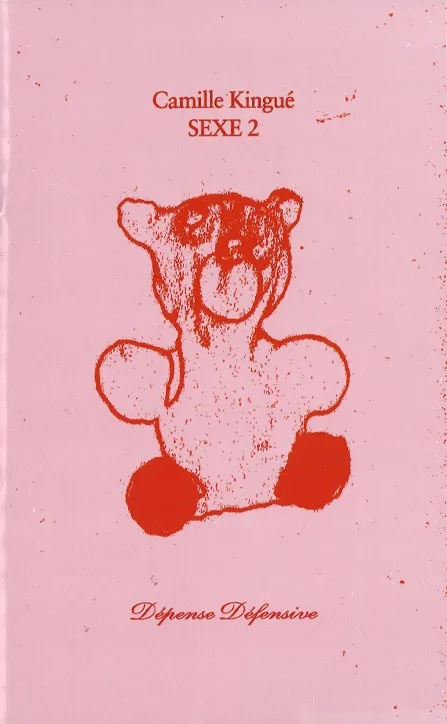
Cover of Sexe 2

Dépense Défensive

Sexe 2

Camille Kingué

Poetry €12.00

Confession sur le désir (l’action et l’objet du), les liens de mutualité et de résistance, Sexe 2 alterne prose et versification en 27 fragments numérotés à l’adresse plus ou moins dure, plus ou moins sincère, plus ou moins formulée car plus ou moins éloignée du Toi et du Je. Camille Kingué s’attache à révéler, à voir quelque chose à travers son image réelle et virtuelle, agrandie et rétrécie, droite et renversée, déployant une recherche des principes de l’amour (l’amour comme amour, pourquoi est ce qu’il y a de l’amour) où la métaphysique et la compréhension de soi – donc de l’autre – n’ont jamais été aussi sexy.

Claire Star Finch, dans la magnifique préface qu’iel signe au début de l’ouvrage, écrit : « Après avoir lu tous les livres de Kingué, je ne sais pas si je crois en “l’amour”, que ce soit en tant que substantif absolu ou en tant que proto-résidu de tout ce que “le sexe” peut signifier. Mais je crois définitivement qu’il faut l’écrire. » Définitivement.

Cover of Tongue Ring: Issue 01

Tongue Ring

Tongue Ring: Issue 01

Aodhan Madden, Claire Star Finch

Periodicals €13.12

Oh oh this is the first issue of Tongue Ring, a journal of experimental writing in English & French, with original contributions and translations of texts* by Ariana Reines*, CAConrad*, Camille Kingué, Kaur Alia Ahmed*, Rafael Moreno, Taos Bertrand, and Théo Robine-Langlois*. 

Vous voyez, c’est ça mon genre. Je ne sais pas ce que c’est. 
Mais c’est mon genre. J’ai cet esprit en moi—qui est très ému
par la féminité. Je pourrais me mettre à pleurer. Je veux poser
mon manteau par terre pour la laisser marcher dessus
—Ariana Reines

Premier numéro de la nouvelle revue fantastique et bilingue (FR + EN) d’écriture expérimentale Tongue Ring, avec des contributions originales ainsi que des traductions* de textes de Ariana Reines*, CAConrad*, Camille Kingué, Kaur Alia Ahmed*, Rafael Moreno, Taos Bertrand, and Théo Robine-Langlois*. 

Cover of Some Monologues

Wendy's Subway

Some Monologues

Tyler Coburn

Working at the nexus of performance, art writing, and fiction, Tyler Coburn creates monologues that explore how the “I” is marked in speech. His myriad topics—alternate history, legal personhood, digital labor, and resonant frequency, to name a few—defy straightforward modes of presentation, often insisting on site-specificity and social intimacy at the expense of conventional documentation. 

Some Monologues collects, for the first time, the scripts of Coburn’s work from the past fifteen years, many of which have not previously been published. Accompanying them are texts by eleven artists, writers, curators, and scholars who experienced these performances firsthand, collaborated in their making, conversed with the artist about them, or share an interest in the subjects they engage. Written in theoretical, poetic, and autobiographical registers, these contributions offer new perspectives on the monologue as an expansive and relational form.

Introduction by Elvia Wilk. Contributions by Yu Araki, A.E. Benenson, Mashinka Firunts Hakopian, Sven Lütticken, Kameelah Janan Rasheed, Spyros Papapetros, Camille Richert, Théo Robine-Langlois, Ian Wallace, and Michelle Wun Ting Wong.

Tyler’s scripts refuse to fix an authorial voice; instead, they make the conditions of authorship itself their subject. Blurring the boundaries between fiction and document, the human and the bureaucratic, the self and its doubles, his work thinks through systems from the inside, often using language as both architecture and trap. In their precision and porousness, I recognize a shared pursuit: how to locate agency within constraint, and how to turn the administrative or the technological into a site of intimacy. — Jill Magid

In Tyler Coburn’s Some Monologues, a binary that remains constitutive for the ideological continuity of modern life, in all its colonial and capital forms, is undone: digital vs. physical. In troubling that chasm, Coburn plays out the repercussions of these ideologies of anthropomorphic naturalism, guiding us through their resonances, doubles, codings, and relays. But he also renders himself as the relay of these transferences, in the process expanding art’s premodern calling: to exist as an invocation. Reification suddenly appears as what is situated between embodiment and disembodiment, with both potentially destabilized. Some Monologues, the book, is this destabilization’s ideal format: as much documentation, an echo, of Coburn’s works through their scripts, as it is an instruction manual for denaturalizing our sense/s. — Kerstin Stakemeier

Tyler Coburn is an artist, writer, and professor based in New York. He received a 2024 Andy Warhol Foundation Arts Writers Grant, and his writing has appeared in ArtReview, BOMB, C Magazine, Dis, e-flux journal, frieze, LEAP, Metropolis M, Mousse, and Rhizome. Coburn is the author of four books: I’m that angel (self-published, 2012), Robots Building Robots (CCA Glasgow, 2013), Richard Roe (Sternberg, 2019), and Solitary (Sternberg and Art Sonje Center, 2022). He has presented artwork at such venues as Centre Pompidou, Paris; Bergen Kunsthall; Hayward Gallery, London; Para Site, Hong Kong; and Kunstverein Munich. 

Cover of Heights of Macchu Picchu

The Economy Press

Heights of Macchu Picchu

Pablo Neruda

Poetry €18.00

Pablo Neruda’s Alturas de Macchu Picchu is a poem that distrusts solitary authority even as it passes through a single voice, moving from the lyric “I” toward a collective utterance grounded in labor, history, and shared breath. 

Producing the first collaborative translation of Alturas de Macchu Picchu is not incidental but consonant with its deepest claims. Attentive to Neruda’s unique lyric pressure, this new English version resists the tradition of singular, authoritative renderings by allowing meaning, rhythm, and decision to emerge through dialogue and negotiation. 

In this way, the translation does not merely transmit Neruda’s poem but enacts its insistence that voice is a collective achievement, not a solitary possession.

Cover of The Book of Advice

Ugly Duckling Presse

The Book of Advice

Ghazal Mosadeq

Poetry €20.00

The Book of Advice, an experiment in self-translation, stems from the andarznameh tradition of classical Persian literature, a form that moves between verse and prose as it engages invented or familiar sayings and folktales. Originally written in Persian between 2018-2020, the book now speaks in both English and Persian, opening at once from the back and the front, in a voice both distanced and familiar. The vicissitudes of the everyday preoccupy its intimately impersonal speaker as she wrestles with the inadequacy and mobility of language. 

Ghazal Mosadeq is a poet, editor and translator. She is the founder of Pamenar Press, an independent publisher of poetry, translation, hybrid and critical writing. Her own work has been published by Sheirsman, Fence, Arc Poetry, Fiddlehead, Asymptote, Modern Poetry In Translation and Words Without Borders, among others. She is a member of the editorial advisory board for the Journal of British and Irish Innovative Poetry.

The Book of Advice knows 'we didn’t have to break the flower stem/ to let the/ light pass through,' even as it knows we have already broken everything we could. Here, no one knows our names, nor the name of our horse, though someone did once ask. From the sliver between a face and its forgettable name, from the sliver between what’s been said and what’s yet to be said, slightly but exactly differently, Ghazal Mosadeq offers a chasm. The floor is deep, but, when you land, very tender. No one hails us, but the well wishes, oh, open your mouth for the well wishes." —Farid Matuk

Cover of Envois / The Complete Correspondence

Tenement Press

Envois / The Complete Correspondence

Sharon Kivland

Poetry €24.00

Somewhere between fact and fiction, 
memoir and novelisation ... 
a tidal thread of correspondences. 

A novel-in-correspondence, a neither/nor publication defying easy category—a book that rests somewhere between fiction and memoir—Envois is a collection of letters sent to Sharon Kivland by the French psychoanalyst Jacques Lacan during the course of their long and stormy love affair from 1953 until his death in 1981.

A publication assembled chronologically—following the yearly seminars of Lacan and structured per their delivery—and in which love emerges as a form of appropriation; a litmus for authenticity; a look book for learning; an atlas for forms of yearning; a map for multimodal thinking; a log book for passing hours; a calendar to keep track of the quickening of time; an itinerary of preoccupations; a discipline; a vocation; a dressing up and dressing down of language; a lens; an aperture; a tool shed; a window; a corridor; and/or an arena of investigation. Kivland was not listening for psychoanalytic theory and she is faithful to the words of her beloved, attuned to his speech towards her and her alone... And yet, well, and yet, all that remains as her master breaks the silence.

Cover of DUB

Duke University Press

DUB

Alexis Pauline Gumbs

Poetry €25.00

Dub: Finding Ceremony takes inspiration from theorist Sylvia Wynter, dub poetry, and ocean life to offer a catalog of possible methods for remembering, healing, listening, and living otherwise.

"In DUB Alexis Pauline Gumbs continues with the third book in her poetry series, the first two books being Spill, inspired by Hortense Spillers, and M Archive, inspired by Jacqui Alexander. Whereas Spill deals with the contemporary afterlives of slavery and M Archive describes the post-dated evidence of our imminent apocalypse, DUB destroys Gumbs' own origin story, as she questions the assumptions and histories she has held onto most of her life. This text, through engagement with Sylvia Wynter's rigor, reinvents language outside of personal histories.

DUB is organized into topical sections, where spacious prose poems animate the voice of an underwater chorus in ceremonies that flow into one another. Beginning a daily writing practice, Gumbs wrote DUB based on moments of emphasis in Sylvia Wynter's essays (and one interview over several decades).

This book is influenced by the promiscuity and prolificity of dub music, the confrontational home-grown intimacy of dub poetry, and the descendants of this work. Dub uses the impact of repetition and the incantatory power of the spoken broken word. Gumbs uses dub to emphasize that Sylvia Wynter learned every colonial language and came to the conclusion that the ways of thinking that made colonialism and slavery imaginable were constructed over time and heretical to the ways of thinking that came before them; and so it must be possible to construct ways to understand life and place differently now as well.

Gumbs goes back to the origin stories that precede her and turns the blood into paint, emphasizing that "then" is also "now" through the broken and intense voices of ancestors. Inspired by Wynter's heretical poetic action against our deepest beliefs, DUB is an artifact and tool for breath retraining and interspecies ancestral listening.

Throughout the text, listening includes speakers who have never been considered human: whales and algae. Gumbs is attentive to kindred beyond taxonomy, questioning kinship loyalty, and suggests that our perceived survival needs are responses to a story we made up and told ourselves was written by our genes, a story that can be changed. This book will be of interest to scholars of African-American studies, diaspora studies, feminism, queer theory, English, creative writing and poetry"

Cover of Vestiges_07: Catachresis

Black Sun Lit

Vestiges_07: Catachresis

Jared Daniel Fagen

Periodicals €15.00

To wilt tears for an infatuation who has no name of their own. To weep rain like a sentence that passes through the unrequited glimpse. Language is the instrument of our shivers; literature the wink that slips into a wince.

Out of profane necessity we dress the missing words for each circumstance in ecstatic deprivation. Anticipation and alienation. Shock and sorrow. Craving and cruelty. Elation and tension. Emotion is the borrowed absence of transferred meaning: the sensuous "legs" of a table and the sunrise that falls-in-shadow upon the "foot" of a bed. Quintilian's "thirsty" crops that have neither tongue nor throat. Barthes' compassed "wings" of a house. Augustine's "piscina" in which no fish are to be found (and only humans drown). With delirium we endure, and delight in, the abuse of our sensibilities by the sadistic literalization of metaphor.

Featuring Will Alexander, Kimberly Alidio, César Dávila Andrade, Martine Bellen, Stanislav Belsky, Anselm Berrigan, David Buuck, Garrett Caples, Sam Cha, Logan Fry, Lawrence Giffin, Tilghman Alexander Goldsborough, E. Tracy Grinnell, Karen Holman, Elise Houcek, Andrew Joron, Inna Krasnoper, Carlos Lara, Jonathan Larson, Sueyeun Juliette Lee, Michael Leong, Douglas A. Martin, olga mikolaivna, Sheila E. Murphy, Ann Pedone, Sal Randolph, Martha Ronk, Jonathan Simkins, Christophe Tarkos, Edwin Torres, Christina Vega-Westhoff, Wendy Xu & John Yau