rile*books

Search books

Search books by title, author, publisher, keywords...

Cover of Blood Marrow Oolong Ivory

GenderFail

Blood Marrow Oolong Ivory

Rin Kim

€15.00
"Blood, Marrow, Oolong, Ivory" is a bow. My lips are the arrows. I pour plum wine over paper and lick the pages until I am drunk on the substance. This publication is about sleeping with grief and waking up with pleasure. This publication is an orchid door. This publication is an annihilation of ritual. This publication is an altar. This publication is about when I awoke a fish and they took off my scales by the riverbed. This publication is about my mother, about my chest, about god, about power, about vulnerability. I want you to read it and I want you to taste the ingredients when they serve me fresh, hot, on a jade slab: blood, marrow, oolong, ivory.

Language: English

recommendations

Cover of Nan Vant solèy la

GenderFail

Nan Vant solèy la

Abigail Lucien

LGBTQI+ €24.00

Through creative nonfiction, poetry, and the printed image, the publication considers the playful and purposeful self-actualization of a bicultural queer identity while navigating grief as a landscape to address themes of (be)longing, futurity, and place. Alongside a collection of their works and research, Abigail Lucien weaves written and visual offerings by fellow Caribbean and queer artists, including works by Lukaza Branfman-Verissimo, Justin Chance, Cielo Felix-Hernandez, Sucking Salt, and Tamara Santibañez, to create an expanded context for their work rooted in friendship and radical love.

Abigail Lucien (b.1992) is a Haitian-American interdisciplinary artist, educator, auntie, lover, and friend. Working in sculpture, literature, and time-based media, Lucien’s practice addresses themes of (be)longing, futurity, myth, and place by considering our relationship to inherited colonial structures and systems of belief/care. Past exhibitions include SculptureCenter (NY), MoMA PS1 (NY), Deli Gallery (NY), MAC Panamá (Panamá), Frost Art Museum (Miami, FL), Atlanta Contemporary (Atlanta, GA), UICA (Grand Rapids, MI), and The Fabric Workshop and Museum (Philadelphia, PA). Residencies include Amant Studio & Research Residency (NY), Skowhegan School of Painting & Sculpture (Madison, ME), the Eugeniusz Geppert Academy of Fine Arts (Wrocław, Poland), The Luminary (St. Louis, MO), Santa Fe Art Institute (Santa Fe, NM), ACRE (Steuben, WI), and Ox-Bow School of Art & Artist Residency (Saugatuck, MI).

Lucien has taught as a full-time faculty member and professor in the Department of Sculpture & Extended Media at Virginia Commonwealth University and the Interdisciplinary Sculpture Department at the Maryland Institute College of Art. In the fall of 2023, they will join the Department of Art and Art History as an Assistant Professor of Sculpture at Hunter College in NYC. Deli Gallery represents Abigail Lucien.

Cover of Gay Pompeii 79 A.D.

GenderFail

Gay Pompeii 79 A.D.

Legacy Russell

Poetry €20.00

With her debut chapbook, award-winning author and curator Legacy Russell returns to poetry with her GAY POMPEII, a collection of lyric poems that begin at the end of the world.

Rising out of Russell's 2022-2023 Digital Fellowship for Pompeii Commitment. Archaeological Matters, the first long-term, contemporary art programme established by the Archaeological Park of Pompeii, the author and curator explores ash, filth, dirt, and decay, intersectional with the fetishistic mythos of Pompeii and its destruction in 79 CE by the eruption of Mount Vesuvius. Pompeii today is a UNESCO World Heritage Site that receives over two million visitors per year to view its archeological excavation. Russell puts the mass voyeurism, sensation, extraction, and loss of Pompeii—a devastating moment frozen in time—to work. In GAY POMPEII, the site becomes a device with which Russell unspools birth, death, genocide, visual culture, and space-time. The title of this compilation underscores the essence and demand of capitalism: to be carefree in the face of looming extinction. Russell's GAY POMPEII is a selfie taken at the edge of catastrophe and a polyphonic elegy.

Legacy Russell (born 1986 in New York City) is a curator and writer. She is the Executive Director & Chief Curator of the experimental arts institution The Kitchen. Formerly she was the Associate Curator of Exhibitions at The Studio Museum in Harlem. Russell holds an MRes with Distinction in Art History from Goldsmiths, University of London with a focus in Visual Culture. Her academic, curatorial, and creative work focuses on gender, performance, digital selfdom, internet idolatry, and new media ritual. Russell's written work, interviews, and essays have been published internationally.

Cover of Textdemic: A Retrospective on Jenny Holzer’s Laments

GenderFail

Textdemic: A Retrospective on Jenny Holzer’s Laments

A.L. Steiner

Poetry €22.00

Textdemic | A Retrospective on Jenny Holzer’s Laments” Ed. by A.L. Steiner and GenderFail, a publication based on A.L. Steiner + Friends on Jenny Holzer at Dia Chelsea. This book is based on the Artists on Artists Lecture Series when the Dia Art Foundation invited Steiner to curate a public program based on a work of the artist's choice.

Steiner chose Jenny Holzer’s Laments and invited Morgan Bassichis, Riel Bellow, Gregg Bordowitz, Alexander Chee, Malik Gaines, Guadalupe Maravilla + Alexa Mishell Guillen, Lucas Michael, Eileen Myles and Pamela Sneed to present in Dia’s first in-person program after the Covid-19 pandemic began in 2021. This publication features records of the poems, lectures, and performances during this memorial program. The book's design plays homage to the 1990 Laments publication by the Dia Art Foundation.

For this publication, Steiner and GenderFail invited Matilde Guidelli-Guidi, Associate Curator at Dia Art Foundation and the organizer of the Artists on Artists Lecture Series, to write an afterword for the book. In this, she states: "Dispensing altogether with the monographic formula that characterizes the institution, for her Lecture A.L. Steiner convened a group of artists, writers, and activists to join her in responding to Jenny Holzer’s 1989 text-based installation, Laments. Holzer identified the thirteen texts that comprise Laments as 'voices of the dead,' a visual choir in response to the raging HIV/AIDS epidemic and government inaction. Over the protracted COVID-19 lockdown, Steiner developed the idea to organize an evening for the voices of the living to lament today's crises.”

Cover of Tongue Touching The Other

Cutt Press

Tongue Touching The Other

Bilge Emir

Tongue Touching the Other / Dil Ötekine Değince is a result of a research project on the Turkish language and its exchanges mainly with Arabic, Farsi and Kurdish. Through language, it aims to follow a common, transnational history and how modern national identities affected our knowledge of that history, and sense of belonging. However, as much as commons, varied forms and dimensions of marginalization are also deeply embedded in our history, culture, language, and as a result, in our everyday lives and in our collective unconsciousness. This book is an attempt to rethink the social, economic & cultural contexts of identity and the concept of “othering” and reflect on inherited motives of imperial and colonial structures, racism, colourism, classism & gender roles.

The book was created through a multi-layered process involving research, conversations, and design. The research phase explored academic texts, etymology, and visual culture to uncover narratives of commons and division. Conversations with 18 people across 9 countries—based on trust and anonymity—provided personal, subjective insights, recorded between July 2022 and January 2025. These dialogues were transcribed and, rather than presented chronologically, were edited into a montage alongside archival visuals and texts, shaping the book's four-chapter narrative:

Yabancı / Stranger / یابان
Misafir / Guest / مسافر
Eğitim / Education
Temsil / Representation / تمثيل

Cover of fierce pussy

Primary Information

fierce pussy

fierce pussy

This eponymously titled publication by fierce pussy brings together thirty-nine of the legendary art collective’s posters, from works made in the urgent early days of the AIDS crisis to present-day advocacy for Queer and Trans rights. In keeping with fierce pussy’s activism in public spaces, the publication is designed to allow readers to tear out any of the posters to share, wheatpaste, scan, photocopy, and distribute or to easily open the book to any page to hang it on a wall. Combining calls for political and social action, proud reclamations of derogatory language, and pointed questions, the posters in fierce pussy address pressing sociopolitical issues in the group’s distinctive voice.

Emerging during a decade steeped in the AIDS crisis and LGBTQ+ activism, fierce pussy brought Queer identity directly into the streets in a manner characterized by the urgency of those years. In recent years they have expanded to also present their work in galleries and museums, while continuing to intervene in the public space, always working with an economy of means and a collective ethos of inclusion and solidarity.

This publication was originally published by Printed Matter in 2008 to coincide with a retrospective exhibition of the collective’s work. This new expanded edition includes twenty-five additional posters.

fierce pussy is an art collective formed in New York City in 1991. Originally composed of a fluid and often-shifting cadre of dykes, the collective was active through 1994. In 2008, the four core founding members Nancy Brooks Brody (1962–2023), Joy Episalla, Zoe Leonard, and Carrie Yamaoka began working together again. Adamantly low-tech and low-budget, fierce pussy has always relied on modest resources: old typewriters, found photographs, and their own baby pictures. In the early days, much of the work was produced using materials and resources they had on hand and the equipment at their day jobs. This publication exemplifies the ethos of the group—to share their work and messaging with the masses.

Managing Editor: Jules Spector
Designers: Garrick Gott and Bryce Wilner

Cover of Working Through Objects

Bricks from the Kiln

Working Through Objects

Susan Hiller

The text by Hiller navigates the boundaries between art, anthropology and psychoanalysis in relation to her installation at the Freud Museum in 1994 titled At the Freud Museum. Accompanying images included throughout from Book Works UK archive, the commissioner of the artwork and talks that this text is edited from.

Cover of Tangents

Tangents

Tangents

Isabelle Sully, Becket Flannery and 1 more

Tangents is an English-language online review platform focused on writing about the Dutch art scene-on what is happening both within the borders of the Netherlands and about Dutch-based artists presenting work beyond them. Born from a frustration with the prevalence of objectivity and imposing house styles in the majority of art writing commissioned by leading platforms, Tangents instead encourages contributors to approach criticism from within the specificities and focuses of their own writing practice. 

Tangents publishes a monthly review written by a writer from our stable of permanent contributors. This publication is the first printed compendium of recent writing, published on the occasion of Tangents' mentorship pro-gram, for which the founding editors each supported a young writer through development and to publication. The 2024/25 mentees were Mehmet Süzgün, Lou Vives and Dido W.

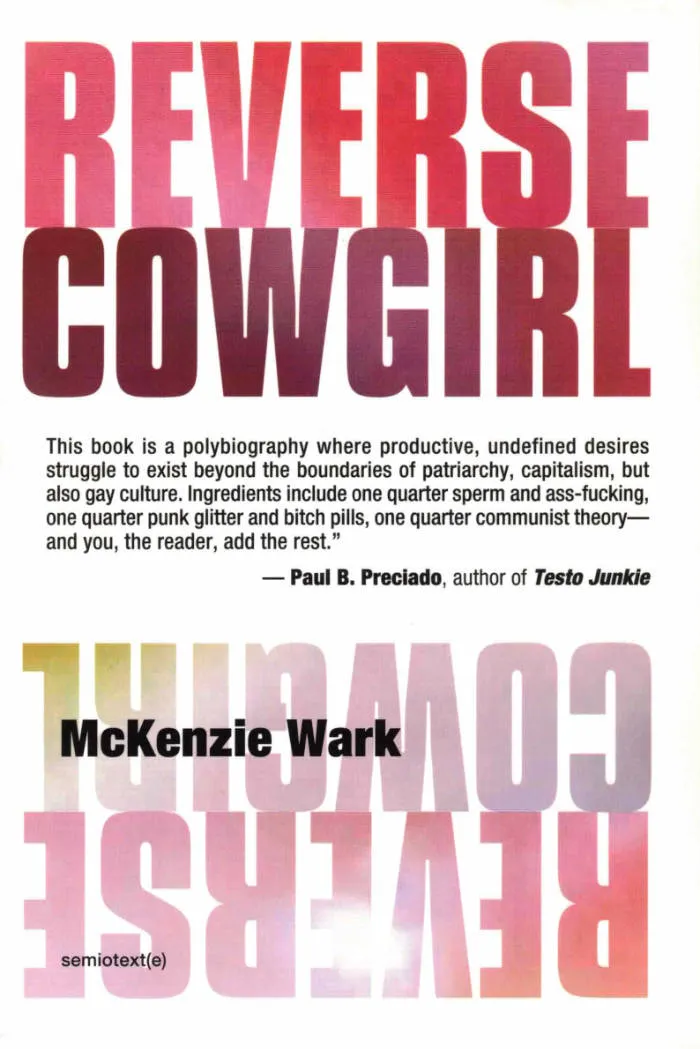
Cover of Reverse Cowgirl

Semiotext(e)

Reverse Cowgirl

McKenzie Wark

Fiction €16.00

McKenzie Wark invents a new genre for another gender: not a memoir but an auto-ethnography of the opacity of the self.

Another genre for another gender.

What if you were trans and didn't know it? What if there were some hole in your life and you didn't even know it was there? What if you went through life not knowing why you only felt at home in your body at peak moments of drugs and sex? What if you expended your days avoiding an absence, a hole in being? Reverse Cowgirl is not exactly a memoir. The author doesn't, in the end, have any answers as to who she really is or was, although maybe she figures out what she could become.

Traveling from Sydney in the 1980s to New York today, Reverse Cowgirl is a comedy of errors, chronicling the author's failed attempts at being gay and at being straight across the shifting political and media landscapes of the late twentieth century. Finding that the established narratives of being transgender don't seem to apply to her, Wark borrows from the genres of autofiction, fictocriticism, and new narrative to create a writing practice that can discover the form of a life outside existing accounts of trans experience: an auto-ethnography of the opacity of the self.