rile*books

Search books

Search books by title, author, publisher, keywords...

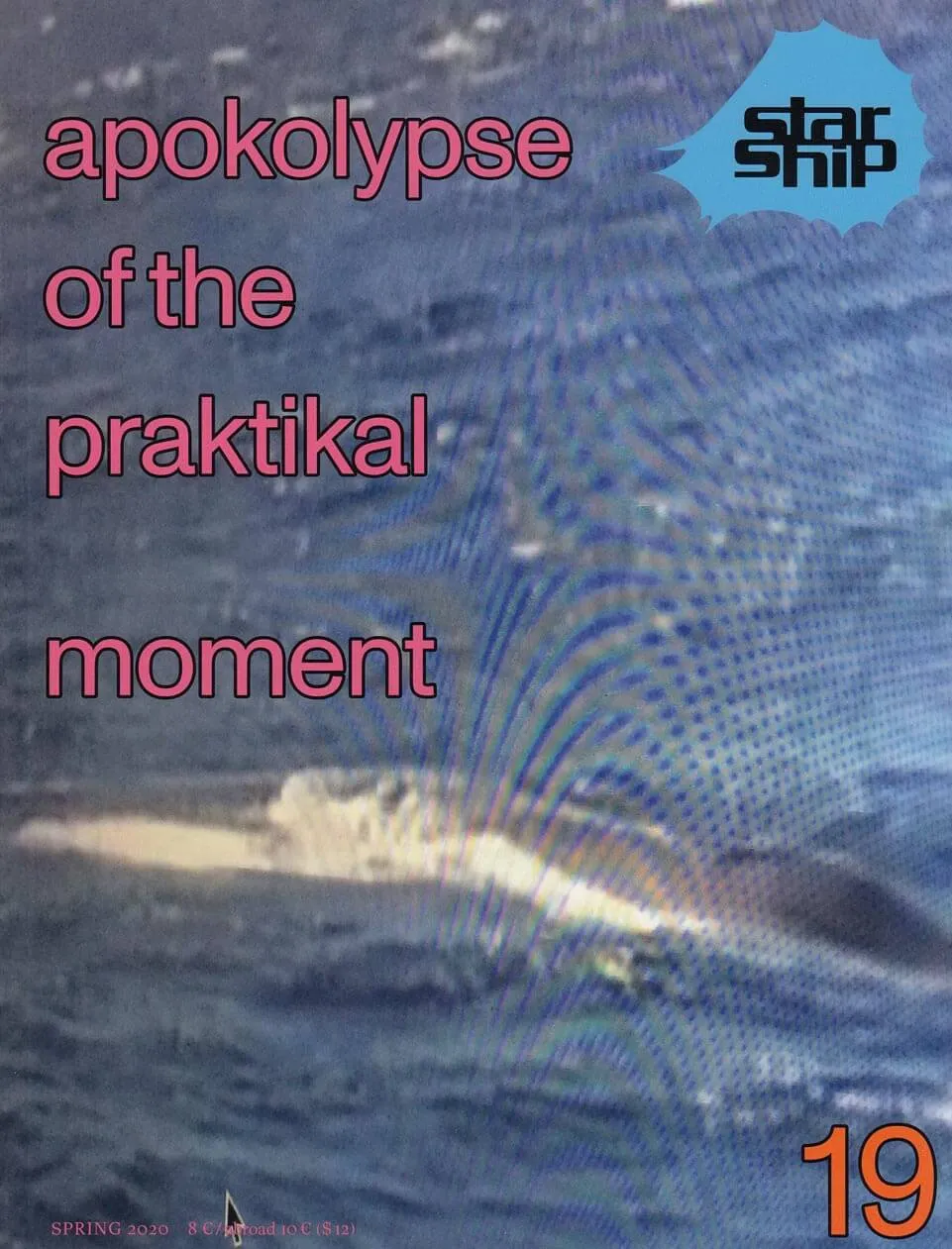
Cover of Apokolypse of the praktikal moment

Starship Magazine

Apokolypse of the praktikal moment

Starship

€10.00

Starship Magazine #19 presents contributions by John Boskovich, Elijah Burger, Simon Denny, Cornelia Herfurtner, Yuki Kimura, Vera Palme, Nora Schultz, Jack Smith; and by Rosa Aiello, Carter Frasier, María Galindo, Samuel Jeffery & Daniel Herleth, Elisa R. Linn, Paul B. Preciado, and Haytham El-Wardany

introducing new columnists: Mihaela Chiriac, Michèle Graf & Selina Grüter, Julia Jung, The Parliament of Bodies, and Ulla Rossek

and our columnists: Tenzing Barshee, Gerry Bibby, Mercedes Bunz, David Bussel, Eric D. Clark, Jay Chung, Hans-Christian Dany with Valérie Knoll, Francesca Drechsler, Stefanie Fezer & Vera Tollmann, Julian Göthe, Karl Holmqvist, Stephan Janitzky, Jakob Kolding, Lars Bang Larsen, Ariane Müller with Huang Rui, Robert M. Ochshorn, Mark von Schlegell, Max Schmidtlein, Amelie von Wulffen, and Florian Zeyfang 

and artworks by Melvin Edwards, Elizabeth Ravn, Nong Shoahua, and Mark van Yetter.

Language: English

recommendations

Cover of Starship 20

Starship Magazine

Starship 20

Henrik Olesen, Ariane Müller

Periodicals €11.00

Contributors to Starship № 20:

Rosa Aiello, Terry Atkinson, Tenzing Barshee, Gerry Bibby, Mercedes Bunz, David Bussel, Jay Chung, Eric D. Clark, Caleb Considine, Hans-Christian Dany, Albert Dichy, Nikola Dietrich, Martin Ebner, Ruth Angel Edwards, Stephanie Fezer, Jean Genet, Simone Gilges, Julian Göthe, Michèle Graf, Selina Grüter, Ulrich Heinke, Toni Hildebrandt, Beatrice Hilke, Karl Holmqvist, Stephan Janitzky, G. Peter Jemison, Charlotte Johannesson, Julia Jost, Julia Jung, Jakob Kolding, Nina Könnemann, Lars Bang Larsen, Anita Leisz, Norman Lewis, Elisa R. Linn, Sebastian Lütgert, Vera Lutz, Chloée Maugile, Robert McKenzie, Ariane Müller, Christopher Müller, Robert M. Ochshorn, Henrik Olesen, Kari Rittenbach, Nina Rhode, Ulla Rossek, Cameron Rowland, Mark von Schlegell, Ryan Siegan Smith, Philipp Simon, Valerie Stahl Stromberg, Josef Strau, Vera Tollmann, Eleanor Ivory Weber, Camilla Wills, Amelie von Wulffen and Florian Zeyfang.

"This is the 20th issue of Starship and we are proud and very happy to present it, and mainly want to thank all the artists, the contributors, the columnists, and the people who helped us gather images of exhibitions past, and gave us texts from books not yet published. Starship never starts with a clear concept about its future content, or what could be called a theme, but always with a sort of attentive interest. The theme may develop through its columnists—we now think it is easy to distinguish lines of thoughts, images, and texts answering each other. But it surely does so out of this editorial interest that wanders, and finds, and collects, is enthusiastic about artworks, and texts, and people, and then, well, brings this all together in a magazine. This was our working mode during the past year, and the responsiveness of those who regularly write for Starship (the columnists) has shown us that out there others are involved in thoughts that run very much in parallel. It is a strange form, a magazine like this, not getting funded, appearing irregularly, but still following a sort of conventional form that shows its consistency. It is at its core an excess of producing something that might prove itself valuable and liberating in the future."
—Ariane Müller, Henrik Olesen
Cover of Dysphoria Mundi: A Diary of Planetary Transition

Graywolf Press

Dysphoria Mundi: A Diary of Planetary Transition

Paul B. Preciado

Essays €22.00

A revolutionary book tracing the collapse of the paradigms that have organized the world for centuries. 

In Dysphoria Mundi, Paul B. Preciado, best known for his 2013 cult classic Testo Junkie, has written a mutant text assembled from essays, philosophy, poetry, and autofiction that captures a moment of profound change and possibility. Rooted in the isolation of the COVID-19 pandemic, and taking account of the societal convulsions that have ensued, Preciado tries to make sense of our times from within the swirl of a revolutionary present moment.

The central thesis of this monumental work is that dysphoria, to be understood properly, should not be seen as a mental illness but rather as the condition that defines our times. Dysphoria is an abyss that separates a patriarchal, colonial, and capitalist order hurtling toward its end from a new way of being that, until now, has been seen as unproductive and abnormal but is in fact the way out of our current predicament.

With echoes of visionaries such as William S. Burroughs and Kathy Acker, Preciado’s theoretical writing is propelled by lyric power while providing us with a critical toolbox full of new concepts that can guide our thinking and our transition, cognitive emancipation, denormalization, disidentification, “electronic heroin,” digital coups, necro-kitsch. Dysphoria Mundi is Preciado’s most accessible and significant work to date, in which he makes sense of a world in ruins around us and maps a joyous, radical way forward.

Cover of Aftershow

Sternberg Press

Aftershow

Pauline Boudry/ Renate Lorenz

Performance €25.00

A monograph / artists' book that engages with the recent film installations of Pauline Boudry / Renate Lorenz. Installation shots, research material, scripts, and film stills give an insight into the artists' investigation of performance in film and their dense net of references to experimental film, the history of photography, sound, and underground (drag) performances.

The book's title alludes to an interest in opaque events that are belated, left backstage or off-screen. A number of (fictitious) letters to friends and collaborators such as Sharon Hayes, Yvonne Rainer, Ginger Brooks-Takahashi, and Jack Smith place the work of Boudry & Lorenz in a context of debates around temporalities, activism, the archival, decolonizing practices, and queer histories. Published following the exhibition “Patriarchal Poetry” at the Badischer Kunstverein, September 27– November 24, 2013.

Cover of == #2 (edition)

Capricious

== #2 (edition)

Matt Keegan

First launched in 2012, and published by mfc michèle didier (micheledidier.com), == is a small-run arts publication, edited by Matt Keegan. ==#2, 2015, is designed by Su Barber and published in an edition of 500 by Capricious Publishing. Barber and Keegan worked together on North Drive Press (northdrivepress.com) between 2005-2010, and this publication shares a variety of traits with NDP.

==#2 is a non-thematic arts publication contained in a box with a 96-page bound volume featuring artist-to-artist interviews, texts, and transcriptions. Six loose multiples are also included.

Contributors include: Sam Anderson, Uri Aran, Fia Backström, Darren Bader, Judith Barry, Stefania Bortolami, Daniel Bozhkov, Milano Chow, Anna Craycroft, Lucky DeBellevue, Cristina Delgado, Haytham El-Wardany, Jake Ewert, Vincent Fecteau, Corrine Fitzpatrick, Harrell Fletcher, Rachel Foullon, Aurélien Froment, Kenny Greenberg, Calla Henkel, Leslie Hewitt, Jaya Howey, Adelita Husni-Bey, Iman Issa, Ruba Katrib, Jill Magid, Jo Nigoghossian, Aaron Peck, Max Pitegoff, David Placek, Olivia Plender, Lisa Robertson, Andrew Russeth, Amy Sillman, Diane Simpson, Greg Parma Smith, Jessica Stockholder, Martine Syms, and Anicka Yi.

Cover of The Lesbian Body

Winter Editions

The Lesbian Body

Monique Wittig

Fiction €22.00

In this genre- and gender-breaking work of theory-fiction, legendary writer and cofounder of the 1970s French feminist movement Monique Wittig celebrates the body—lesbian, literary and defiantly political—and challenges the order of heterosexuality in literature. 

First published in French in 1973, The Lesbian Body mines the relationship between a lover and a beloved—also a writer and a text—to explore the ideological and historical constructions of the female subject. Organized according to the principle of montage, poetic passages are juxtaposed with anatomic lists that mark lesbian eros. Through expressions of joy, violence, and tenderness, the site of pleasure is celebrated. In her transfiguration of gender and its paradigms, Wittig transformed French vocabulary, feminizing grammar and lesbianizing myths. This edition brings the English translation of Wittig’s groundbreaking work back into circulation for the first time since the mid-1980s, revised according to the author's notes, and with an introduction by Paul B. Preciado.

The Lesbian Body is a fundamental work of lesbian existence. Wittig's applied vision is a state of natural delirium, a revolutionary excess of utopianism, refusal, and mutual self-creation. Revisiting it reveals how much passionate free thought has been lost, and simultaneously, how many of her tropes and discoveries have integrated into our collective consciousness.” — Sarah Schulman

“In this stunning new rendering of The Lesbian Body by the French author, theorist, activist and teacher, the late Monique Wittig, we are plunged into an imagined world of passionate violence and erotic lesbian mayhem intertwined in strikingly bold poetic images. Wittig, in the reach and volatility of her imagination, stands alongside such important American writers as Audre Lorde, Adrienne Rich, and Valerie Solanas, all of whose work deserves to be read again, or for the first time.” — Esther Newton

“To read the book is to be forced by Wittig into another grammar and happily contaminated by its strange forms. You will never think straight again.” — Jack Halberstam

“For me, Wittig opened up a sense of the world that had been, quite literally, unimaginable. She tore us apart.” — Judith Butler

“Together with Ursula Le Guin and Samuel R. Delany, Wittig is the first to design a nonbinary utopia, a world in which the binary categorization of sexes and genders will have ceased to exist.” — Paul B. Preciado

Introduction by Paul B. Preciado
Translated by David Le Vay

Cover of Can the Monster Speak?: Report to an Academy of Psychoanalysts

Semiotext(e)

Can the Monster Speak?: Report to an Academy of Psychoanalysts

Paul B. Preciado

Essays €16.00

Paul Preciado's controversial 2019 lecture at the École de la Cause Freudienne annual conference, published in a definitive translation for the first time. 

In November 2019, Paul Preciado was invited to speak in front of 3,500 psychoanalysts at the École de la Cause Freudienne's annual conference in Paris. Standing in front of the profession for whom he is a mentally ill person suffering from gender dysphoria, Preciado draws inspiration in his lecture from Kafka's Report to an Academy, in which a monkey tells an assembly of scientists that human subjectivity is a cage comparable to one made of metal bars.  

Speaking from his own mutant cage, Preciado does not so much criticize the homophobia and transphobia of the founders of psychoanalysis as demonstrate the discipline's complicity with the ideology of sexual difference dating back to the colonial era, an ideology which is today rendered obsolete by technological advances allowing us to alter our bodies and procreate differently. Preciado calls for a radical transformation of psychological and psychoanalytic discourse and practices, arguing for a new epistemology capable of allowing for a multiplicity of living bodies without reducing the body to its sole heterosexual reproductive capability, and without legitimizing hetero-patriarchal and colonial violence.  

Causing a veritable outcry among the assembly, Preciado was heckled and booed and unable to finish. The lecture, filmed on smartphones, was published online, where fragments were transcribed, translated, and published with no regard for exactitude. With this volume, Can the Monster Speak? is published in a definitive translation for the first time.

Cover of KAMERA CAHIER N° 10

Avarie Publishing

KAMERA CAHIER N° 10

Helga Fanderl

A special edition issue curated, designed and published by AVARIE, Paris and Labor Neunzehn, Berlin. It accompanies KAMERA SERIES, while it is an independent and valuable object to collect. The central idea that informs and directs the booklets’ montage is the interplay between the concepts of addition and subtraction. This is achieved by unveiling a missing image in the screening or an unreleased second from an artist's film, expanded to 24 pages. Additionally, each booklet contains a piece directly removed from the show.

The editing establishes a dialogue between film frames and performed writings derived from texts, scripts, storyboards, and notes. The KAMERA exhibition is consequently extended into a physical space—the book—allowing for its widespread dissemination, complementing and contrasting with its potential online occurrence.

KAMERA SERIES is a screening program of experimental films, video art works and printed matter taking place in a former GDR building in Berlin. Each event showcases a retrospective of selected films by an artist and a small exhibition of his/her publications or works on paper over a span of 4 days.

KAMERA centers on fostering a critical dialogue between different film formats and artists’ books. Through its regular occurrence, it aspires to create a space for community exchanges about contemporary image-making. KAMERA is a series conceived and curated by Labor Neunzehn and AVARIE.

Fascinated by the intersection of visual art and cinema, Helga Fanderl’s short poetic films evoke intense and sensitive experiences of the real world. Using a small hand-held super 8 camera, she creates filmic responses to her perceptions, weaving together imagery and emotions in dense, rhythmic patterns solely through in-camera editing. She presents silent films in the form of ‘compositions’, crafting unique programs for site-specific personal projections and transforming spaces into temporary cinemas.

Cover of Poster Edition (bundle)

Self-Published

Poster Edition (bundle)

etaïnn zwer

4 poèmes-affiches, format A3, impriméx en risographie au studio Colorama (Berlin), sur papiers variés, tirage à 150 exemplaires

«GASOLINE, Apocalypse 1998», «the category is: phone sex», «zona nudista», «(fête) sentimental-e-s» : étés d'apocalypse, émojis banane, cruising transocéanique, SMS en short, sales coeurs, baraques à frissons et grand-huit sentimental... ces poèmes courent toustes ~ à genoux, à nu ou en solex ~ après la question du désir, après l'amour aussi, avec une tendre obsession

Design graphique signé Auriane Preud’homme, Enz@ Le Garrec, Roxanne Maillet & Martha Salimbeni, avec des dessins de Gaëlle Loth