Books
Books

Comme des œufs, comme des pierres
[fr] Dans l’imaginaire collectif, l’œuf évoque la fragilité et la promesse de vie, tandis que la pierre renvoie à la permanence et à la disparition. Cette édition tente de déplacer cette opposition à travers une forme fragmentaire. Il rassemble des notes écrites au fil du temps. Sa production suit cette logique : imprimé en offset, le projet prend en compte les formats de papier afin d’en optimiser l’usage. Les chutes sont utilisées dans un cahier complémentaire, rassemblant textes et images laissés en marge. La reliure, cousue à la main au fil de coton, reste simple et légère. L’objet se conçoit comme quelque chose à manipuler et découvrir, entre publication et transmission plus intime.
« J’ai donc cherché une forme simple, en évitant tout formalisme superflu. Le projet repose sur une question : est-il nécessaire de produire ce type d’objet, et pourquoi ? »
[en] In the collective imagination, the egg suggests fragility and the promise of life, while stone evokes permanence and disappearance. This edition seeks to move beyond this opposition through a fragmentary form. It gathers notes written over time. Its production follows the same logic: printed in offset, the project takes paper formats into account in order to optimize their use. Offcuts are used in a supplementary section, gathering texts and images left aside. The binding is hand-sewn with cotton thread, remaining simple and lightweight. The object is conceived as something to handle and discover, between publication and a more intimate form of transmission.
“So I sought a simple form, avoiding unnecessary formalism. The project rests on a question: is it necessary to produce this type of object, and why?”

Inhabiting the 0.6%: The reality of Seoul's Black Hole
[FR] Cette édition documente la surpopulation de Séoul et les statistiques tragiques qui s'y rapportent. Elle rassemble les voix de ceux qui y vivent, de ceux qui y ont vécu, de ceux qui doivent s'y rendre et de ceux qui l'ont quittée. La production suit les principes écologiques énoncés par la graphiste, Sara de Bondt en 2014. Pour éviter le gaspillage, des formats standard (A4) et du papier 100% recyclé ont été choisis, avec une impression en risographie. Pourquoi cet exode massif vers Séoul ? Comment Séoul est-elle devenue un trou noir ?
[EN] This edition documents Seoul’s overpopulation and the tragic statistics associated with it. It gathers the voices of those who live there, those who have lived there, those who must travel there, and those who have left. The production follows the ecological principles set forth by the graphic designer Sara de Bondt in 2014. To avoid waste, standard formats (A4) and 100% recycled paper were chosen, with an impression in risography. Why this massive exodus toward Seoul? How has Seoul become a black hole?
[KO] 이 책은 서울의 인구 과밀화와 이와 관련된 비극적인 통계들을 기록한다. 서울 거주자, 과거의 거주자, 가야만 하는 자, 그리고 이방인까지. 이들의 목소리를 인터뷰로 담았다. 2014년 그래픽 디자이너 사라 드 본트가 제시한 생태적 원칙을 따라 A4 규격 사이즈의 100% 재생용지 위에 리소그래피로 인쇄되었다. 왜 모두가 이토록 서울로 몰려드는 것일까? 서울은 어쩌다 블랙홀이 되었을까?

touxs mes queers sont des poéte·sses
[FR] car archiver nos écrits et nos paroles n'a jamais été aussi important, car il faut rendre compte de nos existences, de ce moment, pour nous et pour les futurs queers en recherche de repères oui, nous avons écrit, donc oui vous pourrez écrire aussi ! oui, nous avons existé, donc oui, vous existerez aussi ! car oui, nous sommes toustes poéte·sses ! car nos vies sont des poèmes et être queer est de la poésie car touxs mes queers sont des poéte·sses!
[ENG] because preserving our writings and our words has never been more important, because we must bear witness to our lives, to this moment, for ourselves and for future queers in search of guidance yes, we have written, so yes, you can write too! yes, we have existed, so yes, you will exist too! because yes, we are all poets! because our lives are poems and being queer is poetry because all my queers are poets!

Ursa Major
[FR] Ce jeu memory invite à découvrir la symbolique de l’ours à travers l’Histoire, et plus précisément à travers l’histoire de l’ours en peluche. L’animal n’a pas toujours eu bonne réputation chez les humains. Comment un jouet à son effigie a-t-il pu devenir un emblème de l’enfance ?
Le jeu se compose de 54 cartes numérotées (27 paires) et d’un poster explicatif imprimés en risographie.
[EN] This game of memory is an invitation to discover the symbolism of the bear through history, more specifically, through the history of the teddy bear. The animal didn’t always have such a good reputation among humans. How could a toy in his likeness become an emblem of childhood ?
The game is made of 54 numbered cards (27 pairs), and an explanatory poster printed in risography.

Culottes
[FR] Culottes est une édition qui retrace l’histoire de ce sous-vêtement à travers différentes matières textuelles et visuelles. Elle interroge sa symbolique dans un milieu artistique et explore le rapport des femmes à cet objet de leur quotidien. Le tout est accompagné d’images emblématiques de pub et de goodies !!
[EN] Culottes is a publication that traces the history of this underwear through different textual and visual materials. It questions its symbolism in an artistic context and explores women’s relationship to this everyday item. It comes with iconic images from advertisements and goodies!!

Prisoner of Love
Starting in 1970, Jean Genet—petty thief, prostitute, modernist master—spent two years in the Palestinian refugee camps in Jordan. Always an outcast himself, Genet was drawn to this displaced people, an attraction that was to prove as complicated for him as it was enduring. Prisoner of Love, written some ten years later, when many of the men Genet had known had been killed, and he himself was dying, is a beautifully observed description of that time and those men as well as a reaffirmation of the author’s commitment not only to the Palestinian revolution but to rebellion itself. For Genet’s most overtly political book is also his most personal—the last step in the unrepentantly sacrilegious pilgrimage first recorded in The Thief’s Journal, and a searching meditation, packed with visions, ruses, and contradictions, on such life-and-death issues as the politics of the image and the seductive and treacherous character of identity. Genet’s final masterpiece is a lyrical and philosophical voyage to the bloody intersection of oppression, terror, and desire at the heart of the contemporary world.

Every Moment Is a Life: Gaza in the Time of Genocide
susan abulhawa, Huzama Hubayeb
In early 2024, writer and activist susan abulhawa managed to enter Gaza twice through the Rafah crossing. There, at the Culture and Free Thought Association, susan held a series of workshops for young people who had been displaced to tent encampments. The lives of all participants were marked by unrelenting Israeli violence and extraordinary loss—of home, family, safety, education, electricity, and all the structures of life. They’d fled from place to place as Israel’s colonial violence swirled around them, complete with food and water insecurity and constant threat. Still, despite the bitterness of life in tents and the dangers of travel, they came together to share in the refuge of writing and community.
Samya recounts a tender moment with an old man mending shoes in the street, while her cousin Saja hides books in her closet, hoping they and her home will still be there when she returns. Ghassan is haunted by the baby he rescued from the rubble, who for a time became his son. Fatima risks it all retrieve her clothes from a danger zone buzzing with drones and warplanes. Maram’s loving aunt is gone, and chaos inhabits Amr’s mind. Samah, Lubna, Rizq, and Nebal take us by the hand through raining death, trails of tears, classroom shelters, and shared clothes in crowded tents.
Every Moment Is a Life delivers rare, unfiltered portraits of life under genocide, platforming the emerging voices struggling to survive in Gaza today. These essays are raw and real, capturing human moments—buying bread, going to the bathroom, sharing a meal, drinking coffee—all set against the backdrop of history’s first livestreamed ethnic cleansing. With courage, anger, love, agony, and—impossibly—hope, these achingly tender voices from Gaza will stay with us, captured in these pages, forever.

Maitonaut
There is escapism, yes-but then there is transcendence. And the more MAITONAUT self-reveals the more we see hints of full blown eternity hidden within the blur of modern everydayness. Mixing poems and fiction and narrators with the fluidity of water becoming ice then vapor, Kaisa Saarinen's collection self-escapes somehow in the midst of its very self-materialization.

On the Verge of Becoming
Ann Leda Shapiro, Christina Yuen Zi Chung and 1 more
On the Verge of Becoming is the first comprehensive monograph on Ann Leda Shapiro, whose visually arresting and symbolically layered works have challenged cultural taboos and institutional limits for over five decades.
Edited by Christina Yuen Zi Chung and Catharina Manchanda, the book offers new feminist and decolonial readings of Shapiro's work. It includes an in-depth conversation with artist Joyce Kozloff, as well as over 150 pages of full-color reproductions and archival materials. This publication is an essential contribution to feminist art history and a long-overdue recognition of a visionary artist whose work continues to resonate across generations and geographies.
Ann Leda Shapiro (born 1946 in New York City) is an American artist whose career spans over five decades and is marked by a consistent commitment to feminist critique and experimental figuration. After studying at the San Francisco Art Institute and the University of California, she gained early visibility with her 1973 solo exhibition at the Whitney Museum of American Art. The show became a flashpoint in debates around censorship and representation, when several works addressing female sexuality were removed before opening—sparking controversy that ultimately contributed to the institutional reception of feminist art in the United States.
Throughout the 1980s, Shapiro remained active in activist circles, including as a member of the Guerrilla Girls. Her practice, which includes drawing, watercolor, and mixed media, reflects a sustained engagement with the body as both subject and site of resistance. In parallel with her artistic work, she has practiced acupuncture since the early 1990s, a discipline that has informed her sensitivity to form, gesture, and internal systems.

Troubling the Stage – The Choreographic Work of Marlene Monteiro Freitas
Five dance pieces and an iconographic imaginary in convulsion: making the most of these ingredients, Alexandra Balona engages with the work of Cabo Verdean choreographer and dancer Marlene Monteiro Freitas.
This book offers a lens onto the dazzling oeuvre of a choreographer whose boldness shakes the foundations of every theater she enters. It centers on five emblematic works: Guintche (2010), Paradise—Private Collection (2012), Jaguar (2015), Bacchae—Prelude to a Purge (2017), and Mal—Embriaguez Divina (2020). It follows Monteiro Freitas's creative methodology, weaving references from her personal archive together with works from art history, navigating between ideas and possibilities in the manner of an atlas bearing the weight of the world. From wonder emerges a mode of attentive reading; one capable of observing and, out of fragments, revealing the methods, processes, and mechanisms of art. The texts in this book are "small critical machines for reading the unreadable."
Troubling the Stage: The Choreographic Work of Marlene Monteiro Freitas is both a study and an encounter; a powerful crossing of choreography with critical thought. It invites readers, scholars, and audiences alike to experience the intensity, violence, joy, and humanity of one of today's most uncompromising choreographic voices.

Mouvement #128
How the right wing is ruining culture, part II; in Sicily, humanitarian flotillas bound for Gaza are on the US Army's radar; Alice Diop and the Black Venus; Iraqi singer Sajda Obeid unites the country; theater according to Sylvain Creuzevault; the British left reveals fascism...
Founded in 1995, Mouvement is a French “indisciplinary cultural magazine”, published quaterly.

Mouvement #129
The new “left-wing Catholics”; education under Trump and the American brain drain; theater, porn, and bullfighting with Lorraine de Sagazan; an X-ray journey with the nuclear nomads; soccer, Gen Z, and algorithmic governance in Morocco; Pedro Rhino, cinema at the end of the neocolonial mirage...
Founded in 1995, Mouvement is a French “indisciplinary cultural magazine”, published quaterly.

BUTT 38
Slide into spring with our mega-stimulating 38th issue.
Hop in the jacuzzi with Italiano chart-topper Mahmood. Read the hustling tell-all with Ashland Mines aka deejay Bobby Beethovan. Zip to queer futures with internet-doll sensation @StarAmerasu. Go behind-the-scenes of some of the biggest French content creators with photographer @RaphaelChatelain. There’s hairy art from China, trans love affairs, cottaging evidence for court, d*ck arrangements, ladyboy activism, and so much more.
Plus, a back section of smutty poetry submitted to us by our talented readers, and a visit to our favorite local cruise bar on BUTT’s 25th anniversary. At 152 pages, it’s sure to satisfy size queens all around the world.

BUTT 37
Lots of straight-talking in BUTT no. 37. Catch Édouard Louis shot by Nan Goldin, Bruce LaBruce meeting Omar Apollo, real talk with Brazilian deputy Erika Hilton and dirty talk with Martin Margiela and Jean Paul Gaultier. Plus a lesbian threeway, Bogotá’s sauna/museum, cocks in sock and oh so much more. Bangers only.

A Dance Mag - Issue 05: Flow
Issue 05, Flow, moves like water through rupture and release. Guided by the I-Ching, we drift into synesthetic rope rituals in Germany, spiral through Taijiquan in Canada, sway in sacred dances under Ethiopian stars, and lose ourselves in the rapture of Krishna Vandana. Here, flow is both a political current and a state of surrender. From Gabriel Semerene's meditations on faith and protest across Gaza and Brazil to Nerda Khara's navigation of societal constraints in Pakistan, these pieces explore how movement becomes both resistance and surrender. Tejaswini Loundo ponders flow states in Indian classical philosophy while Erika Mattio finds unity in the sacred dances of Lalibela. Shanny Rann discovers spirit in Taijiquan's slow power, Antje Brockmüller maps synesthesia through rope flow, and Anna Chwialkowska questions ghosts’ choreography. Each piece paired with its own hexagram, creating a map of emergence and dissolution. Maria Harfouche's photography dissolves structure into motion where edges blur and time becomes fluid, capturing the moment when form gives way to flowing energy.
A Dance Mag is an independent magazine that looks at the world through the lens of dance. It transcends differences, distances, and disciplines to tell the stories of people from all over the world, who are dancing their lives and giving their bodies a voice.

A Dance Mag - Issue 04: Structure
Issue 04, Structure, traces the scaffolding of our lives, seen and unseen. We travel from the palaces of Versailles to the basements of Russian resistance, from origami folds to mechanized labor, from cosmic geometry to the twitch of a stimming hand. These are the choreographies that hold us, train us, divide us, and sometimes set us free. This issue moves through power's choreography with Vinícius Portella tracing repression from TikTok algorithms to Candomblé persecution, Sasha Portyannikova documenting dance as survival under Russian authoritarianism, and Ellen Jeffrey revealing how stimming becomes its own radical dance practice. Mariam Ala-Rashi finds cosmic alignment in contortion while Michael O'Connor explores the body as origami, structure folded into self. Katja Vaghi contrasts baroque precision with contemporary chaos, and Nathaniel Moore exposes the market forces shaping European dance. Cover and insert artist, Maria Harfouche, captures structure through double-exposed analog photography and layered compositions that reveal how moments build upon each other.
A Dance Mag is an independent magazine that looks at the world through the lens of dance. It transcends differences, distances, and disciplines to tell the stories of people from all over the world, who are dancing their lives and giving their bodies a voice.

Safar Issue 9: Protests
"Journal Safar's 9th issue is Protests. To protest is a fundamental human act against injustice. It takes many forms: the defiant act of existing, the organized resistance of multitudes, armed struggles, and the disruption of systems through speech, action, and refusal in person, in prints and slogans online, or on the streets. Some forms of protest require symbols, flags, and specific attire, while others are carried out through non-verbal communication, secret dissemination, and ideological discipline. Yet all of them need cultural carriers–our bodies, our stories, and our marks to hold what can be remembered and learned from. Whether explicit or invisible, in communities or in solitude, this issue explores why we protest, and how, in the hopes of sparking solace, solidarity, and action.
In this issue: Maya Saikali sits down with Gérard Paris-Clavel, a co-founder of the pioneering Grapus Collective, to talk political image-making and the life of the image. Gérard delves into his own work and where it survives, “I don’t do exhibitions, I do demonstrations.” An illustrated Toolkit for Actions by Palestine Action makes direct action tactics accessible to anyone ready to confront the international system complicit in the Palestinian genocide. Two conversations by Maya Moumne: with Adbusters Magazine founder Kalle Lasn on the power of artists in revolutions, and with Ahmad Swaid, editor of Dazed MENA and former Editor-in-Chief of GQ Middle East, on censorship, identity, and building new cultural platforms across the region. While Audrey Tseng and Chong Gu write on Red Canary Song, a grassroots collective of Asian and migrant sex workers, massage workers, and allies of the Asian diaspora, that resist policing through notions of homemaking.
These highlights sit alongside stellar contributions by Alina Lupu, Ahmad Zaghmouri, Muhannad Hariri, Elias Erkan, Bettina Nagler, Rasha Dakkak, Yaa Adae, and Nihal ElAasar. And for the first time: another magazine inside this magazine: Design Drafts #3, a collaboration with Nieuwe Instituut, on protest and design with contributions by Tala Abdalhadi, Myriam Amri, Shruti Hussain, Candice Jensen, and Alice Wan on the theme of protest and design."

The Secret History Of Kate Bush (And The Strange Art Of Pop)
The Secret History of Kate Bush, first published in 1982 as Kate was on the verge of superstardom, is a daring and unorthodox dive into the world of music, fame, and cultural obsession. Written by Fred Vermorel—a close associate of Malcolm McLaren and Vivienne Westwood, and renowned for his subversive "anti-biographies"—the book shatters the boundaries of traditional celebrity profiles. Told from the perspective of a die-hard fan, it unveils the mystique of one of pop’s most elusive icons while exposing the capitalist machinery driving the entertainment industry. Part biography, part cultural critique, and entirely provocative, this is not just a book about Kate Bush but a rebellious manifesto against the commodification of art.
Republished in 2022 by Le Gospel in France, this special edition goes even deeper with unpublished treasures from Vermorel’s personal archive. Featuring an exclusive interview with Kate’s father, Dr. Robert Bush, a razor-sharp foreword by novelist and musician Tony O’Neill (Digging the Vein), and Vermorel’s own afterword reflecting on his explosive work four decades later, this is a must-read for anyone fascinated by Kate Bush, the art of fandom, and the raw power of creative rebellion. Fred Vermorel is a pioneer of the in-depth study of celebrity and fan cultures, best known for his controversial "anti-biographies" of pop icons including the Sex Pistols, Kate Bush, Vivienne Westwood, and Kate Moss.

Basta Now (Expanded Edition)
Basta Now - Women, Trans & Non-binary in Experimental Music is a non-academic essay by French poet, novelist and music enthusiast Fanny Chiarello. It’s also the first book to be published by Permanent Draft, an all-female record label and micro-press founded by Chiarello & musician Valentina Magaletti, dedicated to promoting contemporary female, non-binary and transgender artists.
Basta Now is essentially a huge (yet admittedly not definitive) overview of 3867 womxn in the global experimental sound & music scene. It’s been written in playful and compelling prose and stylishly presented with photos, illustrations, and discographies.
Now in its expanded edition, the book includes 80 more pages and an additional 1496 names than the first edition, extended lists and discographies, and updated chapters – especially Wild Things, All-Stars and Madame Bricolage. “This book has nothing against men, it’s just not about them” (Fanny Chiarello)

The Performative Word
First monograph dedicated to the American artist, poet, and activist John Giorno, this publication introduces some of the many ways Giorno wove poetry into all aspects of daily life—by putting words on the wall, on the performance stage, on LP vinyl records, or on the telephone, in the context of the iconic Dial-A-Poem, one of his most celebrated works. A wide range of archival documents, images, and ephemera also form an intimate portrait of Giorno as an activist, performer, Buddhist practitioner, collaborator, and friend.
Published on the occasion of the eponymous retrospective exhibition at the MAMbo - Museo d'Arte Moderna di Bologna, in 2026.
Emerging from the New York downtown scene of the 1960s, John Giorno (1936–2019) developed a singular artistic voice at the crossroads of poetry, performance, painting, and political activism over the course of more than six decades. By bringing the written word off the page and into performance, technology, and visual art, Giorno consistently challenged disciplinary boundaries and advanced a radical vision of language as central to human expression. Though often positioned at the margins of multiple downtown scenes—the Beats, Andy Warhol's Factory, punk music, queer counterculture, anti-war activism—he was in fact an influential presence within all of them, operating as a conduit between coexisting cultural communities. His collaborators included Robert Rauschenberg, William S. Burroughs, Laurie Anderson, Anne Waldman, Allen Ginsberg, and Ugo Rondinone, among many others.

How to speak dead
A meditative reflection on language and its loss.
How does one language inherit another? Defeat, erase or live through another? How to speak dead is Walid Sadek's meditative reflection on language, dead or victorious. At heart, beyond defeat and victory, it is a reflection on how one can approach a speaking that is of neither a living language nor a dead one. A speaking that knows loss and knows it is woven into every uttered word, every spoken sentence. A loss that becomes syntax.
"There, where the battle is lost and won and where, after the hurly-burly is done, we may approach a speaking that is of neither a living language nor a dead one. A speaking that knows loss and knows it is woven into every uttered word, every spoken sentence. A loss that becomes syntax."
Walid Sadek
Walid Sadek (born 1966 in Beirut) is a Lebanese artist and writer. He is a professor at the Department of Fine Arts and Art History of the American University of Beirut.

How to live from fire to fire
Olivier Marboeuf takes us on a journey through myths, archives, and fables, where fire symbolizes Caribbean culture, colonial oppression, and ecological disasters, and where the echo of past revolts becomes the spark for future insurrections.
How to Live from Fire to Fire brings together two closely linked texts by Olivier Marboeuf. The volume opens with Marboeuf's latest work, How to Live from Fire to Fire, written as a new commission, and is followed by the first English translation of his earlier text The Night Just Before the Fire, originally published in French in 2025 by Atlantiques déchaînés.
Written as if in the same breath, the two texts follow one another in a fevered, relentless movement. In The Night Just Before the Fire, Marboeuf reworks Bernard-Marie Koltès's play La Nuit juste avant les forêts (Éditions de Minuit, 1977), transforming it into the delirious, unbroken monologue of a man with dark blue skin calling out to another man in the streets of a major European city. Through this act of rewriting, the echo of past revolts becomes the spark for future insurrections. Next time, a riot.
"The French believed that burning the king of the carnival would suffice to erase these old stories and impose a modicum of order in the beautiful Caribbean colony. They thought that everyone would return home and that the streets would take on their usual amnesiac calm after this necessary moment of release. At the end of the celebration, on Ash Wednesday, King Vaval would be burned and along with him, corruption, excess, and bad lives would burn too. But nothing was said about monopolies. Because even when residents returned home, exhausted by the festivities, even when the dark of night cloaked this whole little world and emptied its public squares, water continued to flow dark from taps and poison snaked a path into the land and its gardens. Somewhere, forests and cities continued to burn."
—Olivier Marboeuf
Olivier Marboeuf (born 1971) is an author-storyteller, artist, independent curator, cultural theorist and film producer from Guadeloupe. In the early 1990s, he co-founded éditions Amok (now Frémok) publishing and launched the Parisian literary café Autarcic Comix. He was artistic director of Espace Khiasma (2004–2018) which contributed to introducing postcolonial theories to the French art scene through numerous exhibitions and encounters
Translated from the French by Liz Duff Young.

ISSUE TWO Traces
MARG1N is an annual Southeast Asian film magazine by writers, filmmakers, and artists. Our second issue honors memories and gazes that drift through Singapore and Vietnam. Through essays, visual scripts, archives, and more, TRACES unearths the flotsam, jetsam, and derelict that churns throughout or beneath today’s cinematic currents.
Traces are fragmentary by nature. You can never deduce a comprehensive view from a trace. Traces gesture, shock, defy, and aspire toward a greater truth than their whole existence. In some way, a film is also a collection of traces, with the hope of invoking in its viewers a sense of wonder and resonance that makes us pause, perhaps rewatch, and rethink certain rigidities. The writings that we have worked with in this issue embody that generative power of traces.
Contributors (In Order of Appearance)
Tracey Toh, Bert Ackley (vinatapes), Daryl Cheong, Lananh Chu, Nguyễn Trinh Thi, Tan Pin Pin, Đỗ Văn Hoàng, Yeo Siew Hua, Lena Vu , Mai Huyền Chi, Hugo Hamon, Mark Chua, Lam Lishuen, Looi Wan Ping, Sasha Han, Dan N.Tran, Alex Lee, Nguyên Lê, The Yang One, Linh Duong, Ton-Nu Nguyen, An Trần, Grace Song, Krystalle Teh, and Dương Mạnh Hùng
Featured Filmmakers
Toh Hun Ping, Tranh Anh Hung, Nhu Quynh, Dang Nhat Minh, Ho Tzu Nyen, Daniel Hui, Min-Wei Ting, Tony Bui, Truong Minh Quy, Nguyen Vu Tru, Trinh Thi Minh Ha
Editor-in-chief: Savunthara Seng
Managing editor: Alyssandra Maxine
Guest editor: Dương Mạnh Hùng
https://marg1n.com/
CUNY Center for the Humanities
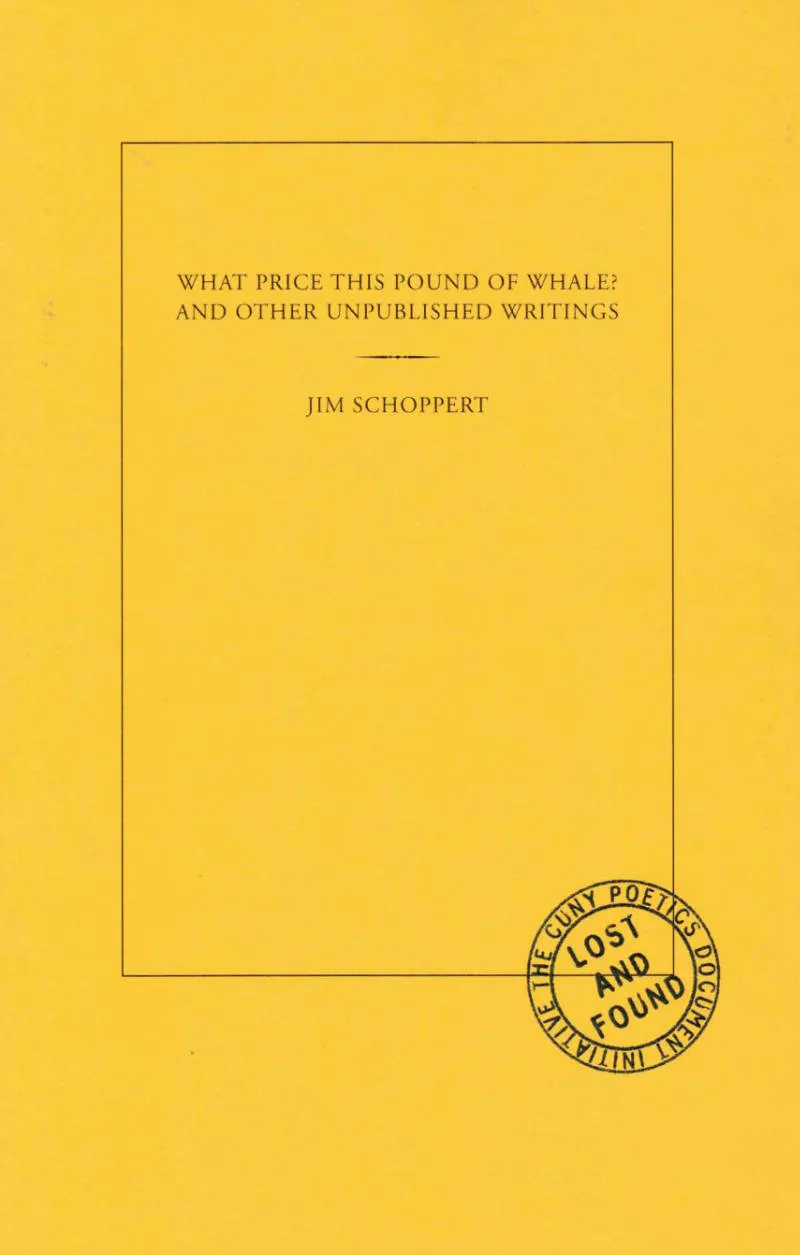
What Price This Pound of Whale? and Other Unpublished Writings
The Tlingit artist Jim Schoppert (1947-1992) was among the most accomplished, innovative, and prolific Alaska Native artists of the twentieth century. His whimsical sculptures and large scale painted wooden carvings reconfigure Tlingit visual motifs, and he challenged the binary categories against which Indigenous artists are so often defined, such as traditional and contemporary, historic and innovative, and artist or craftsperson. While known primarily for his modernist interventions in Tlingit visual traditions, Schoppert was also a prolific writer, an eloquent speaker, and an ardent advocate for Alaska Native artists. This publication brings together a selection of his unpublished poetry and writings from the artist’s personal papers. Presented alongside never before seen sketches and studies, this selection bridges Schoppert’s written and artistic practices in a deeply personal portrait of the artist and Alaska Native life that upsets preconceptions about Native art and unsettles the established narrative of Euro-American and Indigenous aesthetic relations.
Jim Schoppert (1947-1992) was a Tlingit multidisciplinary artist and writer. He was a Taku Tlingit Raven of the Ishkahittaan (Inland Frog) clan from his Tlingit mother and half-German from his father and carried the Łingit name Dom-Yetz. Born in Juneau, Alaska, he earned a BFA in Sculpture and Printmaking from the University of Alaska—Anchorage and an MFA from the University of Washington. In addition to his artistic career, Schoppert was instrumental in promoting Alaska Native arts and organizations. He was Director of Arts and Crafts at the Cook Inlet Native Association, Director of the Alaska Arts in Prisons Program for the University of Alaska Juneau, and organized exhibitions and workshops across Alaska and the Pacific Northwest. He was visiting professor in visual art at the University of Alaska, Fairbanks and directed its Native Art Center. He sat on the Washington State Arts Commission and on the boards of the Alaska State Council on the Arts and the Institute of Alaska Native Arts. His work is held in public and private collections across the United States, including the Smithsonian National Museum of the American Indian, the Anchorage Museum, the Heard Museum, and the Newark Museum, among others. His writing and poetry has appeared in The Greenfield Review and Journal of Alaska Native Arts, among other publications.