Pedagogy
Pedagogy

A Cosmology of Bliss – OEI #112-113
OEI #112–113: A Cosmology of Bliss concerns Bliss (aka Blissymbols or Semantography) — an unspoken language made of countless little geometric symbols, many resembling the things they point to, others remaining more mysterious. Charles K. Bliss (1897–1985) began the project in 1942 while a stateless refugee in the Shanghai International Settlement, and who, after emigrating to the Australian beach town of Coogee, worked on it for the rest of his life. After 30 years of obscurity, the language was picked up as a communication system for nonverbal children in a small hospital school in Canada, with great promise. This, however, led to acrimony between its creator and its first genuine users, who sought to amend it for their needs—an event which Charles likened to ‘a new Babel of symbols’.
A Cosmology of Bliss reconsiders the histories, forms, and dreams of Bliss and its many contributors. It includes a new picaresque biography of Charles, the chemical engineer, wounded refugee, and amateur semanticist; essays that draw out affinities and resistances, such as with the history of 20c Australian poetry and experimental pedagogy; unpublished material from Bliss’s manuscripts and correspondences, including an extensive selection of the barely-published Blissymbols Picture Book—Charles’s final work; and commissions by some thirty artists and poets who put the symbols to new and unruly use. Together they seek to lodge Bliss into the history of Australian visual art and poetry as a remarkable exception. Against received accounts of a failed auxiliary language or an outmoded therapeutic aid, A Cosmology of Bliss is the first study to insist that Bliss is a poetic project. Taken as such, the symbols begin to speak—silently—of a world of lucky faults, chemical grammars, speechless inscriptions, and untenable, incandescent loves.
with Dr. Charles K. Bliss & his devoted coworkers: Javant Biarujia, Claire Bliss, Christopher Brennan, Melinda Bufton, Alexis Carrel, Brendan Casey, Justin Clark, Mitchel Cumming, Gabriel Curtin, Jesse Darling, Douglas Everingham, Michael Farrell, Elisa Gabbert, Samantha Gorman, Agatha Gothe-Snape, Sam de Groot, Gail Hastings, Julian Huxley, Martin Johnston, Alfred Korzybski, Ruark Lewis, Aodhan Madden, Ern Malley, Rowan McNaught, Shirley McNaughton, Tom Melick, Quenton Miller, Robert Milne, Anthony O’Donnell, Ouyang Yu, Victoria Perin, Oscar Perry, π.O., Lisa Radford, Oliver Reiser, Bertrand Russell, Mark von Schlegell, Imogen Stidworthy, Brian Stride, Ella Sutherland, Sam Szoke-Burke, Elisa Taber, Peter Tyndall, Lucy Van, Ania Walwicz, Margaret Woodward, Tim Woodward, Tom Wright, Xu Bing, Jarrod Zlatic, etc.
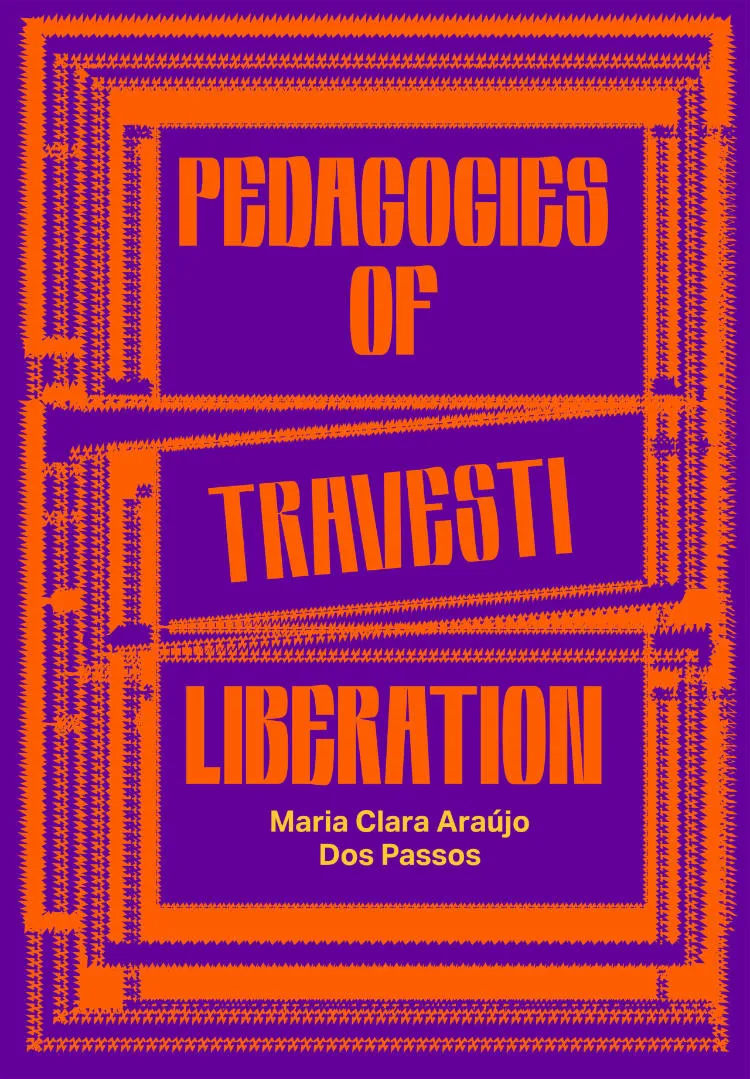
Pedagogies of Travesti Liberation
Maria Clara Araújo dos Passos, Natália Affonso
Maria Clara Araújo dos Passos examines the interplay of education, identity, and liberation in Brazil's travesti community.
In Pedagogies of Travesti Liberation, Maria Clara Araújo dos Passos critiques traditional pedagogical frameworks that marginalize gender nonconforming narratives and highlights the effects of systemic discrimination on travestis' psychosocial well-being. The book advocates for inclusive educational practices and emphasizes the need for affirmative curricula.
Newly translated from Portuguese, this work contributes towards connecting political struggles globally and navigating the complexities of translation—particularly of the term "travesti"—across various geographical and political contexts, featuring a conversation between Araújo dos Passos and translator Natália Affonso.
Maria Clara Araújo dos Passos (born 1996 in Recife) is a Brazilian Afro-transfeminist educator and sociologist, and an activist for LGBT rights.

HUH why didn't I know this?
“Sometimes I find myself explaining to someone at 2 a.m. what a subsidy is. Or how train tickets become cheaper if you have the increased allowance – and what that is exactly. Or in which months you should email a cultural centre if you want to sell a performance. Then those people often say: “Huh, why didn’t I know this?” And: ‘Why isn’t all this just explained somewhere in simple words?’
So I started writing it myself. Because I had to figure these things out myself as a new creator, I can speak from experience. I know better than Kunstenpunt or Cultuurloket what a starting creator struggles with, because I’ve only been doing this for a few years myself. I can explain it better because some things in practice are quite different from the theory.”
Egon Schoelynck (he/him, 1996) is a Sunday child and theatre maker. His work is political-ish and can be found in black boxes, on paving stones and in collective collaborations. His artistic practice was supported by detheatermaker (’22-’25), where he explored, among other things, how to run a soap opera in a café without actors. Together with Runa Robbroeckx and Lennert De Vroey, he created KAK, an ecological shitshow (2025). He also solves global problems with punk songs and children’s instruments, under the name Middle Class Babypunk.

Espaces pédagogiques alternatifs
A critical exploration of the values and qualities inherent in independent educational organizations and the hurdles in the way of remaining "alternative" with the passing of time.
Anna Colin is programme director of the MFA Curating and co-director of the Centre for Art and Ecology, Goldsmiths, London. Besides Open School East, Anna worked as associate curator at Lafayette Anticipations, Paris (2014–20), associate director at Bétonsalon, Paris (2011–12), and curator at Gasworks, London (2007–10). She co-curated Chaleur Humaine, the 2nd Dunkirk Art & Industry Triennale (2023–24) on the relationship between energy and the arts since 1973. She holds a PhD in cultural geography and has a training in arboriculture.
Edited by Céline Chazalviel, Alice Dusapin, Sophie Orlando.
Texts by Anna Colin and Catherine Quéloz.

Biting the Hand – Traces of Resistance in the Art & Language diaspora
Extensive survey of the politically outward-looking Conceptualism emerging from Art & Language in the UK. Especially considering its critique of the norms of Modernist art practices in contemporary art, particularly practices of art education.
Edited, compiled and introduced by Paul Wood, Biting the Hand: Traces of Resistance in the Art & Language diaspora is about a dissident formation of artists active in the UK in the 1970s and 80s.
The book tells the story of artists engaging with a critique of then-contemporary modernist art education, who have embarked on a series of theoretical investigations which became increasingly politicised under the pressures of an evolving social crisis. Increased racism, unemployment and attacks on the organised working class all raised questions about how a critical art might respond.
By the late 1970s, these radical artists, mostly in the orbit of the Art & Language group, were producing posters and leaflets for a wide range of left-wing causes, as well as analyses of the politics of art and design education and the role of cultural ideology in maintaining consensus. In the 1980s, as Thatcherism tightened its grip, those involved went their separate ways into areas as diverse as media work, trade unionism, health and education.
Biting the Hand has three parts: a retrospective introduction setting the formation in its historical context, and two annotated documentary sections presenting examples of the work as both text and image, written and edited by Paul Wood.
It also includes a foreword by Sezgin Boynik, publisher, and an afterword by Ann Stephen, curator and art historian, further expanding on the book's subject.
For many years Paul Wood worked for the Art History Department of the Open University. His publications from that period include Conceptual Art (2000), Western Art and the Wider World (2013), and the four-volume anthology Art in Theory (1990-2020), co-edited with Charles Harrison and others.
Edited, compiled and introduced by Paul Wood.
Foreword by Sezgin Boynik; afterword by Ann Stephen.