Facsimile & Reprints
Facsimile & Reprints

DDA Exchange
A facsimile reprint of the CIA's never-before-seen internal employee newsletter.
DDA Exchange collects, for the first time in public print, the CIA's internal employee newsletter from the 1970s and 1980s. Created in the wake of Watergate and the revelations of the Church Committee, DDA Exchange was the CIA's internal propaganda organ meant to boost employee morale and instill an esprit de corps among members of 'the Company.' The newsletter, featuring a contemporary avant-garde layout and style, kept employees informed of the vast array of Agency business such as remote-viewing health care options, prudent retirement strategies, the latest in terrorism signal processing, and how to use the Agency's brand-new Media Center.
Included in this facsimile reprint is the original design document in which the Agency discusses font choices and graphic elements to be used for their newsletter. A metatextual art book as well as an institutional zine compilation and aesthetic reference, DDA Exchange offers a rare glimpse into the gears and cogs which turn the odious machinery of the shadow state.

Argento Series
Reprinted for the first time in over twenty years, Kevin Killian’s first book of poetry is an audacious, operatic dive into the darkest recesses of the AIDS crisis.
In 1991, Killian reported he was “frozen, unable to think of a way to write about AIDS crisis”. A year later, his friend Kathy Acker suggested the “films of Dario Argento as a prism through which to take apart horror of living and dying in AIDS era”. The result is Argento Series, framing Killian’s real-life experience of losing his friends and lovers to the disease through the camera lens of Italian horror filmmaker, Dario Argento. Here, AIDS is cast as the horror film monster, wreaking cold, unfeeling chaos and destruction wherever it finds itself.
Blending a chilling, impersonal observation of death with Killian's typical high camp, tenderness and O'Hara-like wit, the poems use unflinching honesty and gallows humour to devastating effect. In Argento Series, Killian finds expression for a crisis, and moment in history, that changed everything, forever.
Kevin Killian (1952-2019) was a San Francisco-based poet, novelist, playwright, and art writer. Recent books include Fascination: Memoirs and the poetry collections Tony Greene Era and Tweaky Village. He is the coauthor of Poet Be Like God: Jack Spicer and the San Francisco Renaissance, the first biography of the important US poet. With Dodie Bellamy, he coedited Writers Who Love Too Much: New Narrative Writing, 1977–1997. He died in 2019.
'Here is Kevin Killian, pounding with bloodied fists on Poetry’s door. My heart swells with pride as I claim his masterpiece for our beleaguered city. Argento Series is Kevin’s Lament for the Makers, a monument reaching half-way to the stars for our fallen stars and every big dream of the world lost to AIDS.’ — Robert Glück
Foreword by Derek McCormack.

La Maison des Maladies
Unica Zürn, Ruth Henry and 1 more
Unica Zürn dans La maison des maladies raconte, par un ensemble de textes et dessins, un séjour en hôpital où elle est soignée d’une jaunisse. Elle y écrit et compose ce carnet où le regard qu’elle pose sur son propre corps, les lieux qu’elle habite et les personnages qu’elle rencontre, témoigne d’une sensibilité hors-norme qui tire à la fantaisie, voire au délire.
Pour la première fois en France, La maison des maladies est publié intégralement.
Le texte est traduit de l’allemand par Ruth Henry & Robert Valençay. Un après-propos de Mathilde Girard clôture le livre.
CUNY Center for the Humanities
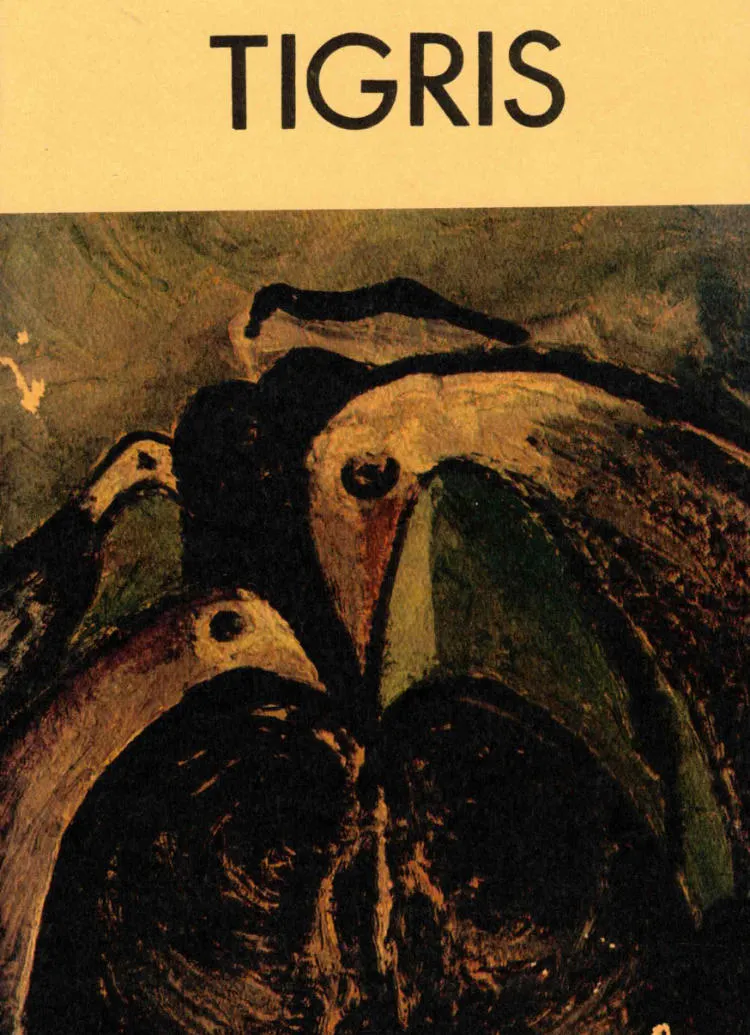
Tigris Vol. 1
In 1971, the great Iraqi poet Sargon Boulus (1944-2007) published a single issue of an English-language literary anthology that he called Tigris. The magazine—a whisper on the literary landscape that appeared three years after Boulus’s arrival in the US—brings together work by Boulus and several of his literary friends, in translation by Boulus and Etel Adnan.
Tigris was not an end in itself, but rather a temporary solution to the lifelong problem of how to devote oneself to poetry across different countries, eras, and styles: how to live poetry. Yet, in so doing, the small anthology includes significant work: Etel Adnan’s “Jebu,” translated by Adnan, and poetry by Boulus, Fouad Rifkah, Yusuf al-Khal, Mouayad al-Rawi, and Riadh Fakhouri, all in Boulus’s translations, as well as a work by Ankido, a “street-activist poet-café worker of importance to the Palestinian Liberation Movement.”

Efemmera Reissue #3: Saving Seeds: Metaphors of Lesbian Growth
Originally published in 1987, Saving Seeds: Metaphors of Lesbian Growth, a special issue of Maize: A Lesbian Country Magazine, was created by artist and writer Jenna Weston as a tribute to "magical female-oriented gardens."
From her Introduction: "I have found that, generally speaking, lesbian gardens are works of art. We make intricate designs with twine between sapling posts. Later, these weavings support tomato vines. Bright colored ribbons flutter from the tops of tall bean poles. Raised vegetable beds are sculpted into various graceful shapes. The winding paths are edged in pieces of broken pottery and stones we've found. We build altars in the centers of our gardens, and hold rituals between the onions and the lettuce."
"I asked wimmin to send me drawings and photos and descriptions of their magical female-oriented gardens. The replies came from near and far, and make up a part of this book. The rest of the book contains poems and prose that came directly from my experiences as a gardener and a lesbian."
This reissue reimagines the black and white stapled original in a bounty of earth tones: different colored French Papers are risograph printed in green, brown, and orange ink. The book is handsewn with gradient thread. Also included is a recent interview with Jenna Weston printed as an 11x17 leaflet, reversed with a poster of one of the garden diagrams in the book.

Efemmera Reissue #7: Cassandra Radical Feminist Nurses Newsletter
Various
A reissue of the 1982 inaugural Cassandra Radical Feminist Nurses Newsletter: founding members explain their interests, intentions, and goals, and invite other nurses to join them.
Introductory text by Peggy Chinn, founding member, and also co-author of Peace & Power: A Handbook of Feminist Process.
The Alder & Frankia Efemmera Reissue series amplifies, graphically reinterprets, and shares historic feminist ephemera. What ideas, strategies, and tactics from the past can we inherit to bring forth a feminist future?

Terminal Boundaries and A natural water course diverted reduced or displaced
Made in 1969 but never published, Terminal Boundaries is an artist book by Lawrence Weiner, a sculptor whose medium was language. The manuscript for the publication, which was recently brought to light, contains two related bodies of work represented as typewritten statements on paper that Weiner pasted to the pages of a small composition notebook. The book’s absence from Weiner’s oeuvre plagued him as it marked a terminus of his relationship to the physical construction of his artworks, and illustrated the principle of “specific” and “general” which he applied to his art.
Created from a standard notebook purchased in a stationery store, the manuscript is two books in one: Terminal Boundaries and A natural watercourse diverted reduced or displaced. A tête-bêche with two front covers, the book can begin from either cover by turning it upside down.
Weiner was a traveler by nature and the materials he refers to in these works are those that one can encounter on a road trip. The artist was traveling across Europe when this manuscript was composed. Struck by the tumultuous times and the critical illuminations about the climate from the Club of Rome discussions, the works in this book are in Weiner’s words, “concerned with the relationship of natural resources in relation to human beings.” Distinct from his contemporaries associated with the Land Art movement, in Terminal Boundaries and A natural water course diverted reduced or displaced, Weiner constructs his landscape interventions in language—the specific and/or general act and the location are stated—offering the reader/viewer the opportunity to consider each work’s existence, to build it in their mind’s eye. One can only wonder what Weiner did to divert, reduce, or displace a natural water course in Saltsrumen, Norway, the location of the world’s strongest maelstrom, or in nearby Bodø at the site of Svartisen glacier. A work in Terminal Boundaries titled The joining of France Germany and Switzerland by rope demonstrates the geopolitical perspective of Weiner’s land art. Requiring physical and mental borders to be transgressed in performing this work; how and where could this happen?
Terminal Boundaries finds Weiner just off the cusp of his decision to make art that lived centered in language, emphasizing the viewer’s responsibility to engage with it to make it whole. The book marks a crucial inflection point in the artist’s practice, defining his direction to make work that “attempts to present something to people that is not just about me,” but about materials and the world we find ourselves in here and now.

fierce pussy
This eponymously titled publication by fierce pussy brings together thirty-nine of the legendary art collective’s posters, from works made in the urgent early days of the AIDS crisis to present-day advocacy for Queer and Trans rights. In keeping with fierce pussy’s activism in public spaces, the publication is designed to allow readers to tear out any of the posters to share, wheatpaste, scan, photocopy, and distribute or to easily open the book to any page to hang it on a wall. Combining calls for political and social action, proud reclamations of derogatory language, and pointed questions, the posters in fierce pussy address pressing sociopolitical issues in the group’s distinctive voice.
Emerging during a decade steeped in the AIDS crisis and LGBTQ+ activism, fierce pussy brought Queer identity directly into the streets in a manner characterized by the urgency of those years. In recent years they have expanded to also present their work in galleries and museums, while continuing to intervene in the public space, always working with an economy of means and a collective ethos of inclusion and solidarity.
This publication was originally published by Printed Matter in 2008 to coincide with a retrospective exhibition of the collective’s work. This new expanded edition includes twenty-five additional posters.
fierce pussy is an art collective formed in New York City in 1991. Originally composed of a fluid and often-shifting cadre of dykes, the collective was active through 1994. In 2008, the four core founding members Nancy Brooks Brody (1962–2023), Joy Episalla, Zoe Leonard, and Carrie Yamaoka began working together again. Adamantly low-tech and low-budget, fierce pussy has always relied on modest resources: old typewriters, found photographs, and their own baby pictures. In the early days, much of the work was produced using materials and resources they had on hand and the equipment at their day jobs. This publication exemplifies the ethos of the group—to share their work and messaging with the masses.
Managing Editor: Jules Spector
Designers: Garrick Gott and Bryce Wilner

Bird Watching and Their First Three Books of Poetry
Any future film director planning to make a movie of Myles's iconic novel Chelsea Girls (it's always just about to happen) would be wise to read Bird Watching first. Written in 1978 and unpublished until now, the central character of the book is a twenty-something that is already filled with memories. Living in New York City, resplendent, full of both grandeur and awkwardness, they are about to embark on a life fully invested in art. Bliss happens, as does uncertainty. Everything is here and now.
The Irony of the Leash, A Fresh Young Voice from the Plains, and Sappho's Boat, the other collections contained in the volume, comprise the first three books that Myles published, when their promise as one of the most important writers of their generation was just coming into view. Immensely readable, raw, and slightly unhinged, the poetry that comprises these three texts is post young. Slight creaky but fully functional, all of these poems are beautiful and funky.Bird Watching and Their First Three Books of Poetry contains a critical foreword by poet and scholar Rosa Campbell, along with a preface by Eileen Myles contextualizing the book within our contemporary moment.
Eileen Myles (them/them, b. 1949) is a poet, novelist and art journalist whose practice of vernacular first-person writing has made them one of the most recognized writers around town (globally). They live in New York & in Marfa, TX.

A Witch Recipe for Grievers
"Sometimes nothing can be done to change things, and hurt and anger must be transmuted . . ."
This essay was originally published in 1984 as the last recipe in a Bloodroot Collective feminist vegetarian cookbook (see Our daily lives have to be a satisfaction in themselves which includes this essay as a chapter).
This new version is completely redesigned as a ritual object to be given to a friend in mourning. Hand-sewn, and illustrated with New England gravestone rubbings, the uncut pages are intended to be cut by the recipient as they read the book.
Emily Larned's Alder & Frankia Efemmera Reissue series amplifies, graphically reinterprets, and recirculates historic feminist ephemera. Each issue is different in form. What ideas, strategies, and tactics from the past can we borrow to bring forth a feminist future? A Witch Recipe for Grievers is Efemmera Reissue #5.

CUNY Center for the Humanities
“This Great River”—Translating the Beats into Arabic
Sargon Boulus, Khaled al-Hilli
The Great River—Translating the Beats into Arabic traces the literary encounters of Sargon Boulus (1944-2007), an Iraqi poet who was part of the vibrant literary scene of late 60’s San Francisco. His life was marked by a period of restless traveling, that he would later describe as an attempt to pursue a poetic imaginary. This project continues to map his proximity to the Beat poets, his short-lived Bay Area poetry journal, Tigris, and his other English language publications.
This publication includes a facsimile reproduction of Tigris, featuring a long poem “Jebu” by Boulus’ good friend Etel Adnan.

Making a Way: Lesbians Out Front
JEB (Joan E. Biren) first introduced viewers to her photographs in 1979 when she published Eye to Eye: Portraits of Lesbians, a groundbreaking celebration of women loving women. In the years that followed, JEB collaborated with poets, musicians, filmmakers, elected officials, healthcare providers, factory workers, spiritual leaders, and others who built communities and worked for political change. Her second book Making a Way: Lesbians Out Front, published in 1987, depicts the spirit and energy of this movement in more than a hundred emotionally resonant photographs that take us from passionate activism to thoughtful solitude, while remarks and remembrances from each woman photographed deepen the historic record. This reissue of Making a Way adds insightful new essays by Cheryl Clarke and JD Samson, resulting in an essential document of an era whose impact continues to be felt across our society today.

Ten Week Garden
What is this life if, full of care,
We have no time to stand and stare? –
A facsimile of a 1973 Something Else Press gardening book – the press had then relocated to Vermont, with a shift towards the publication of such lifestyle guides. Hand-drawn and ilustrated by Linda Larisch.

Schizo-Culture: The Event, The Book
Sylvère Lotringer, David Morris
The legendary 1975 "Schizo-Culture" conference, conceived by the early Semiotext(e) collective, began as an attempt to introduce the then-unknown radical philosophies of post-'68 France to the American avant-garde. The event featured a series of seminal papers, from Deleuze's first presentation of the concept of the "rhizome" to Foucault's introduction of his History of Sexuality project. The conference was equally important on a political level, and brought together a diverse group of activists, thinkers, patients, and ex-cons in order to address the challenge of penal and psychiatric institutions. The combination proved to be explosive, but amid the fighting and confusion "Schizo-Culture" revealed deep ruptures in left politics, French thought, and American culture.
The "Schizo-Culture" issue of the Semiotext(e) journal came three years later. Designed by a group of artists and filmmakers including Kathryn Bigelow and Denise Green, it documented the chaotic creativity of an emerging downtown New York scene, and offered interviews with artists, theorists, writers, and No Wave and pre-punk musicians together with new texts from Deleuze, Foucault, R. D. Laing, and other conference participants.
This slip-cased edition includes The Book: 1978, a facsimile reproduction of the original Schizo-Culture publication; and The Event: 1975, a previously unpublished and comprehensive record of the conference that set it all off. It assembles many previously unpublished texts, including a detailed selection of interviews reconstructing the events, and features Félix Guattari, William Burroughs, Kathy Acker, Michel Foucault, Sylvère Lotringer, Guy Hocquenghem, Gilles Deleuze, John Rajchman, Robert Wilson, Joel Kovel, Jack Smith, Jean-François Lyotard, Ti-Grace Atkinson, François Peraldi, and John Cage.

ESDS Archives 3 : Pascal Doury - carnet inédit c.97-99
Facsimilé d'un carnet inédit de Pascal Doury réalisé par Jonas Delaborde (Der Vierte Pförtner Verlag) et co-produit par les Editions l'Amazone, réalisé dans le cadre de la publication des Archives Elles Sont de Sortie suite à la parution de Choquer le monde à mort. Elles Sont de sortie. Bruno Richard - Pascal Doury.

The Stuart Sherman Papers
This collection of poetry, prose, and other texts is the first publication dedicated to the writing of the late performance, video, and visual artist Stuart Sherman.
The Stuart Sherman Papers presents a selection of facsimile reproductions from his archive at New York University's Fales Library. This collection of entries is not exhaustive but conveys the diversity in Sherman’s writing, which used the ever-expanding vocabulary of the English language as a plastic material to study the abundance of meaning that can be derived through playing with combinations, order, and proximity of words. The texts reproduced here leave his edits, scribbles, and notes to self intact, presenting the page as Sherman last engaged with it.
With text contributions by Sally Banes, Mark Bradford, Michiel Huijben, and Nicholas Martin. Photographs by Nathaniel Tileston and Paolo Rapalino.
Editor: Michiel Huijben
Graphic design: Loes Verstappen
Copy editing: Harriet Foyster
Lithography: Marc Gijzen
Stuart Sherman (1945–2001) was a New York-based artist best known for his performances and video, but working in a variety of visual and literary media. He performed, exhibited, and lectured throughout the United States, Europe, and Asia. Sherman died of AIDS in San Francisco in September 2001.

Superior and Inferior
Superior and Inferior presents a facsimile reprint of Italian abstract artist and feminist Carla Accardi's provocatory publication Superiore e Inferiore and the first ever English translation of the full text.
"In this book, I have bought together the transcripts of dialogues I recorded on tape in three girls' classes from the first, second and third year of a state middle school. For having proposed this unauthorised activity, I was dismissed from teaching in the light of a formal complaint". – Carla Accardi introducing her book Superiore e Inferiore, 1972.
First published in 1972 by Carla Accardi, the book Superiore e Inferiore features discussions among girls at a middle school—all between 10 and 13—about society's discriminatory behaviour towards women. They also commented the Manifesto of the revolutionary feminist group Rivolta Femminile—collectively written by Accardi, art critic and feminist activist Carla Lonzi, and Elvira Banotti—which first appeared posted on city walls in Rome in July 1970. For having discussed sex-related issues with pupils, Accardi was fired and permanently suspended from teaching. (Her letter of dismissal issued by the Italian Ministry of Education forms part of the introduction to the book.) Along the lines of Pasolini's Comizi d'Amore (Love Meetings), Accardi's own voice is secondary in the book, giving way to the thoughts, narratives, opinions, and debates expressed among girls on the role of women and girls, family conflicts and intimate relations.
Carla Accardi (1924–2014) was an Italian abstract painter associated with the Arte Informale and Arte Povera movements, and a founding member of the Italian art groups Forma (1947) and Continuità (1961). She experimented with different forms of art, such as black and white painting and Sicofoil. During the late 1970s, she became part of the feminist movement with critic Carla Lonzi. Together, they founded Rivolta femminile in 1970, one of Italy's first feminist groups. Accardi's first solo exhibition in the United States was in 2001 at MoMA PS1.

The Assassination of Pier Paolo Pasolini in the Garden of Earthly Delights
Derek Jarman’s unrealised film treatment, The Assassination of Pier Paolo Pasolini in the Garden of Earthly Delights, takes as its subject matter the events leading up to and including the murder of Italian film director Pier Paolo Pasolini following the making of his final film Saló, or the 120 Days of Sodom in 1975.
Written in 1984, the setting of Jarman's film is inspired by the renaissance painter Hieronymus Bosch’s triptych, The Garden of Earthly Delights (1490-1500), a painting that depicts both the joys and perils of temptation, and which Jarman encountered on a visit to the Museo de Prado in Madrid the year he began working on the project.
For the first time, a facsimile of the treatment is presented alongside reproductions from the film's workbook, which show Jarman's calligraphic notes towards the film’s sequences, themes, cinematography, lighting, sound, costume, casting and props.
2025 marks fifty years since Pasolini's murder and thirty-two since Jarman’s death due to AIDS. Against a backdrop of funding cuts to the arts and the arrival of the HIV/AIDS epidemic that vanished away so many important artists and visionaries, The Assassination of Pier Paolo Pasolini in the Garden of Earthly Delights is a powerful elegy to the decadence of queer cinema and the tragedy of its last auteur.
Derek Jarman was one of the most influential British artists of the twentieth century. His practice, as diverse as it was prolific, spanned painting, sculpture, film, writing, stage design, gardening and activism. He was an outspoken campaigner for LGBTQIA+ rights, and was one of the first public figures in the UK to raise awareness for those living with HIV/AIDS, announcing his own HIV diagnosis on the radio in 1986.

Coming To Power: writings and graphics on lesbian s/m
[reprint] a founding work of lesbian BDSM originally published in 1981.
Coming to Power is more than an attempt to put sex back into lesbian politics. It is an attempt to show, through stories, graphics and analysis, just how political lesbian sex really is. It is an attempt to remind all of us that we must continue our fight to define sexual relations in our own terms as something valid and important. And it’s the best thing that has been published on feminist theory/practice in a long, long time. So let’s go for that long-awaited walk on the wild side.
Samois was a lesbian feminist BDSM organization based in San Francisco that existed from 1978 to 1983. It was the first lesbian BDSM group in the United States.[1] It took its name from Samois-sur-Seine, the location of the fictional estate of Anne-Marie, a lesbian dominatrix character in Pauline Réage's erotic novel Story of O, who pierces and brands O. The co-founders were writer Pat Califia, who identified as a lesbian at the time, Gayle Rubin, and sixteen others.

Impossible Dreams
Pati Hill's cult novel, available for the first time since 1976.
Impossible Dreams was Pati Hill's last published novel, released in 1976 after it was partially published two years earlier in the Carolina Quarterly under the title "An Angry French Housewife." Hill tells the story of Geneviève, a middle-aged woman whose life is turned upside down when she unexpectedly falls in love with her neighbor, Dolly. Mixing anecdotes with existential thoughts, the novel describes the gradual disruption of the heroine's daily life. Almost every chapter (the length of which varies from a single sentence to no more than three pages) is accompanied by a xerograph of a photograph, selected by Hill with permission from its maker. The resulting combination of text and image constitutes her most ambitious attempt to produce a work in which "the two elements fuse to become something other than either."
This novel is also one of the most incisive examples of Hill's writing—dry and impartial, yet managing to capture the contradictory feelings of her characters. In a letter addressed to the photographer Eva Rubinstein asking for reproduction rights, she writes: "My book is about a woman with a little girl and a husband who falls in love with a woman and a little girl and a husband and loses them all, just like in your mirror. It doesn't sound very cheerful but it is mainly funny."
Daisy, an independent publishing house, releases a facsimile of the out-of-print work that, after almost 50 years since its initial publication, has become a coveted collector's item.
"Impossible Dreams charmed me with its droll and irreverent tone when it was first published. Hill's use of embedded photographs was unexpected and transgressive for its me. Brilliant!"
Anne Turyn, photographer, educator and founding editor, Top Stories
Pati Hill (1921, Ashland, Kentucky – 2014, Sens, France) left behind a litterary and artistic output spanning roughly 60 years . After a short but dazzling career as a model, between 1951 and 1962 she wrote a dozen short stories—several of which were published in George Plimpton's prestigious literary journal, The Paris Review—and five books which earned her real critical recognition. Hill published One Thing I Know in 1962 after giving birth to her first and only daughter. She was then forty-one years old, and would later claim to have decided at that time to "stop writing in favour of housekeeping.''
Edited by Ana Baliza and Baptiste Pinteaux.

Songhai!
Askia Touré was there at the birth of the Black Arts Movement. He was there at the birth of Black Power. In the era of decolonisation, Touré’s visionary poems and essays spoke powerfully to the Tricontinental struggle against the forces of colonialism and white supremacy in Latin America, Asia and Africa. They continue to speak to this struggle today. This 50th anniversary edition of Touré’s visionary 1972 book Songhai! is his first UK book publication and provides a powerful guide to the states and stages of Black radical politics not only during and up to 1972, but into our uncertain future.
Reprinted with a new foreword and original preface by Askia Touré, original introduction by John Oliver Killens, and a new introduction by David Grundy. Illustrations by Abdul Rahman.
Askia Touré is one of the pioneers of the Black Arts / Black Aesthetics movement and the Africana Studies movement. Ishmael Reed has called Touré “the unsung poet laureate of cosmopolitan Black Nationalism.” His poetry has been published across the United States and internationally, including in Paris, Rome, India, and The People’s Republic of China. His books include From the Pyramids to the Projects, winner of the 1989 American Book Award for Literature; African Affirmations: Songs for Patriots: New Poems, 1994 to 2004, and Mother Earth Responds. In 1996, he was awarded the prestigious Gwendolyn Brooks Lifetime Achievement award from the Gwendolyn Brooks Institute in Chicago. Now based in Massachusetts, since August 2019, Mr. Touré has been reading with the Makanda Orchestra, beginning with a celebration of the South African musician Ndikho Xaba.

The Spiritual Hunt
A long lost poem purportedly by Rimbaud is finally made available in English.
Referenced only in a few letters of Paul Verlaine, The Spiritual Hunt is Arthur Rimbaud's forgotten masterwork, a poem in five parts that explored the mystic philosophy that guided the young poet's heart and hand. Considered lost for years, a typewritten manuscript appeared in Paris in the late 1920s, circulating around a close-knit group of booksellers, poets, and playwrights. Yet it wasn't until 1949 that Mercure de France took the initiative to publish the unauthenticated galley and unleashed a literary controversy that shook France. Sides were drawn, with Andre Breton leading the charge of forgery, calling the work an utter hoax, and others defending it as legitimate and an essential key to understanding Rimbaud and his work. Bookstores were raided for copies, critics were skewered in journals, and tempers flared on radio and in print, but no conclusive judgement could be drawn and Mercure de France withdrew the work from publication and pulped all the copies they could find.
Now, seventy-five years after its initial imbroglio, The Spiritual Hunt is available in English for the first time with a facsimile letterpress edition of the original. Featuring Pascal Pia's original introduction along with an edifying afterword by translator Emine Ersoy.

A Finger in the Fishes Mouth
A facsimile edition of Derek Jarman’s sole, early, extremely rare poetry book A Finger in the Fishes Mouth, originally published in 1972.
Heavily illustrated from Jarman’s collection of postcards, the book combines text and visual imagery in a way which foreshadows his subsequent style as an artist and filmmaker. With the majority of the first edition having been destroyed by Jarman, this makes available a missing, significant piece of his oeuvre.
The facsimile retains the book’s original format, with a silver mirror cover, and an image accompanying each poem, printed in a striking green ink. Additional material comes in the form of a Foreword and Afterwords by So Mayer, Tony Peake and Keith Collins.

Contextures
Linda Goode Bryant, Marcy S. Philips
Contextures was originally published in 1978 by New York City’s legendary Just Above Midtown gallery. Edited by gallery founder Linda Goode Bryant and Marcy S. Philips, the publication provides an extensive history of Black artists working in abstraction from 1945 to 1978, while also articulating a newly-emerging movement of Black Conceptual Art in the 1970s.
The publication contains extensive writing by Goode Bryant and Philips drawn from interviews with the featured artists, as well as 58 black-and-white and 16 color images documenting the work of 25 artists: Banerjee, Frank Bowling, Donna Byars, Ed Clark, Houston Conwill, John Dowell, Mel Edwards, Wendy Ward Ehlers, Fred Eversley, Susan Fitzsimmons, Sam Gilliam, Gini Hamilton, David Hammons, Manuel Hughes, Suzanne Jackson, Noah Jemison, James Little, Al Loving, Senga Nengudi, Howardena Pindell, Betye Saar, Raymond Saunders, Sharon Sutton, Randy Williams, and William T. Williams. A newly commissioned afterword by Thomas (T.) Jean Lax, curator of the exhibition Just Above Midtown: Changing Spaces at the Museum of Modern Art, is also included.
Goode Bryant and Philips originally conceived Contextures to accompany The Afro-American Artists in the Abstract Continuum of American Art: 1945–1977. Functioning more like a textbook than a traditional catalog, the book nonetheless realizes a vital mission of their curatorial vision, placing Black artists within the still-prevalent, white-dominated canon of post-war abstract art. Despite its historical importance and visionary scholarship, Contextures was originally produced in a limited run of just a few hundred copies by the gallery and remains rare and largely unknown.
This new edition is produced in facsimile form and is a co-publication with Pacific.