Books
Books
in random order

Malibongwe: Poems from the Struggle by ANC Women
In the late 1970s, Lindiwe Mabuza, a.k.a. Sono Molefe, sent out a call for poems written by women in anc camps and offices throughout Africa and the world. The book that resulted, published and distributed in Europe in the early 1980s, was banned by the apartheid regime.
Authorised by the editor, this re-issue of Malibongwe re-establishes a place for women artists in the history of South Africa's liberation. These are the struggles within the Struggle: a book that records the hopes and fears, the drives and disappointments, and the motivation and resilience of women at the front lines of the battle against apartheid. Here we see the evidence, too often airbrushed out of the narratives of national liberation, of a deep and unrelenting radicalism within women; of a dream of a South Africa in which not only freedom reigned, but justice too.

Nights of the Dispossessed
Natasha Ginwala, Gal Kirn and 1 more
Riots are extraordinary events that have been recurring with increasing frequency and occupy a highly controversial space in the political imagination. Despite their often negative portrayals, it is undeniable that riots have played a pivotal role in the confrontation between authority and dissent. Recently, with the deepening crises of capitalism, racial violence, and communal tension, an “age of riots” has powerfully begun. As master fictions of the sovereign nation-state implode, and the hegemonic silencing of the dispossessed reveals the cracks in governability, Nights of the Dispossessed: Riots Unbound brings together artistic works, political texts, critical urban analyses, and research projects from across the world in an endeavor to “sense,” chronicle, and think through recent riots and uprisings—evoking a phenomenology of the multitude and surplus population.
With contributions from Asef Bayat, Joshua Clover, Vaginal Davis, Keller Easterling, Zena Edwards, Nadine El-Enany, Dilip Parameshwar Gaonkar, Gauri Gill, Natasha Ginwala, Natascha Sadr Haghighian, Louis Henderson, Satch Hoyt, Hamid Khan, Gal Kirn, Josh Kun, Léopold Lambert, Margit Mayer, Vivek Narayanan, Ai Ogawa, Oana Pârvan, Elizabeth A. Povinelli, SAHMAT, Thomas Seibert, Niloufar Tajeri, Chandraguptha Thenuwara, Dariouche Tehrani, and Ala Younis.

A4 review N°5
Amandine André, Gary Farrelly and 2 more
Founded in 2023, A4 is a poetry review which showcases and explores contemporary writings practices. Run by Littérature Supersport collective, the object is seen as the extension of their events. The review takes the form of 4 postcards which, when placed side-by-side, form an A4-sheet. A light (even precarious) format for literature that slips into the back pocket of pants and hangs on fridge doors. Each issue features unpublished texts by 4 authors.
This issue presents texts by : Amandine André, Gary Farrelly, Fanny Garin, Michael Strunge.
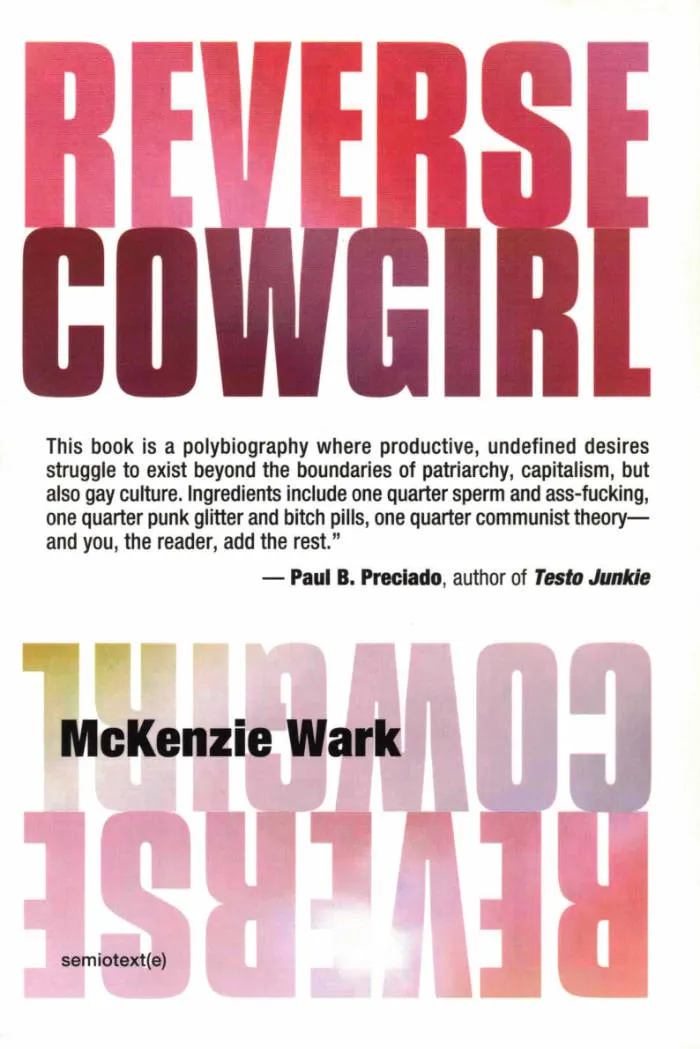
Reverse Cowgirl
McKenzie Wark invents a new genre for another gender: not a memoir but an auto-ethnography of the opacity of the self.
Another genre for another gender.
What if you were trans and didn't know it? What if there were some hole in your life and you didn't even know it was there? What if you went through life not knowing why you only felt at home in your body at peak moments of drugs and sex? What if you expended your days avoiding an absence, a hole in being? Reverse Cowgirl is not exactly a memoir. The author doesn't, in the end, have any answers as to who she really is or was, although maybe she figures out what she could become.
Traveling from Sydney in the 1980s to New York today, Reverse Cowgirl is a comedy of errors, chronicling the author's failed attempts at being gay and at being straight across the shifting political and media landscapes of the late twentieth century. Finding that the established narratives of being transgender don't seem to apply to her, Wark borrows from the genres of autofiction, fictocriticism, and new narrative to create a writing practice that can discover the form of a life outside existing accounts of trans experience: an auto-ethnography of the opacity of the self.

Portrait of the Artist as a Writer
"Portrait of the Artist as a Writer" is a collection of short stories, quotes and drawings about dinosaurs, gay lesbians and how to lose a joke at the lake.
Risoprinted in pumpkin and purple, perfect binding with glue, first edition of 300, Berlin 2022.

Pussy Studies
The discursive pussy of Zoe Tuck’s Pussy Studies is a portal into yearning for a Divinity that is “rich, thick, fecund, and plural.” The study of Pussy Studies is a living series of questions and propositions which leave the trace of their passage in the sensuous medium of the sentence. Written within the context of queer sociality, these linked prose poems have a devotional intertextuality and espouse the belief that, “‘Paradise now’ could be more than a dream some of us had.”

The Refusalist International
The many mass protests that have taken place since 2011 have been characterised by an unmistakable need to challenge, overthrow and destroy the prevailing political representations without proposing new ones. The protests are not concerned with replacing the current government or leader with others, and thus getting a better version of what we already have. Instead, they refuse all leaders, including the most critical opposition leaders: these protests are about dismantling the need for leaders. More and more people are coming to the view that it is not possible to manage the many crises within the framework of the political institutions we have today.
The new protests are political acts that are neither class struggle nor the establishment of an opposition to those in power. Rasmussen argues that we should understand these protests as the emergence of a new kind of revolutionary action that is as much an anthropological as a political transformation: it is an attempt to break free from all the traditional notions of how the social context that we call society and the nation-state is organised.

Listen to the Golden Boomerang Return
Following their book AMANDA PARADISE: Resurrect Extinct Vibration (winner of the PEN and the Ruth Lilly Prize for Poetry), CAConrad's Listen to the Golden Boomerang Return shifts its attention from the previous book’s focus on communing with animals who are extinct toward communicating and caring for animals still living among us.
Recalling the historical and symbolic significance of the boomerang as an instrument of return, these poems emerged from a (soma)tic poetry ritual in which the author wrote with animals who have found ways to thrive in the Anthropocene, resulting in sculptural poems that are uninhibited and mysterious as they emerge organically from the bottom of each page. Guided by the urge “to/desire/the world/as it is/not as/it was,” CAConrad writes from an ecopoetics that is generous and galvanizing, reminding us of how our present attentions collectively shape a future humanity.

Borderlands / La Frontera: The New Mestiza 5th Edition
A new edition of Anzaldúa's classic text.
Borderlands/La Frontera: The New Mestiza is a 1987 semi-autobiographical work by Gloria E. Anzaldúa that examines the Chicano and Latino experience through the lens of issues such as gender, identity, race, and colonialism. Borderlands is considered to be Anzaldúa’s most well-known work and a pioneering piece of Chicana literature.
Rooted in Gloria Anzaldúa's experience as a Chicana, a lesbian, an activist, and a writer, the essays and poems in Borderlands/La Frontera: The New Mestiza profoundly challenged, and continue to challenge, how we think about identity. Borderlands/La Frontera remaps our understanding of what a border' is, presenting it not as a simple divide between here and there, us and them, but as a psychic, social, and cultural terrain that we inhabit, and that inhabits all of us.

Unbidden Tongues #9: Potty Mouth
Unbidden Tongues #9: Potty Mouth is a collection of what could be described as concrete poetry, written over the past two years by our niece Violet Bartley, now aged five. Typed at a computer and sent exclusively via e-mail, the poems stand as clear evidence of a person in the beginnings of grasping (at) language. Throughout, characters are repeated uninterrupted until margins break them, keys pushed down by a finger not yet strong enough to lift itself up.
Over the years, as her written vocabulary grew and these attempts at communication slowly stacked up into the collection printed here, Violet delivered poem after poem within which different mutations of the word ‘poo’ were uttered in type: poo, poobum, bum poo, ipoo, poop. While simple, often illegible and definitely isolated utterances (she never replies when you send a poem back in turn), they are decipherable examples of someone learning defiance through language.

Lava Lines
Lava Lines explores the life forms, contemporary myths and geopolitical powers that shape volcanic landscapes. It gathers poetry, role play's transcription, film scripts and visual works of several artists, to touch on collective memory, non-human agency and myth-making.
The art works presented in the publication are by Leïla Arenou, Francisca Khamis, Naïmé Perrette, Camille Picquot, Rachel Pimm, Francisca Khamis, Juliette Lizotte, Riar Rizaldi and Arif Kornweitz
It also archives live performances/screenings by Francisca Khamis, Arif Kornweitz, Mika Oki, Chooc Ly Tan, Adán Ruiz, Ana Vaz, and Rieko Whitfield.

Yellow Songs 1: Voiced-Voiceless
Fifty years after the fall of Saigon, Dao Strom’s Yellow Songs vibrates with the ramifications and ripples of Empire. Each of the four Yellow Songs books reckons with the intimate consequences of the colonial project, reconfiguring them into complex and lucid, literal and figurative songs of selfhood. Embodied, critical, wholehearted, collective, personal, genre-defying—Yellow Songs renders the brute force of history with tender precision. Art book quality printing in full color with felt paper inserts.
Yellow Songs 1: Voiced-Voiceless unearths, unwinds, un-bodies the violence of stigma, reclaiming the ventriloquized voice of David Bowie's "China Girl” through a lyric-critical essaying (assaying) of cultural tropes, racialized and gendered power plays, and memory.

Bad Language
There is no such thing as a safe word.
In Bad Language, So Mayer blends memoir and manifesto as they explore the politics of speech, while looking at how language has been used – and abused – in their own life. What is the relationship between language and sexual violence? And how can we ‘make ourselves up’ in language when words themselves are encoded by a dominant culture that insists we see ourselves as powerless listeners rather than active speakers?
Examining the semantic traps of their multi-lingual childhood – and taking in texts from the Torah to Grimms’ Fairytales, from protest bust cards to the works of Ursula K. Le Guin – Mayer asks who gets to speak, and who is forced into silence. Bad Language calls out the harm that words can do, while searching for crafty ways through which we can collectively reclaim language for protest and pleasure.
‘Mayer’s writing is generous, astute and sincere; in Bad Language, they choose their words carefully, using incantation and spell to distil a complex argument – the transformative power of language lay in its ability to shape sense perception. For Mayer, the task of ‘making ourselves up’ is another way of asking, what kind of world do we want to live in?’ – Lola Olufemi
SO MAYER is a writer, editor, bookseller and organiser. Truth & Dare, their first collection of speculative fiction, was longlisted for the Republic of Consciousness and Edge Hill Short Story prizes. With Sarah Shin, they co-edited Ursula K. Le Guin, Space Crone, winner of the 2024 Locus Award for non-fiction. Bad Language is their second book for Peninsula, after A Nazi Word for a Nazi Thing.

Pfeil Magazine #18 – Body
From its anatomy and autonomy to its death and diet, this issue focuses on the motif Body and all its meanings, direct and indirect, for instance as in relation to human and non-human bearers of bodies, its inhabitants like bacteria and organs, its social, medical and juridical conditions, its intoxications, chemical processes, traumas, transitions, well-being, replacements, weaknesses, and its opposites.
Contributors: Adam Dickinson, Andrea Éva Győri, A.L. Steiner, Alexandra Ivanciu, Barak Zemer, Bernhard Willhelm, Clara Lena Langenbach, Clémentine Bedos, Constance DeJong, Daisy Hildyard, Fanny Howe, Hanne Loreck, Hasti, Holly Hunter, Ingrid Jäger, Jannis Marwitz, Jess Arndt, Johannes Kuczera, Jolanta Nowaczyk, Henriette Maier, Mag Gabbert, Maja Smrekar, Manuel Vason, R.I.P. Germain, Rebekka Endler, Sonja Yakovleva
Within the format of a magazine, each page of Pfeil represents the floor, walls, or ceiling which together create an imagined room displaying a printed exhibition. Each issue is dedicated to a specific word, and artists are invited and given space to work on and with this term, and to construct or deconstruct the architecture around it. Combined, the contributions transform into an organic display surrounding the leitmotif.

Minor Detail
Minor Detail begins during the summer of 1949, one year after the war that the Palestinians mourn as the Nakba—the catastrophe that led to the displacement and exile of some 700,000 people—and the Israelis celebrate as the War of Independence. Israeli soldiers murder an encampment of Bedouin in the Negev desert, and among their victims they capture a Palestinian teenager and they rape her, kill her, and bury her in the sand.
Many years later, in the near-present day, a young woman in Ramallah tries to uncover some of the details surrounding this particular rape and murder, and becomes fascinated to the point of obsession, not only because of the nature of the crime, but because it was committed exactly twenty-five years to the day before she was born. Adania Shibli masterfully overlays these two translucent narratives of exactly the same length to evoke a present forever haunted by the past.

Fanta For The Ghosts
fanta for the ghosts by Elisabeth Molin
120mm x 210mm
edition of 500
Co-published with OneThousandBooks and Elisabeth Molin

Love, Leda
Newly discovered in the author’s archives and published for the first time in the UK in 2023, this portrait of queer, working class London drifts from coffee shop to house party, in search of the next tryst.
Leda is lost. He spends his days steeped in ennui, watching the hours pass, waiting for the night to arrive. Trysts in the rubble of a bombsite follow hours spent in bed with near strangers, as Leda seeks out intimacy in unlikely places. Semi-homeless and estranged from his family of origin, he relies on the support of his chosen one: a community of older gay men and divorced women who feed and clothe him, gently encouraging him to find a foothold in a society which excludes him at every turn. And then there is Daniel, a buttoned-up man of the Lord, for whom Leda nurses an unrequited obsession—one which sends him spiraling into self-destruction. Pre-dating the British Sexual Offences Act of 1967, Love, Leda was first published in 2023 in the UK. This long lost novel is a portrait of London’s Soho that is now lost, an important document of queer working-class life from a voice long overlooked.

Movement Research Performance Journal
Issue #61 - Dramaturgy
Ligia Lewis, Joshua Lubin-Levy
Theories of dance dramaturgy can be found in a growing body of literature on the field (see our incomplete reading list in this issue). But for Issue #61 of the Movement Research Performance Journal the editors decided stay in the not-knowing by inviting contributions from those whose work touches on dance dramaturgy with curiosity, anxiety, anarchy, as well as a conviction for the intimacy it requires and a resistance to its history of institutional/state authority.
At the heart of the issue is a special section by Contributing Editor Ligia Lewis. Across Lewis’ works there are not only a range of dramaturgs, but the role of dramaturgy shifts and morphs in relationship to the differing works and over time. The reinvention of the dramaturg that Lewis’ work articulates is something that has proliferate throughout the field of contemporary dance. The rest of the issue includes a range of texts, some from practicing dramaturgs, others from to those who have reluctantly accepted this title, and still more who reject the role outright — all exploring a simple question: why has there been an explosion of interest in, perhaps even desire for, dramaturgs in contemporary dance? The explosion I’m thinking of is not about a growing professionalization of dance dramaturgy (though that is certainly happening…). I mean simply that more dance and performance artists are including dramaturgs as part of their process, and at the same time seem to be continually reinventing what the dramaturg is meant to do. What can we make of the desire for the dramaturg as well as the desire to continually reinvent this figure and its function?

Cyclamen
A debut collection from the poet, artist and designer, a suite of unfaithful translations/transversions of works drawn from Baudelaire’s Les Fleurs du mal / Flowers of Evil, a bunch of flowers in decay, pressed and frayed, ‘a flock of pockmarked words.’
Through these creative ‘translations’ of Charles Baudelaire, Alix Chauvet—artist, designer, poet—refuses fidelity in favour of flirtation: her ‘flowers of evil’ line Amsterdam’s canals, drink from the same rainclouds as Rachel Ruysch’s bewitching bouquets, sprout through peat, and are tended by a distinctly feminist and nomadic sensibility. Chauvet—akin to Olive Moore, Sean Bonney and Lisa Robertson—takes the nineteenth-century French decadent as a contemporary accomplice for aesthetic and linguistic misbehaviour. Walter Benjamin once wrote of Baudelaire that he is ‘der geheime Architekt der Moderne,’ and in Chauvet’s hands, those foundations are made porous, unbuilt into cast shadows, into ribbons, into veins streaming across the page. Accompanied by scans of the French poems and Chauvet’s shadow photography, what Cyclamen ultimately offers us is a regenerative rewilding of the English language: a wondrous terrain ringed by vines of unruly syntax and dotted with the fruit of words refusing domestication by any single tongue. — Mia You
Alix Chauvet is a Swiss-French poet and graphic designer based in Amsterdam, taking pleasure in the possibilities of translation. She received her BA in Graphic Design from the Gerrit Rietveld Academie (Amsterdam, 2020), and has since been working independently and in collaboration with contemporary artists. Investigating the relationships between language and body, intimacy and collectivity, past and contemporary, her hybrid practice covers a wide range of visual and linguistic experiments from artist’s book design to experimental translation. Her method is rooted in decelerating the creative process through the use of analogue and unprofitable techniques such as cut-outs, letterpress, linocut, handwriting and painting. Chauvet’s poetic approach follows the same logic, prioritising English over her mother tongue as a way to revise language with both critical detachment and a degree of identification. Her poems have appeared in literary magazines such as Blackbox Manifold, and Cyclamen is her debut collection.

F.R. David - Spin Cycle
F.R.DAVID is a typographical journal, dealing with the organisation of reading and writing in contemporary art practises.
This issue, "Spin Cycle", is concerned with captioning, commentary and description. Edited with Mike Sperlinger.

The Minor Gesture
In this wide-ranging and probing book Erin Manning extends her previous inquiries into the politics of movement to the concept of the minor gesture. The minor gesture, although it may pass almost unperceived, transforms the field of relations. More than a chance variation, less than a volition, it requires rethinking common assumptions about human agency and political action. To embrace the minor gesture's power to fashion relations, its capacity to open new modes of experience and manners of expression, is to challenge the ways in which the neurotypical image of the human devalues alternative ways of being moved by and moving through the world—in particular what Manning terms "autistic perception." Drawing on Deleuze and Guattari's schizoanalysis and Whitehead's speculative pragmatism, Manning's far-reaching analyses range from fashion to depression to the writings of autistics, in each case affirming the neurodiversity of the minor and the alternative politics it gestures toward.
I have been enthralled and held by this book! Erin Manning has given us a new theory of bearing, as well as a new elaboration of gesture, going beyond Balzac’s theory and Agamben’s interpretation of it. She doesn’t lament the loss of gesture but celebrates gesture's minoritization.
- Fred Moten

Dust
Cactus erotica. Dykes taking T erotica. Handmade rope erotica.
Tangentially alien erotica. Clit long like laffy taffy erotica. Death erotica.
In L.A. Warman's anti-sequel to her award-winning debut Whore Foods, two anonymous lovers traverse the vast and lonely desert which has blighted most of the continent. In their possession is the gift of the Vapors, a mystical substance which allows them to transcend death. Yet as they explore the desert realm and each other, they cannot help but wonder if their entwined destiny resides somewhere beyond transcendence.
LA Warman is a poet, performer, and teacher currently based in New York City. Warman is the author of Whore Foods, an erotic novella which recieved a Lambda Literary Award in 2020. She is the founder of Warman School, a non-accredited and body based learning center. The Warman School has taught over 500 students online and in person. She teaches topics such as erotics, death, depression, and god. Pitchfork named her piece ADMSDP one of the top 100 songs of 2020. She has had performance and installation work in shows at MOCA Cleveland, ICA Philadelphia, Time-Based Art Festival, Poetry Project, and Open Engagement. Warman has presented performative poetics research at Brown University, Hamilton College, Reed College, Hampshire College, and others. She is a founding organizer of the Free Ashley Now survivor defense campaign.
"This book is an instant waypoint on my return to the revelation: if nothing else, my tears have a place where they belong—mixed into the dust of others." — Wilmer Wilson IV

Toward a Transindividual Self (2nd edition)
A book that examines the process of performing the self, distinctive for the formation of the self in Western neoliberal societies in the 21st century. It approaches the self from a transdisciplinary angle where political and cultural anthropology, performance studies and dramaturgy intersect.
Starting from their concern with the crisis of the social, which coincides with the rise of individualism, Vujanović and Cvejić critically untangle individualist modes of performing the self, such as possessive, aesthetic, and autopoietic individualisms. However, their critique does not make for an argument for collectivism as a socially more viable alternative to individualism. Instead, it confronts them with the more fundamental problem of ontogenesis: how is that which distinguishes me as an individual formed in the first place? This question marks a turning point in the study, where it steps back into the process of individuation, prior to, and in excess of, the individual.
The process of individuation, however, encompasses biological, social, and technological conditions of becoming whose real potential is transindividual, or more specifically, social transformation. A ‘theater of individuation’ (Gilbert Simondon) captures the dramaturgical stroke by which the authors investigate social relations (like solidarity and de-alienation) in which the self actualizes its transindividual dimension. This epistemic intervention into ontogenesis allows them to expand the horizon of transindividuation in an array of tangible social, aesthetic and political acts and practices. As with every horizon, the transindividual may not be closely at hand; however, it is certainly within reach, and the book encourages the reader to approach it.
"Towards a Transindividual Self is an ambitious and capacious effort to theorize a new way to approach collectivity for political purposes through the lens of performance. Convinced that the current neoliberal conjuncture has only heightened a form of capitalist individualism that blocks notions of the social, the authors aim to show that a "transindividual formation of the self can bring about different courses of action and a more socially driven imagination." Transindividuation, they assure us, shows how "we form ourselves on the basis of interdependence, sharing, commonality, as well as indispensability of the individual as the agent of creativity/ knowledge, freedom, and change, who 'possibilizes' their own conditions of formation."
— Professor Janelle Reinelt (University of Warwick), co-editor of Critical Theory and Performance (University of Michigan, 2006)
"Perhaps the most striking thing about this book is the manner in which it is able to engage with multiple discourses from political theory to aesthetics. In this way it both follows the ambitious scope of Simondon’s work on individuation, and expands into areas that Simondon did not cover, most notably politics and cultural politics, which is the book’s central concern. Rather than ask the question is the individual imagined or real, an effect of social relations or their distortion, the focus on the transindividual makes it possible to grasp individuation as a process: “Instead of pondering how the passage from one to many occurs, individuation permits us to immediately trace a bidimensional process in which both individual persons and the collectivities they form are altered. Another meaning of the crisis of the social has brought about a perfect slogan of such a process of transindividuation: ‘No one will be left alone in the crisis.” (…) Towards a Transindividual Self does a brilliant job of not only arguing for the importance and relevance for the transindividual as a concept for politics, performance, and the politics of performance, but of demonstrating a bold standard for political and aesthetic inquiry."
— Professor Jason Read (University of Maine), author of The Politics of Transindividuality (Brill, 2015)
Co-published by Oslo National Academy of the Arts, Sarma and Multimedijalni institut.

Installation Views
Conceived as a visual résumé, Installation Views provides both a comprehensive overview of Charlotte Posenenske's solo exhibitions and a record of her numerous group shows.
In her Manifesto, Charlotte Posenenske stated: "I find it difficult to come to terms with the fact that art can contribute nothing to the solution of pressing social problems."
Developing her artistic practice throughout the 1960s, Posenenske produced a body of work that uniquely combined several strands of the art of the period: conceptualism, minimalism, and socially engaged participatory art. Her Manifesto, published in Art International in May 1968, lays out the social demands on art as well as the impossibility of fulfilling those demands. Shortly after its publication, Posenenske left the art world behind to pursue her studies in sociology, undertaking a new career in that field.
Conceived as a visual résumé, Installation Views provides both a comprehensive overview of Charlotte Posenenske's solo exhibitions and a record of her numerous group shows. The book features an essay written by curator Erlend Hammer on the role of documentary photographs in the circulation of works of art.
The book was published in conjunction with the eponymous show at the Haugar Art Museum in Tønsberg, Norway—the first full-scale presentation of the artist's oeuvre in Scandinavia. The exhibition showcased works from all the artist's major series of modular sculpture. Consisting of works made over the course of less than 12 months, between 1967 and 1968, preceding the abrupt end to Posenenske's career as an artist, the exhibition had the character of a snapshot. We are left wondering whether her withdrawal from the art world was a logical or necessary consequence of the development of the series. What are we to do with Posenenske's assertion that art is powerless to effectively change society for the better?