Books
Books
in random order

Hortus
The Hortus project is an open investigation into the nature of seemingly common objects through 'Floriography', urban gardens, and the history of female rights. Hortus was inspired by urban gardens in West Amsterdam and created with its plants by Lilia Luganskaia.
Joanna Cresswell about the 'Hortus':
History teaches us that a language of flowers can communicate endless things about the culture in which it emerged, and herein lies Lilia Luganskaia's interest. Taking inspiration from the world of 19th Century sentimental flower books, Hortus presents itself as a set of notes towards a modern handbook for contemporary floriography, considering what the discipline might look like today. By collecting common flora across one year in the urban gardens around her home in Amsterdam and cross-referencing their meanings with publications from the past, Luganskaia reflects on their natures, their roles, and the symbolic familiarity they might hold for the communities living with them. A female artist and reader of the twenty-first century, she seeks out the essence of modern life through her lens, and through flowers, just like the women who came before her.
Lilia Luganskaia (1990) Russian - Dutch multidisciplinary artist and author, based in Amsterdam. In her artistic practice, Lilia uses her background in documentary techniques to focus on what she calls ‘investigating reality’. Her practice is research-based, Lilia decodes abstract notions such as love, tourism, bureaucracy, politics, and feminism through the use of constructed images, sculptures, videos, and installations. One of the key elements of her work is to understand multiple aspects of the photographic image.

Thora
It’s 2009 and summer is encroaching on the town of Bellingen when Rhiannon is forced to move from her local high school to one in Coffs Harbour. Initially reluctant to leave behind her best friend Ellie, she quickly finds herself infatuated with the enigmatic Vanora. It’s only on befriending her, does she discover that like her, Vanora is a girl whose home life is shrouded in a web of secrets. Secrets that relate to her mother.
Set in the verdant Mid North Coast of New South Wales, Australia, Thora deals with family dysfunction, emancipation through friendship, and how girlhood is affected by the isolation of the country and the solace of nature.
Tilly Lawless is a queer, Sydney-based sex worker and writer. Her debut title Nothing But My Body was published in 2021.
Cover art by Rufus Shakespeare

This Is Not a Memoir
What do you call a memoir that isn’t? In This Is Not a Memoir, Janette Parris incisively narrates a journey through lost high street landmarks of East and South London in a series of detailed artworks blending map, archive and anecdote with deadpan humour. Part graphic novel, part recollection, and accompanied by an in-conversation between Janette Parris and Gilane Tawadros, this is an intimate exploration of what it means to have ownership of public space, from Wimpy to Woolworth’s via Canning Town. And somewhere in the gaps, in absent moments caught gazing at the sky or a kerbside, an impression of a life emerges–or is that just what she wants you to think?
“This book by Janette Parris tells a deflationary yet expressive coming-of-age story in the East End of London. While it may seem fun and superficial, its considerable power lies in how it moves through memories and moments in a witty and light-footed way presented as a roman-à-clef. This Is Not a Memoir is particular in the way it conjures a world of the 1970s and 1980s that is lost to most of London, yet still resonates with what it means to grow up as a working class young woman who ends up at art school and becomes an artist. It is a brave book to make, but one that will be remembered.”
— Rachel Garfield, artist, Professor of Fine Art at the Royal College of Art and author of Experimental Filmmaking and Punk: Feminist Audio Visual Culture in the 1970s and 1980s (2021)
Janette Parris is an artist who investigates the contemporary urban experience, using narrative, humour and popular formats including soap opera, stand-up comedy, musical theatre, pop mu-sic, cartoons, comics and animation. Parris has exhibited widely nationally and internationally for 25 years at spaces including TATE, The New Art Gallery Walsall, ICA, Kunsthaus Zürich, Hay-ward Gallery Touring, Art on the Underground and Royal Academy of Arts.

Antilogy
Drawing from notions of "bad poetry" as the critical undoing of normative taste, Antilogy brings together works by the Brazilian artist and poet Alex Hamburger.
Central to Hamburger's practice and engagement with poetry is a focus on writing as the expression of a performative disruption and playful reworking of semiotic systems. With references to Fluxus intermediality, Brazilian concretism, experimental music, and sound poetry, Hamburger's work dynamically collapses the distinctions between fact and fiction, theory and performance, system and noise. From visual poems to abstract narrative to personal fantasy, Antilogy reminds us about the potent sense of refusal and experimentation that all art should carry.
Alex Hamburger was born in Belgrade, Serbia, in 1948. From the 80s onward his researches and proposals turned to the possibilities of fusion and intertwining of languages, developing works in Verbal, Visual and Sound Poetry, Object-Poem, Artist's books, Installation, Performance art, etc. He has published seven books in various poetical genres, three CDs of Sound Poetry and has performed several performance pieces, some in partnership with the visual artist Marcia X, with whom he established a fruitful relationship throughout the 80s, contributing decisively for a better understanding and acceptance of the above practices in the local art circuit of Rio de Janeiro. His work is held in the collections of contemporary art institutions, in Brazil and abroad, including The Museum of Modern Art, RJ, The Museum of Modern Art, SP, Printed Matter Bookstore, New York, Compendium of Contemporary Fine Prints, Hamburg, ICA, London among others. Alex Hamburger continues to live and work in Rio de Janeiro, Brazil.

F.R. David - With Love
F.R.DAVID is a typographical journal, dealing with the organisation of reading and writing in contemporary art practises.
“With Love,” takes correspondence and calligraphy—or letter-writing—as model for information theory, and adaptive, cybernetic relations.

Histoire de la séparation
Pour les révolutionnaires des deux derniers siècles, l’accumulation du capital devait unifier la classe ouvrière sous la bannière du sujet révolutionnaire. Le mouvement ainsi né était appelé à renverser la société de classes et les clivages divisant les prolétaires. Mais le mouvement de la valeur a finalement triomphé, pour donner naissance à la société de la séparation. L’atomisation a pris le pas sur les puissances du rassemblement. La civilisation du capital traverse aujourd’hui une crise sans fin, mais les forces capables de la défaire brillent par leur absence.
Ces textes tirés de la revue Endnotes, réunis pour la première fois en français, dessinent la carte d’un présent ponctué de paysages désindustrialisés, de centres logistiques et de bidonvilles où s’entassent les populations rejetées aux marges de l’accumulation – autant de coordonnées nécessaires pour continuer à penser le dépassement du capitalisme : une fois encore, reprendre le chantier de l’hypothèse communiste.
Endnotes est une revue théorique communiste produite par un groupe de discussion du même nom basé en Grande-Bretagne et aux États-Unis.
Traduction: Pablo Arnaud
Préface: Aaron Benanav Et John Clegg

HUH why didn't I know this?
“Sometimes I find myself explaining to someone at 2 a.m. what a subsidy is. Or how train tickets become cheaper if you have the increased allowance – and what that is exactly. Or in which months you should email a cultural centre if you want to sell a performance. Then those people often say: “Huh, why didn’t I know this?” And: ‘Why isn’t all this just explained somewhere in simple words?’
So I started writing it myself. Because I had to figure these things out myself as a new creator, I can speak from experience. I know better than Kunstenpunt or Cultuurloket what a starting creator struggles with, because I’ve only been doing this for a few years myself. I can explain it better because some things in practice are quite different from the theory.”
Egon Schoelynck (he/him, 1996) is a Sunday child and theatre maker. His work is political-ish and can be found in black boxes, on paving stones and in collective collaborations. His artistic practice was supported by detheatermaker (’22-’25), where he explored, among other things, how to run a soap opera in a café without actors. Together with Runa Robbroeckx and Lennert De Vroey, he created KAK, an ecological shitshow (2025). He also solves global problems with punk songs and children’s instruments, under the name Middle Class Babypunk.

Parapraxis 06: Resistance
In 1911, Sigmund Freud addressed his followers gathered at Nuremberg, where he restated the import of his practice: “the task of psychoanalysis lies not at all in the discovering of complexes, but in the dissolving of resistances.” A formal antipode to political resistance, psychoanalytic resistance dams up desire and obstructs traumatic knowledge. It is conservative, allergic to change, and aims for the kind of frictionless normativity against which the unconscious drives rail. Meanwhile, we associate political resistance with change itself, with a blockade that pushes for revolution—rather than a blockage that censors its very possibility. If we read Freud as urging his followers to help their patients move through their resistance, psychoanalysis is a project on the side of material and political reality by bringing patients out of isolation and into social struggles. However, psychoanalysis is often glossed in reverse: as a project of isolated relief for the stubborn individual.
Should psychoanalysis only succeed at rendering patients compliant in their cure? Is psychoanalysis a tool for nullifying political resistance? If so, Freud’s edict for the aim of psychoanalysis is now but an epitaph. It would be easy, then, to give up the ghost, to let psychoanalysis go. But why should psychoanalysis retreat from collective symptoms back into the consulting room for individual treatment—away from strikes, riots, and uprisings, and toward complacency and normativity, if not quite literally marriage and babies? Why should the clinic not dare to be in and of the world?
Feeling restless. Hunger tactics. Laughing in the face of fascism. Breaking through. Diagnosing revolution. Madness in the Maghreb. Essays by Fady Joudah, Jamieson Webster, Dylan Saba, Yasmin El-Rifae, Ussama Makdisi, Mary Turfah, Hannah Proctor, and more.
In Memory of Joshua Clover (1962-2025).

Exophony
Yoko Tawada, Lisa Hofmann-Kuroda
Yoko Tawada's first essay collection in English presents and electrifying new side of the National Book Award-winner as she dives deep into her lifelong fascination with cross-hybridizing languages. The accent here, as in her fiction, is on the art of drawing closer to the world through defamiliarization. Tawada famously writes in both Japanese and German, but her interest in language reached beyond any mere dichotomy.
The term "exophonic," which she first heard in Senegal, has a special allure for the author: "I was already familiar with similar terms. 'immigrant literature,' or 'creole literature,' but 'exophonic' had a much broader meaning, referring to the general experience of existing outside of one's mother tongue." Exophony opens a new vista into Yoko Tawada's world and delivers more of her signature erudite wit—at once cross-grained and generous, laser-focused and multidimensional, slyly ironic and warmly companionable.
A New Yorker Best Book of 2025. Translated from Japanese by Lisa Hofmann-Kuroda.

Répondeur
Slow Reading Club (SRC) is a semi-fictional reading group initiated and run by Bryana Fritz and Henry Andersen. Since 2016, in numerous contexts, they have rehearsed alternatives to the kinds of reading they were taught in school, actively suppressing semantic content through strobe lights, strange postures, sociality, and toxins. Operating at the contact zones between reader and text, text and text, reader and reader, they attempt to build a practice from within the unstable space of reading itself.
Répondeur is an extensive account of SRC’s practice in collective reading sessions, exhibitions, and textual bootlegging. Imagined as a scroll, with a rhyme structure and typesetting by Will Holder, the book brings together facsimiles of SRC readers, a wide-ranging interview by Alicja Melzacka, new texts by Joyelle McSweeney and Bill Dietz, and visual work and translations by SRC. These discrete elements are interwoven into a complex, shimmering whole, delighting in the ruptures and elisions of one text’s move into the next.

Lákíríboto
A twisty thriller about the fate of a sprawling family in Lagos, Lakiriboto is a queer, feminist revenge thriller like no other, in which murder, betrayal, and witchcraft collide – with explosive results.
When her grandmother dies in the night, Moremi’s fate falls to her uncle, the grasping family chief who sends her off to work as a housemaid in Lagos. On arriving there, Moremi finds that the big city is not all she thought it would be. But she’s not alone. After another family death, Kudirat, accused of bringing misfortune to her close family, has also been sent to live as a maid in the same house, scrubbing floors and folding laundry for long-suffering Tola, whose abusive doctor husband refuses to treat. Together, with the help of her queer aunt Morieba, the four women must wrestle back control of their lives as the patriarchal traditions that govern the family push back against their freedoms. When Tola’s condition worsens, someone new emerges, someone with revenge and redemption in mind.
Mixing family saga, mobster pulp, and queer coming-of age, Lakiriboto is a staggeringly original and surprising novel about Nigeria’s queer and feminist communities, the struggles they face, and the lengths they will go to to overcome them.

Tripwire 16 - Performance/Writing
A special issue focused on performance writing, with work by Tanya Lukin Linklater (with Michael Nardone), Jibade-Khalil Huffman & Simone White, Jean-Thomas Tremblay, Claudina Domingo (trans. Ryan Greene), Kim Rosenfield, Nathan Walker, Liz Knox, Rona Lorimer, Léo Richard, & Hector Uniacke, Mohamed A. Gawad & Dalia Neis, Mei-mei Berssenbrugge & Teddy Yoshikami, interviewed by Michelle N. Huang, Kyoo Lee and Jocelyn Saidenberg, Adriana Garriga-López, Gabrielle Civil, plus a Kevin Killian Tribute, with Eileen Myles * Scott Hewicker * Cliff Hengst * Karla Milosevich * Craig Goodman * Michelle Rollman * Anne McGuire * Wayne Smith * Tanya Hollis * Steve Orth * Lindsey Boldt * Maxe Crandall * Arnold J. Kemp * Carla Harryman, Lee Ann Brown & Tony Torn * Susan Gevirtz * Laynie Browne * Patrick Durgin * Norma Cole * Jo Giardini. & reviews: Jessica Lopez Lyman & Jocelyn E. Marshall on Gabrielle Civil, alex cruse on Merce Cunningham, Rob Stanton on Anne Boyer, Jack Chelgren on Miyó Vestrini, David Grundy on Stephen Jonas, Virginia Konchan on Sarah Vap.

The Joy of Electronic Music
This book is for people who love electronic music, people who probably have a synthesizer or two at home. It’s for people who tell themselves that they should find some time for their passion, who blame themselves for not making enough music. This book is for them.
For decades, I thought that I could be a music producer. But over the years, I have discovered that my contribution to the electronic scene wasn’t exactly the music itself. Although I was lucky enough to produce a few successful tracks in Lithuania, back in the ‘90s, my actual achievement turned out to be raising interest in electronic music, for other young people. I’m still surprised when someone remembers my old tracks, but I’m very proud when someone tells me that listening to me speak on the radio about Berlin techno changed their dreams back in the day. Later, in the 2000s, I was part of the early SoundCloud team. The code we wrote has touched hundreds of millions people around the world. No track or song I would have ever produced would have had such an effect. There is a reason that Brian Eno says the evolution of music is moved by technology as much as it is by artists. The people who created Logic and Ableton, those who code SoundCloud and Spotify, design Korg and Roland synths, they influence the course of music on a massive scale. The development of music technology is the work of many people and I’m happy to call myself one of that gang.
This book is a natural extension of those ideas. It’s not based on scientific or journalistic research, but it’s not a biography, either. I imagine this book sitting on a studio desk, or in a gig bag. In the process, I hope that some young music creators will find answers here, and inspirations, to the questions they’ve been wrestling with for a long time.

Ding Dong Bell
Ding Dong Bell is an invitation to cross the threshold into a world that belongs not only to the imagination, but also to the concrete possibility of a different way of inhabiting reality. In this space, details weave together landscapes and reveal characters, hinting at unexpected encounters in a continuous search for shapes and textures, in a chromatic immersion and a sequence of perspectives on a syncretic and archaic world, on an alchemical pictorial practice, where the complex figurative iconography of living beings and cosmic constellations is progressively enriched with tonal stratifications and semantic density.
The collection of paintings outlines universes in which plants, animals, human beings, and subtle presences coexist outside any pre-established hierarchy. The forms cross each other lymphatically and transform without ever being fully accomplished, metamorphically generating a visual ecosystem based on the continuous exchange of substances and the visceral mixture of matter. In this fluid chorus, everything is constantly redefined in the process of becoming, yet without losing its identity. What emerges is a symbolic horizon that becomes a universal hope: an invitation to living beings, witnesses of contemporaneity, to cultivate mutual respect and nurture a providential alliance, where the different planes of existence vibrate in resonance.
The titles of the works, inspired by traditional English nursery rhymes, and the accompanying texts take the form of ancient and surreal chants, capable of evoking both the childhood of the world and its possible future. Their language, closer to illuminated manuscripts than to linear narration, constructs a vivid imaginary world in which whirlwinds and impulses evoke the idea of original totality: at the end of this long succession of worlds, everything seems to tend towards a single, shared substance of being.
Barbara Cammarata (born in 1977) lives and works in Catania (Sicily).

A Series Of Attempts #3: Loving Women aka Le Poney
"We didn’t have anything & we hadn’t seen much. So, naturally we understood less & felt owed something. We weren’t entirely wrong, though. It was 2011."
Part archival remix, part recruitment manual, this pamphlet’s cast of BAD HORSEY GIRLS will teach you how to neigh, dance and flirt until the vampires come home. A Series of Attempts #3 opens with Jordan/_Hell’s new manifesto ☆ LOVING WOMEN ★, that takes the Nomadic Sisters 1976 publication by the same name as a departure point. From here, ★ LE PONEY ☆ then follows a string of lesbian ponies through a dimensional split. A dimensional split that looks suspiciously like the L.A./Parisian+ queer scene… (͠≖~≖ ͡ )
About the author:
Jordan/_ Hell is a Black trans(2s) artist, writer, & scholar. Hell is the author of CONSTANT VIOLINS (Arcadia Missa, 2021) & AUTOLINGO DIDACTICA (Monitor Press, 2023), amount others. Hell’s writing has been internationally published in multiple languages in press, interdisciplinary projects, & exhibitions by Kunstverein Grafschaft Bentheim (DE), Arcadia Missa Gallery & Publishing (UK), Monitor Books (UK), Real Review (UK), Soft Opening (UK), Mousse Magazine (DE), 032c (DE), Rosie’s Disobedient Press (UK), Sticky Fingers Publishing (UK), The Bittersweet Review (UK), Pratt Institute’s The Felt (US), & others. Hell studied at Hochschule für Bildende Künste–Städelschule (DE) & Cooper Union School of Art (US). Currently, Hell is a doctoral candidate in the School of the Arts at Queen Mary University of London.

Diversity of Aesthetics
Jose Rosales, Andreas Petrossiants
Critical conversations and reflections about lessons learned at the intersection of social movements and artist production.
Diversity of Aesthetics collects powerful and timely conversations among leading cultural critics, artists, and organizers to connect the threads between some of the most pressing social struggles and conflicts of our time: policing, war, borders and migration, economic crisis.
Across three themes—infrastructure, migration, and riots—militant thinkers, artists, educators, and others discuss aesthetic production, forms of social organization, modes of struggle against gendered and racialized capitalism, and revolutionary theory. Common to all three conversations is a commitment to rethinking the relationship between forms of critique and forms of struggle undertaken by collective social practices, offering lessons for tactics, strategies, and practices.
With contributions by Claire Fontaine, Iman Ganji, Saidiya Hartman, Vicky Osterweil, Andreas Petrossiants, Christina Sharpe, Stevphen Shukaitis, Michael Rakowtiz, Shellyne Rodriguez, Jose Rosales, Rinaldo Walcott, Andreas Petrossiants, Jose Rosales
Andreas Petrossiants is a writer and associate editor of e-flux journal. His work has appeared in Historical Materialism, Social Text, New Inquiry, AJ+ Subtext, Frieze, Bookforum.com, Roar Magazine, the Verso blog, the Brooklyn Rail, Hyperallergic. He is a PhD candidate in performance studies at NYU where he is researching anti-eviction, squatting, and tenants’ movements as they relate to the production of social space.
Jose Rosales is an independent researcher and journalist based in Lisbon, Portugal. His work has appeared in e-flux notes, Lumpen: A Journal of Poor and Working Class Writers, and has contributed a chapter called “Communism As the Riddle Posed to History” in Double Binds of Neoliberalism (2022).

Nightwood
Nightwood, Djuna Barnes' strange and sinuous tour de force, "belongs to that small class of books that somehow reflect a time or an epoch" (Times Literary Supplement). That time is the period between the two World Wars, and Barnes' novel unfolds in the decadent shadows of Europe's great cities, Paris, Berlin, and Vienna—a world in which the boundaries of class, religion, and sexuality are bold but surprisingly porous.
The outsized characters who inhabit this world are some of the most memorable in all of fiction—there is Guido Volkbein, the Wandering Jew and son of a self-proclaimed baron; Robin Vote, the American expatriate who marries him and then engages in a series of affairs, first with Nora Flood and then with Jenny Petherbridge, driving all of her lovers to distraction with her passion for wandering alone in the night; and there is Dr. Matthew-Mighty-Grain-of-Salt-Dante-O'Connor, a transvestite and ostensible gynecologist, whose digressive speeches brim with fury, keen insights, and surprising allusions. Barnes' depiction of these characters and their relationships (Nora says, "A man is another persona woman is yourself, caught as you turn in panic; on her mouth you kiss your own") has made the novel a landmark of feminist and lesbian literature.

Marlie Mul
Marlie Mul (b. 1980 in Utrecht, the Netherlands; lives and works in Brussels) is characterized by a strong material awareness, spatial thinking, and an ongoing engagement with conditions of labor, systems of value, and forms of collectivity. Her practice foregrounds a sustained interest in sculptural concerns, direct engagement with materials, and processes of layering, transformation, meaning and re-meaning across multiple levels of articulation. Central to this is a continuous process of familiarizing herself and working with new materials and practices, which are repeatedly extracted from their conventional contexts and expanded into new bodies of work. These are, in turn, accompanied and reframed by other materials as well as by more social formats of production and presentation.
The first comprehensive monograph on Marlie Mul’s work is published on the occasion of her solo exhibition Das Budget (2025) at Kunsthaus Glarus. It offers a comprehensive chronological overview of key bodies of work from the early 2000s to the present and, through a richly illustrated index, unfolds a complex structure of contexts, collaborations, and modes of production. The publication includes new contributions by Annie Goodner, Lili Reynaud-Dewar and Frank Wasser, a dialogue between the artist and the editor, as well as numerous reprints of texts that have accompanied Mul’s work over the years, including writings by the artist herself.

Fous Moi La Paix
Goswell Road presents Fous Moi La Paix a book of drawings by multidisciplinary artist Vava Dudu. Vava made 37 exclusive drawings for the publication, which launched at Paris Ass Book Fair 2024 at Palais de Tokyo. The drawings are offset with her texts, poems and several images of her iconic clothing and accessories.
"The multidisciplinary artist Vava Dudu refuses to follow convention: she draws and writes poetry, makes clothes and accessories, and builds furniture and guitars. She asserts her position as an outsider in contemporary art by stating that she “prefers extremes to the middle ground.” Her work as an independent stylist goes hand in hand with her activity as a singer in La Chatte, an electro-zouk punk new wave band founded in 2013 with Stéphane Argillet and Nicolas Jorio, aka “Nikolu.” Her underground artistic world, which joyously combines text and image, is expressed through various media.
Vava Dudu was born in 1970 in Paris, where she lives and works."
Text from Lafayette Anticipations website
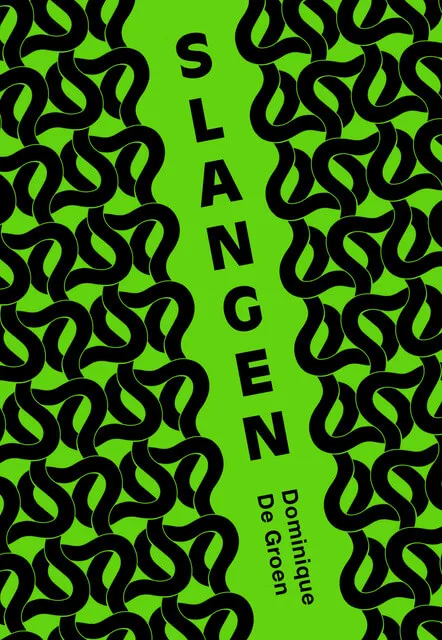
Slangen
Slangen krioelen in de sarcofaag van het heden, in de krochten van de popcultuur, in de mummie van de natuur, in wondes en rot vlees, in artificiële woestijnen en op geoliede dad bods. Ze wentelen zich rond beursgrafieken, raken verstrengeld met wurgende algoritmes, orkestreren een trage ondergrondse revolutie. Een meisje snijdt zich aan een nepdiamanten piramide en werpt haar slangenvel van zich af.
Dominique De Groen is schrijver en beeldend kunstenaar. Ze publiceerde de dichtbundels Shop Girl (2017), Sticky Drama (2019) en offerlam (2020). Ze werd genomineerd voor de Poëziedebuutprijs Aan Zee 2018, de Herman de Coninckprijs 2020 en de Fintroliteratuurprijs 2021 en won de Frans Vogel Poëzieprijs 2019 en de Fintropublieksprijs 2021.

Fuel
Traversing multivalent intimacies from the underworld of California’s Central Valley oil fields to the quotidian domestic and love’s painful retraction, Stockton’s poems articulate the blurry modes of extraction, fantasy, loss, gender, and labor as they interact and overlap in the shadow of environmental and personal collapse. Between gas station gifts, Venmo requests, and nocturnal love letters, Fuel unravels the self and violent systems of domination, longing for a togetherness that transcends its own ending.
In these poems, Stockton plunges into petrologic, long drives, the beginnings of ends—whatever enters into love between people and makes it so abstract, or common. In other words, its great subject is the edge, and Fuel is a book of horizons. - Benjamin Krusling
Rosie Stockton is the author of Permanent Volta (Nightboat Books 2021) which was the recipient of the Sawtooth Prize as well as being a finalist for the California Book Awards in Poetry and the Publishing Triangle’s Audre Lorde Award for Lesbian Poetry. Their poems have been published by Social Text Journal, VOLT, Jubilat, Apogee, Mask Magazine, Tripwire and WONDER PRESS. They hold an M.A. in Creative Writing from Eastern Michigan University and are currently a Ph.D. Candidate in the Gender Studies Department at UCLA. Rosie lives and works in Los Angeles.

Troubling the Stage – The Choreographic Work of Marlene Monteiro Freitas
Five dance pieces and an iconographic imaginary in convulsion: making the most of these ingredients, Alexandra Balona engages with the work of Cabo Verdean choreographer and dancer Marlene Monteiro Freitas.
This book offers a lens onto the dazzling oeuvre of a choreographer whose boldness shakes the foundations of every theater she enters. It centers on five emblematic works: Guintche (2010), Paradise—Private Collection (2012), Jaguar (2015), Bacchae—Prelude to a Purge (2017), and Mal—Embriaguez Divina (2020). It follows Monteiro Freitas's creative methodology, weaving references from her personal archive together with works from art history, navigating between ideas and possibilities in the manner of an atlas bearing the weight of the world. From wonder emerges a mode of attentive reading; one capable of observing and, out of fragments, revealing the methods, processes, and mechanisms of art. The texts in this book are "small critical machines for reading the unreadable."
Troubling the Stage: The Choreographic Work of Marlene Monteiro Freitas is both a study and an encounter; a powerful crossing of choreography with critical thought. It invites readers, scholars, and audiences alike to experience the intensity, violence, joy, and humanity of one of today's most uncompromising choreographic voices.

And so on, a single universe
A collection of Pauline Julier’s art that expands from the terrestrial to the cosmos to comment on our place in the universe.
At the interface of documentary and fiction, the multimedia works collected in Pauline Julier take us on a dizzying journey through space and time. Julier’s art travels through the geological ages of planet Earth, through different histories, natural disasters, and the Anthropocene’s paradigm shifts and into outer space. Her background in political science and photography is reflected in her work: looking into the past and the future, she investigates topical questions about our unlimited use of natural resources, escapism, and the colonization of space.
Conceived and designed as a work of art in its own right, this volume offers a comprehensive insight into Julier’s art and thought through a conversation with eminent scholar of science and technology studies Donna Haraway alongside contributions by curator Céline Eidenbenz, anthropologist, and writer Nastassja Martin, and art historian, curator, and author Chus Martínez.
Edited by Céline Eidenbenz and Sarah Mühlebach.
With Contributions by Donna Haraway, Pauline Julier, Nastassja Martin, and Chus Martínez.

Moon Mirrored Indivisible
Multilayered lyric poems that resist systems of power and foster intimacy.
An inheritor of lineages marked by colonial and gendered violence, Farid Matuk approaches the musical capacities of verse not as mere excitation or decoration, but as forms that reclaim pleasure and presence. Entering the sonic constellations of Moon Mirrored Indivisible, the reader finds relief from nesting layers of containment that systems of power impose on our bodies and imaginations. In this hall of historical mirrors, fictions of identity are refracted, reflected, and multiplied into a vast field of possibilities. Matuk’s meditations on place and power offer experiments in self-understanding, moving through expansive conversations between a lyric “I” and others, including poets, the speaker’s partner, ancestors, and the reader, and creating spaces for strange intimacy. Each of the book’s four sections of poems builds on the other to ask how we might form a collective—a people—not founded in orthodoxies of originality but in the mutual work of mirroring one another.