Books
Books
in random order

MW Collected Texts (Bootleg)
This bootleg edition collects scanned copies of Monique Wittig's writing. It includes; The Lesbian Body, Les Guérillères, The Opoponax, and Lesbian Peoples: material for a dictionary— In true bootleg style, punk enough to carry the truly radical words of Wittig: scans, a little grainy, with marginalia of unknown origins. Now, we can dress ourselves in the ravishingly erotic, violent splendorous brilliance to become baby Wittigs.
This edition was assembled out of a deep love of Wittig's work by Chloe Chignell.
Monique Wittig was a French author and feminist theorist particularly interested in overcoming gender and the heterosexual contract. She published her first novel, L'opoponax, in 1964. Her second novel, Les Guérillères (1969), was a landmark in lesbian feminism.

The fruitfull sence
Titus Lucretius Carus, Lucy Hutchinson
The fruitfull sence is an excerpt from Lucretius’s masterwork De rerum natura, in which the poet marvels at the sensory world. Optical illusions, the drift of smell, the juicy mechanics of taste. All animated by Lucy Hutchinson’s gorgeous 1640 translation, which renders the original Latin into bouncy English pentameter. The first publication in our new series, Sensory Dispatches.

Portrait of the Artist as a Writer
"Portrait of the Artist as a Writer" is a collection of short stories, quotes and drawings about dinosaurs, gay lesbians and how to lose a joke at the lake.
Risoprinted in pumpkin and purple, perfect binding with glue, first edition of 300, Berlin 2022.

Estonian Academy of Arts / EKA GD MA
to flaunt, really
“… Ever since its inception as a profession, graphic design has exhibited its necessity to make information public. Its urge to expand and to reproduce reflects its capitalist inheritance. This desire however isn’t always shared by all stories molded and articulated by the discipline.
Publishing is preceded by a series of labours, but the act itself consists just of a very instant. It is one loud shriek from the top of a hill. A toppling-over. From then on a story will tumble downhill—distribute and disseminate. However that happens, and who it reaches is an unpredictable process. Thereafter publishing enables, and sets in motion, all its future readings and retellings.
Wondering the many contradictory sensibilities contained in this process, we attempt to grasp their whys, their hows and their ifs. The following essays— written by Sunny Lei, Haron Barashed, Agathe Mathel, Alina Scharnhorst, Villem Sarapuu, Gal Šnajder, Seppe-Hazel Laeremans, Fernanda Saval and Eva Claycomb—stretch and curl in between these various registers of opening up and closing in.
Unraveling the movements, strategies, forms and intentions of publishing, this book attempts to unfold their utterances, platforms, languidities, reinterpretations, identities, tactilities, ambiguities, characters and audiences.”
—from the introduction by Seppe-Hazel Laeremans and Agathe Mathel.

Country Lesbians
A bootleg of the first edition of Country Lesbians, published by WomanShare Books in 1976. It was printed in the context of a 2024 exhibition at Shmorévaz, a Paris-based independent art space, dedicated to the WomanShare collective, taking the book as its starting point, and borrowing its title.
WomanShare Collective is Sue Deevy, Billie Miracle, Nelly Kaufer, Carol Newhouse and Dian Wagner.
Co-published by Ness Books and Shmooks
Graphic design: Espace Ness

German Staatstheater
In GERMAN STAATSTHEATER, thirteen performers set up a world in which stress, ambition and absurdity follow each other at a rapid pace. The creators Rosie Sommers and Micha Goldberg are inspired by the monumental German state theatre: a tradition full of great emotions, huge player ensembles and serious dedication. They use that intensity as a springboard to investigate how workload and expectations put our bodies — and our society — under high voltage.
Rosie Sommers (°1995) is a theatre maker. She graduated from the KASK. Until 2022 she worked in Volksroom, an off-space for performance art (Anderlecht, Brussels) and is active in the music scene with the girls band Forsissies. Rosie worked with theatre makers such as Thomas Ryckewaert, Bosse Provoost, Amanda Piña, Phoebe Berglund, Benjamin Abel Meirhaeghe, Gaël Santisteva, Nathan Ooms, Anna Franziska Jaeger, Micha Goldberg, Sophia Rodríguez, Tomas Gonzalez, Igor Cardellin and De Warme Winkel.
Micha Goldberg (°1983) is a Norwegian performer and theatre maker. He studied physical theatre at the Accademia Teatro Dimitri in Switzerland and attended a master’s degree at the RITCS in Brussels. He worked with Sophia Rodriguez, Ivo Dimchev, Lea Moro, Rosie Sommers, Simon van Schuylenbergh, Jozef Wouters and Simon Baetens. In 2016 he founded Micha’s Amateur Theater Group (for professionals), who made a retrospective at the Batard festival as early as 2018. From 2013 to 2022 he was co-host of Volksroom (Brussels).

Why I Failed in Porn
This book follows my journey of launching, growing, and ultimately failing in the adult entertainment industry. It explores society’s complex relationship with porn and sex education, the challenges of entrepreneurship, and the struggles of working in a deeply stigmatized space. Sometimes funny, often dramatic, and always surprising, it offers an unfiltered look at the business side of porn and what it really takes to challenge the status quo.

Planning prévisionnel Printemps
This publication presents research conducted by visual artist and choreographer Clarissa Bauman over two years, in the frame of the exerce MA in choreography and performance (National Choreographic Center of Montpellier / Occitanie). Here, writing becomes movement, a weaving of words, gestures, images, and drawings that rub against each other in a dialogue articulated from page to page.
"The choreography of small, overlooked gestures from moments of boredom, letting loose, detours. The finger sliding along the table, the arm coinciding with the back of this wooden chair. The coincidence of a gesture with an image, and the instantaneous disparition of this image in the body, as it transforms into the sketch of another movement. Contours, strokes, perspective lines, everything sinuous, asking at what moment does the image appear, emerge, and then become undone? The impossibility, within the body, of an image being fixed, still, one. (…) At this point in the writing, I perceive text less as a desire to organise, sediment, or give form to something, whatever it might be, but rather as a desire to find the outlines of connections between materials left hanging in the room I share with them, the tight space around the table, the images pinned to the walls in front of and behind me, the markings layered, scratched, or sketched in notebooks, the pages from books insistently revisited these last months, the memories that wane, escape, or insinuate themselves between these spaces. Developing a strategy for distracted observation."
Contributions by Anne Kerzerho, Christian Rizzo, Rostan Chentouf, Alix de Morant, Laurent Pichaud, Myrto Katsiki, Jocelyn Cottencin.

Seeing for Ourselves
Why do we yearn to be seen when we are already far too visible? How do we want to be perceived, and how are we exposed? Could we ever really see for ourselves?
In memoir, vignettes, poetry and essays, Suhaiymah Manzoor-Khan records her observations from the stands at the dizzying circus of being seen and unseen. She surveys the criminalising stadium of civic life, the open-air arenas of family, friendship and grief, the performative pageantry of the public eye and the unclad secrets of the self in solitude, paying attention to what’s on show and what goes undetected.
Perhaps the strangest, most exciting possibilities are opened when we surrender to another kind of sight. Submitting to the gaze of the Unseen and the All-Seeing, Manzoor-Khan invites us to close our eyes and discover what it would mean to look with our souls instead.
Suhaiymah Manzoor-Khan is a poet and writer whose work disrupts assumptions about history, race, violence and knowledge. She is the author of Tangled in Terror and the poetry collection Postcolonial Banter; a co-author of A FLY Girl’s Guide to University; and a contributor to the anthologies Cut from the Same Cloth? and I Refuse to Condemn. She is based in Leeds and is currently writing for theatre.
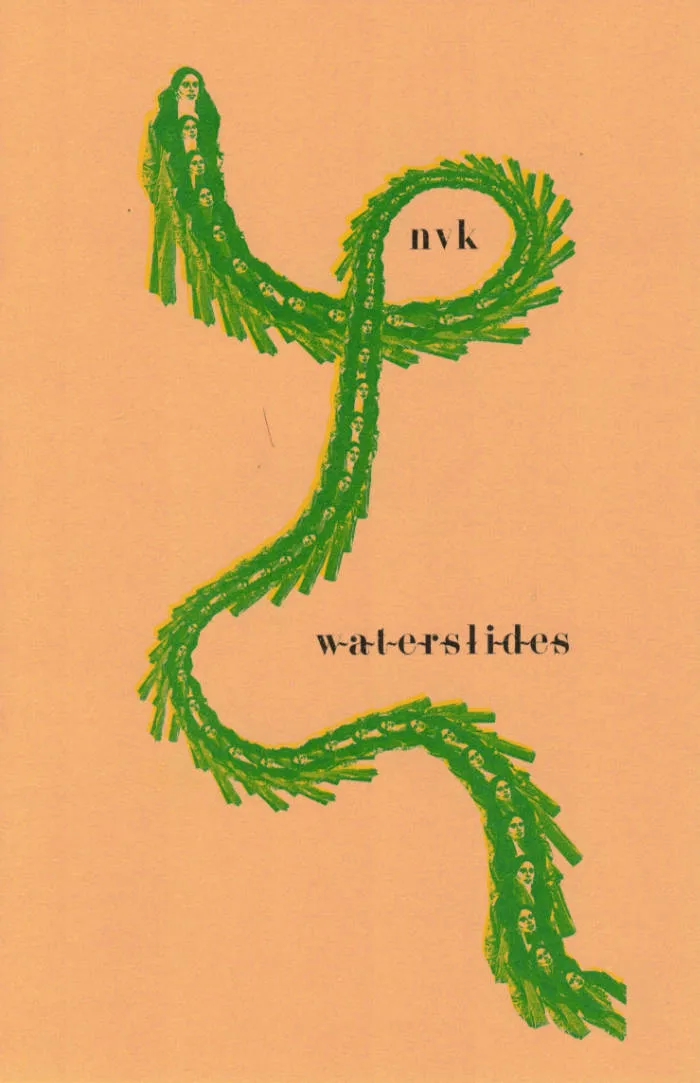
Waterslides
"Waterslides is a falling and plunging, short starts and stops aided by movement, until we splash, climb and plunge again. Each sliding is the same but different—with each descent new expectations and thoughts swirl, shifting focus and gaining new insights or blockages. Waterslides are brief moments of remembering, remembering as a present tense activity, one that happens as we think of it, projected on our now. The waterslide is the moment of past and present working in tandem, a movement of repeating, revisiting and remembering all at once.”
Written by nvk 2021-2023. Dedicated to Judi, MM & TNN.
A version of these poems was published as an audio work through Ignota Press’ The Mountain (2023) and included in a reading with James Loop on Montez Press Radio (2023). nvk would like to thank Jan Matthé, Stine Sampers and Michelangelo Miccolis for their patience & love.
This book was first presented at Kransen in Antwerp, May 6th 2023, with a performance by Sassy (costume by Rosa Schützendorf). Printed and bound at Risiko Press, Borgerhout. Cover image by nvk. Fonts: Adonis, Garamond Pro. Limited to 150 copies.
128x195mm, 16p., stapled, cover: green, yellow and black risoprint on 160gsm caramel paper, inside: black and blue riso on 120gsm Munken Pure paper.

Ordinary Notes
A singular achievement, Ordinary Notes explores profound questions about loss and the shapes of Black life that emerge in the wake. In a series of 248 notes that gather meaning as we read them, Christina Sharpe skillfully weaves artifacts from the past—public ones alongside others that are poignantly personal—with present realities and possible futures, intricately constructing an immersive portrait of everyday Black existence. The themes and tones that echo through these pages—sometimes about language, beauty, memory; sometimes about history, art, photography, and literature—always attend, with exquisite care, to the ordinary-extraordinary dimensions of Black life.
At the heart of Ordinary Notes is the indelible presence of the author’s mother, Ida Wright Sharpe. “I learned to see in my mother’s house,” writes Sharpe. “I learned how not to see in my mother’s house . . . My mother gifted me a love of beauty, a love of words.” Using these gifts and other ways of seeing, Sharpe steadily summons a chorus of voices and experiences to the page. She practices an aesthetic of "beauty as a method,” collects entries from a community of thinkers toward a “Dictionary of Untranslatable Blackness,” and rigorously examines sites of memory and memorial. And in the process, she forges a brilliant new literary form, as multivalent as the ways of Black being it traces.

Practicing Dying
Practicing Dying is a literary anti-memoir documenting life in a Zen Buddhist monastery in rural France where the protagonist, a woman in her late twenties, attempts to overcome chronic drug addiction and mental illness.
Broken and severely unwell, our protagonist arrives at the monastery from London: starving, drug-addicted and disillusioned, having exhausted every conventional treatment route available to her. The book examines how, habituated to a life of benefits assessments, petty-crime and sex work, she struggles to adjust to the rules, discipline and religious life of the monastery—at times to devastating and comedic effect.
As the story unfolds, she reflects on her addictions and past experiences, raising critical questions about what it means to be "an addict" and why there may be vested corporate and societal interests in maintaining a narrow, individualistic understanding of addiction.
Anarchic and provocative, tender and self-deprecating, Practicing Dying differs from other contemporary memoirs in the genre of addiction-recovery by simultaneously challenging the dominant narratives surrounding mental health while proposing an alternative approach to treating the “sickness of self” from which we all increasingly suffer.
‘Practicing Dying is brilliant, rewarding and difficult. Northall offers the most brazen and shocking account of addiction I’ve ever read. Committing herself to the practice of Mahayana Buddhism, she eventually finds a way out, but only on the most rambling, circuitious path. Her account of addiction and loss, displacement and grief is profound and it proves that nothing is ever one thing.’ — Chris Kraus, author of The Four Spent The Day Together
Charlotte Northall is a London-based writer. Her debut, Practicing Dying, blends autobiography and cultural criticism to explore addiction, capitalism, and spiritual practice. She works with rough sleepers, supporting those living with addiction and complex mental health needs.

Unable To Achieve Broad Recognition In My Lifetime, I Laboured In Obscurity Until My Death Last Year
For nearly two years the author collected phrases from the exhibition press releases she received through email, posting certain of them on Facebook in a rather unsystematic way (that is to say, when she felt like it), with only one change, that of the personal pronoun, so each statement appeared vainglorious, absurd, even tragic. She supposes the measure was if they made her laugh or gasp or used words she deplores when thinking or writing about art. The posts gathered quite a following. Some people still mention them to her, and others have asked her to look at their own press releases before circulation.
These extracts have provoked laughter, disbelief (especially when performed as public readings, when she has been obliged to swear to their veracity), self-recognition, and yes, shame.
She had only three rules: 1) She would not quote the press release of anyone she knows (certainly she could have done—she must admit that both a friend and someone she dislikes intensely have slipped in, and she fervently hopes neither ever reads this book); 2) She would not alter anything except the pronoun (this is largely true; however, for this book, she corrected some errors of punctuation and spelling, changed spellings to their English form, and employed her beloved Oxford comma); and 3) She would not use anything the artist had written (this, too, is true, save for one exception that was too wonderful not to include).
Finally, she gathered a collection of endorsements, some along the way, others when she indicated this work was done. She is still alive and she continues to labour in obscurity.

Elad Lassry: On Onions
An artist's book presenting a photographic study of onions.
On Onions is a photographic study of onions by artist Elad Lassry (born 1977). Characteristically highlighting the spectrum of hues and shapes for the vegetable, Lassry's selected taxonomy includes sections on red, yellow and white onions, each of which possesses its own distinct taste and benefits. On Onions is Lassry's first artist's book, and the work will exist only in book form; it is at once wry, refreshing and disorienting in its biology workbook style, which makes fruitful use of "the confusion that results when there is something just slightly wrong in a photograph" (as the artist has described his practice in general).
Composed by the artist and arranged by Stuart Bailey, the book includes an essay written by Angie Keefer about the effects of sliced onions on human tear ducts.
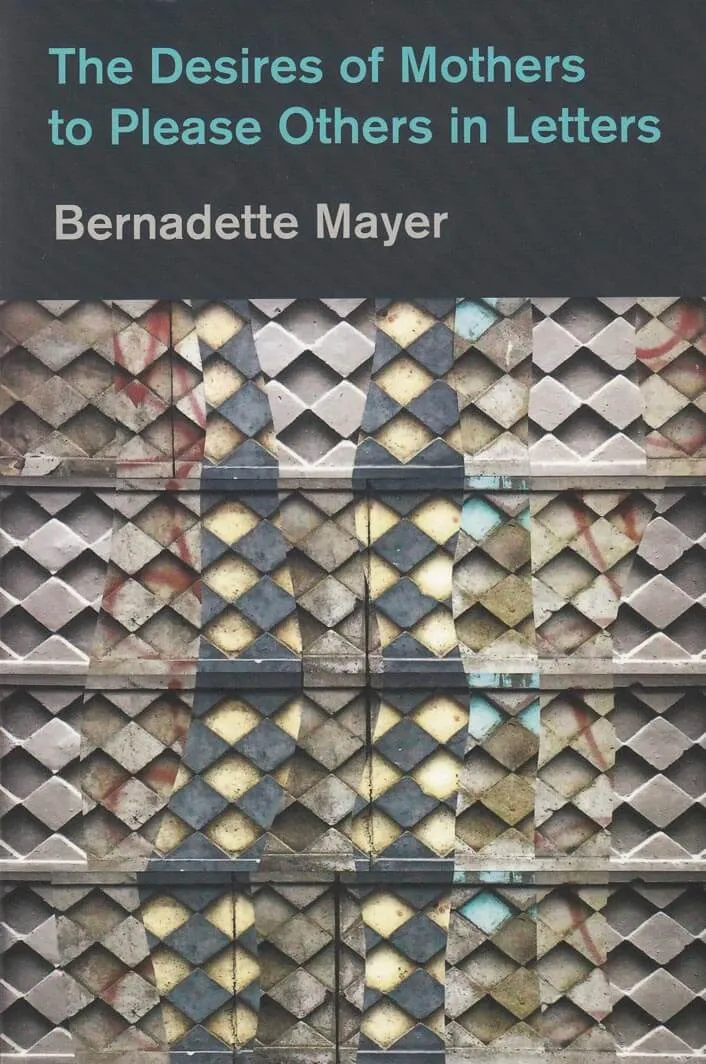
The Desires of Mothers to Please Other in Letters
A reissue of Bernadette Mayer's classic fugitive intergenre text. Endlessly inclusive, The Desires of Mothers to Please Others in Letters, first published in 1994 and long out of print, evokes the complexity of real persons as it simultaneously reinvents multiple genres: epistle, prose poem, and memoir.
Written between 1979 and 1980 while pregnant with her third child, Mayer extends her imaginative letters into meditations for us all on life as it is lived in real time, with its responsibilities and manifold desires. Fierce, lyrical, intimate, and wise, both new and familiar readers, both mothers and non–mothers, will find this book beckoning again and again to offer delicious writing, timely information, consolation, and advice.
With Introduction by Laynie Browne.

The Chroma Series
The Chroma Series lists elements of reality and systematically changes their color to evoke monochrome universes. The resulting poems may be conceived as mental films where quick-change art coexists with nonsense and politics.

The Activist
The Activist begins in the middle of a revolution. There is a protesting group of commuters with a missing leader. There is a bridge that may or may not have been bombed. People speak in nonsense and cannot stop themselves. In the midst of all this, the language of news reporters mixes with the language of confession. The art of this beautifully written book is in how it touchingly illustrates that relations between humans and cities are linked in a more complex interface than most realize. The book is full of entrances and exist, alternate routes and incommensurate geographies. The Activist does not analyze or explain the hopeful desires of protest at the turn of the century, but it does enable us to see them differently. — Juliana Spahr
"Whether this is a dream in which I'm captured or I've been captured and made to think I'm in a dream, I can't figure." Apropos to the rapturous tension The Activist evokes. A covert narrative operating as an event disguised as a repot. A grass trap glimpsed through the lashes of a sleepwalker. Topography of disrupted positionality, reflection girders flaccid memory against the romantic high up. Flea-bitten news and neuralgic placards. You are here**. Is dreaming the medium for crossing the ambiguous borders of talk, responsibility, collectivity, solitude? Or does reading anatomize a phantom bridge that carries you over to an unmappable reality and calls you by your secret name? Root, plan and faction, armed with tongue-tied intensity. You may ask how Renee Gladman knows that this city of slippage is your city, how she holds you within it, riveted. And therein lies the magic of this book. — Tisa Bryant

Postmortem issue 1
Marina Mardas, François Peyroux and 1 more
How can we define and document our present?
Postmortem is a sensitive yet critical metaphor for a world suspended between collapse and reinvention—a diary of the now. Drawing together writers and artists from Europe and the SWANA region, this issue locates areas of tension that define our era. Far from a mere dialogue between regions, it exposes the inner and outer fractures of Western hegemony, unearthing shared emotions.
From reclaiming histories and narratives in the Arab world to deconstructing digital spaces as arenas of control and resistance—even exposing systemic exclusions embedded in blood donation policies—contributors reveal these tensions as a fertile terrain for dialogue and reflection.
Through critical essays, narrative writing, poetry, interviews, and contemporary art, the concept of Postmortem unfolds an in-between state where death and rebirth occur simultaneously. Across three interwoven chapters—Metaconnexion, Dissociation, and Fragmentation—the issue engages radically with body politics, othering, post-orientalism, surveillance, decoloniality, freedom, and resistance.
Both a chronicle and a hybrid object where text, design, and image interact, Postmortem archives a world in flux. Rather than prognosticate, it dissects the present as the essential site for reimagining our future.
Contributors : Sara El-Jazara, François Peyroux, Nadine Makarem, Soukaina Melhaoui, Louise Mervelet, Manon Schaefle, Marina Mardas, Irina Breitenstein, Amer Al-Dakar

HOOT nr. 3 — Kamilé Krasauskaité
Gufo, Clément Faydit and 1 more
Last year, on a summer night in Marseille, someone, within all the hungry people I am meeting during my dinners, specifically set her attention on my projects. Later during the fall I received a call from Austė ZDANČIŪTĖ, the cultural attache at the Lithuanian embassy in France, who introduced me to Kamilè Krasauskaitè. Since that fall, we kept on exchanging and making future plans in France where she would have a residency. The more we chatted, the closest we began. Kamilè is a almost-thirty-years-old Lithuanian artist that has been including sourdough bread in her work and builds a poetic and mesmerising world around that dimension of food, fermentation, senses, environment, rituals...Through our communication I decided to share that encounter that we managed to welcome in Marseille. We kneaded some bread together, shared it in a forest of Marseillais sunflowers, walked the streets, met people, questioned and compared artists' lives in Europe. This issue might be an excerpt of all the long conversations we had, it was hot and sunny in Marseille, it was in June.

The Error is Regretted
‘Corrections and Clarifications’ is an ongoing newsprint project by Anita Di Bianco, an edited compilation of daily revisions, retractions, re-wordings, distinctions, and apologies to print news from September 2001 to the present. In essence, a reverse chronological catalogue of lapses in naming and classification, tangled catchphrases, and patterns of misspeak and inflection.
Previous editions have examined the printed news media in the United States and United Kingdom, Germany, Austria and Switzerland, and other international press from Asia, Turkey, and the Balkans printed in English. The publication includes text contributions by Di Bianco and Francesco Gagliardi.
108 p, ills bw, 24 x 32 cm, hb, German/English

Les arbres la nuit
Rosanna Puyol Boralevi, Pablo Réol
An artist's book for children, with text by Rosanna Puyol Boralevi and drawings by Pablo Réol, printed in risography.
New edition of the book published in a limited edition of 50 copies in 2024.
Rosanna Puyol Boralevi is a French poet, translator and editor. Co-founder of Brook editions, she publishes translations of texts inspired by feminist and anti-racist struggles, a literature that is both poetic and analytical. She collaborates with artists on exhibitions, video and performance programs, and organizes reading groups, writing and translation workshops, often with friends.
Pablo Réol (born 1989 in Bordeaux) is a French artist.

Issue 7: Daffodils
Many bulbous plants have been dubbed ‘heralds of spring’, but none is more deserving of the title than those carrying actual megaphones to spread the word – daffodils. To know a daffodil is to love a daffodil. Come join our cult.
Including:
I Like the Daffodils – An introduction by Lou-Lou van Staaveren to the genus Narcissus, with amazing photographs by Elspeth Diederix from her garden.
Dafs in Art History – Painters, poets and writers all over the world, have been inspired by the daffodils’ dual aura of macabre and threatening elegance.
The Daffodil Society – The members of The Daffodil Society in the UK promote the genus Narcissus for everyone’s greater pleasure. Photographer Luke Stephenson followed them to various shows where their flowers are reviewed.
How to follow your nose – Philosopher Christopher F. Julien invites us into his fragrant garden where scent mixes with memories with drawings by Pom Koolen.
Artist Tina Farifteh digs into her personal archive and writes a beautiful account of her memories growing up in Iran, and how daffodils have become a staple for New Year’s celebrations and a symbol of hope.
Cover and inside cover by Lou Buche
Centrefold miniatures by Jesse Fischer

PRESCRIPTIONS: A Collection for Many Evils of the Body and the Mind, Also for Witchcraft
PRESCRIPTIONS is a transcription of a handwritten manuscript, dated to approximately 1650, containing a wide range of medicinal and magical remedies. Currently housed in the Cornell University Witchcraft Collection, it is assumed this practical handbook was a reference for healing, midwifery, and other medical/magical advice. Recipes and instruction cover various methods of purging, ointments for swellings, fevers, and pain reduction, lotions for venereal disease, advice for childbirth, and dilemmas such as “worms in the ear.” Accompanying these medicinal prescriptions are a series of magical prescriptions: charms, rituals, and spells recorded to fortify the ailing body, induce amorous desire, or seek revenge.
With its mix of Latin words, Early Modern English parlance, colloquial plant names, apothecary weights, and archaic medical terms, the recipes can at first appear opaque, but with sustained engagement one can begin to decipher the logics and structures within the writer(s)' shorthand. The original manuscript, in having its own detailed glossary, index, and citations, exhibits a meticulous cataloging of knowledge and resources, and reveals an earnest desire to hold onto the integrity and sanctity of the body in the face of 'many evils.'
The transcription is accompanied by a glossary of terms, an explanation of the various apothecary measurements used, and expanded citations of the medicinal/magical treatises that were abbreviated within the original text.

La Redoutable
La Redoutable compile les archives lesbiennes de trois provenances distinctes mais complémentaires. Aux abords de l’ARCL (Archives Recherches Culture Lesbiennes) se rencontre Caroline Drieu, Roxanne Maillet et Suzette Robichon. Elles se racontent des mots imprimés sur des t-shirts et des gapettes. Ces slogans, fruits de détournements, plagiats et jeux de mots sont en plus d’être revendicateurs, des signes distinctifs pour un réseau de lesbiennes absolument occupées à incarner les attitudes qui les définissent. Ces viragos peuvent se connaître ou non, mais un jour, ielles se retrouveront certainement dans des jardins partagés, à des groupes de lecture, des barbecues ou des karaokés.