Books
Books
in random order

Gravity And Grace
Simone Weil, the French philosopher, political activist, and religious mystic, was little known when she died young in 1943. Four years later the philosopher-farmer Gustave Thibon compiled La pesanteur et la grbce from the notebooks she left in his keeping.
In 1952 this English translation accelerated the fame and influence of Simone Weil. The striking aphorisms in Gravity and Grace reflect the religious philosophy of Weil's last years. Written at the onset of World War II, when her health was deteriorating and her left-wing social activism was giving way to spiritual introspection, this masterwork makes clear why critics have called Simone Weil "a great soul who might have become a saint" and "the Outsider as saint, in an age of alienation." Introducer Thomas R. Nevin is a professor of classical studies at John Carroll University and the author of Simone Weil: Portrait of a Self-Exiled Jew.

RUSTIQUE
“RUSTIQUE” is an artist book created by Nicola Godman. This book is sprung out of a residency in September 2021 at Hôtel Chevillon, a former Scandinavian artist colony in Grez-sur-Loing, France. Barbizon, the village where the painter Jean-François Millet (1814–1875) lived and died, is located 20 km away from there. The book interweaves the life and work of Millet with Godman’s photographs, drawings and personal anecdotes.
“RUSTIQUE” wishes to put forward the artistic gaze towards rural life by artists who themselves are born peasants. Nicola Godman (b. 1989, Rute) is an artist working with photography, video, books and stories, currently based in Stockholm, Sweden. Having grown up on an organic dairy farm, she is researching depictions of rural life in art history and contemporary culture.

Woman Journal Vol. 6: Back in Shape
Do we always have to be nice, kind and communicate respectfully? Wouldn't it sometimes be better to change our tone, to use force or even violence? We often want to act in a spirit of “care” and benevolence, but how do we know if we're really being altruistic and sympathetic? Vol.5 asks the question: Nice?
With contributions from :
Muf architecture/art, Mélanie Mazet, Bui Quy Son, Paul-Antoine Lucas, Armelle Breuil, Annabelle Vaillant, Napsugár Trömböczky, Alessandro Di Egidio,
Elsa Muller, Clara Lenoir, Léo Jacqmin, Clem Koren, Pola Noury, Grève cœur and Cassiane C. Pfund
This publication is edited by the Woman Cave collective founded by Leticia Chanliau and Chloé Macary-Carney.
318 black & white pages, brown cover
Micro edition of 700, printed in Aubervilliers by Isiprint.

Mountainish
Zsuzsanna Gahse, Katy Derbyshire
A narrator and her dog are criss-crossing the Swiss Alps. She travels with friends who share her interest in food, languages and their topographical contexts. They collect colours, even look for colourlessness, and develop the idea of a walk-in diary, a vain attempt to archive their observations, encompassing portraits, descriptions and ruminations on mountains, hotels, people, language, food, flora and fauna.
Gradually, other mountains appear in their observations and memories, as do the mountains of literature and art. Mountains may be sites of fear and awe, of narrow-mindedness, racism and ever-looming collapse; Alpine lodges may be places of hospitality, retreat and unexpected encounters; of nature under threat.
In 515 notes, Zsuzsanna Gahse unfolds a finely woven interplay between her six characters while giving us a vivid panorama of mountain worlds, a multi-layered typology of all things mountainish.
![Cover of Dante's Joynte: Lingua 1. [Poems and Other Theaters]](https://rile.space/storage/744/conversions/dante-webp.webp)
Dante's Joynte: Lingua 1. [Poems and Other Theaters]
Kenneth Gaburo (1926-1993) is renowned as a teacher, pioneer of electronics in music, jazz pianist, writer, ecologist, publisher, and proponent of compositional linguistics. Over the course of a dedicated career, his uncompromising work carved out its own patch in the territory of American experimentalism.
Lingua Press, 1976

The History of Sexuality, Volume 1: An Introduction
Michel Foucault offers an iconoclastic exploration of why we feel compelled to continually analyze and discuss sex, and of the social and mental mechanisms of power that cause us to direct the questions of what we are to what our sexuality is.

Inheritance
Taylor Johnson’s debut poetry collection, Inheritance, explores the complexities and limitations of language, physicality and capitalism. Resisting singularities, each poem emerges with a distinct sound, space and sensibility. Whether driving in a Lincoln Town Car; moving through pine forests and becoming immersed in the sounds of animals and nature; languishing in a lovers’ invitation, transcending from the syncopation of Go-go or walking the pavements of Washington D.C.—‘dissolving into sound’. Johnson’s critical perspective is rooted in connection. These poems gesture towards the tools we might need for living alongside rather than against or in spite of an inundation of daily oppressions. Be it redefining trans Blackness, environmental degradation, or land ownership and labour. With receptiveness and tenderness Johnson strolls around language, listening to silence—inheriting it, filling it and remaking it.

Conflict Is Not Abuse
From intimate relationships to global politics, Sarah Schulman observes a continuum: that inflated accusations of harm are used to avoid accountability. Illuminating the difference between Conflict and Abuse, Schulman directly addresses our contemporary culture of scapegoating. This deep, brave, and bold work reveals how punishment replaces personal and collective self-criticism, and shows why difference is so often used to justify cruelty and shunning. Rooting the problem of escalation in negative group relationships, Schulman illuminates the ways in which cliques, communities, families, and religious, racial, and national groups bond through the refusal to change their self-concept. She illustrates how Supremacy behaviour and Traumatized behaviour resemble each other, through a shared inability to tolerate difference.
This important and sure to be controversial book brings insight into contemporary and historical issues of personal, racial and geo-political difference, as tools of escalation towards injustice, exclusion and punishment, whether the objects of dehumanization are other individuals in our families or communities, African Americans at the hands of police, people with HIV, and Palestinians. Conflict Is Not Abuse is a searing rejection of the cultural phenomenon of blame, cruelty, and scapegoating, revealing how those in positions of power exacerbate and manipulate fear of the "other" to avoid facing themselves.

LllOovVee - Forbid me my love
It is right and necessary to be speaking with strangers. There are islands, backroads and cliffs of wet inked worded sea ridgelines where aodán McCardle’s work emerges concrete and lyric as a chant of delicately provoking permutations. forbid me my love, the first part of this beautiful book, is poetry as poiesis or making. By means of a series of concrete meditations, McCardle takes us where he, or perhaps the words themselves, unknit, erase, appear and disappear. Wor(l)ds of the size of terrorist and bomb are subject to a system of alterations that end up shooting lovebombs from the page as if love could become an error in the system. The second part of the book, LllOovVee, starts closer to verse. Reading it, one can almost hear aodán’s delicate Irish voice, but any easy reading gets explosively interrupted by the scanned handwritten, scribbled and scratched lines that open another set of permutations, one about what is behind us, how to be there here and what is it to be there then now, in the making, in the ear and in the eye with this revealing poetry.
- Martín Gubbins
Aodán McCardle is a performance poet, artist, & tattooist. In this book he combines all three artistic expressions into a performance. These poems are audacious. A poetic trajectory worthy of reading aloud.

Black Ark
The point of departure for the book «Black Ark» with Lee “Scratch” Perry (1936–2021), a Jamaican musical and visual artist who was based in Switzerland, is a detailed inventory of photographs and writings (Spring 2021) from the Black Ark Studios in Kingston, Jamaica, where Lee produced his music from 1973 on. He was a seminal pioneer of dub, an electronic subgenre of reggae that uses sampling, looping, remixing, reverb and echoes to create new songs as well as rework and appropriate pre-recorded songs and tracks.
Black Ark Studios was one of the cradles of dub. It’s also where Lee “Scratch” Perry’s musical approach found an enduring visual counterpart in the form of continuously evolving mural paintings and drawings as well as shape-shifting assemblages of records, instruments, found objects, posters, newspaper and magazine clippings, and appropriated books. The artworks form actual layers upon layers that are rhizomatically intertwined with the studio building itself as well as with the furniture inside—and with Perry’s biography and persona.
Perry created his very own, dense and eclectic world—a world that is documented in «Black Ark», before it disappears for good: the premises have recently been sold. The photographic documentation of the studio was supplemented by efforts to secure and preserve Perry’s cultural objects as part of a joint project with various cultural institutions.
«Black Ark» which reflects the rhythm and layering effects of collage both in its content and the materials used to craft the book. Perry was involved in the conception of the book in its early stages. It also interweaves various media and chronologies. The new photographs of the Black Ark Studios will be juxtaposed with stills from old documentaries and archival photos.
The idea of a “house” serves as both a working hypothesis and a metaphor. It will be the starting point and endpoint of various thematic strands, both visual and textual: for example, the book will explore the Black Ark as a “spiritual yard” in the context of African diaspora, as well as looking into archeomusicological aspects. Furthermore, extended captions by Perry’s biographer will provide the backdrop for a kaleidoscopic panorama of Perry’s eclectic and ingenious work.

Pfeil Magazine #18 – Body
From its anatomy and autonomy to its death and diet, this issue focuses on the motif Body and all its meanings, direct and indirect, for instance as in relation to human and non-human bearers of bodies, its inhabitants like bacteria and organs, its social, medical and juridical conditions, its intoxications, chemical processes, traumas, transitions, well-being, replacements, weaknesses, and its opposites.
Contributors: Adam Dickinson, Andrea Éva Győri, A.L. Steiner, Alexandra Ivanciu, Barak Zemer, Bernhard Willhelm, Clara Lena Langenbach, Clémentine Bedos, Constance DeJong, Daisy Hildyard, Fanny Howe, Hanne Loreck, Hasti, Holly Hunter, Ingrid Jäger, Jannis Marwitz, Jess Arndt, Johannes Kuczera, Jolanta Nowaczyk, Henriette Maier, Mag Gabbert, Maja Smrekar, Manuel Vason, R.I.P. Germain, Rebekka Endler, Sonja Yakovleva
Within the format of a magazine, each page of Pfeil represents the floor, walls, or ceiling which together create an imagined room displaying a printed exhibition. Each issue is dedicated to a specific word, and artists are invited and given space to work on and with this term, and to construct or deconstruct the architecture around it. Combined, the contributions transform into an organic display surrounding the leitmotif.
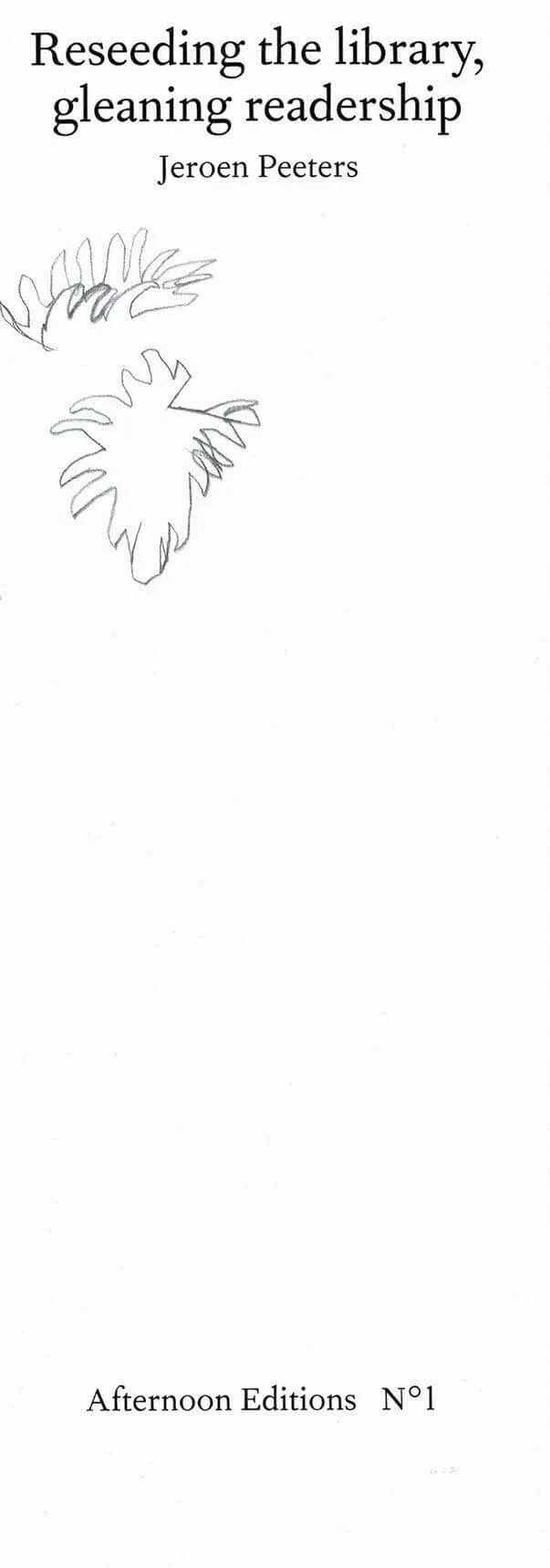
Reseeding the library, gleaning readership
Afternoon Editions no. 1: an essay by Jeroen Peeters titled Reseeding the library, gleaning readership. In May 2017, Time has fallen asleep in the afternoon sunshine settled during three weeks in the Ravenstein Gallery in Brussels as part of the Kunstenfestivaldesarts. Invited as a writer in residence, Jeroen Peeters visited the library of living books on a daily basis and recorded his observations by hand in a notebook, which formed the basis for Afternoon Edition #1. Reseeding the library, gleaning readership is an essay on the seed library, on the dispersion of literature through wind, water and animals, on biodiversity and commoning at the heart of readership. On the cover a drawing by Wouter Krokaert of a Philodendron Xanadu. Published May 2018.

Biting the Hand – Traces of Resistance in the Art & Language diaspora
Extensive survey of the politically outward-looking Conceptualism emerging from Art & Language in the UK. Especially considering its critique of the norms of Modernist art practices in contemporary art, particularly practices of art education.
Edited, compiled and introduced by Paul Wood, Biting the Hand: Traces of Resistance in the Art & Language diaspora is about a dissident formation of artists active in the UK in the 1970s and 80s.
The book tells the story of artists engaging with a critique of then-contemporary modernist art education, who have embarked on a series of theoretical investigations which became increasingly politicised under the pressures of an evolving social crisis. Increased racism, unemployment and attacks on the organised working class all raised questions about how a critical art might respond.
By the late 1970s, these radical artists, mostly in the orbit of the Art & Language group, were producing posters and leaflets for a wide range of left-wing causes, as well as analyses of the politics of art and design education and the role of cultural ideology in maintaining consensus. In the 1980s, as Thatcherism tightened its grip, those involved went their separate ways into areas as diverse as media work, trade unionism, health and education.
Biting the Hand has three parts: a retrospective introduction setting the formation in its historical context, and two annotated documentary sections presenting examples of the work as both text and image, written and edited by Paul Wood.
It also includes a foreword by Sezgin Boynik, publisher, and an afterword by Ann Stephen, curator and art historian, further expanding on the book's subject.
For many years Paul Wood worked for the Art History Department of the Open University. His publications from that period include Conceptual Art (2000), Western Art and the Wider World (2013), and the four-volume anthology Art in Theory (1990-2020), co-edited with Charles Harrison and others.
Edited, compiled and introduced by Paul Wood.
Foreword by Sezgin Boynik; afterword by Ann Stephen.

ZILCH
In banana boxes, Maxime Le Bon collects and stores a lot of documents in a jumble. Most of them are printed, cut out from newspapers, magazines, old publications, erratas and other fragments of texts. Added to this are drawings that he improvises - some of them torn or stained that he don't want to display or throw away. This collection of heterogeneous items is then being rearranged and slipped into plastic pockets where he stores them. Unstable and in constant change, this improbable archive grows with the years. It sedimented layers of experiences and constitutes this heterogeneous deposit from which can emerge all sorts of fragmentary narratives and accidental arrangements. The publication ZILCH brings together a selection of images from this extensive archive.

La même en pire
La même en pire est un roman d’amour enchâssé dans un roman noir, un huis clos dans lequel les confessions de chacune deviennent le procès des autres. Elles sont toutes coupables, toutes victimes, toutes témoins, toutes innocentes de ce qui est arrivé à Madison. Et qu’est-ce qui est arrivé ?
Madison a disparu, Madison a été assassinée, Madison s’est suicidée. Huit femmes se retrouvent dans un appartement et reviennent sur ce qui les avait rassemblées des années auparavant : une maison délabrée que Madison louait et dans laquelle elle avait installé des caméras pour streamer H24 et monétiser son existence. Elles avaient toutes vécu dans cette maison et avaient toutes fini par la déserter. Sophie la poète mariée au terroriste, Cécile la détective privée, Hilary la bourgeoise militante, Lola l’adolescente tiktokeuse muette, Alexandra l’entrepreneuse, Eva la mauvaise mère, Kamila la mère aimante, et la narratrice.
Préface : Lou-Andréa Benzacar

Padam Padam: Collected Poems
A posthumous celebration of the poet and provocateur Kevin Killian, Padam Padam pulses with camp, pop culture, and pleasure.
Kevin Killian—the puckish poet, playwright, novelist, scholar, and impresario of the Bay Area arts community—channeled the charisma of the pop stars. Pulled from his legendary corpus, and long out of print, the work collected here is the record of Killian’s life as a radical littérateur. In Argento Series, Killian conjures the horror, suspense, and cinematic imagery of director Dario Argento as he documents the AIDS epidemic in San Francisco. In Action Kylie, he revels in queer identity and the universal love of fandom. In Tweaky Village and Tony Greene Era, Killian elevates artists and friends to legendary status within his personal pantheon. And Elements, Killian’s wink at the periodic table, makes its U.S. debut.
The collection features an introduction by Kay Gabriel, who writes of Killian’s “fabulous, permissive body of work, charming, filthy and smarmy at turns, with its retchable milk enemas and its devilish twists.”
Edited by Evan Kennedy & Jason Morris

Weird Fucks
A brilliant novella from a legendary figure in American fiction.
A young woman drifts through dimly lit bars and rented rooms, reporting from the erogenous zones of New York and Europe. Encountering increasingly bizarre sexual situations, she turns her curious, comic, and fierce eye onto the contemporary world of sex and desire.
The men of this world evade and simper, they prey, preen, and fall hopelessly in love. In the narrator’s deadpan portraits, we see young women indulging their freedom through hope and disappointment, and young men wearing various guises of masculinity.
This novella surprises with unlikely fucks, disturbing fucks, outlandish fucks, and some truly weird fucks – all written with the smart, elegant, and tough style which could only be that of Lynne Tillman.

The Glover Group – A Los Angeles Story
A portrait of the cohesive community of women artists in Frogtown, Los Angeles, including Ruby Neri, Hilary Pecis, Megan Reed, Lily Stockman, and Austyn Weiner.
The Glover Group: A Los Angeles Story narrates the journey of an extraordinary group of artists who have nurtured their unique artistic voices within the same studio complex in Frogtown, Los Angeles. The Glover Group includes Ruby Neri, Hilary Pecis, Megan Reed, Lily Stockman, and Austyn Weiner, a coincidental yet cohesive community of women artists sharing a unique bond through their interconnected workspace.
This catalog, designed to document their collaborative exhibition held at MASSIMODECARLO in Milan during July and August 2023, features interviews to the artists by Cecilia Alemani, Alison M. Gingeras, Justine Ludwig, Marta Papini, and Heidi Zuckerman, together with photographs by Tracy Nguyen.
Contributions by Ruby Neri & Alison M. Gingeras, Hilary Pecis & Cecilia Alemani, Megan Reed & Marta Papini, Lily Stockman & Heidi Zuckerman, Austyn Weiner & Justine Ludwig.

About Ed
A moving story about love, AIDS, grief, and memory by one of the most adventurous writers to come out of San Francisco's LGBTQ+ scene.
Bob Glück met Ed Aulerich-Sugai in 1970. Ed was an aspiring artist; Bob wanted to write. They were young men in San Francisco at the high tide of sexual liberation and soon, and for eight years, they were lovers, after which they were friends. Ed was an explorer in the realms of sex. He was beautiful, fragile, exasperating, serious, unassuaged. In 1994 he died of HIV. His dream notebooks became a touchstone for this book, which Glück has been working on for some two decades, while also making his name as a proponent of New Narrative writing and as one of America's most unusual, venturesome, and lyrical authors. About Ed is about Ed, who remains, as our dead do, both familiar and unknowable, faraway and close. It is about Bob too.
The book is a hybrid, at once fiction and fact, like memory, and it takes in many things through tales of political activism and domestic comedy and fury to questions of art and love and experiences of longing and horror. The book also shifts in register, from the delicate to the analytic, to funny and explicit and heartbroken. It begins in the San Francisco of the early 1980s, when Ed and Bob have been broken up for a while. aIds is spreading, but Ed has yet to receive his diagnosis. It follows him backward through his life with Bob in the 1970s and forward through the harrowing particulars of death. It holds on to him and explores his art. It ends in his dreams.

I Am the Century
This publication aims to provide a critical and profound reading of Alice Neel's humanism, constructing a journey through her artistic and personal life. The book includes texts by academics and artists, enriched by an extensive number of illustrations, archival photographs and documents.
Alice Neel: I Am the Century accompanies the first major retrospective in Italy dedicated to the US artist Alice Neel (1900–1984), presented by Pinacoteca Agnelli, Turin. Conceived as both a critical and a narrative journey, this publication offers an in-depth exploration of Neel's artistic and personal life, expanding on the exhibition through a rich selection of essays and visual material. It brings together sixty works reproduced in dialogue with archival documents, highlighting Neel's role as a pioneer and one of the most important painters of the twentieth century. Contributions by curators, scholars, and artists—including Kelly Richman-Abdou, Jennifer Higgie, Mira Schor, and Annie Sprinkle—provide multiple perspectives on Neel's practice, situating her radical approach to portraiture within broader artistic, social, and political contexts.
Merging realism with surrealism and empathy with unflinching clarity, Neel captured the psychological and emotional depth of her sitters. The publication emphasizes her capacity to chronicle life's stages and relationships—childhood and adulthood, sexuality and intimacy, community and political consciousness—through works that continue to resonate with contemporary audiences. Positioning Neel as both artist and witness, I Am the Century underscores her enduring humanism and her singular vision of the "human comedy," offering readers a comprehensive entry point into a body of work that is still influencing new generations of artists.
Born in 1900 in Merion Square, Pennsylvania, Alice Neel lived in Philadelphia and Havana before settling in New York (where she lived until her death in 1984), becoming part of the social milieu of the Harlem neighbourhood. She painted figuratively throughout her life, often using the people "around her" as subjects, models and muses. For Neel, this meant portraying both the residents of Harlem as well as strangers, friends and intellectuals who often shared her proximity to the Communist Party. A figurative painter in an era dominated by Abstract Expressionism, Neel developed remarkable and radical new ways of representing the human body in painting, such as with her celebrated nudes of pregnant women.. The introspective aspect of Neel's work, her ability to capture the essence of her subjects and their souls, has made her today one of the most appreciated and respected artists of the twentieth century.
Neel's work has been the subject of retrospectives at the Metropolitan Museum of Art in New York, the Guggenheim Museum Bilbao and the Centre Pompidou in Paris. It forms part of the permanent collections of institutions such as the Art Institute of Chicago; the Hirshhorn Museum and Sculpture Garden in Washington, D.C.; the Metropolitan Museum of Art; Moderna Museet in Stockholm; the Museum of Contemporary Art in Los Angeles; the Museum of Fine Arts in Houston; the Museum of Modern Art in New York; the National Gallery of Art in Washington, D.C.; the Philadelphia Museum of Art; Tate Modern in London; the Walker Art Center in Minneapolis, Minnesota; and the Whitney Museum of American Art in New York.
Edited by Sarah Cosulich and Pietro Rigolo.
Texts by Sarah Cosulich, Jennifer Higgie, Kelly Richman-Abdou, Pietro Rigolo, Mira Schor, Annie Sprinkle.

Tendencies
Tendencies brings together the essays that have made Eve Kosofsky Sedgwick "the soft-spoken queen of gay studies" ( Rolling Stone). Combining poetry, wit, polemic, and dazzling scholarship with memorial and autobiography, these essays have set new standards of passion and truthfulness for current theoretical writing.
The essays range from Diderot, Oscar Wilde, and Henry James to queer kids and twelve-step programs; from "Jane Austen and the Masturbating Girl" to a performance piece on Divine written with Michael Moon; from political correctness and the poetics of spanking to the experience of breast cancer in a world ravaged and reshaped by AIDS. What unites Tendencies is a vision of a new queer politics and thought that, however demanding and dangerous, can also be intent, inclusive, writerly, physical, and sometimes giddily fun.

Weaknesses
Afternoon Editions no. 2: text and drawings by Chrysa Parkinson titled Weaknesses. Between January and March 2019 Time has fallen asleep in the afternoon sunshine was presented as a solo-exhibition at Index Foundation in Stockholm. During this period Chrysa Parkinson was invited as a guest writer for Afternoon Editions. Weaknesses is a leap in memory.

Parapraxis 07: Romance
It is a particularly unlovely time to be thinking about romance. The heart can be fickle, indulgent, its matters distracting, impractical. But in the heavy boots of our undesirable present, seized by colliding catastrophes, we ask: how do we get out of here? Can the simple math of desire plus futurity break us free? Or is this just a barely veiled expression of our longing for avoidance? When we declare that love is the answer, we often forget the ambivalence of which psychoanalysis warns: love emerges in tandem with hate. It is neither the antidote to aggression nor the basis of a coherent social order.
As a narrative structure, romance insists on the future. Whether it's with a new lover hoping to break the repetition of bad patterns, in emotional growth born of the analytic couple, or inside the tremulous energy of an insurgent crowd that makes yesterday seem historically distinct from tomorrow, romance threads time with the texture of meaning. Perhaps delusional, perhaps heroic in this audacious promise, romance must also always be a fantasy, an imagined structure that has not yet met its match in the present. While this fantasy is vital to our attachment to the world and each other, it can also provide the fuel for self-serving denial and disavowal. When we say that the youth are not fucking and that they don’t care about politics, these separate charges obscure the nature of their common cause. As the world attempts to disavow the death of the earth and the removal of its peoples, our sense of continuity flees; the receding horizon is not an open road, but a vanishing point. Whither romance?
Dependent. Detached. Trauma Bonded. The Incest Lobby. Revolution Against Romance. Reading for Love and Labor. Surrealist Bedfellows. Mad Love. Essays by Nadia Bou Ali, hannah baer, Moon Charania, Davey Davis, Kaleem Hawa, Anna Kornbluh, Thomas Ogden, and more.

Ten Bridges I’ve Burnt
In Ten Bridges I’ve Burnt, Brontez Purnell—the bard of the underloved and overlooked—turns his gaze inward. A storyteller with a musical eye for the absurdity of his own existence, he is peerless in his ability to find the levity within the stormiest of crises. Here, in his first collection of genre-defying verse, Purnell reflects on his peripatetic life, whose ups and downs have nothing on the turmoil within. “The most high-risk homosexual behavior I engage in,” Purnell writes, “is simply existing.”
The thirty-eight autobiographical pieces pulsing in Ten Bridges I’ve Burnt find Purnell at his no-holds-barred best. He remembers a vicious brawl he participated in at a poetry conference and reckons with packaging his trauma for TV writers’ rooms; wrestles with the curses, and gifts, passed down from generations of family members; and chronicles, with breathless verve, a list of hell-raising misadventures and sexcapades. Through it all, he muses on everything from love and loneliness to capitalism and Blackness to jogging and the ethics of art, always with unpredictable clarity and movement.
With the same balance of wit and wisdom that made 100 Boyfriends a sensation, Purnell unleashes another collection of boundary-pushing writing with Ten Bridges I’ve Burnt, a book as original and thrilling as the author himself.