rile*books

Search books

Search books by title, author, publisher, keywords...

Cover of Sudden Wealth with Roy Claire Potter

Slimvolume Synthesis

Sudden Wealth with Roy Claire Potter

Chris Evans, Roy Claire Potter

€30.00

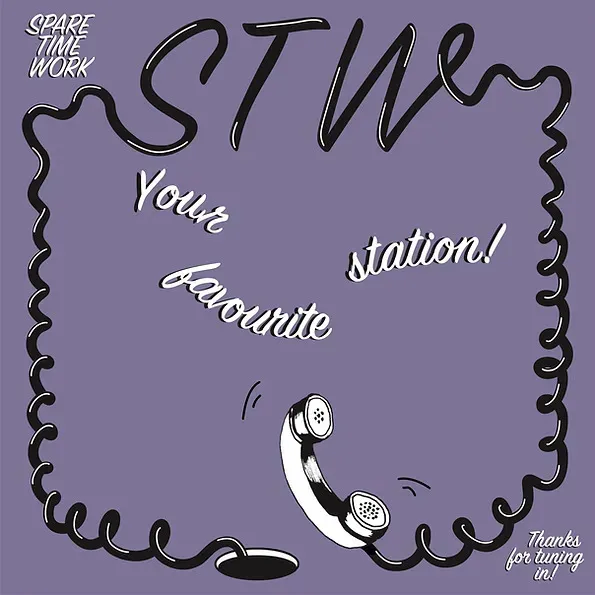
Proposed by Chris Evans, Sudden Wealth is a collaboration with Morten Norbye Halvorsen, Graham Kelly and invited poets and artists who use spoken word as their medium. 

Sudden Wealth looks to how the flux of subjectivity in language can be shaped, agitated and re-imagined through a triangulation between written composition, intonation, and extrinsic sound composition. The latter spans analogue and digital instrumentation, foley recordings and algorithmically derived musical patterns. Divergent methods of composition work on and into a voice, modelling intonation, and affecting its sense and intent. 

This first iteration has been made with Roy Claire Potter, an artist who tells stories from fragmented, intense images that depict moving bodies or domestic scenes and architectural settings. A rapid vocal delivery, a sense of restricted or partial views of space, complex social and group dynamics and the aftermath of violent events are recurrent strands of Potter’s writing, which are often delivered with a dark and sometimes wilful humour. 

Chris Evans was the bassist with the now defunct Life Without Buildings and has previously produced musical compositions with Morten Norbye Halvorsen together with farmers and accountants for his ongoing series ‘Jingle’. Graham Kelly joins Evans and Halvorsen for this present series, Sudden Wealth.

Vocals: Roy Claire Potter.
Electronics: Morten Norbye Halvorsen.
Bass: Chris Evans.
Guitar: Graham Kelly.
Arranged and mixed by Morten Norbye Halvorsen.

Published in 2022 ┊ Language: English

recommendations

Cover of BRICKS FROM THE KILN #7

Bricks from the Kiln

BRICKS FROM THE KILN #7

Matthew Stuart, Harriet Moore and 1 more

Fiction €20.00

Guest edited by artist Helen Marten and literary agent Harriet Moore with Matthew Stuart, this volume of the journal considers what it means for a publication to be an allegorical container. A simple box in which to gather multiple things, an economical set of permutations — rational in one sense, yet defiantly flexible to move. Contributors were approached with an open invitation; some explored the multiplicities of containing or containers, while others filled the printed vessel with their own ongoing preoccupations. The following pages perform as envelope, bag, shell, net, fold, alarm, letter and instruction. There are holes to disappear within; smoke to knot and wind; shadows to unfold — a context that takes in and binds, finding new kinships from unforeseen proximities.

THE FIRE FLOWERS AND THE FLOWER LIGHTS UP –
Lucy Mercer
(spine)

WE SHALL GREET THE MOON AGAIN
Walter Price
(front cover)

BACK PAGES OF ALGIERS DIARIES 2018
Lydia Ourahmane
(inside front & inside back cover)

AN INTRODUCTION TO / NOTES ON / INSTRUCTION FOR THE FRONT NOVEL
Eliza Barry Callahan
(pp.1–16)

SATURDAY MORNING
Kathryn Scanlan
(pp.25–29)

KILLDEER
Jason Schwartz
(pp.33–38)

ALARMS AND EXCURSIONS
Rosmarie Waldrop
(pp.45–61)

"THE BATHROOM"
Najwa Barakat
(pp.67–76)

ARMY ROLLS, A CIRCUMSCRIPTION
Roy Claire Potter
(pp.81–91)

CONCHOMANIA
Felix Bernstein
(pp.95–109)

O-POEM
Line-Gry Hørup
(pp.113–129)

THIS MUSCLE
Cally Spooner
(pp.133–153)

STERLING PARK IN THE DARK
Susan Howe
(pp.159–179)

COCONUTTERY
Mathelinda Nabugodi
(pp.183–193)

YOUR SELF CONFIDENT BABY
Aurelia Guo
(pp.197–206)

BIOGRAPHY OF A NET: HOLDING A VOLUME
Daisy Hildyard
(pp.211–225)

A GUIDE TO THE POETRY OF LI HO
Eliot Weinberger
(pp.229–235)

WOMEN SMOKING
Charline von Heyl
(throughout & p.239)

INFRATHIN
Marcel Duchamp
(throughout & p.239)

THE MAZED WORLD
Rachael Allen
(bookmark insert)

UNTITLED
Helen Marten
(back cover)

Cover of Bodies of Sound: Becoming a Feminist Ear

Silver Press

Bodies of Sound: Becoming a Feminist Ear

Sarah Shin, Irene Revell

Fiction €20.00

‘I am concerned with the power of sound! and what it can do to the body and the mind,’ wrote composer Pauline Oliveros. In the body, histories and politics come together with sound and listening, memory and feeling. Bodies of Sound offers a resonant exploration of feminist sonic cultures and radical listening in over fifty contributions. In this book of echoes, a variety of forms – from essays to text scores to art, fiction and memoir – speak across gender, ways of knowing, witnessing, sounding and voicing, translation, displacement, violence and peace.

With contributions from: 

Sara Ahmed, Ximena Alarcón, Svetlana Alexievich, Ain Bailey & Frances Morgan, Anna Barham, Xenia Benivolski, Leanne Betasamosake Simpson & Kite, Elena Biserna, Karen Barad & Black Quantum Futurism, Anne Bourne, Daniela Cascella, Theresa Hak Kyung Cha, Maria Chávez, Don Mee Choi, Carson Cole Arthur, Petero Kalulé & AM Kanngieser, Lindsay Cooper, Julia Eckhardt, Lucia Farinati & Claudia Firth, Ella Finer, Annie Goh, Louise Gray, Christina Hazboun, Johanna Hedva, Sarah Hennies, Tomoko Hojo, IONE, Lee Ingleton, Hannah Catherine Jones, Christine Sun Kim, Nat Lall, Cathy Lane, Jeanne Lee & Lona Foote, Marysia Lewandowska, Annea Lockwood & Jennifer Lucy Allan, Cannach MacBride, Elaine Mitchener & Hannah Kendall, Alison O'Daniel, Naomi Okabe, Pauline Oliveros, Daphne Oram, Gascia Ouzounian, Holly Pester, Roy Claire Potter, Anna Raimondo, Tara Rodgers, Aura Satz & Barbara London, Shortwave Collective, Sisters of the Order of Celestial Nephology, Sop, Syma Tariq, Marie Thompson, Trinh T. Minh-ha & Stoffel Debuysere, Salomé Voegelin

Cover of All That Beauty

Letter Machine Editions

All That Beauty

Fred Moten

Poetry €20.00

A pathbreaking new volume of poems from Fred Moten, All That Beauty combine's Moten's penchant for lyrical prosody, radical thought, and African American theory to produce writing unlike any other poetry in the world: "What is it to reside without settling? Is that is or is that ain't like being stuck in sweetness, held in life?"

"The line between Fred Moten’s theory and poetry is increasingly cloudy; the distinction almost seems (but isn’t quite) irrelevant. In All That Beauty, his new poetry collection, the poems come closer than ever before to the capacious, disorienting density of his prose writing: not just for their hairpin turns of speculative reasoning, or even their gleeful embrace of specialized academic terminology, but because they are strewn with names, citations and allusions that situate the text in a range of discourses – from Black studies to sound studies to the philosophy of maths." —Steven Zultanski

(Published 2019.)

Cover of The Letters of Douglas Oliver and J. H. Prynne

The Last Books

The Letters of Douglas Oliver and J. H. Prynne

Joe Luna

Poetry €25.00

Douglas Oliver (1937–2000) and J. H. Prynne (b. 1936) are two of the most original and ambitious poets of the contemporary era. Eschewing the conservativism of mainstream postwar British verse and embracing influences from America and Europe, each developed their craft through continuous correspondence and exchange as part of the febrile scene of poetical community and contestation that emerged in Cambridge in the 1960s. Their works over the following decades exhibit frequent shifts in form and style, from Prynne’s radical transformation and dispersal of the lyric tradition to Oliver’s adaptation of dream visions and medieval-inspired verse satires.

Their letters are a record of both the high stakes and playful experiments that constitute the writing lives of two singular poets determined not just to engage with modern political and social life during decades of crisis and upheaval, but to contribute through the circulation and publication of poetry to what Oliver calls “a community of political ethic.” Over the course of more than thirty years of friendship and mutual appreciation, the motivations for, and consequences of, their poems are constantly worked through, tested out, evaluated, and contradicted, always with a view to what the poetry means for the other, for the poetical communities they inhabit, and for the life of poetry itself.

This volume collects for the first time the majority of Oliver and Prynne’s correspondence, allowing new insights into the literary, political, and historical contexts of their lives and writing. An introduction, notes, and appendices provide a scholarly apparatus to situate Oliver and Prynne among the poets and publishers with whom they worked and socialized, and to identify and expand upon their frequent references to an enormous range of source material and reading matter.

“The correspondence between J. H. Prynne and Douglas Oliver is gripping and illuminating, brilliantly edited and completely absorbing. Two great poetic intelligences respond to each other’s work and to the society around them, thinking through the issues at stake in their poetic practice, their differences in approach, the different worlds they inhabit, their shared commitment to writing poetry and their admiration of each other’s work. The letters, complex as their matter can be, repay repeated reading; taken together, over a period of 33 years, they chart the context and creation of some of the most significant work in late twentieth-century poetry. This is an utterly engaging volume, and should be read by anybody interested in poetry and its place in the contemporary world.”—Ian Patterson

“For writers who welcome each other as peers, the exchange of letters is the spontaneous moment of exposure, the drawing out of selves. It is thinking in mutuality. In this thoughtfully edited and carefully, even beautifully, presented correspondence between Douglas Oliver and J. H. Prynne, two of the preeminent poets of the ‘British Poetry Revival’ of the post-World War II generations, we witness two writers of immense gifts thinking with each other, coming alive to thought and, ultimately, a shared world or community of wish. There is life, there is death; there is grief, there is anger – and love – but always there is a seeking, an attempt to arrive at a language for our worlds. Henceforth, one cannot imagine reading the work of either Oliver or Prynne without this correspondence and all that it offers in openings onto what Oliver himself saw as ‘the poet’s full performance [which] is the whole life’s work.’ It is a glimpse into an athanor of poetic creation.”—Michael Stone-Richards

Cover of The Arab Apocalypse

Post Apollo Press

The Arab Apocalypse

Etel Adnan

Poetry €25.00

Translated from the French by the author.

“From time to time, there occurs what suspends time, revelation—at least for certain people, martyrs. But then the apocalypse, revelation, is withdrawn, occulted by the ‘apocalypse,’ the surpassing disaster, so that symptomatically apocalypse’s primary sense (from Greek apokalypsis, from apokalyptein to uncover, from apo- + kalyptein to cover) is occulted by its secondary meaning, and martyr’s primary sense, witness, is occulted by its secondary, vulgar meaning: ‘a person who suffers greatly or is killed because of their political or religious beliefs’… While the Arab ‘apocalypse’ as surpassing disaster leads to a withdrawal of Arabic tradition, the apocalypse as revelation leads to Arabic tradition’s vertiginous extension.” — from the Foreword by Jalal Toufic

Etel Adnan was born in Beirut, Lebanon in 1925. She is a celebrated writer, essayist, and playwright, and is the author of more than twenty books in all these disciplines. Her work as a whole is a faithful record of the times and places she has lived in Beirut, Paris, and in the San Francisco Bay Area. At least eighteen works by Adnan have been published in English. They include Sitt Marie Rose (Post-Apollo Press, 1982); The Arab Apocalypse (Post-Apollo Press, 1989); Sea and Fog (Nightboat Books, 2012), winner of the Lambda Literary Award for Lesbian Poetry and the California Book Award for Poetry; Premonition (Kelsey Street Press, 2014); Surge (Nightboat Books, 2018); Time (Nightboat Books, 2019), winner of the Griffin Poetry Prize and the Best Translated Book Award; and Shifting the Silence (Nightboat Books, 2020). In 2021, Litmus Press published a second edition of Journey to Mount Tamalpais (originally published by The Post-Apollo Press), which included nine new ink drawings by Adnan. Her paintings, described by New York Times art critic Roberta Smith as "stubbornly radiant abstractions," have been widely exhibited. Spanning media and genres, Adnan's writings have led to numerous collaborations with artists and musicians, including the French part of CIVIL warS, a multi-language opera by American stage director Robert Wilson, performed in Lyon and Bobigny in 1985.

Cover of Zoë Lund: Poems

Editions Lutanie

Zoë Lund: Poems

Zoë Lund

Poetry €17.00

Poems presents four unpublished poems by American writer and actress Zoë Lund (1962–1999), written in the 1980s. An incandescent voice emerges, revealing the might, sincerity, and precision of her expression, as well as her vulnerability and defiance in the face of death. This is the first publication dedicated to her work.

Translated into French by Stephanie LaCava and Manon Lutanie, and presented in a bilingual volume (English, French), the poems are introduced by Stephanie LaCava, who retraces their genesis and examines the personality of their author:

"She is unsure of her identity, but hints at certain proclivities: action as the only true form of activism (sustained readiness to strike); a taste for contradictory characters (strength exists where there is also cowardice); romance. [...] Uninterested in mute beauty, Lund wanted to write and produce her own projects. In a news clipping from 1983, titled 'Young Political Filmmaker Shooting at Mount Holyoke,' there is a striking picture of Lund 'working on a film about the radicalization of a young woman,' per the caption. The article talks of her 'uncompromising idealism' and feelings about the naïveté of both American liberals and leftists.

Three years later, in 1986, 'Touchstone Levity' was written, and [...], the same year, "Opium Wars." The latter speaks to Lund's interest in drugs (she had a taste for heroin and would die of heart failure at thirty-seven)."

Printed offset in Italy on a matte, natural paper, stapled, the book also features black-and-white pictures of Lund taken in Paris by the filmmaker, critic, and activist Édouard de Laurot, then the author's partner, in the early 1980s. It's striking to see her in Paris on these images, smoking and posing in front of the Eiffel Tower, disheveled in a nightclub, caught on camera at a shooting range, at such a young age—when we know she would die in Paris fifteen years later. It seemed right to choose these images to accompany the poems, which were written in the same decade, and in the context of this French-American publication.

Cover of Alice Notley, Live in Seattle

Fonograf Editions

Alice Notley, Live in Seattle

Alice Notley

Entirely comprised of poems contained in her latest collection, 2016’s Certain Magical Acts, Live in Seattle elucidates why Alice Notley is one of the world’s most revered poets, the recipient of the Los Angeles TimesBook Award, the Griffin Prize, the Shelley Memorial Award, the Lenore Marshall Prize, and the Poetry Foundation’s Ruth Lilly Prize. “I am alive outside written memory” is how one of the speakers of Notley’s poem “Voices” puts it and listening to the poet read her work live, in front of an entranced audience, serves to detail the intangibility of sound vis-à-vis language.

Live in Seattle also includes excerpts of the onstage conversation Notley had with Seattle poets John Marshall, Christine Deavel and Rebecca Hoogs. Among other topics, the talk revolves around concepts of success, what it means to write a female poetry circa 2017, and the importance of always creating from a position of disobedience.

As part of Seattle Arts & Lectures’ Poetry Series, Live in Seattle was recorded at McCaw Hall in Seattle, Washington on Wednesday, April 5th, 2017 and mastered and engineered by Gus Elg at Sky Onion in Portland, Oregon in the Summer of 2017. 

Purchase of Live in Seattle includes a 11×11 insert of Notley’s poem “FOUND WORK (lost lace),” as well as a download card for the entire album. Live in Seattle can also be found digitally on Spotify and Bandcamp. The record itself is not black but clear.