rile*books

Search books

Search books by title, author, publisher, keywords...

Cover of SCUM Manifesto

Phoenix Press

SCUM Manifesto

Valerie Solanas

€10.00

1991 reprint of Solanas' manifesto.

First circulated on the streets of Greenwich Village in 1967, the SCUM Manifesto is a searing indictment of patriarchal culture in all its forms. Shifting fluidly between the worlds of satire and straightforward critique, this classic is a call to action—a radical feminist vision for a different world.

“Life in this society being, at best, an utter bore and no aspect of society being at all relevant to women, there remains to civic-minded, responsible, thrill-seeking females only to overthrow the government, eliminate the money system, institute complete automation, and destroy the male sex.”

Language: English

recommendations

Cover of We Circle Through The Night and Are Consumed by Fire

SB34

We Circle Through The Night and Are Consumed by Fire

Simon Asencio, Pauline Hatzigeorgiou

This publication acts as a postscriptum to the exhibition project Through The Valley of The Nest of Spiders by Simon Asencio for SB34—The Pool in Brussels. Dedicated to Samuel R. Delany's sci-fi and sexutopia novel, the exhibition was conceived as a process of annotating the book, expanding on the ethics discussed by the characters of the novel through installation, performative readings and with the complicity of other artists and their works. This devious object pursues such an intertextual process, extending and disseminating the writings forged by the exhibition. 

Cette publication se présente comme le post-scriptum de l'exposition de Simon Asencio Through The Valley of The Nest of Spiders pour SB34—The Pool à Bruxelles. Dédiée au roman de science-fiction et de sexutopie de Samuel R. Delany dont elle porte le titre, l'exposition a été pensée comme un processus d'annotation de ce livre, développant les formes éthiques mises en pratique par les personnages du récit, à travers des installations, des lectures et situations performatives, avec la complicité d'autres artistes. Cet objet interlope poursuit ce processus intertextuel, en prolongeant et disséminant les écritures forgées par l'exposition.

With contributions by / avec les contributions de: Reinhold Aman, Henry Andersen, Simon Asencio, Jen Brodie, Chloe Chignell, Jack Cox, Samuel R. Delany, Diana Duta, Loucka Fiagan, gladys, Stefa Govaart, Sean Gurd, Pauline Hatzigeorgiou, Maxime Jean-Baptiste, Bernard-Marie Koltès, David J. Melnick, Matthieu Michaut, Margaret Miller, LaTasha N. Nevada Diggs, Anouchka Oler Nussbaum, Grisélidis Réal, Páola Revenióti, Sabrina Seifried, Raphaëlle Serres, Valerie Solanas, sabrina soyer, Megan Susman.

Cover of Theory, A Sunday

Belladonna* Collaborative

Theory, A Sunday

Louky Bersianik, Nicole Brossard and 4 more

Collectively authored by Louky Bersianik, Nicole Brossard, France Théoret, Gail Scott, Louise Cotnoir, Louise Dupré, Lisa Robertson, and Rachel Levitsky. Twenty-five years after its first French language publication, Theory, A Sunday (2013), a collaborative feminist poetics text, marks the first in Belladonna’s new Germinal Texts series. Written through Sunday meetings in Montreal, this volume gathers six women’s theoretical feminist texts, with a new introduction by Lisa Robertson and afterword by Gail Scott and Rachel Levitsky. Translators of this text include Erica Weitzman, Luise von Flotow, Popahna Brandes, and Nicole Peyrafitte.

Germinal Texts trace feminist avant-garde histories and the poetic lineages they produce. Focused on authors and texts that provide generative grounds for other writers and their work, Germinal Texts gesture to networks of affiliation, whether explicit or subterranean; to kinships and inheritances; to the unfolding of a text through its readership; and to always provisional origins without endings. Germinal Texts are works that gather dense histories and, for this reason, the series is designed to hold a space for critical discussion, with contextualizing front and back matter that launches new conversations.

Louky Bersianik (1930-2011) is the author of twelve books of poetry and prose. Essayist, novelist and poet, her much admired novel L’Eugélionne is considered Québec’s first feminist novel (translated by Howard Scott as The Eugélionne (1996). Her novel Permafrost, 1937-38, won the Governor General’s award in 1997. Louky was born in Montréal and studied at Université de Montréal, the Sorbonne, and Centre d’études de radio et de television.

Nicole Brossard was born in Montréal. Poet, novelist and essayist, she has published more than forty books. Her work has been influential on a generation of poets and feminists. Her work has been widely acknowledged and translated in many languages. Her most recent book, translated into English by Erin Mouré and Robert Majzels, is WHITE PIANO (Coach House Books, 2013). Nicole Brossard lives in Montréal.

Louise Cotnoir has published seventeen books of poetry, fiction and drama. She was twice nominated for the Governor General’s Award for Poetry, most recently for Les îles (2005). Dis-moi que j’imagine was a finalist for the prestigious Académie des lettres du Québec poetry prize (1996). She has participated in numerous conferences on women and writing, notably “Women and Words” (Vancouver, 1983), “L’écriture des femmes au Québec” (Sweden, 1992), “L’originalité de l’écriture au féminin au Québec” (New Jersey, 1995). She has contributed to or served on the editorial boards of Sorcières (Paris), Estuaire, Arcade, Tessera, Matrix, Moebius, Room of One’s Own, Ellipse, Trivia (USA), Silencíada Festada Palabra (Barcelona), El Ciervo (Barcelona) and Cahiers internationaux du symbolisme (Brussels). Her work has been translated into English, Spanish, Catalan, Finnish and Chinese. Her last collection of poetry, Les soeurs de, appeared with Éditions du Noroît (2011), with a stage adaptation in Ottawa (2012) and Montréal (2013). Les îles, translated by Oana Avasilichioaei, appeared as The Islands in 2011. She lives in Montréal.

Poet, novelist and essayist, Louise Dupré has published twenty books. Her work has received numerous awards and has been translated in various languages. She has collaborated with artists of visual arts, cinema, video and dance. Her play Tout comme elle was produced on stage and directed by Brigitte Haentjens in Montréal in 2006 and in Toronto in 2011, during the Luminato Festival. Plus haut que les flammes won the Governor General’s Award for poetry as well as the Grand Prix du Festival international de la poésie de Trois- Rivières in 2011. She is a member of the Académie des lettres du Québec and the Royal Society of Canada. She was professor of creative writing and women’s writing in Université du Québec à Montréal for twenty years.

Gail Scott’s fourth novel, THE OBITUARY (Nightboat Books, 2012), was a finalist for the 2011 Montréal Book of the Year (Grand prix du livre de Montréal). Scott’s other experimental novels include My Paris (Dalkey Archive), HEROINE (Talonbooks, 1999), and Main Brides. She has published collections of essays, stories, manifestos, and collaborations with Robert Glück et al BITING THE ERROR (Coach House Books, 2004), shortlisted for a Lambda award (2005). Scott’s translation of Michael Delisle’s Le Déasarroi du matelot was a finalist for the Canadian Governor General’s award in translation. The Canadian journal Open Letter devoted its autumn 2012 edition to Scott’s work. She lives, mostly, in Montréal and teaches Creative Writing at Université de Montréal.

France Théoret is a Montreal poet, novelist and essayist. She holds a doctorate in French studies from the University of Sherbrooke, and taught literary studies from 1968 to 1987. She was a member of the editorial board of the journal La Barre du jour from 1967 to 1969, and is the author of one of the monologues in the 1976 theatre piece La Nef des sorcières. In that same year she co-founded the feminist journal Les Têtes de pioche and in 1979, the cultural magazine Spirale, which she directed from 1981 to 1984. She has published over twenty books and been nominated for many prizes. Most of her work has been translated into English. Her poetry is available in Italian, Spanish, and Portuguese and has appeared in anthologies in Quebec and abroad. In 2012, she was awarded the Athanase-David Prix du Québec for her entire oeuvre. She lives in Montreal.

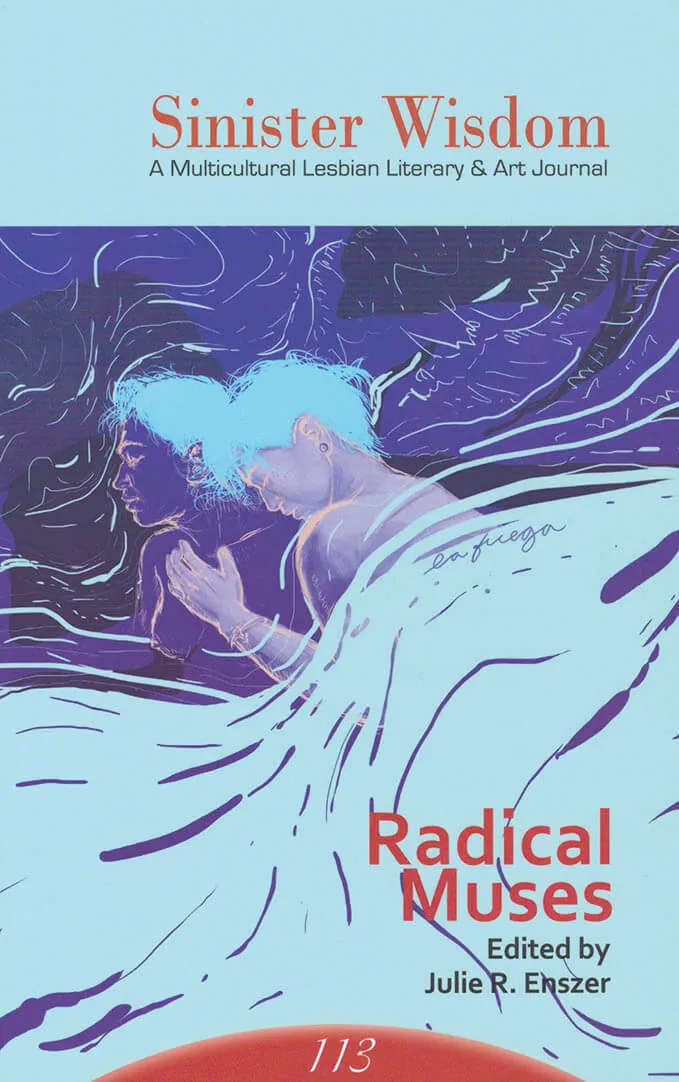
Cover of Radical Muses (Sinister Wisdom nr. 113)

Sinister Wisdom

Radical Muses (Sinister Wisdom nr. 113)

Julie R. Enszer

Sinister Wisdom 113: Radical Muses features an eclectic array of contemporary poetry, prose, and art by lesbians from around the world, including new work by: Andrea Assaf, Tara Shea Burke, Cheryl Clarke, Marina Chirkova, Estela González, Barbara Haas, Nancy E. Lake, Vi Khi Nao, H. Ní Aódagaín and much more!

Cover of Girls Like Us #6 - Secrets

Girls Like Us

Girls Like Us #6 - Secrets

Jessica Geysel, Sara Kaaman and 2 more

A secret can be a private space for self-creation – or a shared site of pleasure.

We explore secrets in a plethora of forms and contexts. From layered accounts of mediaeval ecstasy to the unexplored sensory experience of smell. From camouflaged play to queer readings of astrological charts and the hidden history of house music. From a very analog point of view to the outskirts of the internet.

Cover of Cunt Coloring Book

Last Gasp

Cunt Coloring Book

Tee A. Corinne

Over three dozen c**ts of every size and description for you to color. Originally used for a sex-education class. Crayons not included. First published in 1975 by lesbian activist and artist Tee Corinne.

"In 1973 I set out to do drawings of women’s genitals for use in sex education groups. I wanted the drawings to be lovely and informative, to give pleasure and affirmation. I organized the drawings into a coloring book because a major way we learn to understand the world, as children, is by coloring. As adults many of us still need to learn about our external sexual anatomy." —Tee Corinne

Tee Corinne was born November 3rd, 1943 and grew up in St. Petersburg, Florida. Her mother, also an artist, introduced her to the creative principles and techniques that would serve her all her life. She received a B.A. in printmaking and painting from the University of South Florida, then went on to get an M.F.A. in drawing and sculpture at Pratt Institute, graduating in 1968. Afterwards she taught for many years, traveled through Europe, and finally became enmeshed in the back-to-the-land movement and communal living. After nearly ten years of marriage to a man she referred to as her "best friend," Corinne came out of the closet amidst severe depression in 1975. The strength to accomplish this difficult effort would later propel her to heights and achievements that would distinguish her as "one of the most visible and accessible lesbian artists in the world." From the mid-1960’s to the day she died Corinne created, published, and exhibited her art and writing around the world. She was a co-facilitator of the Feminist Photography Ovulars and a co-founder of The Blatant Image, A Magazine of Feminist Photography. She was the author of one novel, three collections of short stories, four books of poetry and numerous arts publications. In 1980, she was one of ten selected artists invited to have their work exhibited in the Great American Lesbian Art Show. The world lost Tee Corinne to cancer in 2006.

Cover of This Container 08

Self-Published

This Container 08

Stefan Govaart, Maia Means and 1 more

Poetry €10.00

Bringing together thirty authors variously invested in dance, performance and/or choreography; This Container is a zine for texts produced through and alongside dance, performance and choreography. Some write more than dance; others dance more than write. Some practice choreography explicitly; others implicitly. However varied the authors gathered here may be, the expansive field of performance produces all kinds of texts that deserve public recognition, a readership, and an infrastructure for feedback and editing. This issue is another attempt at making this possible.
 
With contributions by: Paula Almiron, Jani Anders Purhonen, Simon Asencio, Mélanie Blaison, Oda Brekke, Juan Pablo Cámara, Laura Cemin, Matt Cornell, Stina Ehn, Emma Fishwick, Lucija Grbic, Sara Gebran, Andreas Haglund, Hugo Hedberg, Alice Heyward, Madlen Hirtentreu, Eleanor Ivory Weber, Nikima Jagudajev, Sonjis Laine, Yoojin Lee, Denise Lim, Theo Livesey, Naya Moll, Caterina Mora, Rhiannon Newton, Zander Porter, Lena Schwingshandl and Stav Yeini.
 
Since its inception, This Container has hoped to contribute to a feminist lineage of textual production. What constitutes this lineage? This is a vast question. The beginning of an answer might start by saying something about genre. If , as Lauren Berlant writes, genre is an “aesthetic structure of affective expectation”, a “formalization of aesthetic or emotional conventionalities”, then genre crafts expectation by pointing to what is recognizable in form.1 If feminism is about wanting the world to be otherwise, the multiplication of genres inducing the multiplication of (imagined) stories helps to recraft expectation toward a less oppressive, less boring, and more just world. Feminist work includes genre work. Poetry, diary, diagram, notes, recipe, critique, the sound file, the epistolary, the essay, the art project: they have all found their way in, sculpting a diverse set of readerly structures of affective expectation. They are to shift your worldly expectations.

More info at http://www.thiscontainer.com