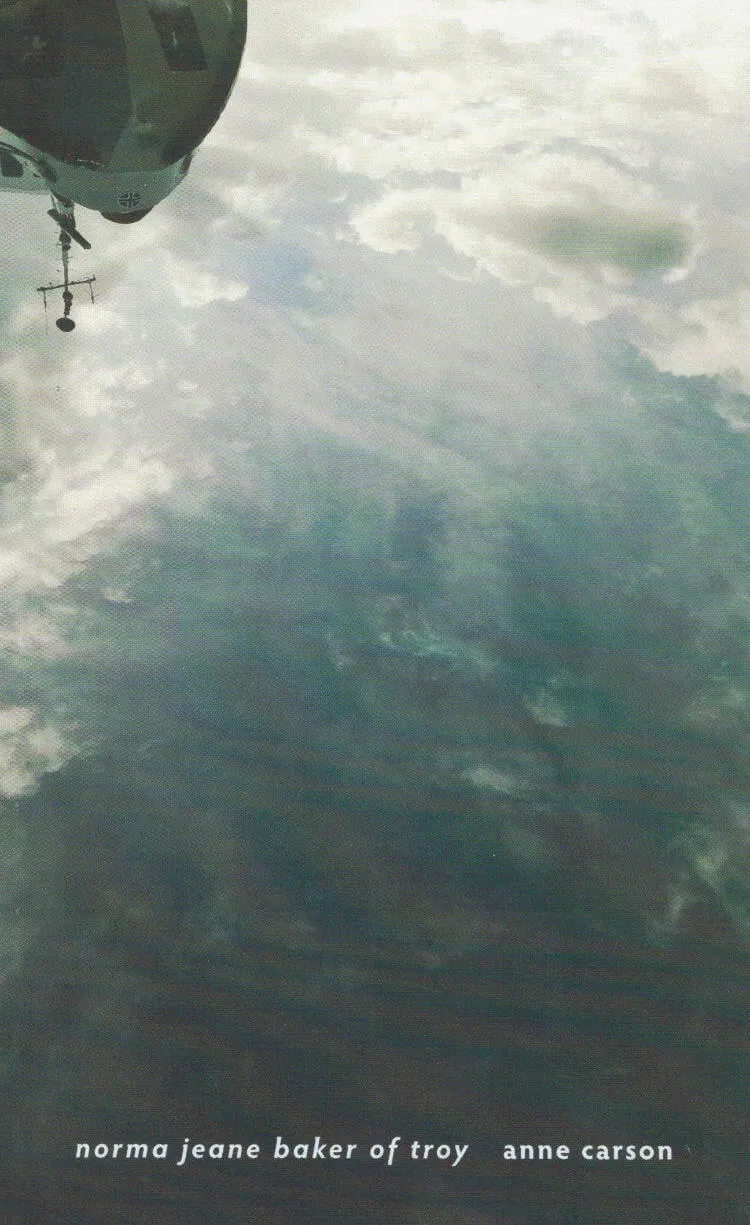
Norma Jeane Baker of Troy
€12.00

Ariana Harwicz, Jessie Mendez Sayer
A bracing novel that asks how far we would go for the ones we love—and what we would do to destroy the ones we hate.
Lisa has lost custody of her young twin boys. Caught between the French legal system’s sluggish bureaucracy and her sinister, scheming in-laws, she’s alone and lost, an Argentine migrant in rural France picking grapes for a pittance, only allowed to see her children in supervised visits once a month. Scapegoated and outcast, destitute and desperate, Lisa decides to take radical action: early one morning, she sneaks into her in-laws’ farmhouse, takes back her children, sets the barn ablaze, and makes her escape.
What follows is a white-knuckled road trip that explores human beings pushed to the edge. Clearly, Lisa is not in her right mind, and as Harwicz deftly mingles a chorus of contradictory voices into her very unreliable narration, the reader comes to regard the protagonist with an unsettling mixture of sympathy and suspicion. Written in savage, chiseled prose, Unfit shoots off, a gripping chase that questions all our assumptions—and points out our hypocrisies— about motherhood, custody rights, love, violence, anti-semitism, and migration. The latest novel by the acclaimed author of Die, My Love (soon to be adapted to a film starring Jennifer Lawrence), Unfit is addictively terrifying, savagely sophisticated, and shockingly brilliant.
Translated from Spanish by Jessie Mendez Sayer

Near to the Wild Heart, published in Rio de Janeiro in 1943, introduced Brazil to what one writer called "Hurricane Clarice" a twenty-three-year-old girl who wrote her first book in a tiny rented room and then baptized it with a title taken from Joyce: "He was alone, unheeded, near to the wild heart of life."
Narrative epiphanies and interior monologue frame the life of Joana, from her middle-class childhood through her unhappy marriage and its dissolution to transcendence, when she proclaims: "I shall arise as strong and comely as a young colt."

Clarice Lispector, Benjamin Moser
The devastating final work by Brazil’s greatest modern writer, The Hour of the Star tells the haunting tale of Macabéa—a typist who lives in the slums of Rio—underfed, sickly, and unloved, yet inwardly free.
Translated from the Portuguese by Benjamin Moser. With a contribution by Paulo Gurgel and Valente Colm Tóibín.
The Hour of the Star, Clarice Lispector's consummate final novel, may well be her masterpiece. Narrated by the cosmopolitan Rodrigo S.M., this brief, strange, and haunting tale is the story of Macabéa, one of life's unfortunates. Living in the slums of Rio de Janeiro and eking out a poor living as a typist, Macabéa loves movies, Coca-Cola, and her rat of a boyfriend; she would like to be like Marilyn Monroe, but she is ugly, underfed, sickly, and unloved. Rodrigo recoils from her wretchedness, and yet he cannot avoid realization that for all her outward misery, Macabéa is inwardly free. She doesn't seem to know how unhappy she should be. Lispector employs her pathetic heroine against her urbane, empty narrator—edge of despair to edge of despair—and, working them like a pair of scissors, she cuts away the reader's preconceived notions about poverty, identity, love, and the art of fiction. In her last novel she takes readers close to the true mystery of life, and leaves us deep in Lispector territory indeed.

Yoko Tawada, Lisa Hofmann-Kuroda
Yoko Tawada's first essay collection in English presents and electrifying new side of the National Book Award-winner as she dives deep into her lifelong fascination with cross-hybridizing languages. The accent here, as in her fiction, is on the art of drawing closer to the world through defamiliarization. Tawada famously writes in both Japanese and German, but her interest in language reached beyond any mere dichotomy.
The term "exophonic," which she first heard in Senegal, has a special allure for the author: "I was already familiar with similar terms. 'immigrant literature,' or 'creole literature,' but 'exophonic' had a much broader meaning, referring to the general experience of existing outside of one's mother tongue." Exophony opens a new vista into Yoko Tawada's world and delivers more of her signature erudite wit—at once cross-grained and generous, laser-focused and multidimensional, slyly ironic and warmly companionable.
A New Yorker Best Book of 2025. Translated from Japanese by Lisa Hofmann-Kuroda.

New Infinity is an experimental novella that follows a woman as she lives and dreams her way through the philosophical implications of autoimmune disease. Met by a labyrinth of closing doors, she searches for meaning and connection among fragmented realities and failed relationships, finding infinitude in the healing process of bibliomancy.
Bára Hladík’s New Infinity is a glittering cross-genre debut. Weaving surrealist stories with meditative poetics, Hladík invites you into a dream world of degenerative illness, left disordered by the failures of ableism, medical professionals, and late-stage capitalism. Here, everything runs on sick time. Where physical health and financial resources grow scarce, the restorative possibilities of queer love, divination, and self-reclamation grant a defiant, yet often tenuous, abundance. Alive with Hladík’s boundless insight and wit, New Infinity is a powerful addition to the collective body of disability literature.
“I have been waiting for a book like New Infinity for years: a story of disability that oozes over the edges of ‘personal narrative’ into the surreal logics of bodies that will not be made useful under capitalism. Bára Hladík’s prose delights me with its 21st-century metamorphoses, its waiting-room dream logics, and its mystical invocations of a body in pain. Her poetry is a channel to another dimension, but one that is grounded inside our everyday sensoria—’cracking, pushing, pulsing’ like a spine writhing with snakes. Here, embodiment is never extractable from the institutions and economies whose profits are predicated on the question ‘do I matter if / I am only a pulse’? New Infinity insists upon a different kind of mattering, in which missed connections, improper fusions, and fleeting moments command the careful, caring attention that is too often denied them.” – Liz Bowen, author of Compassion Fountain (Trembling Pillow Press) and Sugarblood (Metatron Press)
“New Infinity is the most incredible fiction. It explodes the boundaries of this form so as to get to the heart of important truths about the phenomenon of physical pain and of human existence itself. While Bára Hladík’s story draws from a personal experience of survival through a struggle unlike any other, it is an entirely universal tale. In taking us into the most intimate spaces of suffering and narrating a story of a woman navigating a true labyrinth, Hladík shows us a way to face life, with the uncertainties it presents to us all. This novel is at once a profoundly moving story, a brilliant act of creativity, and an existential philosophy. It’s a book I will keep close, so as to revisit— for the thrilling inspiration of its liberated uses of form and style, as well as to learn from Hladík’s honest language, her resilient sense of humour, and her ability to capture the surreal beauty of being alive at all. I felt like I was reading Franz Kafka crossed with a fully unconstrained Anne Carson. I haven’t been so impacted by a book in a long time. It has changed my ways of seeing, feeling, and thinking about what it means to be alive.” – Molly Lynch, author of The Forbidden Territory of a Terrifying Woman (Catapult Books, 2023)
“Bára Hladík’s debut book is a blend of poetry and prose that seeks to make sense of a world that is flagrantly hostile and impatient with bodies that neither perform nor conform to the manic impatience of capitalist acceleration. An honest, vibrant, and very real account of a young writer finding a voice.” – Sina Queyras, writer, editor, professor, curator
“Bára Hladík’s New Infinity is a stirring pedagogy, philosophy, and witness. This offering of sick hybridity coils in a long, calm, and exhilarating breath while asking, ‘Do the doctors know how to breathe?’ Yes, Hladík’s prose and poems prompt, pain cosmologies are at once funny and incantatory. Each of New Infinity’s oneiric turns reads the body as an oracle and mirror, reminds us we are atmospheric. I would rather live here in this book, relearn how to breathe, than return to the ‘impossible crank’ of normal.” – Jane Shi, writer, poet, editor, organizer
Bára Hladík is a Czech-Canadian writer, editor and multimedia artist. Born in Ktunaxa Territory, she began her literary studies in the Creative Writing program at Capilano University in 2011. After studying Technical Writing at the British Columbia Institute of Technology, she received her Bachelor of Arts in Literature and Communications from the University of British Columbia in 2016. Her work can be found in Briarpatch Magazine, THIS Magazine, Contemporary Verse 2, Carte Blanche, EVENT Mag, Hamilton Arts and Letters, Bed Zine, Empty Mirror, Cosmonauts Avenue and elsewhere. Bára’s microchapbook Book of Mirrors was selected for the 2019 Ghost City Press Summer Micro-Chap Series and her collaborative artist book Behind the Curtain (Publication Studio, 2018) was an honourable mention for the Scorpion and Felix Prize (2017). New Infinity is Bára’s first book. She is now a guest in Esquimalt, BC.

Written in the course of the year following the publication of Book of Mutter, and inspired by the lectures of Roland Barthes, Anne Carson, and Jorge Luis Borges, Appendix Project collects eleven talks and essays. These surprising and moving performances, underscored by the sleeplessness of the first year of their child’s life, contain their dazzling thinking through the work of On Kawara, Roland Barthes, W.G. Sebald, Bhanu Kapil, Walter Benjamin, Theresa Hak Kyung Cha, Marguerite Duras, Marlene Dumas, Louise Bourgeois, Doris Salcedo, Jenny Holzer, and more.

Known as a remarkable classicist, Anne Carson weaves contemporary and ancient poetic strands with stunning style in Glass, Irony and God. This collection includes: "The Glass Essay," a powerful poem about the end of a love affair, told in the context of Carson's reading of the Bronte sisters; "Book of Isaiah," a poem evoking the deeply primitive feel of ancient Judaism; and "The Fall of Rome," about her trip to "find" Rome and her struggle to overcome feelings of a terrible alienation there.
Anne Carson was born in Canada and teaches ancient Greek for a living.

Anne Carson's remarkable first book about the paradoxical nature of romantic love. Since it was first published, Eros the Bittersweet, Anne Carson's lyrical meditation on love in ancient Greek literature and philosophy, has established itself as a favorite among an unusually broad audience, including classicists, essayists, poets, and general readers.
Beginning with the poet Sappho's invention of the word "bittersweet" to describe Eros, Carson's original and beautifully written book is a wide-ranging reflection on the conflicted nature of romantic love, which is both "miserable" and "one of the greatest pleasures we have."

Human history is filled with unacceptable sounds: high-pitched voices, gossip, talkativeness, hysteria, wailing and ritual shouts. Who makes them? Those deviant from or deficient in the masculine ideal of self-control: women, catamites, eunuchs and androgynes all fall into this category.
From the myths of antiquity to Margaret Thatcher via Sigmund Freud and Gertrude Stein, The Gender of Sound charts the gendering of sound in Western culture. Carson invites us to listen again, and in doing so to reimagine our conceptions of human order, virtue and selfhood.
Putting a door on the female mouth has been an important project of patriarchal culture from antiquity to the present day. Its chief tactic is an ideological association of female sound with monstrosity, disorder and death.

Dorothea Lasky’s stunning new collection of poems presents an unfurling, terrifying, and fiercely loving embodiment of motherhood as a force of creation. Inspired by Bernadette Mayer’s The Desires of Mothers to Please Others in Letters, Lasky writes from the inner realm of a third pregnancy and guides us through a suspended timeline taut with anticipation. Mother documents caring for small children, the death of the mother, and the simultaneous anxiety and darkness of impending birth, as Lasky transmits from a deep mythic and biologically immediate space: “And even though I’ve spent / Eight months now / Dreading the sight / Of anything red / Now I long to bleed all over.” Invoking the eternal symbol of the mother, Lasky asks us to consider an expansive understanding of the horror and devotion inherent in the daily practices of existence.
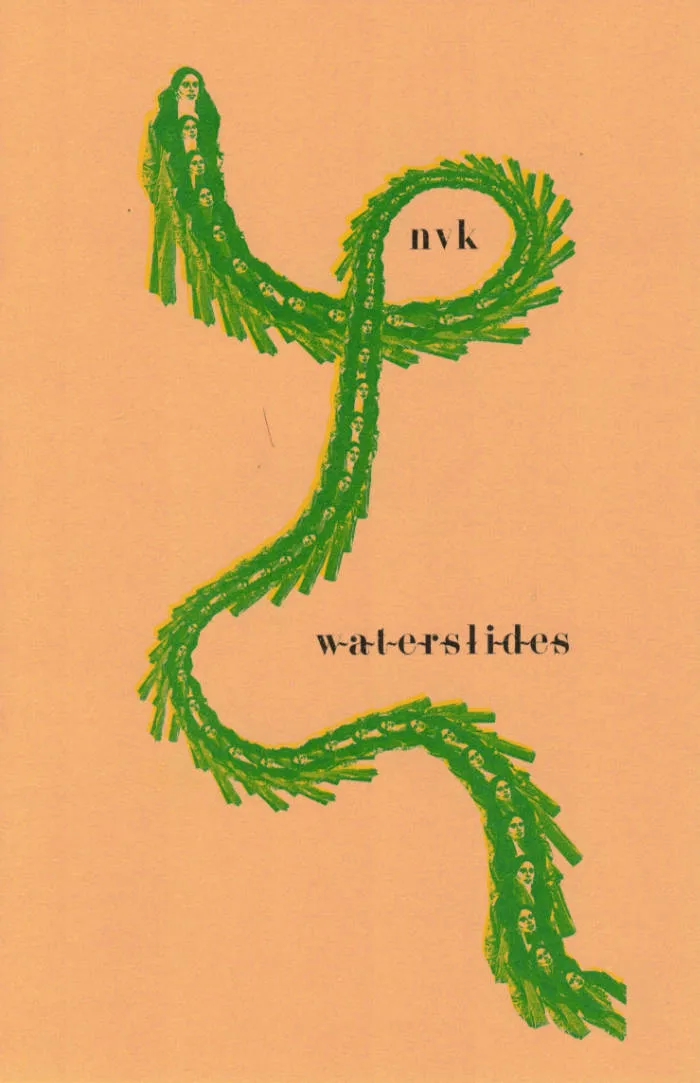
"Waterslides is a falling and plunging, short starts and stops aided by movement, until we splash, climb and plunge again. Each sliding is the same but different—with each descent new expectations and thoughts swirl, shifting focus and gaining new insights or blockages. Waterslides are brief moments of remembering, remembering as a present tense activity, one that happens as we think of it, projected on our now. The waterslide is the moment of past and present working in tandem, a movement of repeating, revisiting and remembering all at once.”
Written by nvk 2021-2023. Dedicated to Judi, MM & TNN.
A version of these poems was published as an audio work through Ignota Press’ The Mountain (2023) and included in a reading with James Loop on Montez Press Radio (2023). nvk would like to thank Jan Matthé, Stine Sampers and Michelangelo Miccolis for their patience & love.
This book was first presented at Kransen in Antwerp, May 6th 2023, with a performance by Sassy (costume by Rosa Schützendorf). Printed and bound at Risiko Press, Borgerhout. Cover image by nvk. Fonts: Adonis, Garamond Pro. Limited to 150 copies.
128x195mm, 16p., stapled, cover: green, yellow and black risoprint on 160gsm caramel paper, inside: black and blue riso on 120gsm Munken Pure paper.

Responses to Untitled (eye with comet) (c.1985) by Paul Thek is the sixth and final anthology in a series that gathered responses to works of art made during a period of the ongoing AIDS Crisis, from the identification of the virus in 1981 to the introduction of life-saving drugs in 1996.
In this sixth iteration, responses were sought to the painting Untitled (eye with comet) by Paul Thek. The work was found in his storage after his death from AIDS in 1988.
List of contributors in order of appearance:
E.R. De Siqueira
Ben Estes
João Motta Guedes
Lucy Swan
Jon Rainford
Louis Shankar
Amy Evans Bauer
Hattie Morrison
Sammy Paloma
AN Grace
James Horton
Nick Wood
Sophie Paul
Jae Vail
Elizabeth Zvonar
Lars Meijer
Clay AD
Michel Kessler
Pablo Miguel Martínez
Emma Harris
Dylan McNulty-Holmes
Kitya Mark
Katherine Franco
Ainslie Templeton
Alistair McCartney
John Brooks
Jesse Howarth
jimmy cooper
Felix Pilgrim
Nicholas Chittenden Morgan
Murphy O’Neir
Rachel Cattle
Isabel Nolan
Susan Finlay
Ted Simonds
Brooke Palmieri
Kate Morgan
Ashleigh A. Allen
Diogo Gama
JP Seabright
Hugo Hagger
Amanda Kraley
Brendan Cook
Matt Bailey
Charlotte Flint
Rodney Schreiner
Lucy Price
Morgan Melhuish
Jordan Weitzman
Jaakko Pallasvuo
Alex Fiorentino
Harald Smart
Marguerite Carson
loll jung
Richard Porter
Nicholas Kalinoski
Hedi El Kholti
Edmund Francis English
Ted Bonin