rile*books

Search books

Search books by title, author, publisher, keywords...

Cover of Death by Landscape

Soft Skull Press

Death by Landscape

Elvia Wilk

€17.00

From the acclaimed author of the novel Oval comes a book of "fan nonfiction" about living and writing in the age of extinction.

In this constellation of essays, Elvia Wilk asks what kinds of narratives will help us rethink our human perspective toward Earth. The book begins as an exploration of the role of fiction today and becomes a deep interrogation of the writing process and the self.  

Wilk examines creative works across time and genre in order to break down binaries between dystopia and utopia, real and imagined, self and world. She makes connections between works by such wide-ranging writers as Mark Fisher, Karen Russell, Han Kang, Doris Lessing, Anne Carson, Octavia E. Butler, Michelle Tea, Helen Phillips, Kathe Koja, Jeff and Ann VanderMeer, and Hildegard von Bingen.  

What happens when research becomes personal, when the observer breaks through the glass? Through the eye of the fan, this collection delves into literal and literary world-building projects—medieval monasteries, solarpunk futures, vampire role plays, environments devoid of humans—bridging the micro and the macro and revealing how our relationship to narrative shapes our relationships to the natural world and to one another.

Published in 2022 ┊ 320 pages ┊ Language: English

recommendations

Cover of Plastic: A Poem

Soft Skull Press

Plastic: A Poem

Matthew Rice

Poetry €16.00

Set during a single twelve-hour night shift in an injection molding factory, plastic is a book-length poem exploring the life of the industrial worker turned poet.

Bringing together memoir, ekphrasis, and satire, plastic is based on Matthew Rice’s experience working in a plastic molding factory for ten years. Illustrating alienated twenty-first-century Irish labor in poetic form, plastic engages with the inflictions and implications of a “post-industrial,” “post-Troubles” society, all while weaving in depictions of factory work from literature, film, and the visual arts.

Time-stamped to highlight the claustrophobia of the worker’s experience, Rice meditates on masculinity, sectarianism, and intergenerational trauma. But at its core is a poem about feeling a calling while being submerged in the world of menial labor—making plastic airplane parts by night, making poetry by day.

Invoking the brevity of Seamus Heaney, plastic is an expansive and imaginative poem that offers the working class a grace, dignity, and truth not often found in contemporary literature.

MATTHEW RICE was born in Belfast. He holds an MA in poetry from Queen’s University Belfast and is currently undertaking a PhD at the Seamus Heaney Centre at Queen’s. His debut collection, The Last Weather Observer, was published in 2021 to critical acclaim, highly commended for the Forward Prize for Best First Collection, and included in the Arts Council of Northern Ireland’s top ten books of the year.

Cover of Subduing Demons in America: Selected Poems 1962-2007

Soft Skull Press

Subduing Demons in America: Selected Poems 1962-2007

John Giorno

Poetry €20.00

Associated with key 1960s avant garde figures such as Ginsberg, Burroughs, Rauschenberg, and Johns, John Giorno was an early pioneer of multimedia poetry through Giorno Poetry Systems, which also distributed a who’s who of the American underground from Patti Smith to Sonic Youth. Giorno’s use of transgressive material and in-your-face, amplified delivery was also a key influence on punk/new wave pioneers such as Suicide, Throbbing Gristle, and Black Flag. Not just a poet but a sexual, spiritual, and political radical, Giorno helped pioneer the open celebration of queer sexuality in poetry in the 1960s.

Subduing Demons in America offers the best of Giorno’s revolutionary poetry, from his striking Pop Art–influenced poems of the 1960s to the psychedelic, echo-laden, multitracked cut-ups of the 1970s with their explosive configurations of queer sex, spiritual practice, and the bohemian Good Life. Also here are the pared-down punk/hip-hop performance poems that Giorno performed in the 1980s.

Cover of Sonic Faction: Audio Essay as Medium and Method

Urbanomic

Sonic Faction: Audio Essay as Medium and Method

Maya B. Kronic, Steve Goodman and 1 more

Explorations of the audio essay as medium and method.

With contributors including Justin Barton, Angus Carlyle, Kodwo Eshun, Steve Goodman, Robin Mackay, Paul Nataraj, and Iain Sinclair, Sonic Faction presents extended lines of thought prompted by two Urbanomic events which explored the ways in which sound and voice can produce new sensory terrains and provoke speculative thought.

Three recent pieces provide the catalyst for a discussion of the potential of the "audio essay" as medium and method, a machine for intensifying listening and unsettling the boundaries between existing forms: documentary, music, ambient sound, audiobook, field recording, radio play….

Kode9's Astro-Darien (2022) is a sonic fiction about simulation, presenting an alternative history of the Scottish Space Programme, haunted by the ghosts of the British Empire. Justin Barton and Mark Fisher's On Vanishing Land (2006) is a dreamlike account of a coastal walk that expands into questions of modernity, capitalism, fiction, and the micropolitics of escape. Robin Mackay's By the North Sea (2021) is a meditation on time, disappearance, and loss as heard through the fictions of Lovecraft, Ccru, and the spectre of Dunwich, the city that vanished beneath the waves.

Alongside photographic documentation of the events and edited transcripts of the artists' discussions, Sonic Faction brings together contributors with diverse perspectives to address the question of the audio essay and to imagine its future.

Contributors
Lawrence Abu Hamdan, Lendl Barcelos, Justin Barton, Ben Borthwick, Angus Carlyle, Matt Colquhoun, Jessica Edwards, Kodwo Eshun, Steve Goodman, Ayesha Hameed, Eleni Ikoniadou, Lawrence Lek, Robin Mackay, Paul Nataraj, Emily Pethick, Iain Sinclair, Shelley Trower

Cover of Meriem Bennani: Life on the Caps

The Renaissance Society

Meriem Bennani: Life on the Caps

Meriem Bennani

Meriem Bennani's Life on the CAPS is the final chapter in her film trilogy of the same name. Set in a supernatural, dystopian future surrounding a fictional island in the middle of the Atlantic Ocean, it is rooted in Bennani’s research and reflections on the histories of island societies, biotechnology, and vernacular music. Layering live-action footage and computer-generated animation, Bennani intuitively adapts editing techniques that evoke documentary film, science fiction, phone footage, music videos, and reality TV. Her one-person exhibition at the Renaissance Society marked the debut of this personal, electric yet melancholic consideration of what it is to live in a state of limbo, and this accompanying book captures the film through a combination of still images and selections from a transcript of the film.

This volume includes essays by Emily LaBarge and Elvia Wilk and transcripts of conversations between Meriem Bennani and: Omar Berrada; Fatima Al Quadiri, Negar Azimi, and Tiffany Malakooti; Amal Benzekri; and Aziz Bouyabrine.

Cover of Some Monologues

Wendy's Subway

Some Monologues

Tyler Coburn

Working at the nexus of performance, art writing, and fiction, Tyler Coburn creates monologues that explore how the “I” is marked in speech. His myriad topics—alternate history, legal personhood, digital labor, and resonant frequency, to name a few—defy straightforward modes of presentation, often insisting on site-specificity and social intimacy at the expense of conventional documentation. 

Some Monologues collects, for the first time, the scripts of Coburn’s work from the past fifteen years, many of which have not previously been published. Accompanying them are texts by eleven artists, writers, curators, and scholars who experienced these performances firsthand, collaborated in their making, conversed with the artist about them, or share an interest in the subjects they engage. Written in theoretical, poetic, and autobiographical registers, these contributions offer new perspectives on the monologue as an expansive and relational form.

Introduction by Elvia Wilk. Contributions by Yu Araki, A.E. Benenson, Mashinka Firunts Hakopian, Sven Lütticken, Kameelah Janan Rasheed, Spyros Papapetros, Camille Richert, Théo Robine-Langlois, Ian Wallace, and Michelle Wun Ting Wong.

Tyler’s scripts refuse to fix an authorial voice; instead, they make the conditions of authorship itself their subject. Blurring the boundaries between fiction and document, the human and the bureaucratic, the self and its doubles, his work thinks through systems from the inside, often using language as both architecture and trap. In their precision and porousness, I recognize a shared pursuit: how to locate agency within constraint, and how to turn the administrative or the technological into a site of intimacy. — Jill Magid

In Tyler Coburn’s Some Monologues, a binary that remains constitutive for the ideological continuity of modern life, in all its colonial and capital forms, is undone: digital vs. physical. In troubling that chasm, Coburn plays out the repercussions of these ideologies of anthropomorphic naturalism, guiding us through their resonances, doubles, codings, and relays. But he also renders himself as the relay of these transferences, in the process expanding art’s premodern calling: to exist as an invocation. Reification suddenly appears as what is situated between embodiment and disembodiment, with both potentially destabilized. Some Monologues, the book, is this destabilization’s ideal format: as much documentation, an echo, of Coburn’s works through their scripts, as it is an instruction manual for denaturalizing our sense/s. — Kerstin Stakemeier

Tyler Coburn is an artist, writer, and professor based in New York. He received a 2024 Andy Warhol Foundation Arts Writers Grant, and his writing has appeared in ArtReview, BOMB, C Magazine, Dis, e-flux journal, frieze, LEAP, Metropolis M, Mousse, and Rhizome. Coburn is the author of four books: I’m that angel (self-published, 2012), Robots Building Robots (CCA Glasgow, 2013), Richard Roe (Sternberg, 2019), and Solitary (Sternberg and Art Sonje Center, 2022). He has presented artwork at such venues as Centre Pompidou, Paris; Bergen Kunsthall; Hayward Gallery, London; Para Site, Hong Kong; and Kunstverein Munich. 

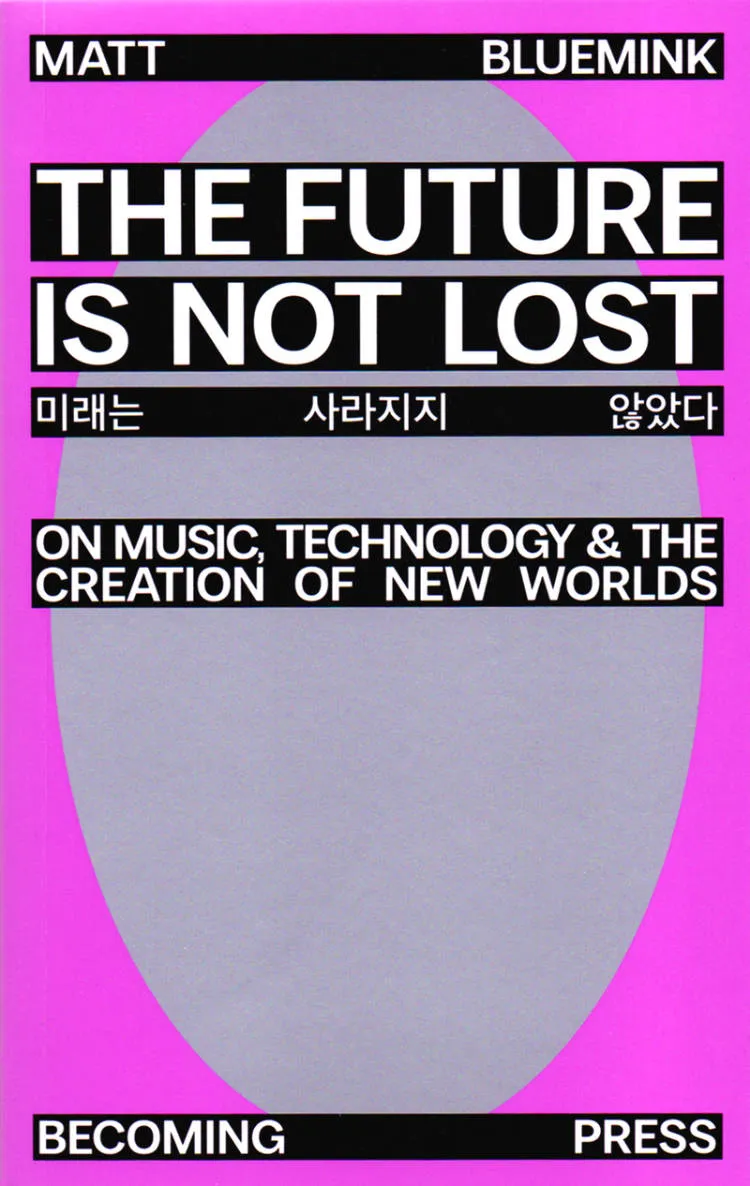
Cover of The Future is not Lost: On Music, Technology, and the Creation of New Worlds

becoming press

The Future is not Lost: On Music, Technology, and the Creation of New Worlds

Matt Bluemink, Alessandro Sbordoni

Philosophy €16.00

Mark Fisher taught a generation to hear the future's disappearance in contemporary music, as if the rhythm of the world was synchronised to the periodic flowering of new creative forms. His diagnosis was devastating: stagnation in music was akin to a venous insufficiency, or worse, some kind of nuclear winter that would ward off the spring for endless generations to come. 

Drawing on musicians like SOPHIE, Arca and Iglooghost, Matt Bluemink declares that the future is not lost; it still speaks to us through music. If Fisher’s Hauntology — dwelling on ghosts of the past — is the logic of depression, then Bluemink’s Anti-Hauntology posits a logic of hope where voices from the future continue to guide the development of the present. 

Island-hopping through Stiegler's philosophy of technics, Simondon's theory of individuation, and the spatial imaginaries of cyberpunk and solarpunk, Bluemink builds a theoretical framework equal to the times — one that takes seriously our capacity to, not only diagnose the world, but remake it. In order to create a new future we must re-imagine our relationship with music, with technology, and with culture. The world of tomorrow is a blank canvas; an open book. New beginnings are always possible. 

Matt Bluemink is the founder and editor-in-chief of Blue Labyrinths online magazine. His research is focused on the relationship between the philosophy of technology, media theory and urbanism. He also writes on contemporary music, literature, and digital culture. 

Cover of Semiotics of the End: Essays on Capitalism and the Apocalypse

becoming press

Semiotics of the End: Essays on Capitalism and the Apocalypse

Alessandro Sbordoni

Philosophy €12.00

The apocalypse as such will not take place, as it is already finished. Today, there is no longer any difference between the end of the world and capitalism itself: from Britney Spears’ Till the World Ends to The Caretaker’s Everywhere at the End of Time, from Avenger’s Endgame to Donnie Darko, and all the way down to the internet’s Backrooms, the world never ends but is reproduced again and again according to the semio-logic of capital. 

In contrast with Mark Fisher’s Capitalist Realism, Semiotics of the End is a manifesto for the imagination of another relationship with the end. If it is easier to imagine the end of the world than the end of capitalism, as Slavoj Žižek, Fredric Jameson, and Mark Fisher put it, it is only because we have not imagined anything yet. The end is just the beginning.

With an Afterword by Matt Bluemink 

Cover of A Room of One's Own

Mariner Books

A Room of One's Own

Virginia Woolf

Essays €14.00

In A Room of One's Own, Virginia Woolf imagines that Shakespeare had a sister—a sister equal to Shakespeare in talent, and equal in genius, but whose legacy is radically different. This imaginary woman never writes a word and dies by her own hand, her genius unexpressed. If only she had found the means to create, argues Woolf, she would have reached the same heights as her immortal sibling.

In this classic essay, Woolf takes on the establishment, using her gift of language to dissect the world around her and give voice to those who are without. Her message is a simple one: women must have a steady income and a room of their own in order to have the freedom to create.

With a Foreword by Mary Gordon

Cover of Typing...

Estonian Academy of Arts / EKA GD MA

Typing...

Lieven Lahaye

Essays €12.00

The fourth in a series of publications, featuring writing by graphic design students of EKA GD MA. Typing... includes essays, scripts, translations and stories on a wide range of topics: killing vowels and milling fonts, personal knowledge management, shortcuts, tedious/careful/tiring/joyful typesetting, type of Georgianness, typing in 3rab(izi) and typing in all lowercase.

With contributions by Anna Wittenkamp Rich, Archil Tsereteli, Fa(tima)-Ezzahra El Khammas, João (Juca) Pedro Nogueira, Karthik Palepu, Laura Martens, Linnea Lindgren, Rok Ifko Kranjc.

Designed by Fatima-Ezzahra El Khammas and Laura Martens
Cover by Hanafi Gazali

Cover of Nilling

Book*hug Press

Nilling

Lisa Robertson

Poetry €18.00

NILLING: PROSE is a sequence of five loosely linked prose essays about noise, pornography, the codex, melancholy, Lucretius, folds, cities and related aporias: in short, these are essays on reading.

"I have tried to make a sketch or a model in several dimensions of the potency of Arendt's idea of invisibility, the necessary inconspicuousness of thinking and reading, and the ambivalently joyous and knotted agency to be found there. Just beneath the surface of the phonemes, a gendered name rhythmically explodes into a founding variousness. And then the strictures of the text assert again themselves. I want to claim for this inconspicuousness a transformational agency that runs counter to the teleology of readerly intention. Syllables might call to gods who do and don't exist. That is, they appear in the text's absences and densities as a motile graphic and phonemic force that abnegates its own necessity. Overwhelmingly in my submission to reading's supple snare, I feel love."

Cover of Chesil Cliff House and other failures

Sticky Fingers Publishing

Chesil Cliff House and other failures

Sam Moore

Orbiting around the saddest house in the history of Grand Designs, Sam Moore’s Chesil Cliff House and other failures takes us to North Devon where, standing at the cliff’s edge, we meet Edward Short: a man with a Fred Perry shirt and a dream. Amongst a chorus of characters including Kevin Mcloud as Father Time, Moore by means of Short leads us into a study of creative failure, gender, and, ultimately, the desire to keep writing.

"I struggle to see anyone living here. It feels like a distorted wonder of the world, a cautionary tale. Something that could never have been lived in, but that had to be made."

About the author:
Sam is a writer, artist, and editor. They are the author of All my teachers died of AIDS (Pilot Press), Long live the new flesh (Polari Press), and Search history (Queer Street Press). They are one of the co-curators of TISSUE, a trans reading and publishing initiative based in London.

About A Series of Attempts:
This new series published by Sticky Fingers Publishing explores the essay form through the etymological root of essay: to try, trial or attempt. In 1508, French theorist Michel de Montaigne published a collection of 107 texts called Essais, described by his contemporaries as ‘self-indulgent and embarrassingly confessional.’ It is through these roots we find the attitude and intentions at the heart of this series; that through thinking together, through trying to figure it out on the page, we can reach new and increasingly nuanced ways to understand each other and the worlds we inhabit.

Cover of Wave of Blood

Divided Publishing

Wave of Blood

Ariana Reines

Poetry €16.00

Is it the computerization of the planet
Or a loosening of my fidelity to suffering
I don’t understand the intensity
I’ve hidden here but I know I despaired
Of finding a physical place to keep
My tears. Now what. Seas that go turquoise
When you stop looking at them . . .
 
Wrestling with the mind of war, at times shocking in its self-analysis, Wave of Blood is a furious and sincere essay, an eclipse notebook, a family chronicle, all told in the poetry of witness.

Praise for Ariana Reines:

Ariana Reines is a go-for-broke artist who honors her traditions by being like no one else. Some of us have made a fetish of our stupidity, pretending to forget history, and some of us have made a fetish of despair, congratulating ourselves on melancholia, but Ariana is too brilliant and too alive for either of those sad luxuries... I am convinced of the authenticity of the summonses she receives and the summonses she issues and when I read her I am reminded that all of this is a calling before it's an identity or career. Her voice-which is always more than hers alone is a dialectic between the very ancient and the bleeding edge. - Ben Lerner

Reines's books are works of intellectual commitment and structural sophistication; at the same time, they allow the raw stuff of being, in all its messiness, to enter the page. -The White Review

Mind-blowing. - Kim Gordon

Her writing is queer and raunchy, raw and occult, seemingly never pulling away from her deepest vulnerabilities. Yet Reines simultaneously maintains a feeling of epic poetry, of ancient intention. She moves between worlds in search of the divine and the self. - The New York Times

These are the kinds of poems that reorient you in the world, make you understand how little you know, but how much is inside you. - NYLON