rile*books

Search books

Search books by title, author, publisher, keywords...

Cover of Lesbian Resistance

Sinister Wisdom

Lesbian Resistance

Sinister Wisdom

€7.00

Sinister Wisdom 48: Lesbian Resistance's writers envision taking power in many ways: some advocate armed struggle, others believe in challenging systems from within, some speak for coalition politics, some for separatism, still others imagine resistance as changing the processes between us. This issue admires and encourages this fantastic lesbian resilience.

Creative Work By

Kathleen O'Donnell
Janice Gutman
Naomi Guilbert
Amber L. Katherine
Sauda Burch
Lisa kenney
Susan Rosenberg
Laura Whitehorn
Jo Ann Starr
Sheila Gilhooly and barbara findlay
L.A. Dyer
Lenore Baeli Wang
Jasmine Marah

And More!

Language: English

recommendations

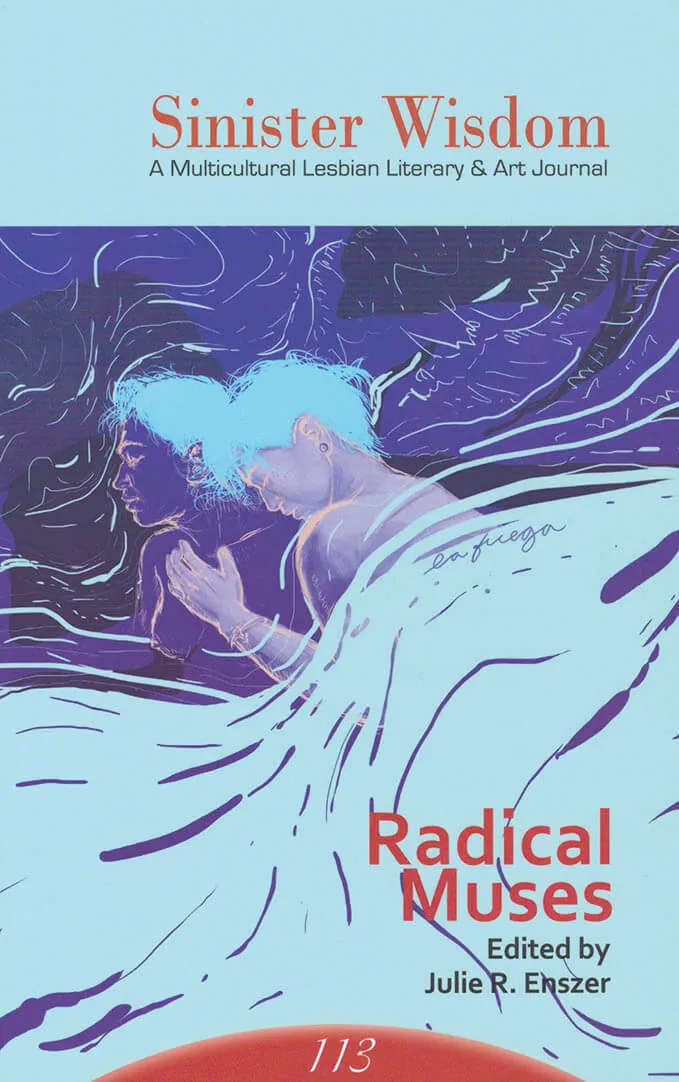
Cover of Radical Muses (Sinister Wisdom nr. 113)

Sinister Wisdom

Radical Muses (Sinister Wisdom nr. 113)

Julie R. Enszer

Sinister Wisdom 113: Radical Muses features an eclectic array of contemporary poetry, prose, and art by lesbians from around the world, including new work by: Andrea Assaf, Tara Shea Burke, Cheryl Clarke, Marina Chirkova, Estela González, Barbara Haas, Nancy E. Lake, Vi Khi Nao, H. Ní Aódagaín and much more!

Cover of Celebrating the Michigan Womyn's Music Festival

Sinister Wisdom

Celebrating the Michigan Womyn's Music Festival

Sinister Wisdom

Sinister Wisdom 103: Celebrating the Michigan Womyn's Music Festival honors the forty-year legacy of the Michigan Womyn’s Music Festival (1976–2015). Sinister Wisdom 103: Celebrating the Michigan Womyn's Music Festival celebrates this embodiment of radical feminist separatist collaboration, transformational self-defined autonomous spaces, a commitment to sisterhood and matriarchal culture, and a musical city sprung from the earth for one week in the woods.

A collective of five womyn each with a deep connection to Fest operated by consensus to create this issue. Striving to represent a range of womyn’s voices, values, traditions, and experiences of Fest, the collective highlighted what Fest has meant to generations of womyn, documented its chronology, and bore witness to the power of this community. Sinister Wisdom 103: Celebrating the Michigan Womyn's Music Festival includes womyn from multiple races, geographies, sexualities, generations, and gender and other social identities. Just as Fest brought together womyn from various backgrounds, our collection includes a range of artistic experience, from seasoned authors and photographers to those womyn new to publishing.
Sinister Wisdom 103: Celebrating the Michigan Womyn's Music Festival remembers the transformations, possibilities, and hopes for spaces cultivating the ongoing empowerment of womyn.

Cover of Parapraxis 05: Economies

Parapraxis

Parapraxis 05: Economies

Periodicals €25.00

Like Freud’s prototypical baby, we struggle over whether to keep our body together or to give it away. We all live these scenes of bodily loss. Freud and Marx both sing harmoniously: what we give up, we give under duress. We are not easy with what we’ve been tasked with, but the task has been the same since birth, doubled in the name of emancipation: first, there’s nothing less than to survive alienation and exploitation, then there’s staying alive for one another’s sake. Perhaps the storied antagonism between Freud and Marx turns on the difficulty of holding these tasks together, balanced on the knife’s edge that separates self-interest from collective liberation.

Capitalism does not produce itself all alone, no matter its disciplines and political-economic constraints on the reproduction of society. If Marx taught us anything, it’s that capitalism produces its own gravediggers, the proletariat—“the unreason of reason,” he quipped, where the dominant social order encounters its unconscious element. Through the bad exchange of capitalism comes a gothic reversal, from preconscious life to premature death, where workers end up burying themselves instead of the system that provides the grave plot. That exchange is felt internally, in a rift that cleaves open the self. Freud, for his part, helps us describe how political economy hammers our lives into unreasonable and reasonable shapes, imaginary and real, as countless and heterogeneous as the individual faces in a collective mass. For each and for all, we bring psychoanalysis to bear on the political-economic problems we suffer in common.

King Ketamine. Beyond the vibecession. Austere Mothers. Sick at Work. Money, Feces, Babies, Gifts. Essays by Juliana Spahr, Peter Coviello, Nicolás Medina Mora, Jyoti Rao, and Hannah Proctor. Images of Red Vienna from Wilhelm Reich’s camera, dispatches from Lebanon, and more.

Cover of Mousse #94

Mousse Publishing

Mousse #94

Periodicals €16.00

Petrit Halilaj and Danh Vo in conversation; Forensic Architecture (Eyal Weizman, Nour Abuzaid, and Elizabeth Breiner); Gabrielle Goliath; Edward W. Said; Shumon Basar; Dani Blanga Gubbay; Yvonne Rainer; Thomas Eggerer and Jochen Klein; Tobias Pils; Travis Jeppesen...

Collective intelligence (along with its wildly popular counterpart, brain rot) is a recurring subject of late. This issue is woven together through reflections on methodologies of the collective, larger-than-ourselves dynamics and "what goes unuttered (of, perhaps, what is painfully unutterable)," as Zoé Samudzi writes about Gabrielle Goliath—whose project for the South African pavilion at the upcoming Venice Biennale has been cancelled by the Arts and Culture Minister of her country for being "divisive." We stand in solidarity with the artist. Forensic Architecture's Eyal Weizman speaks of new ways of detecting "hyper-relations" as strategies to confront systemic violence. Edward W. Said, in his crucial 1993 essay "Speaking Truth to Power" (reprinted here), argues that "the intellectual's voice is lonely, but it has resonance because it associates itself freely with [. . .] the common pursuit of a shared ideal." And in our Curators section, Shumon Basar memetically reaffirms that now more than ever, "Comment is king."
Let's not shy away from commenting.

This issue comes with different covers, randomly distributed.

Cover of Parapraxis 07: Romance

Parapraxis

Parapraxis 07: Romance

Periodicals €25.00

It is a particularly unlovely time to be thinking about romance. The heart can be fickle, indulgent, its matters distracting, impractical. But in the heavy boots of our undesirable present, seized by colliding catastrophes, we ask: how do we get out of here? Can the simple math of desire plus futurity break us free? Or is this just a barely veiled expression of our longing for avoidance? When we declare that love is the answer, we often forget the ambivalence of which psychoanalysis warns: love emerges in tandem with hate. It is neither the antidote to aggression nor the basis of a coherent social order. 

As a narrative structure, romance insists on the future. Whether it's with a new lover hoping to break the repetition of bad patterns, in emotional growth born of the analytic couple, or inside the tremulous energy of an insurgent crowd that makes yesterday seem historically distinct from tomorrow, romance threads time with the texture of meaning. Perhaps delusional, perhaps heroic in this audacious promise, romance must also always be a fantasy, an imagined structure that has not yet met its match in the present. While this fantasy is vital to our attachment to the world and each other, it can also provide the fuel for self-serving denial and disavowal. When we say that the youth are not fucking and that they don’t care about politics, these separate charges obscure the nature of their common cause. As the world attempts to disavow the death of the earth and the removal of its peoples, our sense of continuity flees; the receding horizon is not an open road, but a vanishing point. Whither romance? 

Dependent. Detached. Trauma Bonded. The Incest Lobby. Revolution Against Romance. Reading for Love and Labor. Surrealist Bedfellows. Mad Love. Essays by Nadia Bou Ali, hannah baer, Moon Charania, Davey Davis, Kaleem Hawa, Anna Kornbluh, Thomas Ogden, and more.

Cover of Pfeil Magazine #18 – Body

Montez Press

Pfeil Magazine #18 – Body

Periodicals €15.00

From its anatomy and autonomy to its death and diet, this issue focuses on the motif Body and all its meanings, direct and indirect, for instance as in relation to human and non-human bearers of bodies, its inhabitants like bacteria and organs, its social, medical and juridical conditions, its intoxications, chemical processes, traumas, transitions, well-being, replacements, weaknesses, and its opposites.

Within the format of a magazine, each page of Pfeil represents the floor, walls, or ceiling which together create an imagined room displaying a printed exhibition. Each issue is dedicated to a specific word, and artists are invited and given space to work on and with this term, and to construct or deconstruct the architecture around it. Combined, the contributions transform into an organic display surrounding the leitmotif.