rile*books

Search books

Search books by title, author, publisher, keywords...

Cover of Natural Enemies Of Books: A Messy History Of Women In Printing And Typography

Occasional Papers

Natural Enemies Of Books: A Messy History Of Women In Printing And Typography

Sara Kaaman ed., Maryam Fanni ed., Matilda Flodmark ed.

€16.00

Natural Enemies of Books is a response to the groundbreaking 1937 publication 'Bookmaking on the Distaff Side', which brought together contributions by women printers, illustrators, authors, typographers, and typesetters, highlighting the print industry’s inequalities and proposing a takeover of the history of the book. Edited by feminist graphic design collective MMS, the publication includes newly commissioned essays and poems, conversations with former typesetters Inger Humlesjö, Ingegärd Waaranperä, Gail Cartmail, and Megan Downey, and reprints of the original book and other publications.

Published in 2020 ┊ 176 pages ┊ Language: English

recommendations

Cover of Two Revolutions a Day

Occasional Papers

Two Revolutions a Day

Sophie Nys

Monograph €35.00

Two Revolutions a Day marks the first in-depth publication devoted to the work of Sophie Nys, whose artistic practice over the past two decades has unfolded through an enterprising interplay of research, observation, and formal experimentation. Moving between exhibition-making, design, and subtle acts of re-framing, Nys has developed an oeuvre that resists fixed categories while remaining acutely attentive to the structures – historical, linguistic, psychological – that shape how meaning is produced and circulated.

Rather than presenting a linear retrospective, Two Revolutions a Day is organised as an extended conversation between Nys and critic Christophe Van Gerrewey that mirrors the artist’s own methods. Together, they revisit key works and exhibitions from the early 2000s to today, tracing recurring motifs and questions while allowing contradictions and shifts in perspective to remain visible.

Throughout the book, Nys’s fascination with systems of power and authority intersects with a sensitivity to intimacy, subjectivity, and the everyday, engaging with feminist perspectives that examine the politics of representation. Historical figures, marginal anecdotes, and overlooked documents appear alongside reflections on resistance, collaboration, design, and the conditions under which artworks –and the social roles they inhabit – come into being. Language, in particular, emerges as both material and problem: a tool that promises clarity while constantly slipping, misfiring, or revealing its own limits.

Cover of Import – Export, Friperie

Occasional Papers

Import – Export, Friperie

Mekhitar Garabedian

This book brings together a selection of photographs by artist Mekhitar Garabedian, documenting the warehouse of his late father’s company, Melantex, which exported second-hand clothing from Belgium to the Middle East, Asia, and Africa. The images inspired a one-year sculptural intervention by Garabedian, commissioned by the Antwerp Public Art Collection.

Import—Export, Friperie tells a compelling personal and collective story of how displacement can be turned into economic livelihood while creating connections between old and new homes, languages, and textiles.

The photographs are accompanied by an in-depth conversation between Garabedian and curator Samuel Saelemakers about the relationship between photography and sculpture, public representation, and diasporic thinking.

Cover of Stars at Midday –نجوم الضُهر

Occasional Papers

Stars at Midday –نجوم الضُهر

Noor Abed

Stars at Midday –نجوم الضُهر is a personal diary in which the artist and filmmaker Noor Abed compiles visual and poetic notes from the production phase of her film A Night We Held Between, filmed in Palestine in 2023 with family and friends.

Like the film, the book interweaves narrative fragments, song and diaristic observations, creating a fusion of natural and composed sequences of movement, of documentary and fictional elements.

Through a choreography of bodies, sites, stories, and temporalities, Abed’s work prompts contemplation on the manifestations of social action and resistance in everyday life.

Cover of Répondeur

Occasional Papers

Répondeur

Slow Reading Club

Slow Reading Club (SRC) is a semi-fictional reading group initiated and run by Bryana Fritz and Henry Andersen. Since 2016, in numerous contexts, they have rehearsed alternatives to the kinds of reading they were taught in school, actively suppressing semantic content through strobe lights, strange postures, sociality, and toxins. Operating at the contact zones between reader and text, text and text, reader and reader, they attempt to build a practice from within the unstable space of reading itself.

Répondeur is an extensive account of SRC’s practice in collective reading sessions, exhibitions, and textual bootlegging. Imagined as a scroll, with a rhyme structure and typesetting by Will Holder, the book brings together facsimiles of SRC readers, a wide-ranging interview by Alicja Melzacka, new texts by Joyelle McSweeney and Bill Dietz, and visual work and translations by SRC. These discrete elements are interwoven into a complex, shimmering whole, delighting in the ruptures and elisions of one text’s move into the next.

Cover of Born in Flames

Occasional Papers

Born in Flames

Kaisa Lassinaro

Born in Flames – the publication – is the complete authorised graphic translation of Lizzie Borden’s mythical 1983 film Born in Flames. Kaisa Lassinaro’s post-facto screenplay captures all the political energy and visual brilliance of Borden’s film, which describes a futuristic society (eerily similar to our own) where the achievements of a past revolution are threatened by reactionary sexist forces. 

The published version of Born in Flames allows for a frame-by-frame analysis of the film’s complex plot and soundtrack, with songs by The Bloods and Red Crayola. Included is an interview with Borden conducted by Lassinaro, in which the filmmaker looks back on the making of her film.

Cover of Girls Like Us #6 - Secrets

Girls Like Us

Girls Like Us #6 - Secrets

Jessica Geysel, Sara Kaaman and 2 more

A secret can be a private space for self-creation – or a shared site of pleasure.

We explore secrets in a plethora of forms and contexts. From layered accounts of mediaeval ecstasy to the unexplored sensory experience of smell. From camouflaged play to queer readings of astrological charts and the hidden history of house music. From a very analog point of view to the outskirts of the internet.

Cover of Dear Friend Catalogue 2019-2022

Lugemik

Dear Friend Catalogue 2019-2022

Ott Kagovere, Sandra Nuut

Dear Friend is a monthly letter format publication covering design events, issues, and ideas. This publication distributed via snail mail is initiated by Sandra Nuut and Ott Kagovere.

The publication edited by Sandra Nuut & Ott Kagovere features all the letters from the Dear Friend publishing project, which they initiated at the Graphic Design Department of the Estonian Academy of Arts in 2018. The book includes contributions by Singapore-based design writer Justin Zhuang, designer and writer Else Lagerspetz, and artist Lieven Lahaye. The book is designed by Ott Kagovere and published by Lugemik and Estonian Academy of Arts.

Texts by Justin Zhuang, Lieven Lahaye, Else Lagerspetz

Letters written by Alicia Ajayi, Stuart Bertolotti-Bailey, Claudia Doms, Nell Donkers, Maarin Ektermann, Rosen Eveleigh, Maryam Fanni, Saara Hannus, Eik Hermann, Paul John, Maria Juur, Ott Kagovere, Maarja Kangro, Arja Karhumaa, Kristina Ketola Bore, Nicole Killian, Rachel Kinbar, Tuomas Kortteinen, Keiu Krikmann, Kadri Laas, Else Lagerspetz, Lieven Lahaye, James Langdon, Jungmyung Lee, Kai Lobjakas, Michelle Millar Fisher, Maria Muuk, Sheere Ng, Sandra Nuut, Laura Pappa, Jack Self, Indrek Sirkel, Paul Soulellis, Triin Tamm, Laura Toots, Alice Twemlow, Loore Viires, Sean Yendrys, Justin Zhuang

Cover of A Book Knot Book

Body Text

A Book Knot Book

Sara Kaaman

A Book Knot Book is a 208 pages long performance, the first from the research and publishing initiative Body Text. In this study of language in action systems of meaning-making crash, sparkle and swoon. In a playful voice over A Book Knot Book self-reflects on the materialities and choreographies of publishing, reading and writing. With guest stars in fragments; Monique Wittig, Yvonne Rainer, Cristina Rivera Garza, Amiri Baraka, Will Rawls, David Abram, Thich Nhat Hanh and more. 

Edited and designed by Sara Kaaman. Published with the support of Stockholm University of the Arts.

Cover of Archival Textures - Posting

Archival Textures

Archival Textures - Posting

Carolina Valente Pinto, Tabea Nixdorff

The book Posting brings together a selection of feminist posters from Dutch archives to reflect on posting as an activist strategy, holding the potential to create counter-publics to mainstream culture and to fight against the erasure, exoticization, or tokenism of bodies and experiences that deviate from normative preconceptions.

As is the case for many professions, in the history of Dutch graphic design the absence of women, non-binary, queer, Black designers is striking. This doesn’t only point back to systematic processes of exclusion in the first place, but also to the biases at play regarding whose work is remembered and archived. While efforts have been made to add forgotten names to the existing canon, the many posters, flyers and other printed matter shelved in queer and feminist archives remind us to question the notion of single authorship altogether and instead study graphic design as a decisively collaborative and transdisciplinary practice, which is especially true for community-led and volunteer-based projects.

The posters featured in this book point to this rich landscape of feminist organizing, and were found at the International Institute of Social History and the International Archive for the Women’s Movement (IAV-Atria) in Amsterdam.

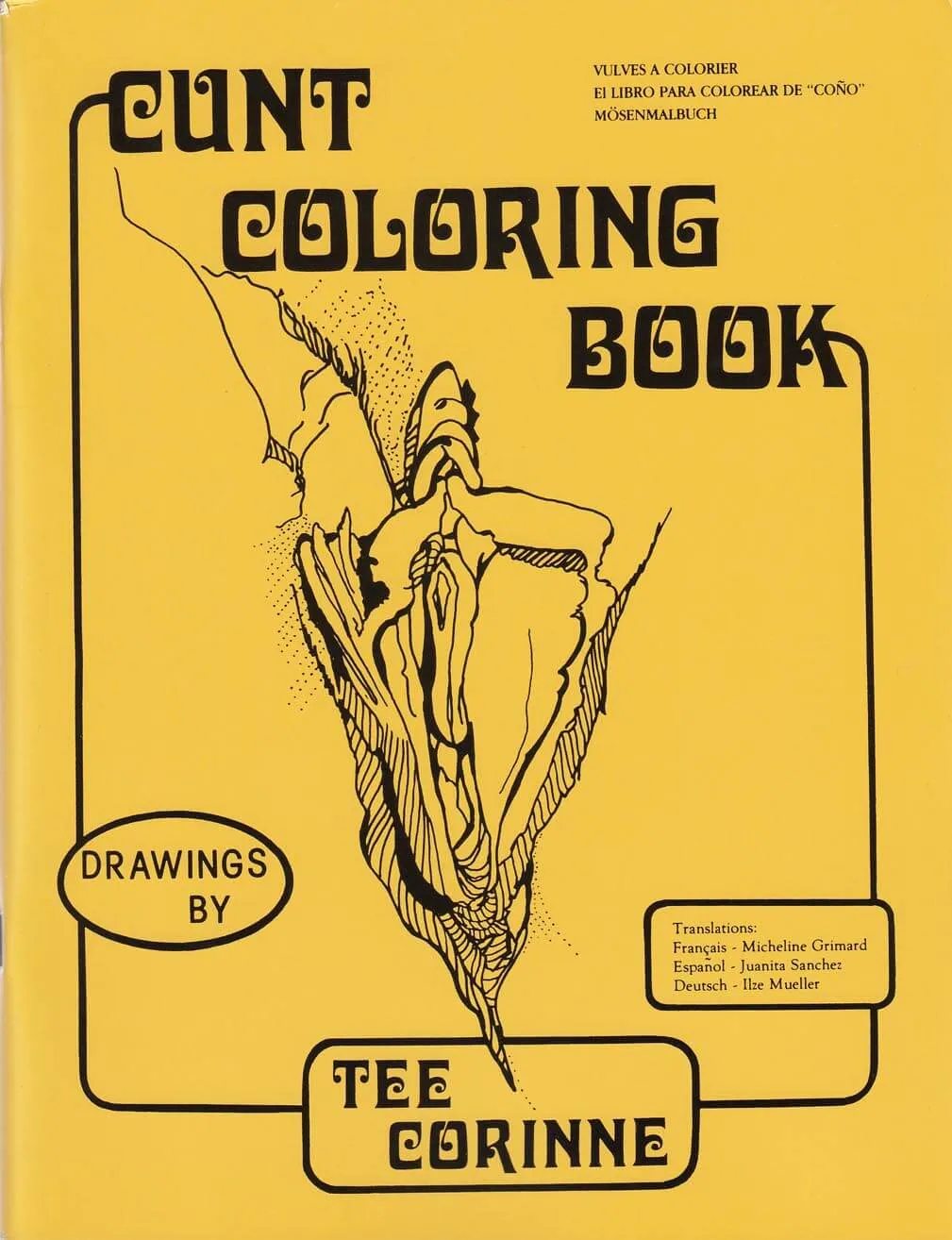
Cover of Cunt Coloring Book

Last Gasp

Cunt Coloring Book

Tee A. Corinne

Over three dozen c**ts of every size and description for you to color. Originally used for a sex-education class. Crayons not included. First published in 1975 by lesbian activist and artist Tee Corinne.

"In 1973 I set out to do drawings of women’s genitals for use in sex education groups. I wanted the drawings to be lovely and informative, to give pleasure and affirmation. I organized the drawings into a coloring book because a major way we learn to understand the world, as children, is by coloring. As adults many of us still need to learn about our external sexual anatomy." —Tee Corinne

Tee Corinne was born November 3rd, 1943 and grew up in St. Petersburg, Florida. Her mother, also an artist, introduced her to the creative principles and techniques that would serve her all her life. She received a B.A. in printmaking and painting from the University of South Florida, then went on to get an M.F.A. in drawing and sculpture at Pratt Institute, graduating in 1968. Afterwards she taught for many years, traveled through Europe, and finally became enmeshed in the back-to-the-land movement and communal living. After nearly ten years of marriage to a man she referred to as her "best friend," Corinne came out of the closet amidst severe depression in 1975. The strength to accomplish this difficult effort would later propel her to heights and achievements that would distinguish her as "one of the most visible and accessible lesbian artists in the world." From the mid-1960’s to the day she died Corinne created, published, and exhibited her art and writing around the world. She was a co-facilitator of the Feminist Photography Ovulars and a co-founder of The Blatant Image, A Magazine of Feminist Photography. She was the author of one novel, three collections of short stories, four books of poetry and numerous arts publications. In 1980, she was one of ten selected artists invited to have their work exhibited in the Great American Lesbian Art Show. The world lost Tee Corinne to cancer in 2006.

Cover of Maisa in Webland

Set Margins'

Maisa in Webland

Maisa Imamović

Design €25.00

What does ‘user-friendly’ website mean if, on it, online behaviors like stalking, teasing, and ghosting — once considered peripheral — are now central to survival, care, and belonging? How to thrive without becoming an “Interdisciplinary Unicorn”: the state’s most beloved user-citizen fluent in multiple registers of production, optimization, and self-branding? How in this beautiful world is one supposed to log off, when surveillance and privacy erosion have been normalized? And how, oh how, could users possibly think of building the alternatives, when cool and cringe online acts, all activate the platform’s reward system: the unleashing of emoji-filled praise? How to resist the platform’s toxic seduction? 

Haunted by screenshots of early cyberfeminist websites and in dialogue with digital sages, web scripts, and business interests, media artist, web developer, and author Maisa Imamović embarks on a philosophical and practice-based crusade through the internet’s surface and its shadows. To expose the various ways of thriving online without surrendering to optimization, the book explores imperfect uses of perfect software, preservation of precarious web infrastructures, tactical content strategies, and experiments with autonomous financial systems — all wrapped in educational efforts to sustain criticality amid automation. Through these traversals beneath the scroll, Maisa finds her Webland: speculative, broken, and oftentimes, poetic infrastructure where logic destabilizes, binaries dissolve, and meaning evades monetization. But can a non-extractive internet exist beyond metaphor? Can poetry rewire protocol? Or will her sanctuary be absorbed into the very architectures it resists?

"In Maisa in Webland, Maisa Imamovic evokes the multidimensional, spontaneous human elements of the early web, using interviews, case studies, critical theory and fiction as her organic materials. She peeks behind the screen and through time to trace the subtle erosion of the web’s early utopian ideals to its cold and extractive present. Imamovic bravely wades through the swampy digital muck that mediates our everyday reality, examining its invisible psychic scaffolding with academic rigor, and a big dose of humor and heart. Was it an inevitable entropy, or an aberration? How and when did we get so off-course? Can we return? Do we want to? In Maisa’s Webland, we might very well be doomed, and maybe that’s a good thing. When the center of this tangled web no longer holds, something new can take shape.” - Nada Alic, author of Bad Thoughts

Cover of Fanzine Grrrls

Monsa

Fanzine Grrrls

Gemma Villegas

Making a fanzine is an act of rebellion, even more so if it is published and produced by a woman. The grrrls of today use them to inspire countless young people around the world, to take control of their lives and to create their own culture. These homemade publications are a quick and cheap way to spread their ideas and dismantle the usual stereotypes. Traditionally hand-drawn, photocopied, and stapled together, the format of fanzines are now as diverse as their subject matter, with online platforms and social networks fast becoming the norm. The fanzine is more alive than ever!

Gemma Villegas runs her graphic design studio based from Barcelona. She works in close dialog with commissioners and collaborators on a broad range of projects, including visual identities, exhibitions, publications, and digital platforms, overseeing the creative process during all the phases of a project. Her work is characterized by a fresh and powerful visual language focused on detail with special attention to typography.