rile*books

Search books

Search books by title, author, publisher, keywords...

Cover of Blue in Green

Blank Forms

Blue in Green

Wesley Brown

€22.00

Wesley Brown narrates the day when trumpeter Miles Davis was assaulted by the New York Police Department. A dramatic and humorous story, told from multiple perspectives including that of Frances Taylor, Davis's wife, and the musicians in Davis's bands: a timely meditation on the psychological impact of police brutality, through the lens of a day in the life of Miles Davis.

The latest work from the veteran novelist called "one hell of a writer" by James Baldwin and "wonderfully wry" by Donald Barthelme, Blue in Green narrates one evening in August 1959, when, mere weeks after the release of his landmark album Kind of Blue, Miles Davis is assaulted by a member of the New York City Police Department outside of Birdland. In the aftermath, we enter the strained relationship between Davis and the woman he will soon marry, Frances Taylor, whom he has recently pressured into ending her run as a performer on Broadway and retiring from modern dance and ballet altogether. Frances, who is increasingly subject to Davis's temper—fueled by both his professional envy and substance abuse— reckons with her disciplined upbringing, and, through a fateful meeting with Lena Horne, the conflicting demands of motherhood and artistic vocation. Meanwhile, blowing off steam from his beating, Miles speeds across Manhattan in his sports car. Racing alongside him are recollections of a stony, young John Coltrane, a combative Charlie Parker, and the stilted world of the Black middle class he's left behind. 

"Wesley Brown is a writer's writer. His dialog in Blue in Green is remarkable. He knows the varieties of the American language in and out. We get fascinating portraits of Dizzy Gillespie, Thelonious Monk, Billie Holiday, Clark Terry, Lena Horne, Katherine Dunham, Eartha Kitt, and others. An insider named Freeloader provides comic relief. Before the salespersons dictated trends in Black literature, a major publisher would have published this book. Thanks to Blank Forms and other midsize presses, the Black literary tradition, whose fictional standards were set by Brooks, Wright, Himes, Polite, Bambara, and others, is alive." — Ishmael Reed

Published in 2022 ┊ 68 pages ┊ Hardcover ┊ Language: English
recommendations

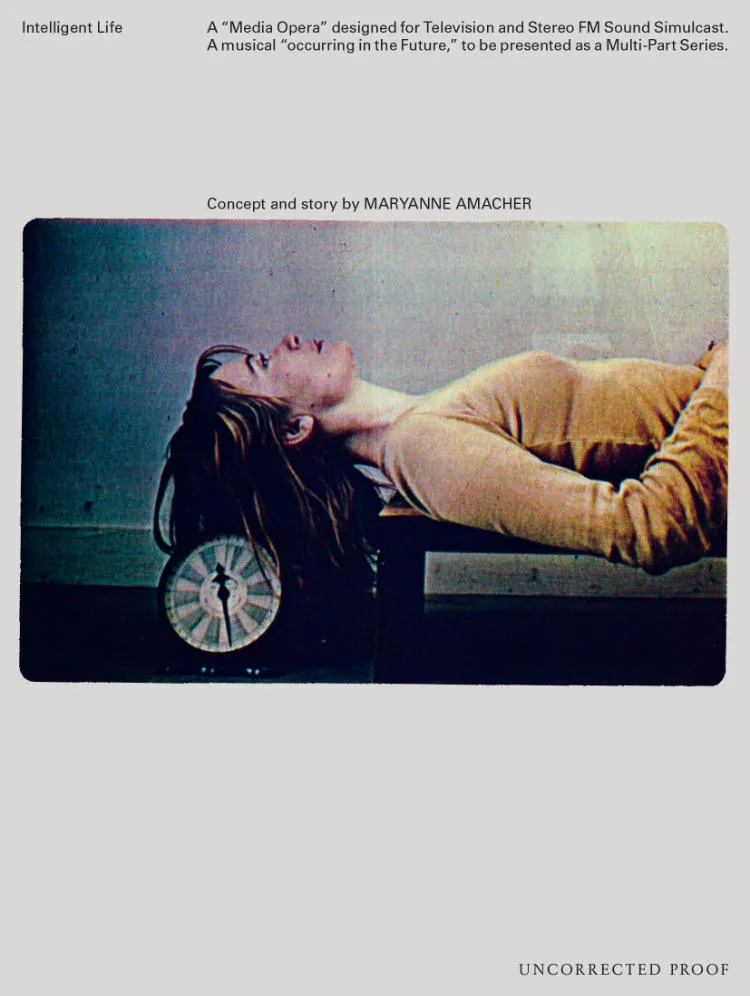
Cover of Intelligent Life

Blank Forms

Intelligent Life

Maryanne Amacher

Comprehensive and previously unpublished documentation on the American composer's unproduced magnum opus.

Had it been produced, Maryanne Amacher's media opera Intelligent Life would have represented the summation of the composer's concept to date. As she wrote to John Cage in the autumn of 1983, following the untimely deaths of the opera's patrons—Wies Smals, founder of De Appel, and curator Josine van Droffelaar, in a plane crash in the Swiss Alps—she would have at last had the support to "communicate the finest of my thought to others." Amacher's serial, intended for broadcast, sought to transmit her evolving ideas about perception, listening, and composition to a broader public—shifting music away from "nod and tap recognition" toward a transformative practice that could awaken intelligence to "unrecognized and new perceptual modes."

Set in the year 2021, Intelligent Life follows the employees of Supreme Connections LLC, a music entertainment corporation navigating a future in which artificial intelligence generates music faster than composers can. Anticipating an industry-wide downturn, Supreme Connections president Aplisa Kandel seeks advanced technologies that will revolutionize the act of listening and the future of music, including a bio-music script that lets the user hear Bach from the aural perspective of a reindeer and a wearable device that goes beyond replicating the mechanical tympanic resonances of the listening subject to produce the "listening mind" or the "sophisticated perceiver"—capturing and reproducing all the emotional and psychological associations unique to each individual.
Though Amacher could not realize Intelligent Life in any of its intended forms—she theorized its publication as a serialized radio broadcast and television simulcast, among other configurations—she continued designing "treatments" for the opera for much of her career. This volume makes the most complete of these working documents—including episodic scripts, notes on the use of LaserDisc, and an illustrated storyboard for the pilot—available to the public for the first time.

Maryanne Amacher (1938-2009) was a composer of large-scale fixed-duration sound installations and a highly original thinker in the areas of perception, sound spatialization, creative intelligence, and aural architecture. She is frequently cited as a pioneer of what has come to be called “sound art,” although her thought and creative practice consistently challenges key assumptions about the capacities and limitations of that genre. Often considered to be a part of a post-Cagean lineage, her work anticipates some of the most important developments in network culture, media arts, acoustic ecology, and sound studies.

Cover of Better Do It Now before You Die Later: Sonny Simmons with Marc Chaloin

Blank Forms

Better Do It Now before You Die Later: Sonny Simmons with Marc Chaloin

Sonny Simmons, Marc Chaloin

Though his years in the New York free-jazz scene of the sixties cemented his reputation as "one of the most forceful and convincing composers and soloists in his field," saxophonist Sonny Simmons (1933–2021) was nearly forgotten by the '80s, which found him broke, heavily dependent on drugs and alcohol, and separated from his wife and kids. "I played on the streets from 1980 to 1994, 365 days a year," Simmons tells jazz historian and biographer Marc Chaloin. "I would go to North Beach, and I'd sleep in the park. The word got around town that Sonny is a junkie, really strung out."

The resurrection of Simmons' career―upon the release of his critically acclaimed Ancient Ritual (Qwest Records) in 1994―has become a modern legend of the genre. In the last two decades of his musical career, Simmons broke through to a new echelon of recognition, joining the pantheon of great innovators and masters of the music. But to this day he remains an undersung figure. Here, in the first ever book dedicated to his life, Simmons recounts his childhood in the backwoods of Louisiana, his adolescence in the burgeoning Bay Area jazz scene and his star-studded life in New York playing alongside the greats.

Cover of If They Come in the Morning...

Verso Books

If They Come in the Morning...

Angela Y. Davis

One of America's most historic political trials is undoubtedly that of Angela Davis. Opening with a letter from James Baldwin to Davis, and including contributions from numerous radicals such as Black Panthers George Jackson, Huey P. Newton, Bobby Seale and Erica Huggins, this book is not only an account of Davis's incarceration and the struggles surrounding it, but also perhaps the most comprehensive and thorough analysis of the prison system of the United State.  

Since the book was written, the carceral system in the US has seen unprecedented growth, with more of America's black population behind bars than ever before. The scathing analysis of the role of prison and the policing of black populations offered by Davis and her comrades in this astonishing volume remains as pertinent today as the day it was first published.  

Featuring contributions from George Jackson, Bettina Aptheker, Bobby Seale, James Baldwin, Ruchell Magee, Julian Bond, Huey P. Newton, Erika Huggins, Fleeta Drumgo, John Clutchette, and others.

Cover of Chapel Road

Dalkey Archive Press

Chapel Road

Louis Paul Boon, Adrienne Dixon

Fiction €18.00

A meta-textual matryoshka doll of a novel from a renowned voice in Flemish literature. 

The twisting narrative of Louis Paul Boon's 1953 masterpiece follows a young girl named Ondine and her brother Valeer, born into poverty at the turn of the century in the industrial city of Aalst, Belgium. Ondine's coming of age is interwoven with a reworking of the medieval fable of Reynard the Fox, as well as a metanarrative in which an author named Louis Paul Boon and his colorful group of friends discuss the writing of a novel named Chapel Road, debating how best to present Ondine's story.

Groundbreaking among post-war Dutch literature for its postmodern structure and irreverent, dialect-studded use of language, Boon's allegory of the rise and fall of socialism in Flanders presents his theory of the novel as a type of "illegal writing" where digressions are far more important than a carefully constructed plot.

Introduction by Chad W. Post

Louis Paul Boon (1912-1979) started out as a house painter but went on to become the author of a large and rich oeuvre spanning several genres: from the compelling historical epics he composed later in life to his sharp, witty work as a newspaper columnist and his tongue-in-cheek, scabrous novels. Boon is one of the most important writers of Flemish literature in the twentieth century, a keen observer of society, the individual and the interplay between them.

Adrienne Dixon is a translator of Dutch and Flemish literature.

Chad W. Post is the founder and publisher of Open Letter Books. He is also the editorial director of Dalkey Archive Press, where he was formerly the associate director. Over the course of his career, he founded the Translation Database, the Best Translated Book Awards, multiple literary podcasts (Two Month Review, Three Percent), the Three Percent website, and currently writes two newsletters: The Three Percent Problem, and Mining the Dalkey Archive. He is also the author of The Three Percent Problem: Rants and Responses on Publishing, Translation, and the Future of Reading. His articles and book reviews have appeared in a range of publications. In 2018 he received the Words Without Borders Ottaway Award for the Promotion of International Literature. 

Cover of My Life and My Life in the Nineties

Wesleyan

My Life and My Life in the Nineties

Lyn Hejinian

Fiction €17.00

New edition of one of the founding works of Language writing. 

Lyn Hejinian is among the most prominent of contemporary American poets. Her poem My Life has garnered accolades and fans inside and outside academia. First published in 1980, and revised in 1987 and 2002, My Life is now firmly established in the postmodern canon. This Wesleyan edition includes the 45-part prose poem sequence along with a closely related ten-part work titled My Life in the Nineties. An experimental intervention into the autobiographical genre, My Life explores the many ways in which language — — the things people say and the ways they say them — shapes not only their identity, but also the very world around them.

Cover of The Book of Disappearance

And Other Stories

The Book of Disappearance

Ibtisam Azem

Fiction €19.00

Alaa is haunted by his grandmother’s memories of being displaced from Jaffa and becoming a refugee in her homeland after the Nakba. Ariel, Alaa’s neighbour and friend, is a liberal Zionist, critical of the military occupation of the West Bank and Gaza yet faithful to the project of Israel. When he wakes up one morning to find that all Palestinians have suddenly vanished, Ariel begins searching for clues to the secret of their collective disappearance.

That search, and Ariel’s reactions to it, intimately reveal the fissures at the heart of the Palestinian question. Between the stories of Alaa and Ariel are the people of Jaffa and Tel Aviv – café patrons, radio commentators, flower-cutters – against whose ordinary lives these fissures and questions play out.

Critically acclaimed in Arabic, spare yet evocative, intensely intelligent in its interplay of perspectives, The Book of Disappearance is an unforgettable glimpse into contemporary Palestine as it grapples with both the memory of loss and the loss of memory.

Cover of Sitt Marie Rose

Litmus Press

Sitt Marie Rose

Etel Adnan

Fiction €17.00

Sitt Marie Rose is the story of a woman abducted by militiamen during the civil war in Lebanon. Already a classic of war literature, this extraordinary novel won the France-Pays Arabes award in Paris and has been translated into six languages. Sitt Marie Rose is part of Comparative Literature, World Literature, Women’s Studies and Middle East Studies curricula at more than thirty universities and colleges in the U.S.

Translated by Georgina Kleege.

Etel Adnan was born in Beirut, Lebanon in 1925. She is a celebrated writer, essayist, and playwright, and is the author of more than twenty books in all these disciplines. Her work as a whole is a faithful record of the times and places she has lived in Beirut, Paris, and in the San Francisco Bay Area. At least eighteen works by Adnan have been published in English. They include Sitt Marie Rose (Post-Apollo Press, 1982); The Arab Apocalypse (Post-Apollo Press, 1989); Sea and Fog (Nightboat Books, 2012), winner of the Lambda Literary Award for Lesbian Poetry and the California Book Award for Poetry; Premonition (Kelsey Street Press, 2014); Surge (Nightboat Books, 2018); Time (Nightboat Books, 2019), winner of the Griffin Poetry Prize and the Best Translated Book Award; and Shifting the Silence (Nightboat Books, 2020). In 2021, Litmus Press published a second edition of Journey to Mount Tamalpais (originally published by The Post-Apollo Press), which included nine new ink drawings by Adnan. Her paintings, described by New York Times art critic Roberta Smith as "stubbornly radiant abstractions," have been widely exhibited. Spanning media and genres, Adnan's writings have led to numerous collaborations with artists and musicians, including the French part of CIVIL warS, a multi-language opera by American stage director Robert Wilson, performed in Lyon and Bobigny in 1985. In 2014 she was named Chevalier des Arts et des Lettres, France's highest cultural honor, by the French Government. She died in Paris, in 2021.

Georgina Kleege is an internationally known writer and disability studies scholar. Her collection of personal essays, Sight Unseen (1999) is a classic in the field of disability studies. Kleege’s latest book, More Than Meets the Eye: What Blindness Brings to Art (2018) is concerned with blindness and visual art. Kleege joined the English department at the University of California, Berkeley in 2003 where in addition to teaching creative writing classes she teaches courses on representations of disability in literature, and disability memoir. Kleege is also the author of Home for the Summer (The Post-Apollo Press, 1989).

Cover of Unfit

New Directions Publishing

Unfit

Ariana Harwicz, Jessie Mendez Sayer

Fiction €16.00

A bracing novel that asks how far we would go for the ones we love—and what we would do to destroy the ones we hate. 

Lisa has lost custody of her young twin boys. Caught between the French legal system’s sluggish bureaucracy and her sinister, scheming in-laws, she’s alone and lost, an Argentine migrant in rural France picking grapes for a pittance, only allowed to see her children in supervised visits once a month. Scapegoated and outcast, destitute and desperate, Lisa decides to take radical action: early one morning, she sneaks into her in-laws’ farmhouse, takes back her children, sets the barn ablaze, and makes her escape.

What follows is a white-knuckled road trip that explores human beings pushed to the edge. Clearly, Lisa is not in her right mind, and as Harwicz deftly mingles a chorus of contradictory voices into her very unreliable narration, the reader comes to regard the protagonist with an unsettling mixture of sympathy and suspicion. Written in savage, chiseled prose, Unfit shoots off, a gripping chase that questions all our assumptions—and points out our hypocrisies— about motherhood, custody rights, love, violence, anti-semitism, and migration. The latest novel by the acclaimed author of Die, My Love (soon to be adapted to a film starring Jennifer Lawrence), Unfit is addictively terrifying, savagely sophisticated, and shockingly brilliant.

Translated from Spanish by Jessie Mendez Sayer