rile*books

Search books

Search books by title, author, publisher, keywords...

Cover of Absence Where As: Claude Cahun and the Unopened Book

Nightboat Books

Absence Where As: Claude Cahun and the Unopened Book

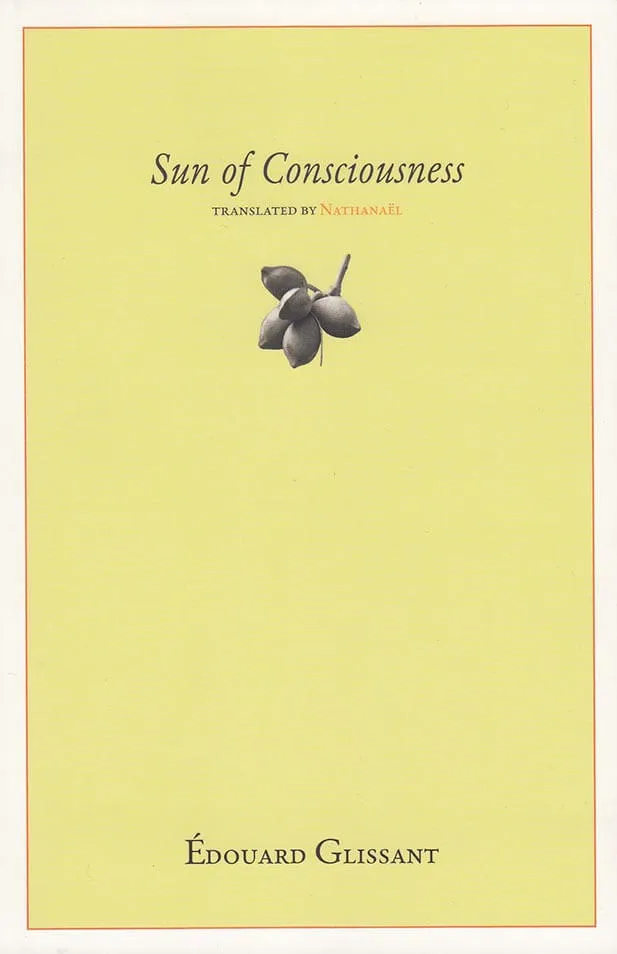
Nathanaël

€15.00

This book, from inter-genre, bilingual writer Nathanaël, investigates the relationship between image and language through a philosophical and poetic meditation on a self-portrait by Surrealist photographer and writer Claude Cahun.

"In Absence Where As, Nathanael reads the unread book, ‘the book that comes’ to us nevertheless, that haunts and hovers unopened and dreamt, proceeding from the Ecrits of the visionary and revolutionary artist-activist Claude Cahun, to life’s library. Through this constellatory essay in the faults of thought, in reading’s flaw, Nathanael comes to know and know how, creating new epistemological and aesthetic territory in the radiant continuum between lyric and narrative, the text and the dream of text, which is literature itself." - John Keene

Published in 2019 ┊ 112 pages ┊ Language: English

recommendations

Cover of Nothing at All

Nightboat Books

Nothing at All

Olivia Tapiero, Kit Schluter

Non-fiction €18.00

An atmospheric rumination on gendered violence, cosmic collapse, and colonialism.

From deep inside a black hole, comes Nothing at All—the space where everything collapses: form, genre, gender, and being. Olivia Tapiero’s poetic  and essayistic fragments overflow with lyric beauty as they explore how colonialism, illness, and desire intertwine amidst personal and collective suffering. Generations, geographies, and desires mingle, contaminating one another in these anarchic, insubordinate texts. Here, the written word disrupts foundations and nations, claiming its own survival.

Olivia Tapiero is a writer, translator and musician. She is the author Les murs (Robert-Cliche Award, Prix Senghor finalist), Espaces (2012), Chairs (2019), Phototaxie / Phototaxis (Nightboat Books, 2017 / 2021, Lambda Literary Awards finalist), and Rien du tout (2021, Grand Prix du livre de Montréal Finalist, Governor General’s Literary Awards finalist). She is editor-in-chief for the literary magazine Moebius, and has contributed poems and essays to various publications in Canada, France, and Korea. She has also translated works of contemporary authors such as Roxane Gay, Anne Boyer and Billy-Ray Belcourt. She lives between Marseille and Montréal.

Foreword by Anne Boyer.

Cover of Memories That Smell Like Gasoline

Nightboat Books

Memories That Smell Like Gasoline

David Wojnarowicz

Fiction €23.00

David Wojnarowicz, one of the most provocative artists of his generation, explores memory, violence, and the erotism of public space—all under the specter of AIDS.

Here are David Wojnarowicz’s most intimate stories and sketches, from the full spectrum of his life as an artist and AIDS activist. Four sections—”Into the Drift and Sway,” “Doing Time in a Disposable Body,” “Spiral,” and “Memories that Smell like Gasoline”—are made of images and indictments of a precocious adolescence, and his later adventures in the streets of New York. Combining text and image, tenderness and rage, Wojnarowicz’s Memories That Smell Like Gasoline is a disavowal of the world that wanted him dead, and a radical insistence on life.

The new and revised edition features a foreword by Ocean Vuong and a note from the editor, Amy Scholder.

Cover of Don't Leave Me This Way

Nightboat Books

Don't Leave Me This Way

Eric Sneathen

Poetry €18.00

A textual and historigraphical odyssey imbued with queer intergenerational yearning and loss.

Don't Leave Me This Way blends archival research with sexual fantasy to produce a series of sonnets inspired by Gaétan Dugas, named by Randy Shilts as "Patient Zero" of the AIDS epidemic in North America. Committed to the utopian possibilities of elegy and pornography, Don't Leave Me This Way exploits the absurdist beauty of the cut-up technique to voice a chorus of lost spirits: poignant, vengeful, and ready to ball.

Cover of The Nightmare Sequence

Nightboat Books

The Nightmare Sequence

Omar Sakr, Safdar Ahmed

Poetry €20.00

An extraordinary collaboration by an award-winning duo—poet Omar Sakr and visual artist Safdar Ahmed–that bears witness to the genocide in Gaza.

The Nightmare Sequence is a searing response to the atrocities in Gaza and beyond since October 2023. Heartbreaking and humane, it is a necessary portrait of the violence committed by Israel and its Western allies. Through poetry and visual art, Omar Sakr and Safdar Ahmed capture these historic injustices, while also critiquing the role of art and media—including their own—in this time. Born of collective suffering and despair, their collaboration interrogates the position of witness: the terrible and helpless distance of vision, the impact of being exposed to violence of this scale on a daily basis, and what it means to live in a society that is actively participating in the catastrophic destruction of Arabs and Muslims overseas. With a foreword by Palestinian American poet George Abraham, this book will serve as a vital record in decades to come.

Cover of Glove Money

Nightboat Books

Glove Money

Sophia Dahlin

Poetry €19.00

A hymn to perversity, a lyric pledge to desire and risk, Glove Money pages through the canon to “seed its sugar in your dreams.”

In this joyful and irreverent exploration of the role of poet-as lover, Sophia Dahlin plays Sappho, O’Hara, romantics and troubadours, assembling a self seaworthy of romance. With humor and a light touch, Glove Money dismisses bioessentialist gatekeeping and expands the lesbian imaginary.  

Cover of The Obscene Madame D

Pushkin Press

The Obscene Madame D

Hilda Hilst

Fiction €15.00

A wickedly funny work of depraved genius by one of Brazil’s most radical twentieth-century writers; imagine the Marquis de Sade as written by Clarice Lispecter.

An electrifying masterpiece by one of modern Brazilian literature’s most significant and controversial writers, Hilda Hilst takes us into the disorder and beauty of a mind restlessly testing its own limits.

Every month I ingested the body of God, not in the way one swallows green peas or agrostis, or swallows swords, I ingested the body of God the way people do when they know they are swallowing the More, the All, the Incommensurable, for not believing in finitude I would lose myself in absolute infinity…

The Obscene Madame D tells the story of Hillé, a sixty-year-old woman who has decided to abandon conventional life and spend the rest of her days in contemplation in a recess under the stairs. There, she is haunted by the perplexity of her recently deceased lover, Ehud, who cannot understand her rejection of common sense, sex and a simple life in favour of metaphysical speculations that he considers delusional and vain. 

In a stream-of-consciousness monologue that’s part James Joyce, part Clarice Lispector, and part de Sade, Hillé speaks of her search for spiritual fulfilment from a space of dereliction, as she searches for answers to great questions of life, death and the relationship between body and soul.

Translated by Nathanaël and Rachel Gontijo Araujo

Cover of Cancelled Confessions (or Disavowals)

Siglio Press

Cancelled Confessions (or Disavowals)

Claude Cahun

First published in 1930 by anti-fascist, avant-garde publisher Éditions du Carrefour in Paris as Aveux non Avenus, Cancelled Confessions (or Disavowals) is Claude Cahun’s wildly radical answer to an invitation to write a memoir. Shattering the very premise of the “memoir”—the singularity of identity—into sharp and prismatic fragments, Cahun assembles an ever-mutating inquiry into the instability of “self” and its many masks.

Masculine? Feminine? It depends on the situation. Neuter is the only gender that always suits me.

Using a multitude of forms (fables, jokes, aphorisms, letters, dialogues, dreams, hymns, pronouncements, etc.), to plumb the subjects of desire, love, gender, sex, fear, faith, religion, and vanity (among others), Cancelled Confessions (or Disavowals) is a tour-de-force work of resistance: it provokes the reader to enter the capacious, provocative, playful, and deeply imaginative space constructed by Cahun in defiance of all categorization, to repudiate a delimited, censured world and embrace, instead, the outcasts and cast-offs, the unknowable and the unknown.

I believe, but in the conditional: I would like to believe.

Thoughtfully redesigned to emulate the original artist’s book, this revised edition of the out-of-print English translation by Susan de Muth—originally published in the UK by the Tate in 2007 and in the U.S. by MIT Press in 2008—includes novelist and critic Pierre Mac Orlan’s original 1930 preface along with contemporary essays by scholar Amelia Groom and translator de Muth. Almost 100-years-old, it is not only prescient, but urgent, in.

It’s not enough to be vanquished, you also have to know how to turn defeat to your advantage.

Translated by Susan de Muth, preface by Pierre Mac Orlan, essay by Amelia Groom.

Cover of A Catalogue of Risk

Wendy's Subway

A Catalogue of Risk

Alisha Mascarenhas

Poetry €18.00

Alisha Mascarenhas’s A Catalogue of Risk is a volte-face of the neoliberal market economy’s construction of isolated, individual safety. In her debut book of poems, Mascarenhas lingers in the question of risk as it arises in daily life and intimacy. Through a close study and partial translation of philosopher-psychoanalyst Anne Dufourmantelle’s Éloge du risque (2011), her poems posit risk as a fissure, through which we might imagine yet-unknown futures.

Alisha Mascarenhas’s A Catalogue of Risk is the recipient of the 2022 Carolyn Bush Award.

Alisha Mascarenhas (b. 1989) is a poet and translator and the author, most recently, of the chaplet Contagion Fields (Belladonna* 2021). She has contributed writing to Pamenar Press, The Poetry Project Newsletter, The Recluse, Peripheral Review, and The Felt, among others. Alisha was a 2023 resident at La Baldi Artist’s Residency in Montegiovi, Italy. She holds an MFA in Writing from Pratt Institute in Brooklyn, where she now lives.

There is a body lying across Alisha Mascarenhas’s A Catalogue of Risk. Here is a book of generosity and perdition, that could not anticipate the death of its author, the one these works are addressed to, written for, dreamt by, in a stream of proximities. A strange dismantling of time occurs as a result of quiet reversals in which light is diffracted across belated syntaxes, reaching past life to the living. Though A Catalogue of Risk is “running past the flowers,” it is a slow text that grieves the day’s illuminations. It is a lesson in transmission in which we, readers, are the apprentices of grace, at the edge also of drowning. Here is a book that has been “hungering to be emptied.” So, too, is it a book of promise.
Nathanaël

A Catalogue of Risk is a book of luminous attention. Alisha Mascarenhas gives us the language of a mind tracking both internal and external weathers, tuning and returning herself to beauty, fear, grief and desire. Attending a cascade of emotions, the poet dwells in questions, knowing that to keep open to difficult questions is to keep open to desire. That she risks such openness, thinking always with others, through pain and love, is an astonishment. 
— Madhu Kaza

A Catalogue of Risk poses an evocative challenge, one of prismatic nuance: to pursue multiple angles of intimacy along the life-death continuum of how risk holds, unfolds, and makes one whole. “The definition” of what risk is “is shaded in questions” and runs a gamut of desires and sensations at once libidinal and cerebral. Alisha Mascarenhas risks risk itself with this generous offering of exquisite phenomenology and experiential trace in the form of a full-saturation poetics glowing in amplitude and intensity.
— Brenda Iijima