Books
Books
in random order

The Site of Memory
All water has a perfect memory and is forever trying to get back to where it was. Writers are like that: remembering where we were, what valley we ran through, what the banks were like, the light that was there and the route back to our original place.
The Site of Memory describes Toni Morrison’s work of literary archaeology. She offers insights into how she arrives at a text through the act of imagination bound up with memory and shows how she explores two worlds – the actual and the possible – via the nimbus of emotion surrounding the journey of an image: from picture to meaning to text.
Exploring the radical possibilities of literature and the limits of history, Morrison finds a truth deeper than documentation in the silences and omissions in African American narratives of the past. Fiction, for Morrison, is a practice of ethical restoration: a means to recover what history has neglected through the ‘flooding’ of a rush of imagination. In The Site of Memory, ancestral presence, emotion and imagination converge.
If writing is thinking and discovery and selection and order and meaning, it is also awe and reverence and mystery and magic.

Parapraxis 05: Economies
Like Freud’s prototypical baby, we struggle over whether to keep our body together or to give it away. We all live these scenes of bodily loss. Freud and Marx both sing harmoniously: what we give up, we give under duress. We are not easy with what we’ve been tasked with, but the task has been the same since birth, doubled in the name of emancipation: first, there’s nothing less than to survive alienation and exploitation, then there’s staying alive for one another’s sake. Perhaps the storied antagonism between Freud and Marx turns on the difficulty of holding these tasks together, balanced on the knife’s edge that separates self-interest from collective liberation.
Capitalism does not produce itself all alone, no matter its disciplines and political-economic constraints on the reproduction of society. If Marx taught us anything, it’s that capitalism produces its own gravediggers, the proletariat—“the unreason of reason,” he quipped, where the dominant social order encounters its unconscious element. Through the bad exchange of capitalism comes a gothic reversal, from preconscious life to premature death, where workers end up burying themselves instead of the system that provides the grave plot. That exchange is felt internally, in a rift that cleaves open the self. Freud, for his part, helps us describe how political economy hammers our lives into unreasonable and reasonable shapes, imaginary and real, as countless and heterogeneous as the individual faces in a collective mass. For each and for all, we bring psychoanalysis to bear on the political-economic problems we suffer in common.
King Ketamine. Beyond the vibecession. Austere Mothers. Sick at Work. Money, Feces, Babies, Gifts. Essays by Juliana Spahr, Peter Coviello, Nicolás Medina Mora, Jyoti Rao, and Hannah Proctor. Images of Red Vienna from Wilhelm Reich’s camera, dispatches from Lebanon, and more.

Au fort les âmes sont
Exclusive works designed by Laure Prouvost for her carte blanche at the Mucem in Marseille, a series of immersive and poetic installations in the heart of Fort Saint-Jean, photographed by Raphaël Massart for this cut-out book, between an artist's book and an exhibition catalogue, accompanied by drawings and critical texts.
For the Mucem, Laure Prouvost has created a series of immersive installations in the heart of Fort Saint-Jean. Repurposed everyday objects, glass sculptures, sound mirages, and underwater videos shot in the depths of the calanques and around Frioul compose a sensitive and poetic universe. Between fiction and reality, the artist invites visitors on a sensory journey where everything is transformed: forms, narratives, and life itself.
The book was conceived as a visual journey leading from the Old Port of Marseille to Fort Saint-Jean and into the very heart of each work. To recreate this encounter between artist Laure Prouvost and the Mucem, there is a constant dialogue between the exterior—the sea, the stone of the fort—and the interior—the intimacy of the installations that unfold in the air, in the bowels of the earth, and underwater... Designed in close collaboration with the artist, the book captures this moment through photographic work carried out especially by Raphaël Massart and an evocative form designed by the artist: like a book that also floats in the Mediterranean. To accompany this visual unfolding, a booklet embedded in the heart of the book contains texts by Hélia Paukner, curator of the exhibition, and Mathilde Roman, art historian.
Published on the occasion of the eponymous exhibition at the Mucem, Marseille, in 2025.
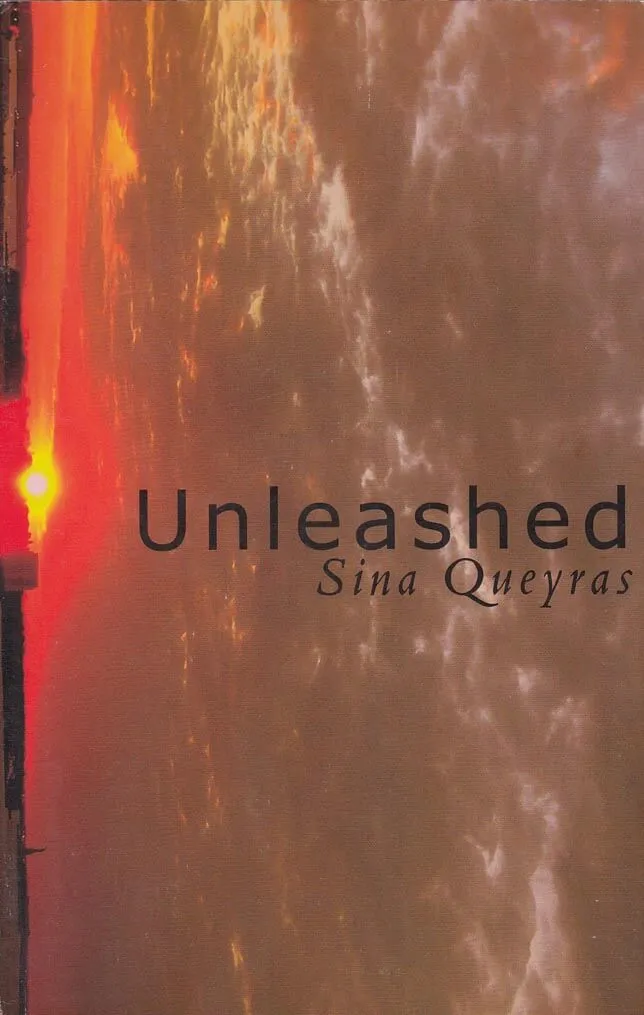
Unleashed
05/09/04 Now she is blogging. Now she is sitting on the black couch listening to the sirens wail and the rain fall. Now she is thinking of oysters. Now she is wondering why this is worth sharing. Now she is thinking, how decipher what is worth reading? Who is to say? Sifters. She thinks we have become a nation of sifters. So began a three-year experiment in blogging. An experiment begun for many reasons—a way for an expat to keep in touch with fellow Canadian writers and artists, a way to come to terms with the increasing relevance of the internet in literary lives, and a way to figure out why, after decades of gains, women writers are still grossly underrepresented in critical dialogues.
With an afterword by Vanessa Place.

Tripwire 19 - Sean Bonney Tribute Issue
Sean Bonney Tribute Issue
Don’t say “Rest in Peace,” say Fuck the Police: A Sean Bonney Tribute Portfolio, featuring: Katharina Ludwig, Lama El Khatib & Haytham El Wardany, Anahid Nersessian, Vicky Sparrow, Koshka Duff, Max Henninger, Joshua Clover, Jasper Bernes, D.S. Marriott, Fran Lock, Joey Frances, Mathilda Cullen, Nicholas Komodore, David Lau, Eve Richens, Sacha Kahir, Uwe Möllhusen & Marie Schubenz, Kashif Sharma-Patel, Linda Kemp, Daniel Eltringham & Fred Carter, Hugo García Manríquez, Jèssica Pujol Duran & Macarena Urzúa Opazo. With additional work by Belén Roca, translated by Noah Mazer, Adelaide Ivánova, translated by Chris Daniels, stevie redwood, Cait O’Kane, Mau Baiocco, Peter Bouscheljong, translated by Jonathan Styles. Zheng Xiaoqiong, translated by Zhou Xiaojing, Mayamor, translated by Eric Abalajon, Afrizal Malna, translated by Daniel Owen, Jorge Carlos Fonseca, translated by Shook, James Goodwin, Amalia Tenuta. Plus Engagements: Anne Boyer interviewed by Eduardo Rabassa, Gail Scott interviewed by Michael Nardone, Noah Ross on David Melnick, Guillermo Rebollo Gil on Pedro Pietri, Coco Fitterman on Ennio Moltedo, Sam Moore on Aaron Shurin, David Grundy on Lorenzo Thomas

Aunonomic Reasoning
Precipitous philosophies. Synaptic-nerve narrations. Syntactic spirals. Hyper-coiled horizons. Will Alexander’s mental range has arrived. An anomalous scripting of the word “automatic,” Aunonomic Reasoning is a whirlwind of lingual torrents triggered by creative mishearing that at once exposes the occupations of orthodox surrealism, summons a voice for the scathed populace of imperial affliction, and forges new paths of phonetic potentiality to mend semantic injury. Pushing prosaic margins beyond their boundaries, these texts take on the etymological condition of the essay as “attempt” with iridescent siege, prepositional frenzy, paratactic provocation, noetic disreckoning, and a critical demand to dismantle: all of which signatures of Alexander’s unilateral poetic innovations.

Phantom Pain Wings
Kim Hyesoon is an iconic figure in feminist poetry. In her new collection, she depicts the memory of war trauma and the collective grief of parting through what she calls an ‘I-do-bird-sequence’. Through intensely rhythmic lines marked by visual puns and words that crash together and then fly away as one, Kim mixes traditional folklore and mythology with contemporary psychodramatic realities as she taps into a cremation ceremony, the legacies of Rimbaud and Yi Sang, a film by Agnès Varda, Francis Bacon’s portrait of Pope Innocent X, cyclones, a princess trapped in a hospital, and more. A simultaneity of voices and identities rises and falls, existing and exiting on their delayed wings of pain.
Winner of the 2024 National Book Critics Circle Award for Poetry (USA)
2024 Poetry Book Society Translation Choice

A Textbook for the Ecocene
A Textbook for the Ecocene is a how-to guide for connecting to self, community and planet. The Ecocene is an emergent and imagined geologic era where all humyns are living in reciprocity with their ecosystems again. Each textbook chapter shares practical exercises to try at home, Earth-centered theory and spirituality, and interviews with Black and Indigenous Earth warriors—cultural workers generating planetary liberation in their everyday lives. These testimonios from Johanna Iraheta, Bruje Fuego, Raquel Lemus, Patty Denisse, Jasmine Nyende, Queen Hollins and Olivia Chumacero shine with wisdom and advice for new and seasoned Earth stewards alike. Created originally as Sarita Dougherty's DIY PhD Dissertation, A Textbook for the Ecocene is a curricula for eco-feminista educations, DIY degrees and planetary destinies. We are activating the Ecocene right now, one step at a time. What we pay attention to grows.
Self-published by Co—Conspirator Press with the support of Women's Center for Creative Work. Edited by Simone Krug, copy edited by Gowri Chandra and Demi Corso. Designed by MJ Balvanera, Riso-printed by Neko Natalia.
SARITA DOUGHERTY (she/her, they/them) is a painter, parent, collaborator and educator of Cajun, Irish and Andean descent. Sarita is a cocreator of The School for the Ecocene Cooperative, offering a DIY PhD and more programs for planetary liberation. She currently lives and cultivates habitat on Ohlone Land. Sarita’s book, A Textbook for the Ecocene, is a continuation of her Artist Residency at The Feminist Center for Creative Work in Fall 2018.

Lives Shaping Works Making Life
Xavier Le Roy, Giulia Casartelli and 2 more
24 transcribed public conversations led by Xavier Le Roy with artists and cultural workers, creating a space where Le Roy's work meets the experiences of his guests.
Lives Shaping Works Making Life is a collection of 24 transcribed public conversations titled Practices: Strategies and Tactics, led by Xavier Le Roy and hosted by the Institute for Applied Theater Studies in Giessen between November 2022 and November 2024. These dialogues bring together artists and cultural workers creating a space where Xavier Le Roy's work engages in conversation with the experiences of each guest. Each encounter follows the same set of 14 questions—printed on the book's cover—which serve as a flexible framework guiding the conversations. Through the careful editing of Giulia Casartelli, Daniel Cordova, and Livia Andrea Piazza, these conversations have been transformed into vivid, polyphonic texts that invite further reflection and offer a point of departure for expanding the dialogue beyond the original live encounters.
Conversations with Antonia Baehr, Matthias Mohr, João Fiadeiro, Herbordt / Mohren, Carolina Mendonça, Rolf Michenfelder, Ana Vujanović, Bojana Cvejić, Joana Tischkau, Giulia Casartelli, Susanne Zaun & Judith Altmeyer, Florence Lam, Olivia Hyunsin Kim, Jorge Alencar & Neto Machado, Rabih Mroué, Ruth Geiersberger, Swoosh Lieu, Arkadi Zaides, Valeria Graziano, Mette Edvardsen, Mala Kline, Sarah Parolin, Andros Zins-Browne, Rose Beermann.

My Homies
Published on occasion of Arnaud Eubelen’s solo exhibition My Homies, curated by Jeanne Mouffe presented by Medusa. Enveloped with a poem by Romain Beaudot, the publication, intended to complement the exhibition, traces Arnaud’s footsteps to the conception of his trash-to-treasure practice.

Memory
A spiritual homage to Bernadette Mayer's monumental artwork of the same title, Dorothea Lasky's Memory is a cycle of "poet's essays" stirred by two profound questions. What constitutes personhood and consciousness? What memories get lost, and why?
Expansive in her quest for answers, Lasky launches an inspired investigation of the forces that form our lives and deepest senses of ourselves. She identifies three dimensions of memory—ancestral, personal, and poetic—and in her singularly clear voice, undertakes to enter into their mysteries. From those recesses, she returns with a wide-ranging collection of essays that like lyric poems find the universal inside the particular. Memory reflects on the banal; private emotions and historical trauma; dear departed poets (Diane di Prima, Lucie Brock-Broido); her father's battle with Alzheimer's; and cultural events that have become charged sites of collective reminiscence (the moon landing, the music of Neutral Milk Hotel). Other pieces face the flip side of memory, asking what's left where memory is absent, and what's "real" beyond the horizon of death. The book closes with "Time, the Rose, and the Moon," an ars poetica published here in English for the first time, which offers the ancient symbol of the Ouroboros as a figure for the nonlinear processes of time, memory, and art.
Like Mayer before her, Lasky reveals memory to be huge and haunting, as she accumulates impressions that challenge the very possibility of fixed meaning. "Every rose has the scent of death," she writes. "And poetry is a perfume. That will stay on your body forever.... Whatever happens this time around, remember that."
Dorothea Lasky is the author of six full-length collections of poetry, including, most recently, The Shining (2023). She is also the author of the prose book Animal (2019) and a forthcoming book about Sappho, as well as the editor of Essays (2023) and a coeditor of Open the Door: How to Excite Young People About Poetry (2013). Her writing has appeared in POETRY, The New Yorker, The Paris Review, The Atlantic, and Boston Review, among other places.

Death Industrial Complex
Candice Wuehle’s Death Industrial Complex is a meditation on the cultural obsession with the bodies of dead women and an occult invocation of the artist Francesca Woodman. Like Woodman’s photographs with their long exposures and blurred lenses, this book is haunted and haunting, hazy yet devastatingly precise. These are poems as possessions, gothic ekphrases, dialogues with the dead, biography and anti-biography, a stunning act of “cryptobeauty.”

The Close Chaplet
Long out of print, The Close Chaplet is Laura Riding's first book, originally published in 1926. Riding deliberately ceased writing poems after 1940, when she came to see poetry as irrevocably flawed as a means of expression. These poems demonstrate Riding's early desire to depart from the close and well-tilled ground of traditional lyric poetry. According to her biographer, Elizabeth Friedman, many of the poems for THE CLOSE CHAPLET were brought in typescript from New York, a few were added in Egypt, and the entire text was carefully edited by Robert Graves.
In his introduction, Mark Jacobs writes that Riding was identifying herself with the pre-moment, the 'what-was-there' before Creation. How did the world, the universe, come to exist, why does it exist, why does it die, why do we? From these questions, Riding begins to develop a theory about the role of women as the origin of all human beings, the only animals with written language. This edition also includes Riding's essay A Prophecy or a Plea, a statement of her poetics initially published in 1926.
Laura Riding was a poet, novelist, short-story writer, essayist, and publisher. While primarily known for the critical works that she co-authored with Robert Graves — A Pamphlet Against Anthologies and A Survey of Modernist Poetry — Riding also left behind an incredibly powerful body of poetry and prose works that, regrettably, remain little read today. These include THE CLOSE CHAPLET (Ugly Duckling Press, 2020), EXPERTS ARE PUZZLED (Ugly Duckling Presse, 2018), CONVALESCENT CONVERSATIONS (Ugly Duckling Presse, 2018), The Lives of Wives, and The Progress of Stories. Famously rejecting poetry early in her career, she spent the last decades of her life co-writing a theoretical work on linguistics, Rational Meaning, with her husband Schuyler Jackson. She was awarded the Bollingen Prize in 1991, the very same year she died.

Bodies Found in Various Places
Elvira Hernández, Daniel Borzutzky and 1 more
The first anthology of Elvira Hernández’s poetry translated into English brings the award-winning contemporary Chilean poet's work of love, survival, persistence, disturbance, amazement, and delight to a new audience.
Elvira Hernández has occupied a marginal position in the Chilean poetic scene for decades, her quiet but mordant voice looking inward and outward, ironizing the circumstances of life that have brought us to this critical point in society. As recently as 2018, her work has become more visible after receiving the Jorge Teillier National Poetry Award (2018), the Pablo Neruda Ibero-American Poetry Award (2018), and the National Literature Prize (Chile 2024). With this belated recognition of her work has come an interest in studying her unique poetic language, with new critical books forthcoming from Spanish and Latin American publishers. Bodies Found in Various Places collects poems written from 1981-2016, providing readers with a curation of texts that show why Hernández is one of the most vital Latin American poets writing today.
"Elvira Hernández wrote her poem “The Chilean Flag” after she herself had been detained and tortured by the dictatorship for not complying with its lies. While Chileans were trained to look the other way, to go quiet by this terror, Elvira Hernández wrote a poem that could not be printed. Yet, the poem escaped like a prisoner and began circulating in Xeroxes, from hand to hand, until ten years later it was finally printed in Buenos Aires. In Elvira Hernández’s poetry, each line restores the right of words to speak. Each word becomes a healer, a prayer for a wounded, enslaved humanity forced to obey the rule of profit over life."— Cecilia Vicuña, author of Spit Temple
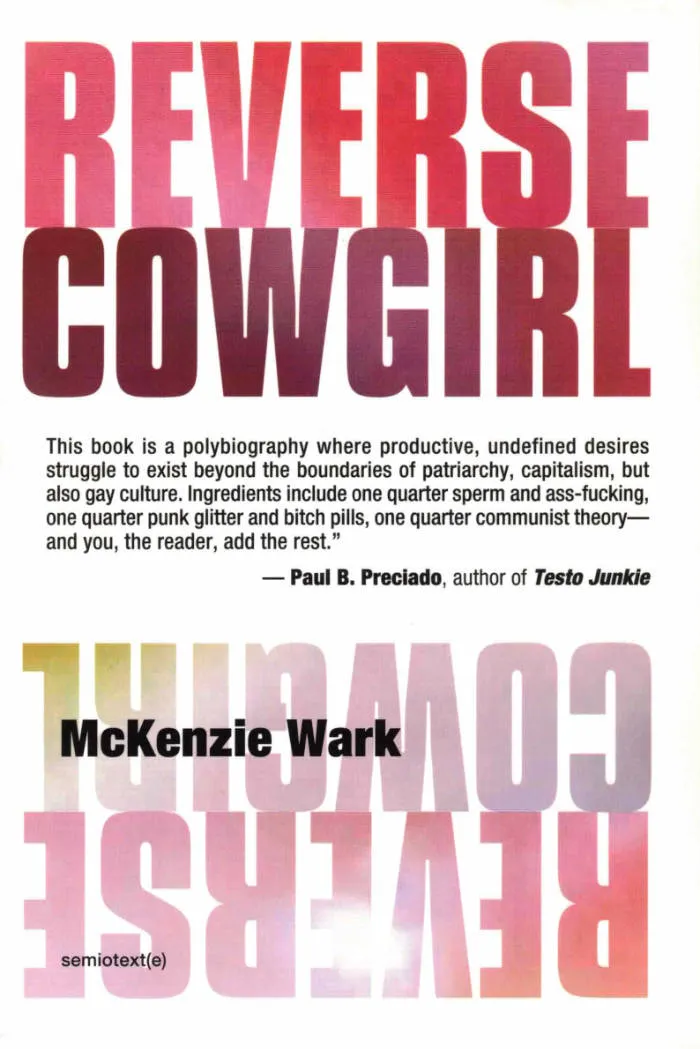
Reverse Cowgirl
McKenzie Wark invents a new genre for another gender: not a memoir but an auto-ethnography of the opacity of the self.
Another genre for another gender.
What if you were trans and didn't know it? What if there were some hole in your life and you didn't even know it was there? What if you went through life not knowing why you only felt at home in your body at peak moments of drugs and sex? What if you expended your days avoiding an absence, a hole in being? Reverse Cowgirl is not exactly a memoir. The author doesn't, in the end, have any answers as to who she really is or was, although maybe she figures out what she could become.
Traveling from Sydney in the 1980s to New York today, Reverse Cowgirl is a comedy of errors, chronicling the author's failed attempts at being gay and at being straight across the shifting political and media landscapes of the late twentieth century. Finding that the established narratives of being transgender don't seem to apply to her, Wark borrows from the genres of autofiction, fictocriticism, and new narrative to create a writing practice that can discover the form of a life outside existing accounts of trans experience: an auto-ethnography of the opacity of the self.

Discrete Categories Forced Into Coupling
"Discrete Categories Forced Into Coupling is consummate masterwork by a singuarly perceptive and articulate poet. Deceptively quiet in manner, its intimate foci and tone make clear the ground of our contemporary lives, our 'being together' despite the distances of isolating thought. I love Kathleen Fraser's extraordinary intelligence, her persistent care for where she is—and for all those she finds there too"—Robert Creeley.
"Here is a language of poetry that recognizes, beyond its intimacies, the intellectual and elusively sensate aspects of visual and literary aesthetic connection"—Carla Harryman.
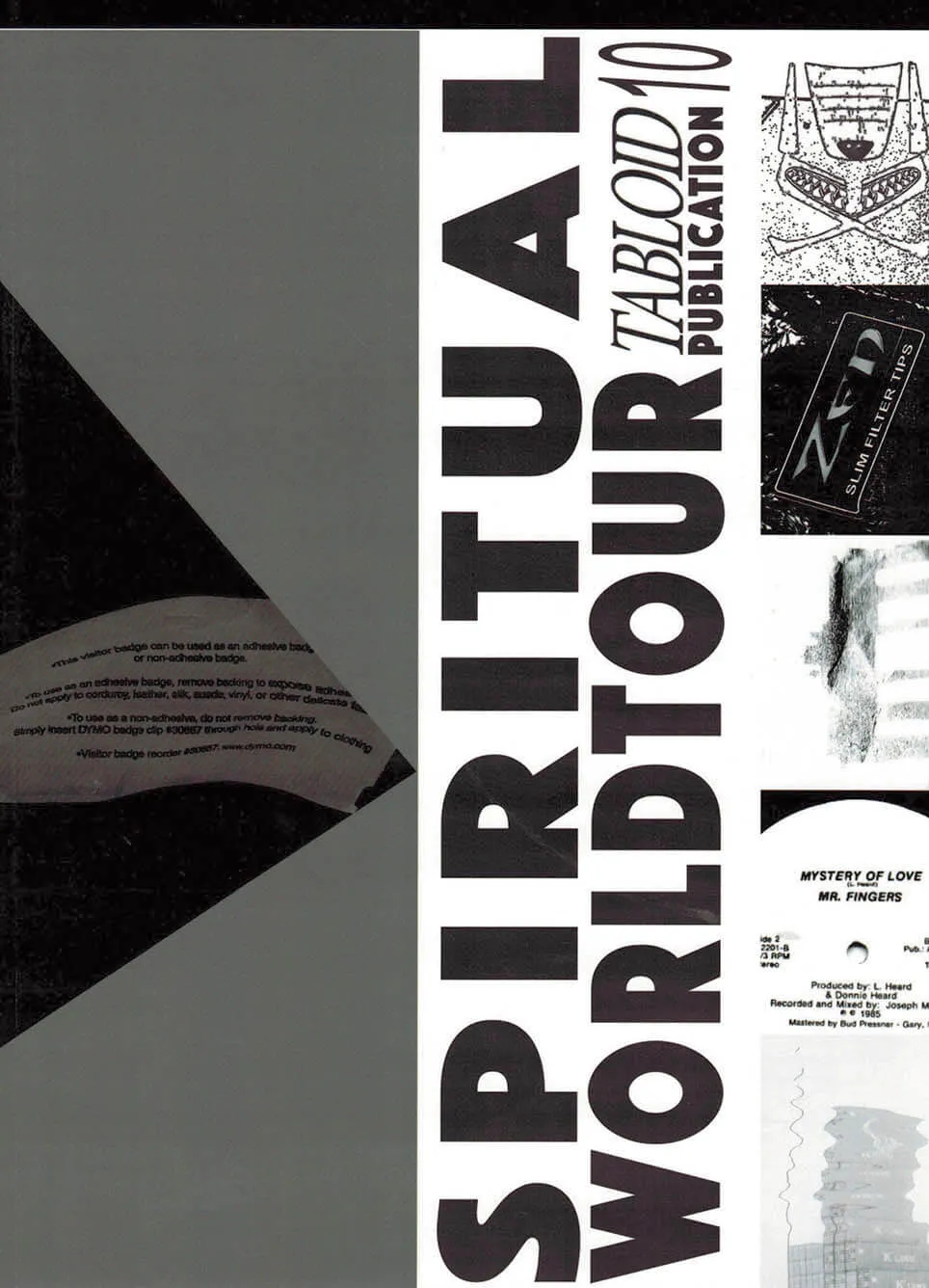

Worms Issue 11: Faith & Worship
Caitlin McLoughlin, Clem Macleod and 2 more
The theme for each issue of Worms tends to emerge steadily as gathering clouds. Often there is a nebulous sense of something that we want to explore, unripe fruits plucked from things we have read and heard and pocketed without much thought for later examination. It’s only when our pockets grow heavy, when ideas amass into something worthy of a second glance, that we start to name them. In the case of this one, our eleventh issue, its theme has its roots in the previous. The Love Issue—released in July 2025—explored love in all its guises: radical, complex, beautiful, violent. But in our study of the heart’s infinite mysteries there lurked an undercurrent of something else. Faith, close to love, was a persistent reoccurrence. Devotion, strength, clarity, refuge – these emerged as dimensions of love that can also be mapped across a search for something beyond the material. Worms 11: Faith & Worship began here.
FEATURING: Lamorna Ash, Clare Carlisle, Fanny Howe, Chris Kraus, Eileen Myles, Kazim Ali, Fiona Alison Duncan, Lauren J. Joseph, Olivia Laing, aja monet, Charlotte Northall, Arpan Roy, Noura Salahaldeen, Sarah Schulman, Michelle Tea.
CONTRIBUTORS: Temperance Aghamohammadi, Alaa Alqaisi, RZ Baschir, Sarah Burgoyne, F. Tibiezas Dager, Giulia De Vita, Helena Geilinger, Misha Honcharenko, Courtney Ann LaFaive, Ozziline Mercedes, Nicko Mroczkowski, Evie Reckendrees, Charlie Stuip, Clár Tillekens, Phoenix Yemi.
PHOTOGRAPHERS: Antonia Adomako, Eve Delaney, Jen Dessinger, Isabel Maccarthy, Britteny Najar, Katarzyna Postaremczak, Honor Weatherall.
ILLUSTRATORS & ARTISTS: Clara Esborraz, Eric Hesselbo, Lily Makoski, Samantha Rosenwald, Ivy Shepherd-Barron, Mary Watt, Shu Hua Xiong.
EDITORS: Caitlin McLoughlin, P. Eldridge, Clem MacLeod, Arcadia Molinas.
Proof Reader: Annalise June Kamegawa.
DESIGN: Caitlin McLoughlin & Clem MacLeod.
RUNWAY JOURNAL SUPPLEMENT
Contributors: Wassila Abboud, Anna Carlsson, Alexander Cigana, Bree Turner, Amelia Zhou.
Editors: Debris Facility, Ena Grozdanic, Victoria Pham.
Runway Supplement Design: SM Studio (Safiye Gray & Molly Cranston).
Cover Credits: Photo of Fanny Howe by Lynn Christoffers, Illustration by Mary Watt.

Split Tooth (Uk edition)
Fact can be as strange as fiction. It can also be as dark, as violent, as rapturous. In the end, there may be no difference between them. An Inuk girl grows up in Nunavut, Canada, in the 1970s. She knows joy, and friendship, and parents’ love. She knows boredom, and listlessness, and bullying. She knows the tedium of the everyday world, and the raw, amoral power of the ice and sky, the seductive energy of the animal world. She knows the ravages of alcohol, and violence at the hands of those she should be able to trust. She sees the spirits that surround her, and the immense power that dwarfs all of us.
When she becomes pregnant, she must navigate all this.
In this acclaimed debut novel – haunting, brooding, exhilarating, and tender all at once – Tanya Tagaq explores the grittiest features of a small Arctic town and the electrifying proximity of the worlds of animals and of myth.
Winner of the 2019 Indigenous Voices Award for Published Prose in English.

Palma Africana
Dans Palma africana, l’anthropologue australien Michael Taussig explore la production d’huile de palme en Colombie. Alors que cette dernière envahit tout, des chips au vernis à ongles, l’auteur examine les conséquences écologiques, politiques et sociales de cette exploitation.
Bien que la liste des horreurs induites par la culture du palmier à huile soit longue, nos terminologies habituelles ne permettent plus de rendre compte des réalités qu’elles décrivent. À travers cette déambulation anthropo-poétique au cœur des marécages colombiens, c’est donc la question du langage que l’auteur interroge. Comme William Burroughs, pour qui les mots sont aussi vivants que des animaux et n’aiment pas être maintenus en pages – Michael Taussig souhaite couper ces dernières, et les rendre à leur liberté.
Pensé à partir d’une vie d’exploration philosophique et ethnographique, Palma africana cherche à contrecarrer la banalité de la destruction du monde et offre une vision pénétrante de notre condition humaine. Illustré de photographies prises par l’auteur et écrit avec la verve expérimentale propre à l’anthropologue, ce livre est le Tristes Tropiques de Michael Taussig pour le XXIe siècle.
Traduit de l’anglais par Marc Saint-Upéry.

Mon musée de la Cocaïne
L’or et la cocaïne sont les deux matériaux bruts de Mon musée de la Cocaïne. C’est au cours de leur transformation et raffinement que ces deux substances ramènent avec elles une histoire de l’oppression et de l’esclavage.
Dans ce livre, l’anthropologue australien Michael Taussig prend comme point de départ la proposition de bâtir un musée de la Cocaïne (qui serait l’image reflétée du musée de l’Or de la Banque de la République à Bogotá) et dresse un portrait sans concession de la vie des mineurs afro-colombiens aspirés dans le monde dangereux de la production de cocaïne au fin fond de la forêt tropicale, sur la côte pacifique de la Colombie. Il décrit la violence, la pauvreté, mais aussi les croyances qui surgissent des marais envahis de mangroves et des rivières tropicales qui, pendant plus de cinq cent ans, ont attiré, ruiné et décontenancé Amérindiens, orpailleurs, conquistadors et pirates, esclaves africains, ingénieurs russes et guérilleros marxistes.
Mon musée de la Cocaïne se présente comme un assemblage éclectique d’histoires et d’anecdotes, présenté comme autant de salles d’un hypothétique musée de la Cocaïne, au sein desquelles le lecteur est invité à déambuler, en croisant des références qui vont de Charles Dickens à Franz Kafka en passant par la poésie de Seamus Heaney.

TYPP (The YellowPress Periodical)
TYPP is the community journal of Sint Lucas School of Arts in Antwerp. TYPP is partly a generator for the shared research of our advanced master students, and partly a platform for carefully selected contributions by tutors, students, alumni, guest lecturers and friends of SLA. TYPP is a stage where art and research from this community is shared with you, to enjoy, read, look, learn and get inspired.
Each edition is carefully and freely designed by Ward Heirwegh.

My Cinema
A collection of writings by and interviews with Duras about her filmmaking, first published in French by P.O.L. in 2021 and translated into English by Daniella Shreir.
Working chronologically through her nineteen films, made between 1966 and 1985, this collection of reflections by Marguerite Duras (1914–1996) includes non-standard press releases, notes to her actors, letters to funders, short essays on themes as provocatively capacious as ‘mothers’ and ‘witches’, as well as some of the most significant interviews she gave about her cinematic and writing practices (with filmmakers and critics including Jacques Rivette, Caroline Champetier and Jean Narboni).
In Duras's hands, all of these forms turn into a strange, gnomic literature in which the boundary between word and image becomes increasingly blurred and the paradox of creating a cinema that seeks ‘to destroy the cinema’ finds its most potent expression.
Yet, Duras is never concerned only with her own work, or even with the broader project of making cinema: her preoccupations are global, and the global crucially informs her perceptions of the way in which she works. With the audiovisual as a starting point, her encyclopaedic associative powers bring readers into contact with subjects as diverse as the French Communist Party, hippies, Jews, revolutionary love, madness and freedom, across four decades of an oeuvre that is always in simultaneous dialogue with the contemporary moment and world history.
MARGUERITE DURAS (1914–1996) published over forty novels, numerous essays, novellas and plays and made nineteen films. She was part of the French Resistance, joined then left the Communist Party, and actively protested against the war in Algeria. She collaborated repeatedly with actors including Jeanne Moreau, Delphine Seyrig and Gerard Depardieu. Her films speak of her childhood in Indochina and the French colonies, of desire (burning and frustrated), madness and domesticity. Contemporary filmmakers including Claire Denis, Alice Diop and John Waters have cited Duras’ cinema as inspiration for their own work.

KW Institute for Contemporary Art
Pia Arke
Pia Arke, Ros Carter and 1 more
Pia Arke (1958–2007) was a Greenlandic Inuk and Danish artist, writer and photographer. She is known for her self-portraits and landscape photographs of Kalaallit Nunaat (Greenland), as well as for her paintings, collages, performative film works and writing. Arke strove to make visible the silence that surrounded the colonial history and complex political and cultural relationship between Greenland and Denmark.
This publication accompanies the first international exhibitions of Arke’s work outside of Greenland and the Nordic countries, happening over the course of 2024 at John Hansard Gallery in Southampton (UK) and at KW Institute for Contemporary Art in Berlin (DE). It reflects on Arke’s ideas and legacy in a wider international context and aims to demonstrate how the work she made and the ideas she expressed connect with current discourse and contemporary thinking.
Texts by Krist Gruijthuijsen, Woodrow Kernohan, Ros Carter, Alice Maude-Roxby, Mette Sandbye, Tiara Roxanne, Sofie Krogh Christensen, Nivi Christensen, Siri Paulsen, Trinh T. Minh-ha