rile*books

Search books

Search books by title, author, publisher, keywords...

Cover of You Must Believe in Spring

Hajar Press

You Must Believe in Spring

Mohamed Tonsy

€18.00

Twenty years after she first chanted in Tahrir, Hanan’s son is living under military rule in Egypt. Though he is both a disciple of the national Sufi institute and a swimmer representing the Armed Forces, proximity to power cannot undo his revolutionary birthright: like his mother and grandmother before him, Shahed is an undercover rebel.

When a general arrives at the Sufi institute looking for help with a military assignment, Shahed accepts, all while concealing his own plans for resistance. The mission takes him behind the walls of a prison town, inside a secret army barracks in the Sinai desert, and deep into the murky waters of the past.

As he wades through his mother’s repressed memories and the state’s repressed histories, Shahed grapples with the traumas of the revolution and the weight of authoritarian rule, searching for new ways to revolt for freedom.

Mohamed Tonsy is a queer Egyptian writer and ceramicist. Formerly an architect and a triathlete representing the Egyptian Triathlon Federation, he completed a PhD in Creative Writing at the University of Edinburgh. His writing has appeared in Mizna and Epoch Press and was shortlisted in MFest’s 2021 Short Story Competition. You Must Believe in Spring is his first book.

Published in 2022 ┊ 264 pages ┊ Language: English

recommendations

Cover of COOP. A Novelette

Hajar Press

COOP. A Novelette

Nida Sajid

Fiction €16.00

On work and words, and how they contort the world.

Lena is a part-time bookseller in a bougie design studio in Oxford Circus. In between minimum-wage work under a politically hostile boss and strained communications with her parents, her days are shaped by a fraught relationship with food, ambiguous experiments in creative writing, and mounting pressure to find a ‘proper’ postgraduate job.

In taut, pocket-sized vignettes, COOP reveals a suffocating lattice of language that makes up a precarious London life. But as each word of her story unravels, Lena discovers interstices between them—to find autonomy and escape.

Cover of Brick by Brick: How We Build a World Without Prisons

Hajar Press

Brick by Brick: How We Build a World Without Prisons

Cradle Community

Non-fiction €18.00

The fight for prison abolition is a struggle for collective liberation: a transformative vision of a safer world, in which communities live free from exploitation on a thriving planet.

Drawing connections across social justice movements with a shared abolitionist ethic, this revolutionary book illuminates how harmful ideas of criminality and punishment can manifest in many ways beyond the prison industrial complex. This work is a collaboration with friends, mentors and giants fighting for housing justice, food justice, climate justice, migrant justice, justice for survivors of violence, and more.

With this insightful and generous book, now in its second edition, Cradle Community invites us to explore what it will take to dismantle structures of oppression, and to imagine the future we can rebuild together—brick by brick.

Cradle Community is a collective of organisers committed to radical education and building understanding of prison abolition and transformative justice. Brick by Brick is their first book.

Cover of Experiments in Imagining Otherwise

Hajar Press

Experiments in Imagining Otherwise

Lola Olufemi

Fiction €18.00

This is a book of failure and mistakes; it begins with what is stolen from us and proposes only an invitation to imagine.

In these playful written experiments, Lola Olufemi navigates the space between what is and what could be. Weaving together fragmentary reflections in prose and poetry, this is an exploration of the possibility of living differently, grounded in black feminist scholarship and political organising.

Olufemi shows that the horizon is not an immaterial state we gesture toward. Instead, propelled by the motion of thinking against and beyond, we must invent the future now and never let go of the otherwise.

Lola Olufemi is a black feminist writer and CREAM/Stuart Hall Foundation researcher from London. Her work focuses on the uses of the feminist imagination and its relationship to futurity, political demands and imaginative-revolutionary potential. She is the author of Experiments in Imagining Otherwise and Feminism, Interrupted: Disrupting Power, the co-author of A FLY Girl’s Guide to University, and a member of ‘bare minimum’, an interdisciplinary anti-work arts collective.

Cover of Pearls from Their Mouth

Hajar Press

Pearls from Their Mouth

Pear Nuallak

Fiction €18.00

This book is built of stories and provocations—like the birth of a pearl, it transforms that which irritates, layer by layer.

Through speculative fiction and critical essays, Pear Nuallak explores what happens when messy, desiring bodies collide with the hard edge of power. The world’s neat categories are unmade and rewritten, revealing that racial capitalism’s myths are just as much fantasies as Thai bird princesses and transgender magic.

Moving playfully across folktale, horror, satire and critique, Nuallak examines how different beings are formed politically, bodily and emotionally. We discover interdimensional fungi resisting colonisation, queer monsters living on Hampstead Heath, and a mysterious canal running through the ruins of capitalism into interstitial realms. We test the borders of queer diasporic nationalism and take apart the racially melancholic memoir. In this fiery yet delicate collection, we aren’t bound by truth, but flow with it into new worlds.

Pear Nuallak is a visual artist and writer from London. They run community art workshops and co-organise a queer social hub with the Black Cap Community Benefit Society. Their writing has been published in The Dark and Interfictions. Pearls from Their Mouth is their first book.

Cover of Seeing for Ourselves

Hajar Press

Seeing for Ourselves

Suhaiymah Manzoor-Khan

Non-fiction €18.00

Why do we yearn to be seen when we are already far too visible? How do we want to be perceived, and how are we exposed? Could we ever really see for ourselves?

In memoir, vignettes, poetry and essays, Suhaiymah Manzoor-Khan records her observations from the stands at the dizzying circus of being seen and unseen. She surveys the criminalising stadium of civic life, the open-air arenas of family, friendship and grief, the performative pageantry of the public eye and the unclad secrets of the self in solitude, paying attention to what’s on show and what goes undetected.

Perhaps the strangest, most exciting possibilities are opened when we surrender to another kind of sight. Submitting to the gaze of the Unseen and the All-Seeing, Manzoor-Khan invites us to close our eyes and discover what it would mean to look with our souls instead.

Suhaiymah Manzoor-Khan is a poet and writer whose work disrupts assumptions about history, race, violence and knowledge. She is the author of Tangled in Terror and the poetry collection Postcolonial Banter; a co-author of A FLY Girl’s Guide to University; and a contributor to the anthologies Cut from the Same Cloth? and I Refuse to Condemn. She is based in Leeds and is currently writing for theatre.

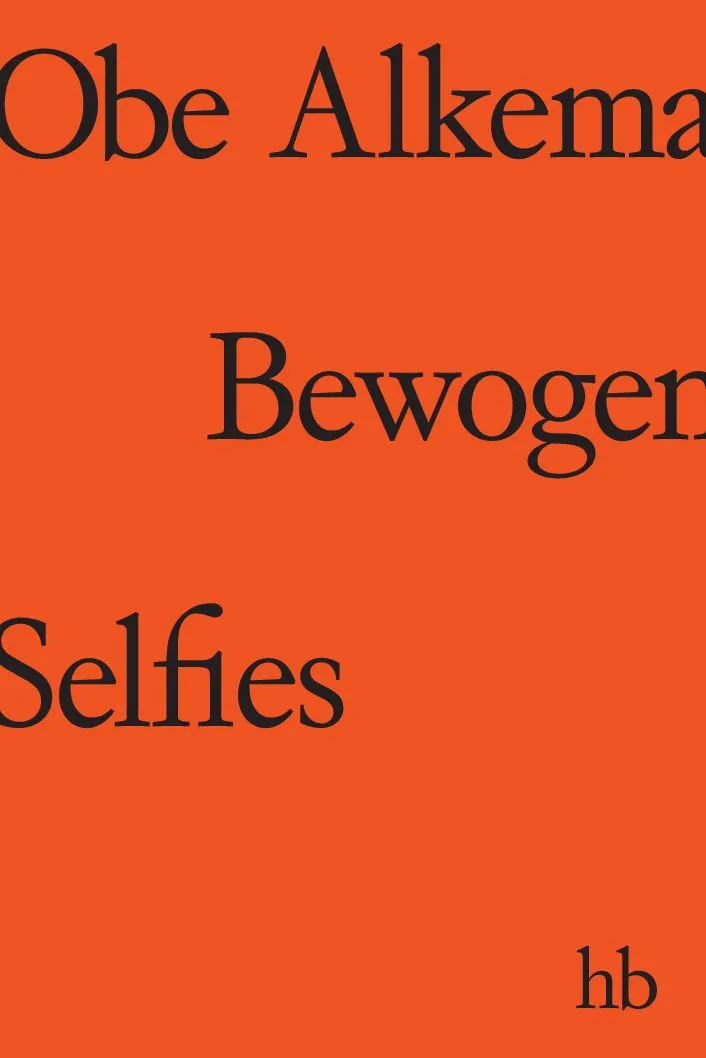
Cover of Bewogen selfies

het balanseer

Bewogen selfies

Obe Alkema

Poetry €24.50

In Bewogen selfies onderzoekt Obe Alkema de verhouding tussen landschap en herinnering. Wat treft hij aan bij terugkeer naar belangrijke plaatsen uit zijn geheugen? Wat herinnert hij zich niet, maar Google wel? Is er een gedenkschrift te puren uit zijn metadata?

Memoires, rechtstreeks verteld en met omwegen, uit eerste hand en van horen zeggen. Archieven en herinneringen eisen spreektijd, houden het niet meer droog of worden tot spreken gebracht. Wat hebben ze eigenlijk te melden? Ze lopen helemaal leeg, net als Alkema zelf. Een leven zoals zovele, poedelnaakt en geretoucheerd, vol zin en onzin.

Cover of Secrèt

Dépense Défensive

Secrèt

Théo Robine-Langlois

Fiction €12.00

Mystique des rues vides et peu éclatantes des banlieues pavillonnaires, ce court poème en prose interpelle par sa langue sombre. Dans une parodie de messe noire – beigeasse comme le crépis des façades –, Théo Robine-Langlois dépeint le monde mystérieux des maisons individuelles, du repli sur soi démonique, et des vieilles qui marmonnent entre leurs gencives au retour du marché, le panier plein de gros sel et de radis noirs en guise d'hostie. Les mots occitans qui ponctuent le texte comme des conjurations en accroissent l’escur.

Cover of Elizabeth in the Woolds

Self-Published

Elizabeth in the Woolds

Jennifer Brewer

Fiction €22.00

Elizabeth in the Woolds is the product of two superimposed compositional strategies; a thematic aggregate based on notes dating back to 2008 and an epic prose narrative. Elizabeth is the device through which this simultaneous register moves. Screen writing provides a model for multiple voices. In a film script, the narrator can be the camera; there’s a machine at the centre of the story structure which figures a demand for resolution of plot; a contrario, the thematic approach (S, U, N, as electric light) obliterates chronology, and enumerates an atemporal topological figure, or the way the world is built.

(730pp., self-published first edition of 50, Kortrijk, 2021) 

Cover of Lote

Duke University Press

Lote

Shola von Reinhold

Fiction €20.00

Shola von Reinhold's decadent queer literary debut immerses readers in the pursuit of aesthetics and beauty, while interrogating the removal and obscuring of Black figures from history.

Solitary Mathilda has long harbored a conflicted enchantment bordering on rapture with the "Bright Young Things," the Bloomsbury Group, and their contemporaries of the '20s and '30s, and throughout her life her attempts at reinvention have mirrored their extravagance and artfulness. After discovering a photograph of the forgotten Black modernist poet Hermia Druitt, who ran in the same circles as the Bright Young Things, Mathilda becomes transfixed and resolves to learn as much as she can about the mysterious figure. Her search brings her to a peculiar artists' residency in Dun, a small European town in which Hermia was known to have lived during the '30s. The artists' residency throws her deeper into a lattice of secrets and secret societies that takes hold of her aesthetic imagination. From champagne theft and Black Modernisms to art sabotage, alchemy, and a lotus-eating proto-luxury communist cult, Mathilda's "Escapes" through modes of aesthetic expression lead her to question the convoluted ways truth is made and obscured.

Shola von Reinhold is a Scottish socialite and writer. Shola has been published in the Cambridge Literary Review, The Stockholm Review, was Cove Park's Scottish Emerging Writer 2018 and recently won a Dewar Award for Literature. Shola is a recent graduate from the Creative Writing MLitt at Glasgow which was completed through the Jessica Yorke Writing Scholarship and has previously studied Fine Art at Central Saint Martins. Shola has also written for publications including i-D, AnOther Magazine.

Cover of The Hour of the Star

New Directions Publishing

The Hour of the Star

Clarice Lispector

Fiction €14.00

The devastating final work by Brazil’s greatest modern writer, The Hour of the Star tells the haunting tale of Macabéa—a typist who lives in the slums of Rio—underfed, sickly, and unloved, yet inwardly free.

Translated from the Portuguese by Benjamin Moser. With a contribution by Paulo Gurgel and Valente Colm Tóibín.

The Hour of the Star, Clarice Lispector's consummate final novel, may well be her masterpiece. Narrated by the cosmopolitan Rodrigo S.M., this brief, strange, and haunting tale is the story of Macabéa, one of life's unfortunates. Living in the slums of Rio de Janeiro and eking out a poor living as a typist, Macabéa loves movies, Coca-Cola, and her rat of a boyfriend; she would like to be like Marilyn Monroe, but she is ugly, underfed, sickly, and unloved. Rodrigo recoils from her wretchedness, and yet he cannot avoid realization that for all her outward misery, Macabéa is inwardly free. She doesn't seem to know how unhappy she should be. Lispector employs her pathetic heroine against her urbane, empty narrator—edge of despair to edge of despair—and, working them like a pair of scissors, she cuts away the reader's preconceived notions about poverty, identity, love, and the art of fiction. In her last novel she takes readers close to the true mystery of life, and leaves us deep in Lispector territory indeed.