rile*books

Search books

Search books by title, author, publisher, keywords...

Cover of Why so few women on the street at night

the87press

Why so few women on the street at night

Sarona Abuaker

€13.00

In Sarona Abuaker’s extraordinary debut collection, “images, graphs, charts, statistics, maps, bank statements from the home of origin &/or showing the said home of origins” perform a version of skin that shakes until it is no longer something another person could touch. Is this erasure, a metamorphic performance, or the moment, in fact, in which the body is disappeared? In one searing instance, Abuaker attends to somatic memory as something made available only by severance, a physiological and political act: “release memory/ muscle/heart/if you cut open the chest/you will see the blockages/cross lines/coronary/green azygous/armistice/ partition/seizing seizing seizing.” Here, syntax performs the cut and becomes the texture, the wound, the very thing that must be sutured now. As the poet writes: “resistance sometimes looks like constraint.” Perhaps the same could be said of recovery (aftermath) as well. Why so few women on the street at night is another brilliant offering from the87press. – Bhanu Kapil

Sarona Abuaker is a poet, artist, and educational outreach worker. Her poems have been published in Berfrois, MAP Magazine, and the87press’ Digital Poetics series. Her mixed-media essay Suture Fragmentations – A Note on Return was published in December 2020 with KOHL: A Journal for Body and Gender Research. She is based in London. Why so few women on the street at night is her debut collection (the87press, 2021).

Language: English

recommendations

Cover of On Feminist Films

the87press

On Feminist Films

Stuart Bell

This collection of essays celebrates the work of international feminist filmmakers from the 1950s to the present. Featuring contributions from leading scholars, filmmakers, essayists and activists, On Feminist Films is the second volume in the South London Cultural Review series. Contributors include: Stuart Bell, Catherine Grant, So Mayer, Louisa Wei, Emma Wilson.

Cover of Fleshed Out For All The Corners Of The Slip

the87press

Fleshed Out For All The Corners Of The Slip

James Goodwin

Poetry €13.00

This major new work is thought, spirit and sense (in every sense) ‘fleshed out’ in ‘all the corners’ by being unmade – as poetry, as music, as (black and white) images, and as attention to the interconnected circuitries the One has with the social, historical and environmental ‘to / link us outside’. These elements are no sooner embodied than they slip, shift, carousel and spin away. As Goodwin puts it: ‘no longer a bodily reference to an individual subject’s presence; not obliterated but made into an element, air or breath, as black poetry’s condition of im/possibility for, and refusal of subjecthood.’ Hence it is that this poetry achieves ‘flightacross precipitous intransigence’ (Will Alexander), perhaps flights of manifestations of spirit, ‘ghostly crowned / apogees’, like duppies, which is to say, sacred. Hence too the work’s urgent task to avoid ‘thingification’: the conscription and exploitation of thought &/or body for neo-colonialist, which is to say, neo-liberal ends. Goodwin eschews identity politics for a phenomenology that is more properly radical in both the etymological sense of the term – rooted and vital to life – as well as situated within a history of experimental black thought which, simultaneously, rejects normative traditions of meaning, signification and value. Both meanings are central to the anti-racist core of this important work – ‘when i don’t know you but you must know who i am’ – in a poetry that’s as breath-taking as it is breath-making. ‘Inexpressibly full with what words can do’.

— Emily Critchley, author of Home (London: Protoype, 2021), Arrangements (Shearsman Books, 2018) and Ten Thousand Things (UEA: Boiler House Press, 2017)

James Goodwin is a poet doing a PhD in English and Humanities at Birkbeck, University of London with a thesis on the blacksociopoetics of marronage, breath, sacrality and emanation. His pamphlet, aspects caught in the headspace we’re in: composition for friends, was published by Face Press; and his debut book, Fleshed Out For All The Corners Of The Slip, is forthcoming with the87press. He serves on the Editorial Advisory Board for the Journal of British and Irish Innovative Poetry.

Cover of The Letters of Audre Lorde and Pat Parker 1974-1989

the87press

The Letters of Audre Lorde and Pat Parker 1974-1989

Julie R. Enszer

Poets Audre Lorde and Pat Parker first met in 1969; they began exchanging letters regularly five years later. Over the next fifteen years, Lorde and Parker shared ideas, advice, and confidence through the mail. They sent each other handwritten and typewritten letters and postcards often with inserted items including articles, money, and videotapes.

The Letters of Audre Lorde and Pat Parker 1974-1989 gathers this unique correspondence in which Lorde and Parker discuss their work as writers as well as the intimate details of their lives, including periods when each lived with cancer. These letters are a rare opportunity to glimpse inside the minds and friendship of two great twentieth century poets.

Introduction by Mecca Jamilah Sullivan.

Cover of Incubation: a space for monsters

Kelsey Street Press

Incubation: a space for monsters

Bhanu Kapil

Non-fiction €23.00

New edition of this long out of-print classic of diasporic literature, featuring a forward by Eunsong Kim, an afterword by Emgee Dufresne, and new endnotes by Bhanu Kapil.

Incubation: a space for monsters is a formally innovative, hybrid-genre book that incorporates poetry and prose. Set in a shifting narrative environment, where human bodies, characters, and text are neither one thing nor another, this fragmentary-diaristic text journeys through the spaces in-between. Originally published in America in 2006 by Leon Works, and out of print for the last seven years, this is the first time this seminal text has been available in the UK.

Following protagonist Laloo – Cyborg, girl, mother, child, immigrant, settler – on a roadtrip through American landscapes, genre styles, and form, Incubation creates radical space for what is ‘monstrous’. Appropriating iconic American tropes, and the structure of Jack Kerouac’s On the Road, Incubation explores the challenges faced by immigrants in attaining such notions of freedom in so hostile an environment. In this fragmentary document there is a celebration in the cobbling together of lives; global in scope, with an intimate focus on interior voice, this landmark text evidences the early innovations and talents of this T.S. Eliot prizewinning author.

Cover of The Vertical Interrogation of Strangers

Kelsey Street Press

The Vertical Interrogation of Strangers

Bhanu Kapil

Poetry €18.00

The Vertical Interrogation of Strangers blends the narratives of the travelog and the coming of age novel. It is written by a young Indian woman whose travels take her between homes in two countries, India and England, and through parts of the United States. These short pieces reveal new ways of belonging in the world and possibilities for an art grounded in a localized cosmopolitan culture.

Bhanu Kapil has written three full-length prose/poetry works, THE VERTICAL INTERROGATION OF STRANGERS (Kelsey Street Press, 2001), INCUBATION: A SPACE FOR MONSTERS (Leon Works, 2006), and HUMANIMAL [A PROJECT FOR FUTURE CHILDREN] (Kelsey Street Press, 2009). Born in the UK to Indian parents, Bhanu lives in Colorado, where she teaches in The Jack Kerouac School of Disembodied Poetics at Naropa University. 

Published 2001

Cover of She Will Last as Long as Stones

Wendy's Subway

She Will Last as Long as Stones

kathy wu

Ecology €18.00

Weaving together the matter of geology, migration, and computation, kathy wu’s debut book She Will Last as Long as Stones mines data from the United States Geological Survey, pairing it with (mis)translations of conversations with the author’s mother, narratives of racialized and gendered labor, and elegies on end-of-life care. Through text, photo-collage, and diagrammatic circuitry, wu mobilizes language toward the edges of things, where glitch and failure meet grief, outpour.

kathy wu's She Will Last as Long as Stones is the 2024 Open Reading Period Book Prize winner, and was selected by guest judge Bhanu Kapil

kathy wu is a Chinese–American artist, poet, and designer living in Providence, Rhode Island, on Narragansett land. She works across digital media, fiber, book arts, and language to pull at histories of science and technology. Her work has appeared via The New School, Dialogist, Rain Taxi, NatBrut, and Tilted House, and has been anthologized by Fonograf Editions and Nightboat Books. She has been awarded fine arts residencies at Blue Mountain Center, Black Mountain College Museum, and Pao Arts Center. She currently teaches full-time at Rhode Island School of Design (RISD), and holds an MFA from Brown University’s Literary Arts program.

She Will Last as Long as Stones has the inter-genre brilliance of asking where materials originate, and following that question until writing becomes a kind of listening with stone, with metal, for magnetic reverberations, for the thinking at the back of the cave.
— Bhanu Kapil

There just might be currents coursing through landscape, language, software, and labor—presences that escape extraction and will not be denied. She Will Last as Long as Stones looks into the multiple temporalities and operations of many things: material place, mining, social and scientific documentation, computation, migrant women's work, and mother-daughter relations, constellating them into a poetics of wondrous design and resonant beauty. 
— Kimberly Alidio

She Will Last as Long as Stones is a subtle circuit that conducts a charge but (paradoxically) remains open. wu's intricate parataxis offers readers fertile resistance, while simultaneously leading us to grounded revelations about the intertwined materialities of technology, language, and memory.
Allison Parrish

Cover of BRICKS FROM THE KILN #8

Bricks from the Kiln

BRICKS FROM THE KILN #8

Matthew Stuart, Andrew Walsh-Lister

Fiction €20.00

This eighth instalment of BFTK is on letters and letters. It takes the double meaning of this word as its point of dispatch, inviting recipients to think through and respond to — directly and indirectly — ideas around correspondence, addressing and alphabets. What it means to be in correspondence with somebody, the initiation and continuation of this communicative exchange and what happens when it is severed or lost. How to write directly towards a you, to you; to a particular reader, object, locale. The volume is littered with letters. There are letters about letters, letters to letters, letters that crease, fold, tear and rip, letters that are sent and lost, found and read. There are letters that pile up, their combinations arranged and rearranged to form comprehensive linguistic logics, and there are letters that are simply letters. Contributions sit in eight-page signatures, of which there are twenty-six in total. Of the eight hundred bound copies, twenty-six are left unbound, returned to discrete correspondence, loose abécédaire units for exchange — letters to be leafed through and addressed once more.

PLEASE TAKE A LOOK AT YOUR
SHADOW IN THAT MIRROR
Chang Yuchen
(pp.1–8, A)

BESTIARY FOR A NON-GENETIC DESCENDANT
Bhanu Kapil
(pp.9–16, B)

THROW STUFF AWAY
Hannah Regel
(pp.17–24, C)

THE MOON HATH XXX DAYS:
LETTERS FOR LETTERS
Helen Marten
(pp.25–32, D)

WHAT DOES THE LOSS FEEL LIKE?
Meg Miller
(pp.33–48, E, F)

LIGHT UP THE A
Kate Briggs
(pp.49–56, G)

THE POSTCODE CONNECTION
Rebecca Ross
(pp.57–72, H, I)

(LETTER) TO S… LABYRINTH-CORTEX
Michèle Métail, trans. Thea Petrou
(pp.73–80, J)

RACKETY CORRESPONDENCES /
A CORRESPONDING RACKET
Nisha Ramayya
(pp.81–96, K, L)

THE COIN OF THE REALM
Lucie Elven
(pp.97–104, M)

UNFOLDING FOLDED FANTASIES:
A CORRESPONDENCE WITH THE SEATED SCRIBE
Fatema Abdoolcarim
(pp.105–112, N)

DEAR DEAREST DEAR MOTHER
Alice Butler
(pp.113–120, O)

/ DON’T BOTHER THE CREASE
Tice Cin
(pp.121–128, P)

FEELING LETTERS, SEEING BLUE
Gemma Blackshaw
(pp.129–144, Q, R)

LINES OF GRACE AND DISGRACE
Francis Haselden
(pp.145–152, S)

AN ABC OF MIMICRY
Jeffrey Stuker & Jan Tumlir
(pp.153–176, T, U, V)

ADDRESS
Céline Mathieu
(pp.177–184, W)

MY VOICE FOLDS YOU
Thea Petrou
(pp.185–192, X)

A LONG DISTANCE LULLABY
Vibeke Mascini
(pp.193–200, Y)

DEBT OF GOLD CAN BE PAID OFF,
DEBT OF KINDNESS IS CARRIED OVER DEATH
Chang Yuchen
(pp.201–208, Z)

LETTERS ON LETTERS
FROM LETTERS ON LETTERS
Matthew Stuart
(covers)

Cover of Appendix Project

Prototype Publishing

Appendix Project

Kate Zambreno

Essays €16.00

Written in the course of the year following the publication of Book of Mutter, and inspired by the lectures of Roland Barthes, Anne Carson, and Jorge Luis Borges, Appendix Project collects eleven talks and essays. These surprising and moving performances, underscored by the sleeplessness of the first year of their child’s life, contain their dazzling thinking through the work of On Kawara, Roland Barthes, W.G. Sebald, Bhanu Kapil, Walter Benjamin, Theresa Hak Kyung Cha, Marguerite Duras, Marlene Dumas, Louise Bourgeois, Doris Salcedo, Jenny Holzer, and more.

Cover of [...]: Poems

Milkweed Editions

[...]: Poems

Fady Joudah

Poetry €16.00

From one of our most acclaimed contemporary writers, an urgent and essential collection of poems illuminating the visionary presence of Palestinians.

Fady Joudah’s powerful sixth collection of poems opens with, “I am unfinished business,” articulating the ongoing pathos of the Palestinian people. A rendering of Joudah’s survivance, [...] speaks to Palestine’s daily and historic erasure and insists on presence inside and outside the ancestral land.

Responding to the unspeakable in real time, Joudah offers multiple ways of seeing the world through a Palestinian lens—a world filled with ordinary desires, no matter how grand or tragic the details may be—and asks their reader to be changed by them. The sequences are meditations on a the past returns as the future is foretold. But “Repetition won’t guarantee wisdom,” Joudah writes, demanding that we resuscitate language “before [our] wisdom is an echo.” These poems of urgency and care sing powerfully through a combination of intimate clarity and great dilations of scale, sending the reader on heartrending spins through echelons of time. […] is a wonder. Joudah reminds us “Wonder belongs to all.”

Cover of Language Arts

Wendy's Subway

Language Arts

Justin Allen

Poetry €18.00

Justin Allen’s Language Arts takes up writing as an integral part of an interdisciplinary art practice. Across poems, essays, lyrics, screenwriting, and drawings, works touch on themes of music and subculture, African diasporic language, visual art, and more, bringing together Allen's numerous influences into one collection.

Justin Allen's Language Arts is the 2022 Open Reading Period Editors' Pick.

About the author
Justin Allen is a writer and performer from Northern Virginia. With a background in tap dancing and creative writing, his work often combines a variety of art forms. He has been commissioned by The Chocolate Factory Theater and The Shed and has held residencies at ISSUE Project Room and the Center for Afrofuturist Studies. He has received support from Franklin Furnace, Foundation for Contemporary Arts, and the Jerome Foundation, and shared his work both stateside and abroad.

"In Hatnaha, Justin Allen has reinvented the myth of Atlantis for our postlapsarian age. His art of language cannibalizes the American grammar book, spawning gorgeous new idiolects. Through the buzz and rumble of Afro-diasporic sound clash, Allen hears the frequency of bodies becoming ungovernable. Set to a soundtrack of punk phonotactics, Language Arts is just the book to toss over the barbed wire fences that cordon us off from our post-Reparations future." —Tavia Nyong’o

"Language Arts shares a name with an elementary school class I always wished was more “art” and less rote memorization, and it fully delivers on that desire with its spellbinding assortment of prose poetry, screamo lyricism, screenplay, conlang, and Black political fiction as vibrant as any comp on physical media or stream. nunats nen-tuk nutaks dipa. Justin Allen creates an executable file, one that's bound to spread like Soulja Boy's "Crank That" renamed “britney_spears-hitmebabyonemoretimeremix.mp3," but without the need for tricknology." —Devin Kenny

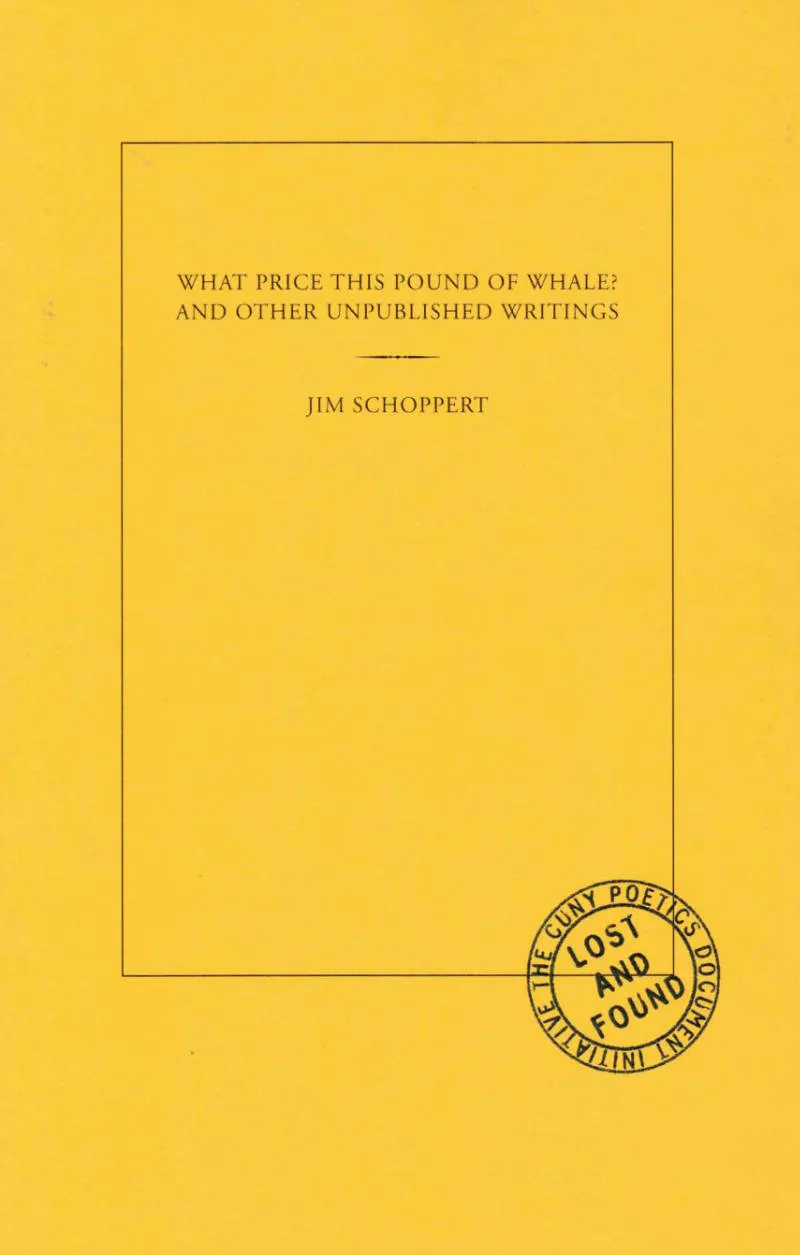
Cover of What Price This Pound of Whale? and Other Unpublished Writings

CUNY Center for the Humanities

What Price This Pound of Whale? and Other Unpublished Writings

Jim Schoppert

Poetry €14.00

The Tlingit artist Jim Schoppert (1947-1992) was among the most accomplished, innovative, and prolific Alaska Native artists of the twentieth century. His whimsical sculptures and large scale painted wooden carvings reconfigure Tlingit visual motifs, and he challenged the binary categories against which Indigenous artists are so often defined, such as traditional and contemporary, historic and innovative, and artist or craftsperson. While known primarily for his modernist interventions in Tlingit visual traditions, Schoppert was also a prolific writer, an eloquent speaker, and an ardent advocate for Alaska Native artists. This publication brings together a selection of his unpublished poetry and writings from the artist’s personal papers. Presented alongside never before seen sketches and studies, this selection bridges Schoppert’s written and artistic practices in a deeply personal portrait of the artist and Alaska Native life that upsets preconceptions about Native art and unsettles the established narrative of Euro-American and Indigenous aesthetic relations.

Jim Schoppert (1947-1992) was a Tlingit multidisciplinary artist and writer. He was a Taku Tlingit Raven of the Ishkahittaan (Inland Frog) clan from his Tlingit mother and half-German from his father and carried the Łingit name Dom-Yetz. Born in Juneau, Alaska, he earned a BFA in Sculpture and Printmaking from the University of Alaska—Anchorage and an MFA from the University of Washington. In addition to his artistic career, Schoppert was instrumental in promoting Alaska Native arts and organizations. He was Director of Arts and Crafts at the Cook Inlet Native Association, Director of the Alaska Arts in Prisons Program for the University of Alaska Juneau, and organized exhibitions and workshops across Alaska and the Pacific Northwest. He was visiting professor in visual art at the University of Alaska, Fairbanks and directed its Native Art Center. He sat on the Washington State Arts Commission and on the boards of the Alaska State Council on the Arts and the Institute of Alaska Native Arts. His work is held in public and private collections across the United States, including the Smithsonian National Museum of the American Indian, the Anchorage Museum, the Heard Museum, and the Newark Museum, among others. His writing and poetry has appeared in The Greenfield Review and Journal of Alaska Native Arts, among other publications.

Cover of Festival

Belladonna* Collaborative

Festival

Mia You

Poetry €18.00

The festival is a space of communion and celebration, a romanticized collision of bodies, music and magic. The revolution will look like a festival, we’ve been told by philosophers, writers, artists, and marketers. But the festival is also, of course, the space of formalizing ideology, ritualizing the consumption and violence that propels existing structures of power. 

This poetry collection views the migrant, female body as both the glorified and martyred totem of the festival-of-all-festivals we call globalization. Drawing from sources such as Sigmund Freud, James George Frazer, H.D., the Situationist International, seventeenth century narratives of Dutch sailors shipwrecked on the Korean peninsula, the rise of K-pop and the “Korean Wave,” and a zoo-breaking gorilla named Bokito, Festival features kaleidoscopic poetic sequences aiming to show that if anything universal is to be found in lyric poetry’s “I,” it is the result of centuries-long entanglements and contaminations, and of the bodies made to bear these exchanges, to give birth to this century’s globalized subject.

“FESTIVAL is an ode to both beauty and misery. Mia You’s ingenious poetry will have you laughing through your tears. Do NOT miss out!”
— Yael van der Wouden

"She reanimates the form-of-life which is a poem with a feminist skepticism, without foreclosing her robustly idealist commitment to poetry’s continuance"
Lisa Robertson