rile*books

Search books

Search books by title, author, publisher, keywords...

Cover of Fleshed Out For All The Corners Of The Slip

the87press

Fleshed Out For All The Corners Of The Slip

James Goodwin

€13.00

This major new work is thought, spirit and sense (in every sense) ‘fleshed out’ in ‘all the corners’ by being unmade – as poetry, as music, as (black and white) images, and as attention to the interconnected circuitries the One has with the social, historical and environmental ‘to / link us outside’. These elements are no sooner embodied than they slip, shift, carousel and spin away. As Goodwin puts it: ‘no longer a bodily reference to an individual subject’s presence; not obliterated but made into an element, air or breath, as black poetry’s condition of im/possibility for, and refusal of subjecthood.’ Hence it is that this poetry achieves ‘flightacross precipitous intransigence’ (Will Alexander), perhaps flights of manifestations of spirit, ‘ghostly crowned / apogees’, like duppies, which is to say, sacred. Hence too the work’s urgent task to avoid ‘thingification’: the conscription and exploitation of thought &/or body for neo-colonialist, which is to say, neo-liberal ends. Goodwin eschews identity politics for a phenomenology that is more properly radical in both the etymological sense of the term – rooted and vital to life – as well as situated within a history of experimental black thought which, simultaneously, rejects normative traditions of meaning, signification and value. Both meanings are central to the anti-racist core of this important work – ‘when i don’t know you but you must know who i am’ – in a poetry that’s as breath-taking as it is breath-making. ‘Inexpressibly full with what words can do’.

— Emily Critchley, author of Home (London: Protoype, 2021), Arrangements (Shearsman Books, 2018) and Ten Thousand Things (UEA: Boiler House Press, 2017)

James Goodwin is a poet doing a PhD in English and Humanities at Birkbeck, University of London with a thesis on the blacksociopoetics of marronage, breath, sacrality and emanation. His pamphlet, aspects caught in the headspace we’re in: composition for friends, was published by Face Press; and his debut book, Fleshed Out For All The Corners Of The Slip, is forthcoming with the87press. He serves on the Editorial Advisory Board for the Journal of British and Irish Innovative Poetry.

Language: English

recommendations

Cover of The Letters of Audre Lorde and Pat Parker 1974-1989

the87press

The Letters of Audre Lorde and Pat Parker 1974-1989

Julie R. Enszer

Non-fiction €18.00

Poets Audre Lorde and Pat Parker first met in 1969; they began exchanging letters regularly five years later. Over the next fifteen years, Lorde and Parker shared ideas, advice, and confidence through the mail. They sent each other handwritten and typewritten letters and postcards often with inserted items including articles, money, and videotapes.

The Letters of Audre Lorde and Pat Parker 1974-1989 gathers this unique correspondence in which Lorde and Parker discuss their work as writers as well as the intimate details of their lives, including periods when each lived with cancer. These letters are a rare opportunity to glimpse inside the minds and friendship of two great twentieth century poets.

Introduction by Mecca Jamilah Sullivan.

Cover of On Feminist Films

the87press

On Feminist Films

Stuart Bell

Essays €18.00

This collection of essays celebrates the work of international feminist filmmakers from the 1950s to the present. Featuring contributions from leading scholars, filmmakers, essayists and activists, On Feminist Films is the second volume in the South London Cultural Review series. Contributors include: Stuart Bell, Catherine Grant, So Mayer, Louisa Wei, Emma Wilson.

Cover of And most of all I would miss

Veer2

And most of all I would miss

Mira Mattar

Poetry €13.00

Picture a pencil curved, implausibly, parabolically. An implement bending back on itself (core straining) so as to be drawing the surest line, even as its eraser-end is simultaneously rubbing that graphite out. What remains almost never was: mark as memorial to foreclosure. Examined from a certain angle, the un-line flickers in and out of thereness. On registration, it lives, it goes forth. Sub rosa, it knows never to clear its throat. It has learnt to calibrate its signature; it can evade infra-red. Propelling itself through the narrowest channels, it proceeds with resolve, flayingly. Mattar’s And most of all I would miss the shadows of the tree’s own leaves cast upon its trunk by the orange streetlight in the sweet blue darks of spring is taut as writing can be. The tone she makes sound is singular and desperately (gloriously) intent.
- Sarah Hayden

Piercing and lucid in its exposition of atmospheric violence and total erasure, Mira Mattar gets to the grain of how the languages of selfhood, mediated but also inhibited by the force of the ‘un-universal’, become complicit in forming the sovereign imperative to self-determination, ‘oh arrogant ambition / to transform / you & keep myself / plumed’, through the reproduction of a ‘contested field / of meaning’, one both marked by the lure and ruse of psychic stability as the real fantasy of occupation, and immanent to concrete, unknown modes of personal resistance and collective recovery thread like a ‘rope / in a knot in a line / of knots’, an inherited ‘excess of memory / mostly portal.’ Mattar carefully gleans in its undecidability, given over to moments of precarious decision without ties or duplicity.
- James Goodwin

Cover of Charismatic Spirals

Isollari

Charismatic Spirals

Will Alexander

Fiction €20.00

Charismatic Spirals is for an America circa 2024, where poetry—the art of developing new means of speaking—has never been of such artistic, technological and political consequences.

An archetypal outsider, Will Alexander released his first poetry collection aged forty-four while working at the Los Angeles Lakers' ticket office. Three decades on, he has ascended to the legendary status of the city's great living surrealist, existing, as Eliot Weinberger wrote, in a state of "imaginal hyperdrive," with forty such collections to his name.

Operating at the edge of language, Alexander deploys words in a way that feels prophetic—human psyches synthesize with technological artifacts; atoms and archetypes collide; bodies are vacated, voices are newly incarnated. His America—like Glissant's—is multinational and—like Coover and Spiegelman's—multivalent and symbolically unstable. That is to say, he belongs to an America circa 2024, where poetry—the art of developing new means of speaking—has never been of such artistic, technological, and political consequence.

In doing so, Alexander draws from a vast array of influences, from luminaries like Aimé Césaire, Bob Kaufman, Andre Breton, Antonin Artaud, and Philip Lamantia, to holistic visions such as Sri Aurobindo's Integral Yoga, the Mayan numerical system, and Cheikh Anta Diop's perspectives on ancient Egypt. In a preview of Charismatic Spirals in the New York Times, Anne Boyer captured the essence of his work: "visionary poetry [that] achieves its effect through sound, not image...Cadence [that] can shatter us, set the world ablaze."
Read it syllabically, surf it quickly—there is no single way to approach this work.

Will Alexander (born 1948 in Los Angeles) is an African-American artist, philosopher, poet, novelist, essayist and pianist.

Cover of Vestiges_07: Catachresis

Black Sun Lit

Vestiges_07: Catachresis

Jared Daniel Fagen

Periodicals €15.00

To wilt tears for an infatuation who has no name of their own. To weep rain like a sentence that passes through the unrequited glimpse. Language is the instrument of our shivers; literature the wink that slips into a wince.

Out of profane necessity we dress the missing words for each circumstance in ecstatic deprivation. Anticipation and alienation. Shock and sorrow. Craving and cruelty. Elation and tension. Emotion is the borrowed absence of transferred meaning: the sensuous "legs" of a table and the sunrise that falls-in-shadow upon the "foot" of a bed. Quintilian's "thirsty" crops that have neither tongue nor throat. Barthes' compassed "wings" of a house. Augustine's "piscina" in which no fish are to be found (and only humans drown). With delirium we endure, and delight in, the abuse of our sensibilities by the sadistic literalization of metaphor.

Featuring Will Alexander, Kimberly Alidio, César Dávila Andrade, Martine Bellen, Stanislav Belsky, Anselm Berrigan, David Buuck, Garrett Caples, Sam Cha, Logan Fry, Lawrence Giffin, Tilghman Alexander Goldsborough, E. Tracy Grinnell, Karen Holman, Elise Houcek, Andrew Joron, Inna Krasnoper, Carlos Lara, Jonathan Larson, Sueyeun Juliette Lee, Michael Leong, Douglas A. Martin, olga mikolaivna, Sheila E. Murphy, Ann Pedone, Sal Randolph, Martha Ronk, Jonathan Simkins, Christophe Tarkos, Edwin Torres, Christina Vega-Westhoff, Wendy Xu & John Yau

Cover of Aunonomic Reasoning

Black Sun Lit

Aunonomic Reasoning

Will Alexander

Essays €18.00

Precipitous philosophies. Synaptic-nerve narrations. Syntactic spirals. Hyper-coiled horizons. Will Alexander’s mental range has arrived. An anomalous scripting of the word “automatic,” Aunonomic Reasoning is a whirlwind of lingual torrents triggered by creative mishearing that at once exposes the occupations of orthodox surrealism, summons a voice for the scathed populace of imperial affliction, and forges new paths of phonetic potentiality to mend semantic injury. Pushing prosaic margins beyond their boundaries, these texts take on the etymological condition of the essay as “attempt” with iridescent siege, prepositional frenzy, paratactic provocation, noetic disreckoning, and a critical demand to dismantle: all of which signatures of Alexander’s unilateral poetic innovations.

Cover of Faux Ice

Materials

Faux Ice

James Goodwin

Poetry €13.00

James Goodwin’s Faux Ice contains six poems: ‘Roman Street Sweeper’, ‘Technomarine’, ‘Meridian Walk’, ‘Astroturf’, ‘Star Bright Ice’, and ‘Faux Ice, or The Same as Fantasy?’ Goodwin writes:

“A constrained economy of expression is the formative approach I’ve taken with these poems. I was motivated, in my early attempts, to reproduce, as a crystallised element of black lyric expressivity, the condensed form of the grime lyric, and its invocations of blackness as a poetic description of being immersed in and by indistinction. Or aspects of the black life of poetry which do not derive their origins, causes, or relations from communicative modes of clarification in language. And so the poems in Faux Ice are oblique expressions and articulations of the ways reality is refracted by [the] questions of what is real, informing, say, the experience of seeing without being seen on the one hand and having no others on the other.”

Inheriting from eskibeat and drill and from other sources of experimental Black sociopoetics, these poems, with their dispersed and insistently plural voices, aren’t interested in building up, but in dismantling a stable subject, their icy conditions always displaced and subject to change.

“shot of this glean of jewel with the

force of a technomarine to

connect the more looks around the

pressure-encrusted, iced out skip and

lack of any protection”

JAMES GOODWIN is the author of Fleshed out For All the Corners of the Slip (the87press, 2021), and Aspects Caught in The Headspace We’re In: Composition for Friends (Face Press, 2020). He is currently completing a PhD at Birkbeck College, University of London.

Cover of The Activist

Krupskaya Books

The Activist

Renee Gladman

Poetry €17.00

The Activist begins in the middle of a revolution. There is a protesting group of commuters with a missing leader. There is a bridge that may or may not have been bombed. People speak in nonsense and cannot stop themselves. In the midst of all this, the language of news reporters mixes with the language of confession. The art of this beautifully written book is in how it touchingly illustrates that relations between humans and cities are linked in a more complex interface than most realize. The book is full of entrances and exist, alternate routes and incommensurate geographies. The Activist does not analyze or explain the hopeful desires of protest at the turn of the century, but it does enable us to see them differently. — Juliana Spahr

"Whether this is a dream in which I'm captured or I've been captured and made to think I'm in a dream, I can't figure." Apropos to the rapturous tension The Activist evokes. A covert narrative operating as an event disguised as a repot. A grass trap glimpsed through the lashes of a sleepwalker. Topography of disrupted positionality, reflection girders flaccid memory against the romantic high up. Flea-bitten news and neuralgic placards. You are here**. Is dreaming the medium for crossing the ambiguous borders of talk, responsibility, collectivity, solitude? Or does reading anatomize a phantom bridge that carries you over to an unmappable reality and calls you by your secret name? Root, plan and faction, armed with tongue-tied intensity. You may ask how Renee Gladman knows that this city of slippage is your city, how she holds you within it, riveted. And therein lies the magic of this book. — Tisa Bryant

Cover of Drafts

TEXTS press

Drafts

Allison Parrish

Poetry €19.00

A weaving draft is a kind of notation for planning and sharing woven textil structures. The threading, along the top, shows how the warp is threaded through the heddles and frames; the treadling, along the right-hand side, show the order in which the treadles of the loom are to be pressed; and the tie-up, in the upper right-hand corner, shows how each treadle interacts with the loom’ frames. The drawdown, in the lower left, shows whether the warp or weft will be on top at any particular intersection of threads—thereby providing a “preview” of the completed textile. Often a draft diagram will indicate the intended color of the warp and weft threads, and the drawdown will show the completed textile’s color patterns. In “Drafts,” Allison uses letters instead of colors, melding digital weaving with writing.

WITHOUT THE E is a series of pamphlets responding to a presence or an absence felt in contemporary digital culture.

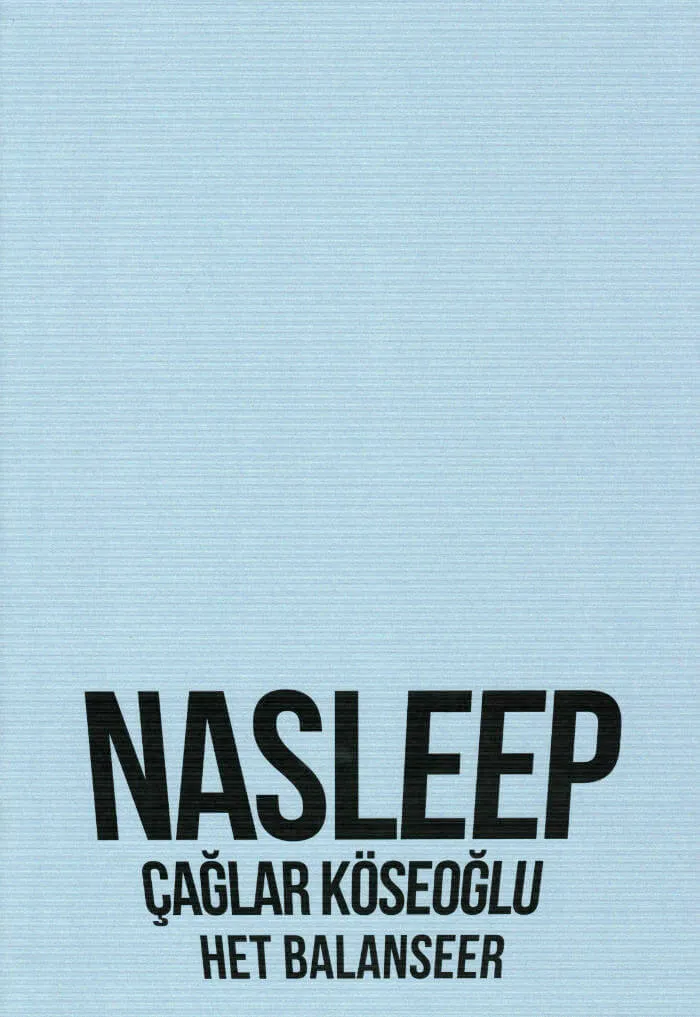
Cover of Nasleep

het balanseer

Nasleep

Çağlar Köseoğlu

Poetry €19.00

Nasleep neemt de protesten rondom het Gezi Park in 2013 als vertrekpunt en verkent gaandeweg wat er is overgebleven van dit historische moment waarin een andere wereld voor het grijpen leek. Het zijn gedichten die laveren tussen ritmische, conceptuele en kritische noise enerzijds en postrevolutionaire affecten anderzijds, tussen politise­ring enerzijds en onmacht en radeloosheid anderzijds.

Cover of Sonnet(s)

Ugly Duckling Presse

Sonnet(s)

Ulises Carrión

Poetry €20.00

A lost gem of permutational conceptualism from a key figure in artist's book culture, available again

Known internationally as one of Mexico's most important conceptual artists, Ulises Carrión (1941-89) played a decisive role in defining and conceptualizing the genre of the artists' book through his manifesto, The New Art of Making Books (1975), which he wrote soon after the 1972 publication of SONNET(S) and his move from Mexico City to Amsterdam, where he opened the legendary bookshop gallery, Other Books and So, the first space dedicated exclusively to artists' publications and an important precursor to such artists' book hubs as Printed Matter.

One of Carrión's earliest bookworks, SONNET(S) represents a landmark shift in the artist's output from poetry to artists' books. Here, Carrión takes a single poem by Dante Gabriel Rossetti through 50 typographic and procedural permutations. This republication is supplemented by new essays on Carrión's bookworks by contemporary artists, writers, and scholars from Mexico, Europe and the US. 

Published March 2021

Cover of Adorno's Noise

Essay Press

Adorno's Noise

Carla Harryman

Essays €18.00

Adorno’s Noise is a collection of experimental, poetic, and conceptual essays. Adorno’s Noise takes a stunning plunge into a kaleidoscopic world of globalization, female sexuality, the place of art and artist, and the looming power of the state. Phrases from Theodor Adorno’s aphoristic philosophical text, Minima Moralia, serve as catalysts for an explosion of thought and language that quickly breaks Adorno’s orbit.

“This work by Carla Harryman, startlingly astute, once again proves how necessary an encounter with her writing has become for us today. Her grasp of theoretical and poetic exigencies is unbypassable, and she moves lightly, lifting the prose poem into the amplitude of a new articulation.” — AVITAL RONELL

“Adorno’s ‘noise’ may be nothing more than the consonance of late modern capital talking to itself, but Carla Harryman listens to Adorno listening, and what she hears is a very different sort of dissonance, something Adorno himself may have been deaf to. Listening for a noise that can’t be heard, Harryman attends to the disruption of signal the aesthetic artifact called a corpse at the limit of Adorno’s magisterial eloquence, where thought steps over the body. Atonally faithful to his negativity the afterglow of torment passing through figures of speech while refusing the authority of a masterful dialectic, Harryman makes our unthought horizon “normality is death” audible, presencing a body that can’t be redeemed by aesthetics the bosy wants tobe art and fails at it. From Gender the Status of Dogs to works by Sun Ra, Anais Nin, Robert Smithson, and Kenzaburo Oe, this radically asynthetic writing moves thru polyphonic configuration of word, image and concept. Synthesia? Emotional truth? The intersection between abstraction and narration? Practicing a militant ethic of non-mastery as every one of its sentences sounds like a sensory organ in the process of becoming its own theoretician. Adorno’s Noise reinvents the “essay as form,” but it doesn’t stop short of reinventing thinking.” — ROB HALPERN

Carla Harryman is the author of twenty-four books of poetry, prose, plays, and essays. Harryman is widely acknowledged as an innovator in poetry, prose, and inter-disciplinary performance. An active collaborator, she is one of ten co-authors of The Grand Piano, an Experiment in Collective Autobiography: San Francisco, 1975-1980 (2006-2010). Open Box, a CD of music and spoken text performance created with composer and musician Jon Raskin was released on the Tzadik label in 2012. Her Poets Theater plays and music/text collaborations have been performed nationally and internationally, including at dOCUMENTA 13, where she presented the closing keynote performance Occupying Theodor W. Adorno’s “Music and New Music,” a music/text work that folds segments of Adorno’s Noise into her poetic adaptation of Adorno’s lecture. She is the editor of two critical volumes: Non/Narrative, a special issue of the Journal of Narrative Theory ( 2012) and Lust for Life: On the Writings of Kathy Acker (with Avital Ronell and Amy Scholder, Verso, 2006).

Other books by Carla Harryman include the collection of poetry and performance writings published in French and English editions Sue in Berlin and Sue á Berlin (2017); A Voice to Perform (Split/Level 2020); the epistolary essay, Artifact of Hope (2017); the diptych W—/M— (2013), Gardener of Stars: A Novel (2001), and two volumes of selected writing: Animal Instincts: Prose, Plays, Essays (1989) and There Never Was a Rose without a Thorn (1995). Her grants and awards include The Foundation of Contemporary Art, New York, Opera America Next Stage (with Erling Wold), and The Ronald W. Collins Distinguished Faculty in Creative Activity Award from Eastern Michigan University, where she serves on the faculty of an interdisciplinary creative writing program.