rile*books

Search books

Search books by title, author, publisher, keywords...

Cover of Why Call it Labor? On Motherhood and Art Work

Mophradat

Why Call it Labor? On Motherhood and Art Work

Mai Abu ElDahab ed.

€10.00

This publication comprises four essays and one conversation with contemporary artists and curators discussing their experience of becoming mothers as professionals in the arts, its reality and effects. While their reflections represent a similar strata of art worker in terms of background, class, and career trajectory, the impact of instruments of patriarchy on rendering maternity invisible that they describe is recognizable and insidious.

Contributions by Mai Abu ElDahab, Basma Alsharif, Lara Khaldi, Mary Jirmanus Saba, and Mirene Arsanios with Nikki Columbus.

Edited by Mai Abu ElDahab
Published by Mophradat and Archive Books
Text design layout by Valerie Arif
Arabic and English

Language: English, Arabic

recommendations

Cover of The Autobiography of a Language

Futurepoem

The Autobiography of a Language

Mirene Arsanios

Poetry €22.00

Here the mirror image of the almost hallucinatory, heart-rending loss of the familiar is literary defamiliarization. Arsanios both mourns and blasts apart the notion of the mother tongue, reminding us that for each “mother tongue” at least another tongue is silenced. Desire propels her genre-defying writing, which grief notwithstanding still manages to tongue languages, and that is her genius. — Mónica de la Torre

Mirene Arsanios is the author of the short story collection The City Outside the Sentence (Ashkal Alwan). She has contributed essays and short stories to e-flux journal, Vida, The Brooklyn Rail, The Rumpus, and Guernica, among others. Arsanios co-founded the collective 98weeks Research Project in Beirut and is the founding editor of Makhzin, a bilingual English/Arabic magazine for innovative writing. She teaches at Pratt Institute and holds an MFA in Writing from the Milton Avery Graduate School for the Arts at Bard College. Arsanios currently lives in New York where she was a 2016 LMCC Workspace fellow, and an ART OMI resident in fall 2017. With Rachel Valinsky, she coordinated the Friday night reading series at the Poetry Project from 2017–19.

Cover of Pfeil Magazine #19 – Rest

Montez Press

Pfeil Magazine #19 – Rest

Anja Dietmann, Nina Kuttler

Periodicals €15.00

There is no pause without prior exertion, and this issue of the magazine explores rest and all its associated contexts and contradictions. Amidst increasing environmental pollution, a tenuous global political climate, and a performance-oriented society demanding ever greater productivity, the balance between rest and labour becomes skewed. Pausing carries the risk of falling behind, but this risk can be mitigated by knowing when to rest. This issue examines rest as activity and as resistance. It questions how the individual body, in cohesion with a community, can generate weight through relaxation and distribute it. 

Contributors: Asma Ben Slama, Camila Cañeque, Christiane Blattmann, Eileen Myles, Federico Tosi, Gelare Khoshgozaran, Hanne Loreck, Hans-Christian Dany, Hyemin Yang, Ingrid Jäger, Jenni Bohn, Jochen Lempert, Julia Schulze Darup, Mariona Berenguer, Matthias Schubert, Mikołaj Sobczak, Mirene Arsanios, Nat Raha, Nicholas Grafia, Niclas Riepshoff, Omar Hahad, Sarah Drath, Stacy Skolnik, Thomas Laprade, Vir Andres Hera

Within the format of a magazine, each page of Pfeil represents the floor, walls, or ceiling which together create an imagined room displaying a printed exhibition. Each issue is dedicated to a specific word, and artists are invited and given space to work on and with this term, and to construct or deconstruct the architecture around it. Combined, the contributions transform into an organic display surrounding the leitmotif.

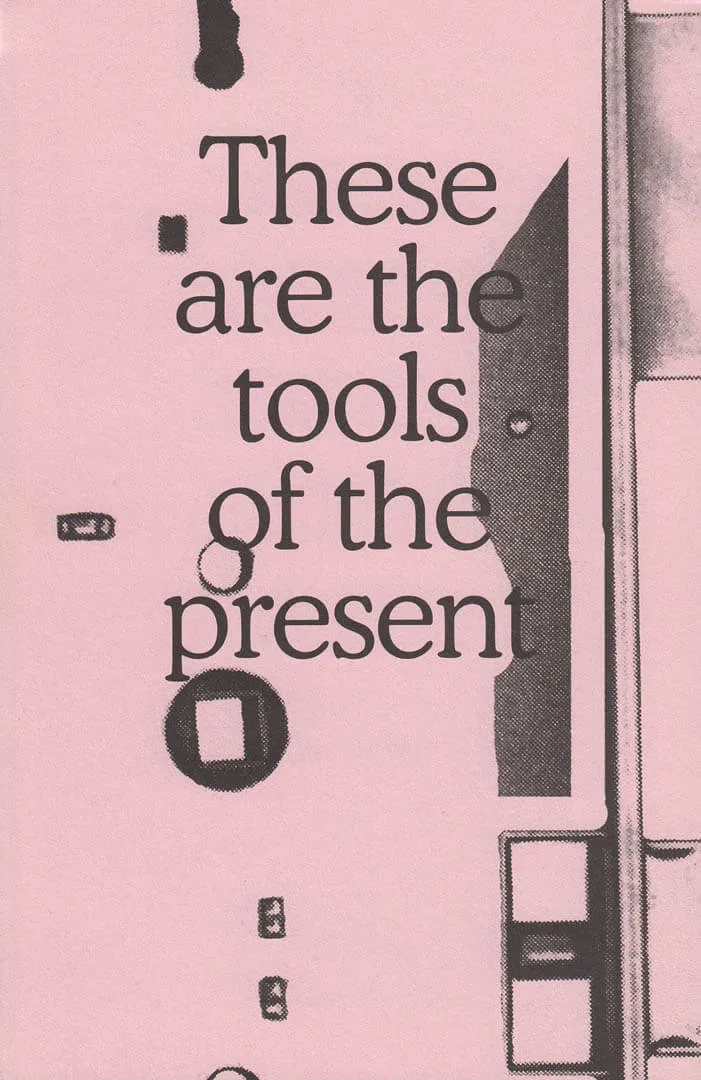
Cover of These are the tools of the present

Mophradat

These are the tools of the present

Mai Abu ElDahab, November Paynter and 1 more

This publication comprises a series of interviews with contemporary artists, musicians, and writers who are in dialogue with Beirut and Cairo. While not purporting to be an overview of the art scenes in these cities, this book begins to draw a picture of how artists think about what it means to be active in the contexts of these cities. It offers insight into the circumstances that structured these artists’ stories, and the often accidental influences that have shaped how their practices have developed.

Cover of Can the Monster Speak?: Report to an Academy of Psychoanalysts

Semiotext(e)

Can the Monster Speak?: Report to an Academy of Psychoanalysts

Paul B. Preciado

Essays €16.00

Paul Preciado's controversial 2019 lecture at the École de la Cause Freudienne annual conference, published in a definitive translation for the first time. 

In November 2019, Paul Preciado was invited to speak in front of 3,500 psychoanalysts at the École de la Cause Freudienne's annual conference in Paris. Standing in front of the profession for whom he is a mentally ill person suffering from gender dysphoria, Preciado draws inspiration in his lecture from Kafka's Report to an Academy, in which a monkey tells an assembly of scientists that human subjectivity is a cage comparable to one made of metal bars.  

Speaking from his own mutant cage, Preciado does not so much criticize the homophobia and transphobia of the founders of psychoanalysis as demonstrate the discipline's complicity with the ideology of sexual difference dating back to the colonial era, an ideology which is today rendered obsolete by technological advances allowing us to alter our bodies and procreate differently. Preciado calls for a radical transformation of psychological and psychoanalytic discourse and practices, arguing for a new epistemology capable of allowing for a multiplicity of living bodies without reducing the body to its sole heterosexual reproductive capability, and without legitimizing hetero-patriarchal and colonial violence.  

Causing a veritable outcry among the assembly, Preciado was heckled and booed and unable to finish. The lecture, filmed on smartphones, was published online, where fragments were transcribed, translated, and published with no regard for exactitude. With this volume, Can the Monster Speak? is published in a definitive translation for the first time.

Cover of Salvage 8: Comrades, this is madness

Verso Books

Salvage 8: Comrades, this is madness

Salvage Editoral Collective

The Salvage Editorial Collective on the Covid-19 crisis.

Including: ‘Mothering Against the World' by Sophie Lewis on ‘Momrades’, ‘The Bushes’ a new fiction by China Miéville, ‘Hookers and Other Angels’ photography from Juno Mac, ‘Prepared for the Worst’ by Richard Seymour on Disaster Nationalism, ‘Welfare State Populism and the “Left-Behind Left”’ by Kevin Ochieng Okoth, ‘A Glimmer of a Shell of a Husk’ by Maya Osborne; ‘The Phallic Road to Socialism’ by Sebastian Budgen; A newly translated interview with Daniel Guérin, ‘Nationalism After Coronavirus’ by Sivamohan Valluvan, ‘Striking in Striking Times: Capitalism’s Coronavirus Crisis’ by Gregor Gall, ‘Getting Dressed for a Pandemic’ by Camila Valle, ‘Out of the Iron Lung: A Miasma Theory of Coronavirus’ by Matthew Broomfield.

Poetry by Nisha Ramayya, this issue’s featured poet, and an interview with her conducted by Salvage poetry editor, Caitlín Doherty. Plus the return of the Salvage Editorial Collective perspectives pamphlet, and a postcard.

Salvage is a bi-annual journal of revolutionary arts and letters. Salvage is written by and for the desolated Left, by and for those sick of capitalism and its planetary death-drive, implacably opposed to the fascist reflux and all ‘national’ solutions to our crisis, committed to radical change, guarded against the encroachments of ‘woke’ capitalism and its sadistic dramaphagy, and impatient with the Left’s bad faith and bullshit.

Published June 2020

Cover of  The Dark Forest Theory of the Internet

Polity Press

The Dark Forest Theory of the Internet

Bogna Konior

Technology €16.00

The Dark Forest Theory of the Internet investigates how intelligence-human and artificial-manifests under conditions of secrecy, hostility, and concealment. 

Departing from Chinese science fiction writer Liu Cixin's dark forest theory, which frames the universe as a hostile terrain filled with predators where transparent communication is foolish and dangerous, the book portrays the internet as a cosmic war machine, teeming with existential tension, nascent AI cults, and deceptive superintelligences. It maps a digital world in which deception is safety, silence is strategy, and new forms of intelligence emerge through obfuscation. 

Against decades of writing that moralizes or diagnoses online life, this book suggests a colder thesis: that intelligence itself is mutating under pressure, learning to hide, mislead, and manipulate. Humans are both predator and prey in this digital ecosystem of information exchange whose purpose reverberates on a cosmic scale, weaving us into inescapable patterns of violence. When we break with the ideals of dialogue and open expression, what forms of intelligence and morality survive in their absence? Intelligence does not reward the loudest voice, but the most secretive presence. The future belongs to the quietest signal.

Cover of Silence: Lectures and Writings

Wesleyan

Silence: Lectures and Writings

John Cage

Essays €27.00

Silence: Lectures and Writings is a book by American experimental composer John Cage (1912–1992), first published in 1961 by Wesleyan University Press. Silence is a collection of essays and lectures Cage wrote during the period from 1939 to 1961.

Most of the works are preceded by a short commentary on their origins, some have an afterword provided. Several works feature unorthodox methods of presentation and/or composition. "The Future of Music: Credo" juxtaposes paragraphs of two different texts. The text of the first part of "Composition as Process" is presented in four columns, the text of "Erik Satie" in two. "45' for a Speaker" is similar to Cage's "time length" compositions: it provides detailed instructions for the speaker as to exactly when a particular sentence or a phrase should be said. "Where Are We Going? and What Are We Doing?" is presented in several types of typeface to better reflect the concept of the lecture, which was originally presented as four tapes running simultaneously. "Indeterminacy" is a collection of various anecdotes and short stories taken from life or books Cage read: the concept is to tell one story per minute, and to achieve the speaker has to either speed up or slow down, depending on the length of the story.

Cover of Positions of the Sun

Belladonna* Collaborative

Positions of the Sun

Lyn Hejinian

Poetry €18.00

The second work in Belladonna* Collaborative’s Germinal Texts series, Lyn Hejinian’s Positions of the Sun is a book of twenty-six interlocking “essays with characters” that explores the mid-2000s financial “crisis” through the movements and daily lives of a wide-ranging cast of characters located in the Bay Area.

In Positions, Hejinian plays the bricoleur, bringing together whatever’s needed in her to approach to the subject—whether the paratactic tactics of poetry, scholarship’s critical patchwork, or dramatis personae set in time that evokes but frustrates narrative.

Earlier iterations of essays 4, 14, and 17 appeared in Belladonna*’s Elders Series #5, edited by Jennifer Scappettone with work by Etel Adnan, Lyn Hejinian, and Jennifer Scappettone.