rile*books

Search books

Search books by title, author, publisher, keywords...

Cover of Where Do You Draw The Line Between Art and Politics

a.pass

Where Do You Draw The Line Between Art and Politics

Davide Tidoni

€15.00

Where Do You Draw The Line Between Art and Politics? consists of a series of interviews with individuals who have been active in various capacities at the intersection of art and politics. Between historical documentation, political memory, dialogic reflections and motivational support, the publication focuses on the experiences, commitments, and feelings that animate and inform aesthetic priorities in social spaces both within and outside of art institutions; a repository designed to inspire and enourage the politicization of aesthetics, as opposed to the aestheticization of politics. 

Davide Tidoni is an artist and researcher working with sound and listening. With a particular focus on direct experience, observation, and action, he creates works of different formats that include live performance, intervention, walk, video, audio recording, and text scores. He is interested in the use of sound and music in counter-culture and political struggles and has published a sound based field research on the northern italian ultras group Brescia 1911 (The Sound of Normalisation, 2018).

Published in 2021 ┊ Language: English, Italian

recommendations

Cover of Forms Of Life Of Forms

a.pass

Forms Of Life Of Forms

Rob Ritzen

FORMS OF LIFE OF FORMS brings artistic research into form – not merely as an aesthetic question but as a social and political one. Indeed, there are no politics without form! With Forms of Life, Rob Ritzen curated several “Moments” that assembled works, collective readings, and other references into a single installation. This publication reshuffles documentation of these “Moments” as a visual reflection of the trajectory of this research.

Rob Ritzen works as a curator with a background in philosophy. His curatorial practice is focusing on self-organized and cooperative formats. Consciously positioned at the margins of established institutions and outside of market-oriented spaces, his practice is placed in close association with communities of cultural practitioners. His initiatives are attempts to reconfigure the politics of making art and alternative forms of production and presentation.

Cover of Beauty Kit

a.pass

Beauty Kit

Isabel Burr Raty

BEAUTY KIT – AN ECO-EROGENOUS ART PROJECT by Isabel Burr Raty with contributions by Kristin Rogghe, Elke Van Campenhout, Gosie Vervloessem, Pablo Diartinez and Tim Vets, is an experimental catalog summarizing Isabel Burr Raty’s research on conceptualizing and manufacturing eco-erogenous para-pharmaceutical products. It tells the story of the BKFF, a mobile farm where she and other females harvest their orgasmic juices to produce beauty bio-products, used for treatments in the BK Spa, critically discussed in the BK Focus Group and moving forward into becoming a village, where every-body harvests each other. The catalog comes with contributing text, “Harvesting bodies – The Farm as Paradox” by Elle/Elke Van Campenhout, and other reflections on the project.

Isabel Burr Raty is a Belgian-Chilean artist, filmmaker, and Media Art History teacher in ERG (École de Recherche Graphique), living between Brussels and Amsterdam. She is currently developing her second feature film, about the colonial impact on Easter Island, and creating live art and new media installations that queer production understandings, such as the Beauty Kit Project. Her works have been shown internationally.

Cover of ROT

a.pass

ROT

Sara Manente

Performance €14.00

ROT is a publication reflecting the research “Wicked technology/Wild fermentation,” by Sara Manente that focuses on forms and practice of fermentation as ways to rethink bodies and their making. This glossy magazine performs research, aiming to infect the reader, and questioning how to spread, publish, and help the work survive. 

Sara Manente is a performance artist, dance maker and researcher born in Italy and living in Brussels. She is interested in narrowing the distance between the performer, the audience, and the work. Her research starts from a dance practice that problematizes perception, translation, and ways of doing. Her work comes out in hybrid forms: book launch, 3Dfilm, written text, interview, choreographic piece, workshop, telepathic experience, collaboration, et al.

Cover of Walking from Scores

Les Presses du Reel

Walking from Scores

Elena Biserna

An anthology of text and graphic scores to be used while walking, from Fluxus to the critical works of current artists, through the tradition of experimental musicand performance, gathered and presented by Elena Biserna.

Walking from Scores is a hundred or so collection of non site-specific protocols, instructions and textual and graphic scores centred on walking, listening and playing sound in urban environment. It explores the relationship between art and the everyday, the dynamics of sound and listening in various environments and the (porous) frontiers between artists and audiences. It starts with two premises: an interest in walking envisaged as a relational practice and tactic enabling us to read and rewrite space; an interpretation of scores understood as open invitations and catalysers of action in the tradition of Fluxus event scores.

With scores and texts by Peter Ablinger, Milan Adamčiak, G. Douglas Barrett, Elena Biserna, Blank Noise, George Brecht, Cornelius Cardew, Stephen Chase, Giuseppe Chiari, Seth Cluett, Philip Corner, Viv Corringham, Bill Dietz, Amy Dignam, David Dunn, Haytham El-Wardany, Esther Ferrer, Simone Forti, Francesco Gagliardi, Jérôme Giller, Oliver Ginger, Anna & Lawrence Halprin, David Helbich, Dick Higgins, Christopher Hobbs, Jérôme Joy, katrinem, Debbie Kent, Bengt af Klintberg, James Klopfleisch, Milan Knížák, Alison Knowles, Takehisa Kosugi, Jirí Kovanda, Anne Leilehua Lanzilotti, Bob Lens, Ligia Lewis, Alvin Lucier, Walter Marchetti, Larry Miller, iLAND/Jennifer Monson, Max Neuhaus, Alisa Oleva, Pauline Oliveros, Yoko Ono, Open City & Emma Cocker, Nam June Paik, Michael Parsons, Ben Patterson, Cesare Pietroiusti, Mathias Poisson, Anna Raimondo, Pheobe riley Law, Jez riley French, Paul Sharits, Mieko Shiomi, Mark So, Standards, Nicolas Tardy, Davide Tidoni, Ultra-red, Isolde Venrooy, Carole Weber, Manfred Werder, Franziska Windisch, Ben Vautier, La Monte Young.

Elena Biserna is a scholar and independent curator based in Marseille, France. She is associate researcher at PRI SM (AMU / CNRS) and TEAMeD (Université Paris 8). Her interests are focused on listening and on contextual, "situated" art practices in relationship with urban dynamics, sociocultural processes, the public and political sphere. Her writings have appeared in several publications. As a curator, she has collaborated with different organisations and presented her projects internationally.

Cover of Metabolize, If Able

Arcadia Missa

Metabolize, If Able

Clay AD

Sci-Fi €14.00
Metabolize, If Able is a queer correspondence sent from a dystopian future. ​Clay AD’s hybrid-novel​ follow​s​ the lives of clones​ and their spawn through ​medical charts, IMs, self-help meditations, screenplays, and, of course, epistles. ​For the clones, a ​corporation​ controls life and death, sickness and wealth. Corp doctors, or DRs, bring the clones to life and assign them work. But DRs restrict clone reproduction. They pathologize and withhold care. They keep the clones sick. What happens when the clones and their anti-Corp cell turn illness into a weapon? AD’s ​sci-fi world posits the hope found in collective intimacy & the struggle against state control.
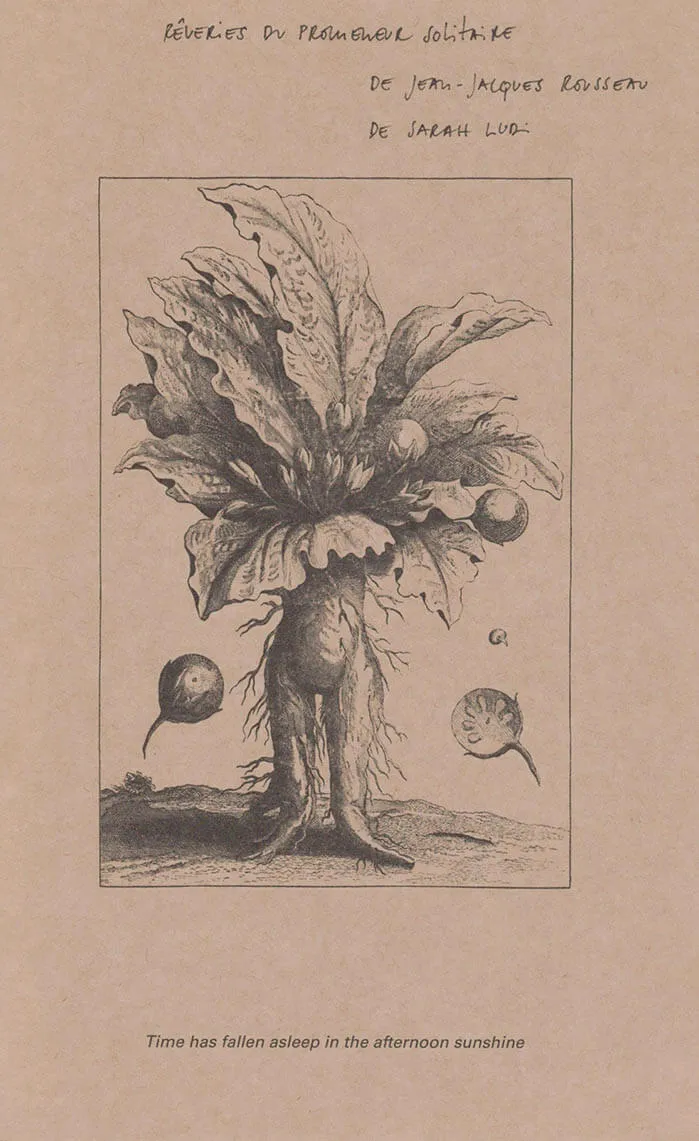
Cover of Rêveries du promeneur solitaire

Time has fallen asleep in the afternoon sunshine

Rêveries du promeneur solitaire

Sarah Ludi

For the project Time has fallen asleep in the afternoon sunshine a group of people/ performers memorize a book of their choice. Together they form a library collection consisting of living books. After years of learning by heart and reciting for readers, some of the books have now been written down from memory to create new editions, versions resulting from this process. This book is one of those books, chosen by one person, learned by heart and recited many times, and now written down again from memory. This edition is not a re-edition of the original text. It is a re-writing of the text after the process of reading, memorizing and reciting, with all the alterations that might have occured in the course of this process.

Cover of Exercises of Poetic Communication with Other Aesthetic Operators

axis axis

Exercises of Poetic Communication with Other Aesthetic Operators

Ernesto de Sousa

Ernesto de Sousa (1921–1988) was a major and multifaceted figure from the Portuguese avant-garde—artist, poet, critic, essayist, curator, editor, filmmaker, and a promoter of experimental ideas and artistic expressions. 
Reflecting questions of hierarchy, authorship, and the complexity of framing or dividing within the multiple and complementary practices of Ernesto de Sousa—whose motto “Your Body is My Body, My Body is Your Body” serves as a poetic manifesto—this publication explores the various aspects of his oeuvre (visual, poetical, and theoretical) and his outstanding inventiveness of concepts.

The volume brings together a selection of works, unpublished archives and their translations, and theoretical texts by Ernesto de Sousa, including the first complete translation in English of «Orality, the future of art?» (1968). Richly illustrated, the book reunites an introductory text by Lilou Vidal, two new essays by Paula Parente Pinto and by José Miranda Justo along with a text by Hugo Canoilas.

"There was a time when bread was sacred; and in a general sense, all fabricated objects deserved the respect that resulted from (for the conscience of those who used them) concretely diving into their own motivations. Human gestures, like aesthetic objects, were inseparable from their relevant functions. Naturalism prompted us to look at natural and fabricated objects with a vision that was cosmic and indifferent at the same time. The objects, today, object. In the future, objects and gestures will perhaps clothe themselves once again in their lost dignity. The word love, a bit of bread, the letter A will stop being mortal accidents of daily life. Desacralized, they will once again be as decisive as the tiniest brushstroke the painter made on his canvas. And each of these brushstrokes will reveal the structure of the world. Life can then be compared to a vast work of art. Everything will be absolutely aesthetic.."
— Ernesto de Sousa

Contributors: Hugo Canoilas, Ernesto de Sousa, Tobi Maier, José Miranda Justo, Paula Parente Pinto, Lilou Vidal

Cover of Schismatics

LAPAS

Schismatics

Goda Palekaite

Essays €20.00

Schismatics consists of 10 short stories, in a fictitious way dealing with forgotten historical personas. Among them, artist Goda Palekaitė includes Mary Anning –– an amateur discoverer of dinosaurs, Emanuel Swedenborg –– a mystic who empirically explored the architecture of heaven, and Essad Bey –– a Jewish-Muslim writer and orientalist. Here their lives are revived and balance between the lines of history and story.

The book fuses elements of fiction, academic writing, and artistic research, and intertwines with rumors, forgeries, and inventions. Previously, its characters and narratives have already appeared in Palekaitė’s performances and installations, which are presented in the middle of this bilingual edition. In the introductory essay, Valerio Del Baglivo analyses the author’s exploration of facts and fiction, the mechanisms of knowledge production, and the trans-chronological perception of time. At the end of the book, Monika Lipšic ‘Riddle’ reflects on a ‘schismatic poetics’. 

Goda Palekaitė is a contemporary artist and researcher whose work combines visual, literary, performative, and anthropological practices. Exploring the politics of historical narratives, the agency of dreams and collective imagination, and social conditions of creativity, her work evolves around long-term projects that manifest as performances, scenographies, installations, and texts. Her performances, solo and group shows are being presented internationally. In 2019 Goda Palekaitė received The Golden Stage Cross and the Young Artist’s Prize for her artistic contributions across disciplines.

Published September 2020

Cover of Writing in Space, 1973–2019

Duke University Press

Writing in Space, 1973–2019

Lorraine O'Grady

Performance €28.00

Writing in Space, 1973-2019 gathers the writings of conceptual artist Lorraine O'Grady, who for over forty years has investigated the complicated relationship between text and image.

A firsthand account of O'Grady's wide-ranging practice, this volume contains statements, scripts, and previously unpublished notes charting the development of her performance work and conceptual photography; her art and music criticism that appeared in the Village Voice and Artforum; critical and theoretical essays on art and culture, including her classic "Olympia's Maid"; and interviews in which O'Grady maps, expands, and complicates the intellectual terrain of her work. She examines issues ranging from black female subjectivity to diaspora and race and representation in contemporary art, exploring both their personal and their institutional implications.

O'Grady's writings—introduced in this collection by critic and curator Aruna D'Souza—offer a unique window into her artistic and intellectual evolution while consistently plumbing the political possibilities of art.

Edited by Aruna D'Souza