rile*books

Search books

Search books by title, author, publisher, keywords...

Cover of Unbidden Tongues #8: Feelers

Unbidden Tongues

Unbidden Tongues #8: Feelers

Alexis Hunter

€7.00

Unbidden Tongues #8: Feelers brings together three photographic series by artist and activist Alexis Hunter. In a storyboard-like fashion, her ‘photo narrative sequences’ forensically detail her manhandling of artefacts of patriarchal oppression through the caressing touch of an array of characters: the Marxist's wife, an interventionist secretary and a manicured mechanic. Born in New Zealand, Hunter moved to the United Kingdom in 1972 where, at the age of twenty-four, she joined the Women’s Workshop of the Artists Union and invested devotedly in feminist organising alongside her artistic practice.

Published in 2023 ┊ 24 pages ┊ Language: English

recommendations

Cover of Unbidden Tongues #7: Continuity Girl

Unbidden Tongues

Unbidden Tongues #7: Continuity Girl

Naomi Pearce

Unbidden Tongues #7: Continuity Girl unpacks the ‘forensic feminist methodology’ developed by writer, curator and administrator Naomi Pearce. Informed by research conducted in various personal archives of women administrators of artist studio spaces in London from the 1970s until now, the components of Pearce’s writing span mortuary field notes, interview transcripts, intimate first-person accounts and an auto-fictive mystery novella. These various evidentiary approaches blend to form an unconventional casebook that puts forward the complicating factors underpinning the process of writing history in the first place.

In this particular title, the biographical lens focuses on Shirley Read—a photographer, writer, teacher, administrator and oral historian, whose work has been largely overlooked, until now.

Cover of Between the Teeth

Unbidden Tongues

Between the Teeth

Theresa Hak Kyung Cha

Produced on the occasion of the exhibition Unbidden Tongues #5: Theresa Hak Kyung Cha: Between the Teeth at Manifold Books, Amsterdam, November 28, 2021 – January 22, 2022.

​Drawing on artist, poet and filmmaker Theresa Hak Kyung Cha’s extensive and largely unexhibited archive of ‘work on paper’, Unbidden Tongues #5: Between the Teeth is a publication-turned-exhibition and the fifth title in the series. From never-realised film scripts to concrete poetry and artists statements written intimately in the first person, the collection of material selected for this occasion presents the varying ways with which Cha drew on her personal and familial experience as an immigrant to conceptually grapple with language and its mediation and suppression, particularly, in this case, in its written form.

Cover of Unbidden Tongues #10: Professional Agitator

Unbidden Tongues

Unbidden Tongues #10: Professional Agitator

Jo Freeman

From the beginning, Unbidden Tongues has claimed to publish 'previously produced yet relatively uncirculated work by cultural practitioners busy with questions surrounding civility and civic life-particularly in relation to language and its administration.' However, over the course of the first nine issues, the 'civic' aspect has been relatively less pronounced, though undeniably subtextual. As such, Professional Agitator-a publication that includes two landmark feminist articles by Jo Freeman-is an attempt to bring civic responsibility more overtly to the surface. While first penned in the 1970s, the articles have a timely relevance, not only because, shockingly, many of the issues on the bill for the women's movement at Freeman's time of writing-employment discrimination, affordable childcare, reproductive rights and sexuality- are back on the table in the U.S. and elsewhere with full force, but also because, in thinking intersectionally as the movement taught me to do, we find ourselves in a moment of necessary and urgent mobilisation for Palestine; with speaking up and out being reprimanded with various forms of organised silencing. 

(From the foreword)

Cover of Unbidden Tongues #9: Potty Mouth

Unbidden Tongues

Unbidden Tongues #9: Potty Mouth

Violet Bartley

Unbidden Tongues #9: Potty Mouth is a collection of what could be described as concrete poetry, written over the past two years by our niece Violet Bartley, now aged five. Typed at a computer and sent exclusively via e-mail, the poems stand as clear evidence of a person in the beginnings of grasping (at) language. Throughout, characters are repeated uninterrupted until margins break them, keys pushed down by a finger not yet strong enough to lift itself up.

Over the years, as her written vocabulary grew and these attempts at communication slowly stacked up into the collection printed here, Violet delivered poem after poem within which different mutations of the word ‘poo’ were uttered in type: poo, poobum, bum poo, ipoo, poop. While simple, often illegible and definitely isolated utterances (she never replies when you send a poem back in turn), they are decipherable examples of someone learning defiance through language.

Cover of This Is Not My Cat

Nieves

This Is Not My Cat

Takashi Homma

Photography €24.00

Renowned Japanese photographer Takashi Homma observes his daily life through the poses of his cat.

A cat wanders, perches, and lounges in various spaces around a humble Tokyo apartment. It is perfectly tranquil in its surroundings, simply going about its daily life. In one image, the cat lays serenely amidst pot plants on the balcony, squinting in morning sunlight; in others, it balances precariously on the edge of the bath, snuggles beneath a sleeping bag, plays in a cardboard box, hides beneath an open umbrella. Here and there, evidence of the cat's fellow inhabitant in the apartment—a man, who also happens to be the internationally renowned photographer Takashi Homma—creeps into the frame. A knee, a foot, a shock of blonde hair, half of a face. There are artefacts of his life and practice too. Framed photographic prints draped in bubblewrap lean against a wall; a tangle of musical effects pedals make for colourful constellation against the cool blue of the carpet.

Many have written of the unique atmosphere and energy of Takashi Homma's pictures. His photographic mannerisms are so light, so subtly empathetic to his subjects, that we all but dissolve into the world he creates. The photographs that populate This Is Not My Cat are no exception. Unencumbered by a sense of fussiness or perfection, these images are casual, diaristic, and quotidian. As viewers, we become part of the images and their atmosphere, rather than poring over their details. They are about feeling as much as they are about looking

The title—This Is Not My Cat—seems multipart. Whereas the anomaly imbedded in Homma's iconic photobook Tokyo and My Daughter is that the girl pictured was not in fact his own child, here, his own cat is recast as belonging to another. Or perhaps it is that a cat's independence cannot be truly curbed. They quietly live, play, and exist alongside us. They move through life in our shadow, but forever in their own world. 

Takashi Homma (born 1962, lives and works in Tokyo) is one of the most internationally recognised Japanese photographers active at the front lines of contemporary photography today.

Cover of New Address II. Stereotypical Artist

After 8 Books

New Address II. Stereotypical Artist

Tobias Kaspar

Photography €27.00

What is an artists’ life made of? From the home to the studio, from the studio to the gallery, from one exhibition to the next, from one place to another – a suite of moves and a list of addresses. Tobias Kaspar’s work sheds light on the ambivalent position of the artist, taken in a web of social and economic relations: in the second volume of New Address, he uses the tone of the diary, combined with the code of the moodboard, to document the side aspects of the life of a “stereotypical artist.”

The book gathers black & white photographs taken between 2018 and 2024, during the installation or the opening of exhibitions; at performances, dinners, parties; in different homes and rooms Kaspar has been living in; and in the course of daily activities. Contrary to an exhibition catalogue, projects by the artist such as his line of jeans, or his series of bronze sculptures made from disposable packaging, are thus shown “in the middle of affairs.”

An additional booklet opens with a short essay by artist Mikael Brkic, reflecting on the “behind the scenes” logics, followed by a letter penned by writer Leif Randt, and a text in which curator Kari Rittenbach discusses Tobias Kaspar’s work in relation to the economics and aesthetics of display and fashion. It concludes with a list of artworks in the order as they appear in the main book.

Published with the support of Erna und Curt Burgauer Stiftung, Pro Helvetia, Kultur Stadt Zürich.

Cover of The Autobiography of H. LAN Thao Lam

Dorothy, a publishing project

The Autobiography of H. LAN Thao Lam

Lana Lin

Situated between memoir, social criticism, and conceptual art, The Autobiography of H. Lan Thao Lam is an incisive response to a modernist classic and an affecting exploration of the poetics and politics of our times. "We are supposed to know where we are with biography and autobiography, they are the literary equivalents of the portrait and the self-portrait," writes Jeanette Winterson about Gertrude Stein's 1932 classic, The Autobiography of Alice B. Toklas. By narrating her own story from the perspective of her partner, Stein invented a literary form that was both intimate and uncanny, blurring lines of authority and identity as it winds through a story of two women living and loving together through a tumultuous moment in history. Almost a century later, experimental filmmaker and artist Lana Lin has resurrected Stein's project to tell another story of queer love, life, and artistic collaboration in a differently discordant age. At heart a candid chronicle of her partner Lan Thao's life journey from Vietnam during the war and her own troubled history as a gender-queer Taiwanese American, Lin's Autobiography draws in subjects as varied as photography, tropical fruit, New York real estate, and queer theorist Eve Sedgewick's eyeglasses, weaving a landscape of living that is also a critical investigation of race and gender in our time. 

Lana Lin is a writer, artist, and filmmaker based in New York and Connecticut. She is the author of the book Freud's Jaw and Other Lost Objects: Fractured Subjectivity in the Face of Cancer and film and video works including The Cancer Journals Revisited. Her various works and collaborative projects (with Lan Thao Lam as "Lin + Lam") have exhibited at festivals and art and educational spaces throughout the world, including the Museum of Modern Art, Whitney Museum, and New Museum, New York; The National Gallery of Art, Washington, D.C.; Gasworks, London; the Taiwan International Documentary Festival and Taiwan Film and Audiovisual Institute, New Taipei City; Arko Art Center, Korean Arts Council, Seoul; and the 2018 Busan Biennale. Having had three years of psychoanalytic training before dropping out, she sometimes still dreams of becoming a psychoanalyst one day.

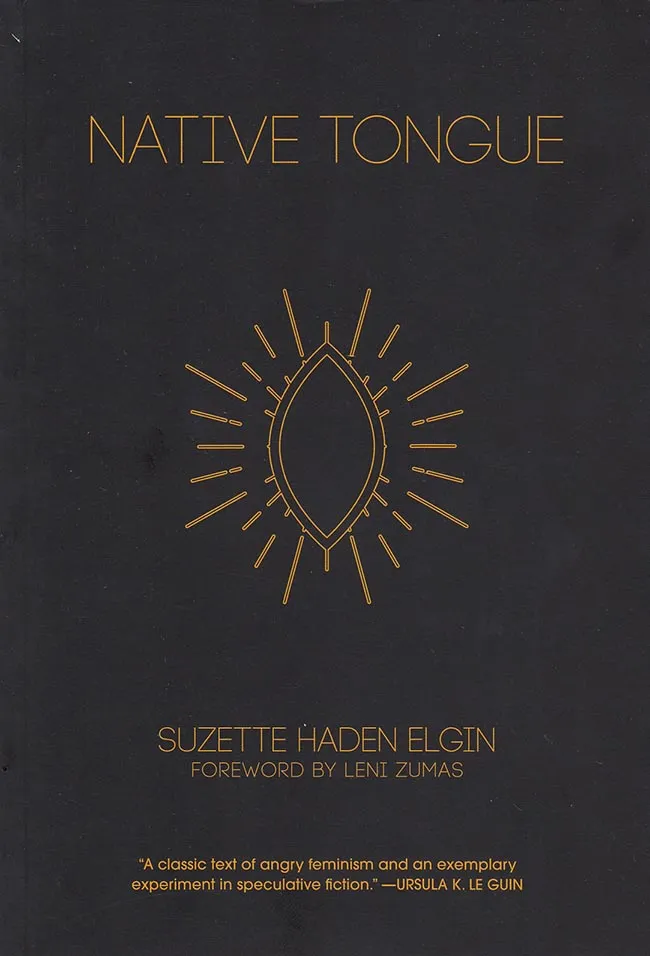
Cover of Native Tongue

Feminist Press

Native Tongue

Suzette Haden Elgin

Originally published in 1984, this classic dystopian trilogy is a testament to the power of language and women's collective action. 

In 2205, the Nineteenth Amendment has long been repealed and women are only valued for their utility. The Earth's economy depends on an insular group of linguists who "breed" women to be perfect interstellar translators until they are sent to the Barren House to await death. But instead, these women are slowly creating a language of their own to make resistance possible. Ignorant to this brewing revolution, Nazareth, a brilliant linguist, and Michaela, a servant, both seek emancipation in their own ways. But their personal rebellions risk exposing the secret language, and threaten the possibility of freedom for all.