rile*books

Search books

Search books by title, author, publisher, keywords...

Cover of The Wax Child

New Directions Publishing

The Wax Child

Olga Ravn

€20.00

In seventeenth-century Denmark, Christenze Kruckow, an unmarried noblewoman, is accused of witchcraft. She and several other women are rumored to be possessed by the Devil, who has come to them in the form of a tall headless man and gives them dark powers: they can steal people’s happiness, they have performed unchristian acts, and they can cause pestilence or even death. They are all in danger of the stake.

The Wax Child, narrated by a wax doll created by Christenze Kruckow, is an unsettling horror story about brutality and power, nature and witchcraft, set in the fragile communities of premodern Europe.

Deeply researched and steeped in visceral, atmospheric detail, The Wax Child is based on a series of real witchcraft trials that took place in Northern Jutland in the seventeenth century. Full of lush storytelling and alarmingly rich imagination, Olga Ravn weaves in quotes from original sources such as letters, magical spells and manuals, court documents, and Scandinavian grimoires.

Published in 2025 ┊ 144 pages ┊ Hardcover ┊ Language: English

recommendations

Cover of Nightwood

New Directions Publishing

Nightwood

Djuna Barnes

LGBTQI+ €16.00

Nightwood, Djuna Barnes' strange and sinuous tour de force, "belongs to that small class of books that somehow reflect a time or an epoch" (Times Literary Supplement). That time is the period between the two World Wars, and Barnes' novel unfolds in the decadent shadows of Europe's great cities, Paris, Berlin, and Vienna—a world in which the boundaries of class, religion, and sexuality are bold but surprisingly porous.

The outsized characters who inhabit this world are some of the most memorable in all of fiction—there is Guido Volkbein, the Wandering Jew and son of a self-proclaimed baron; Robin Vote, the American expatriate who marries him and then engages in a series of affairs, first with Nora Flood and then with Jenny Petherbridge, driving all of her lovers to distraction with her passion for wandering alone in the night; and there is Dr. Matthew-Mighty-Grain-of-Salt-Dante-O'Connor, a transvestite and ostensible gynecologist, whose digressive speeches brim with fury, keen insights, and surprising allusions. Barnes' depiction of these characters and their relationships (Nora says, "A man is another persona woman is yourself, caught as you turn in panic; on her mouth you kiss your own") has made the novel a landmark of feminist and lesbian literature.

Cover of Exophony

New Directions Publishing

Exophony

Yoko Tawada

Non-fiction €17.00

Yoko Tawada's first essay collection in English presents and electrifying new side of the National Book Award-winner as she dives deep into her lifelong fascination with cross-hybridizing languages. The accent here, as in her fiction, is on the art of drawing closer to the world through defamiliarization. Tawada famously writes in both Japanese and German, but her interest in language reached beyond any mere dichotomy. 

The term "exophonic," which she first heard in Senegal, has a special allure for the author: "I was already familiar with similar terms. 'immigrant literature,' or 'creole literature,' but 'exophonic' had a much broader meaning, referring to the general experience of existing outside of one's mother tongue." Exophony opens a new vista into Yoko Tawada's world and delivers more of her signature erudite wit—at once cross-grained and generous, laser-focused and multidimensional, slyly ironic and warmly companionable.

A New Yorker Best Book of 2025. Translated from Japanese by Lisa Hofmann-Kuroda.

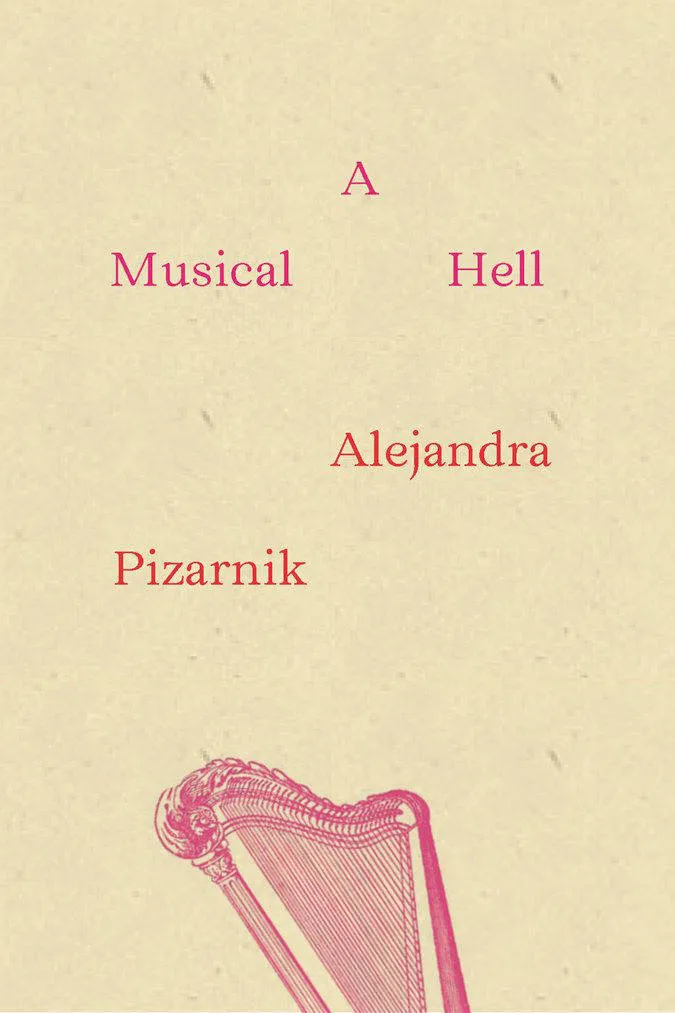
Cover of A Musical Hell

New Directions Publishing

A Musical Hell

Alejandra Pizarnik, Yvette Siegert

Poetry €13.00

“An aura of legendary prestige surrounds the work of Alejandra Pizarnik,” writes César Aira. Her last collection to be published before her suicide in 1972, A Musical Hell is the first book of poems by Pizarnik to be published in its entirety in the U.S. Pizarnik writes at the edge of poetic impossibility, opening with a blues singer, expanding into silence, and closing into a theater of shadows and songs of the drowned.

Cover of Água Viva

New Directions Publishing

Água Viva

Clarice Lispector

Fiction €15.00

In Água Viva Clarice Lispector aims to 'capture the present'. Her direct, confessional and unfiltered meditations on everything from life and time to perfume and sleep are strange and hypnotic in their emotional power and have been a huge influence on many artists and writers, including one Brazilian musician who read it one hundred and eleven times. Despite its apparent spontaneity, this is a masterly work of art, which rearranges language and plays in the gaps between reality and fiction.

Clarice Lispector (December 10, 1920 – December 9, 1977) was a Brazilian writer acclaimed internationally for her innovative novels and short stories. Born to a Jewish family in Podolia in Western Ukraine, as an infant she moved to Brazil with her family, amidst the disasters engulfing her native land following the First World War. 

Cover of Lili Is Crying

New Directions Publishing

Lili Is Crying

Hélène Bessette, Kate Briggs

Fiction €17.00

A forgotten mid-century genius, recently rediscovered in France and never before translated into English, Hélène Bessette is a treasure and a bracing force to reckon with.

With a contribution by Eimear McBride
A New Yorker Best Book of 2025

Lili Is Crying, Hélène Bessette’s debut novel, conveys with singular force the fraughtness and depth of the troubling relationship between Lili and her mother, Charlotte. With a near-mythic quality, Bessette's stripped-back prose evokes at once the pain of thwarted love—of desire run cold—and the promise of renewal. Lauded by critics on its initial 1953 publication for its boundary-pushing style, Lili Is Crying catapulted Bessette to cult status in France. The novel is moving and maddening in turns, with its characters trapped in their own cruelties and sorrows, but in its spareness and strength it feels true. "Show me a woman who's chosen something." Bessette's books were hailed for their unusual economy of expression, rarity, strange humor, and sheer vivacity. She characterized her new kind of novel as "a freshly cut slice of life, whose force comes from its lack of commentary."

Cover of Jaw Filler

Montez Press

Jaw Filler

Maz Murray, Charlie Markbreiter

Fiction €22.00

'You don't need dysphoria to be trans. You don't need a body at all.’

When Sean Hastings, (the first) transgender private detective, is asked to investigate the disappearance of Character, he enters the First Trans Commune in Sim World, a virtual reality community imagineered by transfluencer Kevin and bankrolled by VSI, a mysterious tech company.

At VSI, representation matters, which is why Taylor, the token QTPOC face, runs their latest project. Haunted by the death of his cis gayguy college bestie and their shared diasporic dilemmas, Taylor sees potential in Kevin’s ability to Release trauma into the virtual world, while Casey, Sean’s ex, seeks Releasing as the latest Long Plague miracle cure. Then femme fatale Mitchelle reappears, and the plot thickens.

A pulpy neo-noir romp through the anxiously assimilated transmasculine id, Jaw Filler asks: who is VSI, and what do they really want? Can you be your own dad? And if Character’s mind is trapped in Sim World, then where is his body?

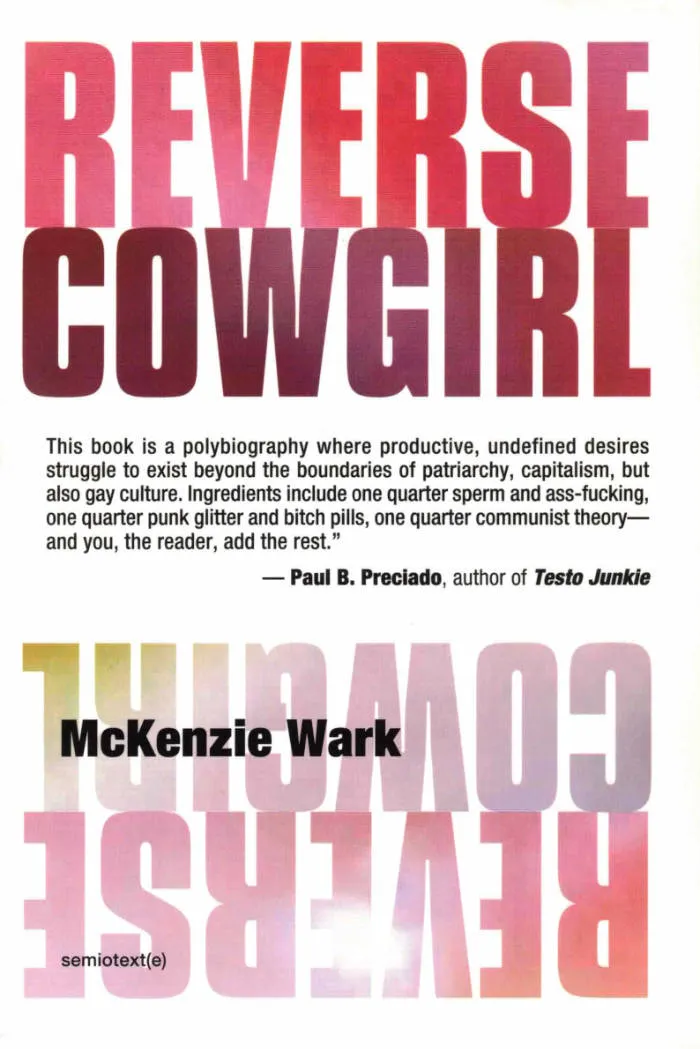
Cover of Reverse Cowgirl

Semiotext(e)

Reverse Cowgirl

McKenzie Wark

Fiction €16.00

McKenzie Wark invents a new genre for another gender: not a memoir but an auto-ethnography of the opacity of the self.

Another genre for another gender.

What if you were trans and didn't know it? What if there were some hole in your life and you didn't even know it was there? What if you went through life not knowing why you only felt at home in your body at peak moments of drugs and sex? What if you expended your days avoiding an absence, a hole in being? Reverse Cowgirl is not exactly a memoir. The author doesn't, in the end, have any answers as to who she really is or was, although maybe she figures out what she could become.

Traveling from Sydney in the 1980s to New York today, Reverse Cowgirl is a comedy of errors, chronicling the author's failed attempts at being gay and at being straight across the shifting political and media landscapes of the late twentieth century. Finding that the established narratives of being transgender don't seem to apply to her, Wark borrows from the genres of autofiction, fictocriticism, and new narrative to create a writing practice that can discover the form of a life outside existing accounts of trans experience: an auto-ethnography of the opacity of the self.

Cover of Night School

Ma Bibliotheque

Night School

Erin Honeycutt

Fiction €15.00

A synthesis of dreamwork and bookwork, combining collaboration with dream-vision report, creative writing, and AI—a “Media Archaeology of Dreams.” Its central character is the author’s voice in this process through ekphrasis. What/where is the separation between the ekphrastic object, the dream, and its description?

Cover of Dark Rides

Pilot Press

Dark Rides

Derek McCormack

Fiction €17.00

Dark Rides is like the best carnival dark ride you've ever been on: funny and frightening, short and shocking. Dark Rides is a collection of stories about gay teenagers growing up in a small city in Canada in the 1950s. There's a different kid in each of the stories: the kid that loves Hank Williams, the kid that works at a haunted hayride, the kid that thinks he's Caligula and so on. They don't meet, but they share similar attributes: they're all named Derek McCormack, and they all fall for the wrong people in the wrong place at the wrong time. 

Published for the first time in 1996, Dark Rides was Derek McCormack's first book. This thirtieth anniversary edition features new illustrations and a foreword by Lisa Robertson.

‘A fresh, thrilling, perfect book.’ — Dennis Cooper

‘Derek McCormack is a genius of prose that is driven and artificial. In Dark Rides, homo-hormones ask our teen hero Derek the questions and deliver the answer—SEX. Derek’s small-town hardscrabble world is suffused with sparkling off-hand clarity as he undergoes the tender and menacing rituals of the high school closet.’ Robert Glück

‘Welcome to the perverse and innocent world of Derek McCormack. The mystery of objects, the lyricism of neglected lives, the menace and nostalgia of the past—these are all ingredients in this weird and parallel universe.’ — Edmund White

‘Way back when, when I first read Derek McCormack's books, I thought that I'd like to be his twin, to share his brain and soul matter—his writing was that important to me and it still is.’ — Miriam Toews

Derek McCormack is a writer and artist who lives in Toronto. Among his previous books are the novels Castle Faggot and The Well-Dressed Wound and a collection of essays about fashion and death titled Judy Blame's Obituary. The Shithole Opry Collector's Guide, a monograph about the hillbilly jewellery he designs, is forthcoming from Cushion Works/DAP. Dark Rides was his first book.

30th Anniversary Edition 
with a foreword by Lisa Robertson

Cover of Angst

Silver Press

Angst

Hélène Cixous, Sophie Lewis

Fiction €19.00

A woman replays her abandonment by her mother, who is sometimes addressed as a male mother-god. She is also abandoned by her lover, to whom she is in thrall. She tries repeatedly to make or receive phone calls with the beloved figures, without success. She waits for their letters and imagines their contents. In a dream-like, torrid sequence, suffering, fear, fatigue and imperfection are apostrophised. Forgetting is examined and toyed with from every angle. Mythical hybrid creatures are invoked: a snake-headed lion, wolf-snakes, a wolf-peacock. How did this come to be? In a cunningly, wittily wrought rush, the unique, unpredictable voice of the narrator speaks from multiple perspectives to express powerful anguish and, ultimately, catharsis.

‘Cixous reminds us that women have long spoken from a wound… To be is already to be abandoned, already to have lost, and still to love. To read Cixous is to tarry with this open wound, to hear how writing becomes testimony to its own possibility.’  Jamieson Webster

‘Language in Cixous’s hands is molten, constantly opening onto fresh possibilities.’  Maggie Nelson

‘With Hélène Cixous you must close your eyes and open your mouth. Wider. So open your throat opens. Your esophagus. Your lungs. Wider. So open your spine unclatters. Your hips swim loose. Your womb worlds itself. Wider. Open the well of your sex. Now speak your body from your other mouth. Yell corporeal prayer. This is writing.’  Lidia Yuknavitch

Foreword by Jamieson Webster