rile*books

Search books

Search books by title, author, publisher, keywords...

Cover of The Floor Is Uneven. Does It Slope?

Mousse Publishing

The Floor Is Uneven. Does It Slope?

Laura Herman ed., Henry Andersen ed.

€22.00

In 1987, artist and poet Madeline Gins (1941–2014) and her partner, painter Arakawa (1936–2010), formed the Architectural Body Research Foundation (later to become the Reversible Destiny Foundation)—an architectural office pursuing the radical conviction that architecture would provide humanity with the necessary tools and training to overcome death. Their wide variety of theories investigated how a person might interact with their environment, and how that environment might condition and enhance the body to increase its capabilities—through a constant undoing and unsettling of subject formation. Taking the work and writings of Madeline Gins and Arakawa as a broad provocation, The Floor Is Uneven. Does It Slope? aims to swallow and masticate the duo’s thought into a new sort of pulp: a collective fan fiction work. Less a book about Gins and Arakawa than a book after them, it tries to seed their work to various fans—writers and makers indebted to the duo’s thinking or suspected to be enthralled by it. 

Contributors speak about Gins and Arakawa through the language of their own practice, through academia, poetry, essays, photography, experimental writing, and fiction—thinking about what Gins and Arakawa might mean to their individual fields. 

Texts by Henry Andersen, Lila Athanasiadou, Ben Thorp Brown, Lucas Crawford, Bryana Fritz, Laura Herman, Daisuke Kosugi, Joyelle McSweeney, Simone C. Niquille, Andros Zins-Browne.

Language: English

recommendations

Cover of This Is Not My Signature

Mousse Publishing

This Is Not My Signature

William Anastasi

Monograph €40.00

A journey through the artist's work and life.

William Anastasi is the author of a prolific body of work. A major figure in conceptualism and in many respects one of its initiators, his trajectory cannot be solely confined to this chapter in the history of contemporary art. The book revisits, through the prism of multiple voices, the various aspects of an approach that unfolded with the use of complementary mediums. Drawing coexists with photography and "new" technologies, alongside objects, paintings, and installations. Within this corpus to be (re)discovered, sounds, images, and language, as well as artifacts, protocols, and processes, convey inquiries related to space and time, representation, and perception. With contributions from Dove Bradshaw, Chiara Costa, Béatrice Gross, Valérie Mavridorakis, Hélène Meisel, Sébastien Pluot, Julia Robinson, Robert Storr, and Erik Verhagen.

Edited by Erik Verhagen.
Texts by Dove Bradshaw, Chiara Costa, Béatrice Gross, Valérie Mavridorakis, Hélène Meisel, Sébastien Pluot, Julia Robinson, Robert Storr, Erik Verhagen.

Cover of I am not done yet

Mousse Publishing

I am not done yet

Kameelah Janan Rasheed

Monograph €40.00

A learner, Kameelah Janan Rasheed grapples with the poetics-pleasures-politics of Black knowledge production, information technologies and belief formation. Her work looks at knowledge and how it is created, embodied, stored, cataloged, hidden, learned, and also unlearned, with particular focus on facets of incompleteness, information (il)legibility and the use of seemingly error-ridden image and text data.
Rasheed works primarily with paper and vinyl that she attaches to walls and public spaces, creating what she describes as "ecosystems of iterative and provisional projects." Based on a 1974 poem of the same name by American writer Lucille Clifton, her exhibition "i am not done yet" deals with questions of incomplete knowledge and continuous learning through "Black storytelling" and "Islamic mysticism." At the same time, the titular sentence "i am not done yet" can also be understood as an assertive, declarative statement in its own right.

This artist book is published on the occasion of Kameelah Janan Rasheed's first ever institutional exhibition in Germany at Kunstverein Hannover in 2022.

"When I think about the density of language, I imagine the material presence of the language in space. But I also hope there is acknowledgment that no sentence is a simple sentence. Every sentence holds meaning, exceeds meaning, moves in different directions simultaneously." - Kameelah Janan Rasheed

Texts by Sergey Harutoonian, Kathleen Rahn, Kameelah Janan Rasheed, Legacy Russell

Cover of Mousse #93

Mousse Publishing

Mousse #93

Periodicals €16.00

Andrew Berardini on Artificial Intelligence; Pepón Osorio; Arash Nassiri; Gloria E. Anzaldúa; Marcela Guerrero speaks with C. Ondine Chavoya; Daisy Lafarge; Dani Blanga Gubbay; Davide Stucchi speaks with Alex Bennett; Luca Lo Pinto on Hanuman Editions; Reynaldo Rivera & Abdellah Taïa; Jungle Books...

This issue comes with different covers, randomly distributed.

Cover of Slipping on Fragmented Shapes

Mousse Publishing

Slipping on Fragmented Shapes

Hoda Kashiha

Painting €27.00

First monograph devoted to the playful, explosive and colorful paintings of the Iranian artist, featuring extensive illustrations along with a selection of drawings and preparatory studies that reveal the methods behind Hoda Kashiha's compositions, which are often constructed like collages, in which multiple layers intersect, cut-out shapes emerge, and images evolve through a combination of hand-drawing and digital manipulation.

Published following the exhibition I'm Here, I'm Not Here at Passerelle Centre d'Art Contemporain, Brest, in 2022, Hoda Kashiha's first solo public exhibition in Europe.

Developing a distinctive form of pop painting that moves freely between uninhibited Cubism and a cartoon-like visual language, Iranian artist Hoda Kashiha (born 1986 in Tehran) produces works that appear playful at first glance but reveal darker, more enigmatic, and deeply symbolic layers upon closer examination. Humour is a recurring strategy in her practice—one that fosters intimacy with viewers while enabling her to address serious and sensitive questions rooted in the social context and political climate of her home country. Her paintings also engage universal concerns, including gender relations and the place of women in society. For Kashiha, her protagonists become activists without ever speaking: they assert their differences openly and remain steadfastly optimistic. With her exuberant use of forms and colour, Kashiha creates an explosive blend of genres in which Picasso seems to drift into the world of Minecraft, joyfully dismantling the conventions of the past.

Text by Lilian Davis; conversation between Loïc Le Gall and Hoda Kashiha.

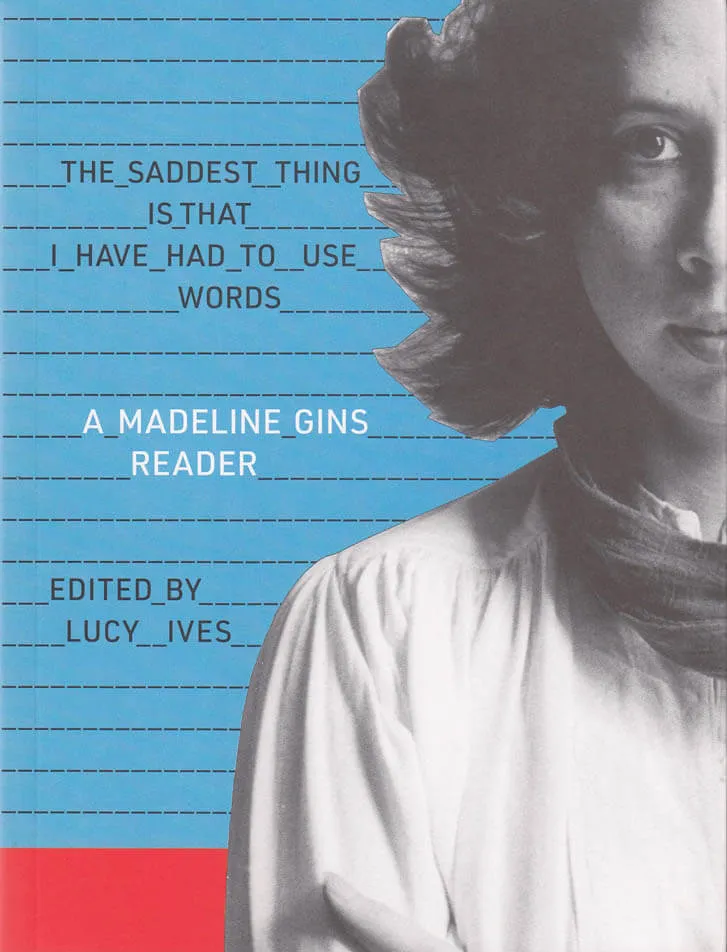
Cover of The Saddest Thing Is That I Have Had to Use Words: A Madeline Gins Reader

Siglio Press

The Saddest Thing Is That I Have Had to Use Words: A Madeline Gins Reader

Madeline Gins

Poetry €28.00

Poet, philosopher, speculative architect and transdisciplinary artist, Madeline Gins is well known for her collaborations with her husband, the artist Arakawa, on the experimental architectural project Reversible Destiny, in which they sought to arrest mortality by transforming the built environment. Yet, her own writings — in the form of poetry, essays, experimental prose and philosophical inquiries — represent her most visionary and transformative work. Like Gertrude Stein before her, Gins transfigures grammar and liberates words. Like her contemporaries in conceptual art, her writing is attuned to the energized, collaborative space between reader and page.

The Saddest Thing Is That I Have Had to Use Words: A Madeline Gins Reader is a revelatory anthology, edited and with an introduction by the writer and critic Lucy Ives. It brings never-before-published poems and essays together with a complete facsimile reproduction of Gins' 1969 masterpiece, WORD RAIN (or A Discursive Introduction to the Intimate Philosophical Investigations of G, R, E, T, A, G, A, R, B, O, It Says), along with substantial excerpts from her two later books What the President Will Say and Do!! (1984) and Helen Keller or Arakawa (1994). Long out of print or unpublished, Gins' poems and prose form a powerful corpus of experimental literature, one which is sure to upend existing narratives of American poetics at the close of the 20th century.

Edited by Lucy Ives. 

Cover of Répondeur

Occasional Papers

Répondeur

Slow Reading Club

Performance €25.00

Slow Reading Club (SRC) is a semi-fictional reading group initiated and run by Bryana Fritz and Henry Andersen. Since 2016, in numerous contexts, they have rehearsed alternatives to the kinds of reading they were taught in school, actively suppressing semantic content through strobe lights, strange postures, sociality, and toxins. Operating at the contact zones between reader and text, text and text, reader and reader, they attempt to build a practice from within the unstable space of reading itself.

Répondeur is an extensive account of SRC’s practice in collective reading sessions, exhibitions, and textual bootlegging. Imagined as a scroll, with a rhyme structure and typesetting by Will Holder, the book brings together facsimiles of SRC readers, a wide-ranging interview by Alicja Melzacka, new texts by Joyelle McSweeney and Bill Dietz, and visual work and translations by SRC. These discrete elements are interwoven into a complex, shimmering whole, delighting in the ruptures and elisions of one text’s move into the next.

Cover of Toxicon and Arachne

Nightboat Books

Toxicon and Arachne

Joyelle McSweeney

Poetry €18.00

In Toxicon & Arachne, McSweeney allows the lyric to course through her like a toxin, producing a quiver of lyrics like poisoned arrows. Toxicon was written in anticipation of the birth of McSweeney's daughter, Arachne. But when Arachne was born sick, lived briefly, and then died, McSweeney unexpectedly endured a second inundation of lyricism, which would become the poems in Arachne, this time spun with grief. Toxicon & Arachne is the culmination of eight years of engagement with lyric under a regime of global and personal catastrophes.

Cover of Flet

Fence Books

Flet

Joyelle McSweeney

Sci-Fi €16.00

Set in a spaced-out future in which all cities have been evacuated after an "Emergency," FLET is named for its female protagonist, an Administration flunky who begins to suspect that the Emergency may be a tool of sociopolitical oppression. An elegant entry in speculative fiction, Flet finds McSweeney slowing her distinctively hyperactive imagination down to the speed of narrative.