rile*books

Search books

Search books by title, author, publisher, keywords...

Cover of Tee A. Corinne: A forest fire between us

MACK

Tee A. Corinne: A forest fire between us

Tee A. Corinne, Charlotte Flint ed.

€52.00

A forest fire between us is an ambitious publication that uncovers Tee A. Corinne’s radical and expansive photographic practice, offering a new perspective on the intersections of her work as photographer, lesbian sex activist, educator, and author. Edited by curator Charlotte Flint, this book charts a route through Corinne’s practice with never-before-seen photographs, slides, contact sheets, and ephemera uncovered from her archive. Showcasing the pioneering work that established Corinne as one of the foremost lesbian photographers of her time, this publication places Corinne alongside friends, fellow artists, writers, and activists who helped define radical counterculture, from Audre Lorde to Joan E. Biren (JEB), Ruth Mountaingrove to Honey Lee Cottrell, among others.

At the book’s heart are the Feminist Photography Ovulars, gatherings of women in the Oregon countryside which were the setting for DIY photographic workshops exploring image-making against the natural landscape, which Corinne co-organized in the late 1970s and early 1980s. The photographs made during these annual gatherings speak to the incredible community that Corinne fostered, and an understanding of the ways in which play and pleasure can come together to create something radical.

Delving into an extensive array of archival material, A forest fire between us is a call to action that shows us the ways in which photography, activism, and community can come together to create a powerful new visual language around desire.

With an extensive chronology and texts by Ruth Mountaingrove, JEB, and Charlotte Flint.

Published in 2024 ┊ 128 pages ┊ Language: English

recommendations

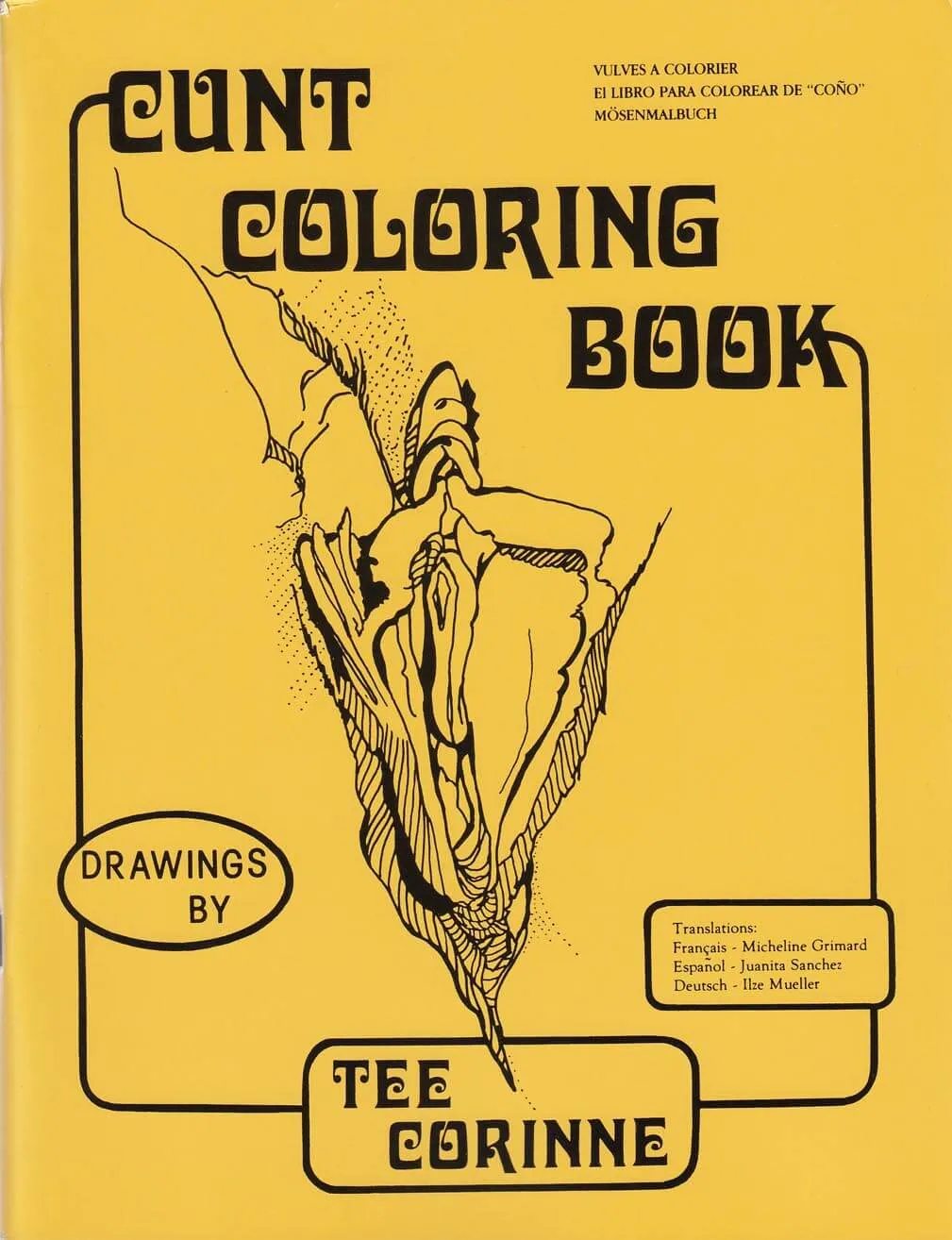
Cover of Cunt Coloring Book

Last Gasp

Cunt Coloring Book

Tee A. Corinne

Over three dozen c**ts of every size and description for you to color. Originally used for a sex-education class. Crayons not included. First published in 1975 by lesbian activist and artist Tee Corinne.

"In 1973 I set out to do drawings of women’s genitals for use in sex education groups. I wanted the drawings to be lovely and informative, to give pleasure and affirmation. I organized the drawings into a coloring book because a major way we learn to understand the world, as children, is by coloring. As adults many of us still need to learn about our external sexual anatomy." —Tee Corinne

Tee Corinne was born November 3rd, 1943 and grew up in St. Petersburg, Florida. Her mother, also an artist, introduced her to the creative principles and techniques that would serve her all her life. She received a B.A. in printmaking and painting from the University of South Florida, then went on to get an M.F.A. in drawing and sculpture at Pratt Institute, graduating in 1968. Afterwards she taught for many years, traveled through Europe, and finally became enmeshed in the back-to-the-land movement and communal living. After nearly ten years of marriage to a man she referred to as her "best friend," Corinne came out of the closet amidst severe depression in 1975. The strength to accomplish this difficult effort would later propel her to heights and achievements that would distinguish her as "one of the most visible and accessible lesbian artists in the world." From the mid-1960’s to the day she died Corinne created, published, and exhibited her art and writing around the world. She was a co-facilitator of the Feminist Photography Ovulars and a co-founder of The Blatant Image, A Magazine of Feminist Photography. She was the author of one novel, three collections of short stories, four books of poetry and numerous arts publications. In 1980, she was one of ten selected artists invited to have their work exhibited in the Great American Lesbian Art Show. The world lost Tee Corinne to cancer in 2006.

Cover of Your Silence Will Not Protect You

Silver Press

Your Silence Will Not Protect You

Audre Lorde

Poetry €18.00

With a preface by Reni Eddo-Lodge and an introduction by Sara Ahmed.
Audre Lorde (1934-92) described herself as ‘Black, lesbian, mother, warrior, poet’. Born in New York, she had her first poem published while still at school and her last the year she died of cancer. Her extraordinary belief in the power of language – of speaking – to articulate selfhood, confront injustice and bring about change in the world remains as transformative today as it was then, and no less urgent. This edition brings Lorde’s essential poetry, speeches and essays, including ‘The Master’s Tools Will Never Dismantle the Master’s House’, together in one volume for the first time.

Cover of Responses to Untitled (eye with comet) By Paul Thek

Pilot Press

Responses to Untitled (eye with comet) By Paul Thek

Richard Porter

Poetry €19.00

Responses to Untitled (eye with comet) (c.1985) by Paul Thek is the sixth and final anthology in a series that gathered responses to works of art made during a period of the ongoing AIDS Crisis, from the identification of the virus in 1981 to the introduction of life-saving drugs in 1996.  

In this sixth iteration, responses were sought to the painting Untitled (eye with comet) by Paul Thek. The work was found in his storage after his death from AIDS in 1988. 

List of contributors in order of appearance:

E.R. De Siqueira
Ben Estes
João Motta Guedes
Lucy Swan
Jon Rainford
Louis Shankar
Amy Evans Bauer
Hattie Morrison
Sammy Paloma
AN Grace
James Horton
Nick Wood
Sophie Paul
Jae Vail
Elizabeth Zvonar
Lars Meijer
Clay AD
Michel Kessler
Pablo Miguel Martínez
Emma Harris
Dylan McNulty-Holmes
Kitya Mark
Katherine Franco
Ainslie Templeton
Alistair McCartney
John Brooks
Jesse Howarth
jimmy cooper
Felix Pilgrim
Nicholas Chittenden Morgan
Murphy O’Neir
Rachel Cattle
Isabel Nolan
Susan Finlay
Ted Simonds
Brooke Palmieri
Kate Morgan
Ashleigh A. Allen
Diogo Gama
JP Seabright
Hugo Hagger
Amanda Kraley
Brendan Cook
Matt Bailey
Charlotte Flint
Rodney Schreiner
Lucy Price
Morgan Melhuish
Jordan Weitzman
Jaakko Pallasvuo
Alex Fiorentino
Harald Smart
Marguerite Carson
loll jung
Richard Porter
Nicholas Kalinoski
Hedi El Kholti
Edmund Francis English
Ted Bonin

Cover of The Lesbian Body

Winter Editions

The Lesbian Body

Monique Wittig

Non-fiction €22.00

In this genre- and gender-breaking work of theory-fiction, legendary writer and cofounder of the 1970s French feminist movement Monique Wittig celebrates the body—lesbian, literary and defiantly political—and challenges the order of heterosexuality in literature. 

First published in French in 1973, The Lesbian Body mines the relationship between a lover and a beloved—also a writer and a text—to explore the ideological and historical constructions of the female subject. Organized according to the principle of montage, poetic passages are juxtaposed with anatomic lists that mark lesbian eros. Through expressions of joy, violence, and tenderness, the site of pleasure is celebrated. In her transfiguration of gender and its paradigms, Wittig transformed French vocabulary, feminizing grammar and lesbianizing myths. This edition brings the English translation of Wittig’s groundbreaking work back into circulation for the first time since the mid-1980s, revised according to the author's notes, and with an introduction by Paul B. Preciado.

The Lesbian Body is a fundamental work of lesbian existence. Wittig's applied vision is a state of natural delirium, a revolutionary excess of utopianism, refusal, and mutual self-creation. Revisiting it reveals how much passionate free thought has been lost, and simultaneously, how many of her tropes and discoveries have integrated into our collective consciousness.” — Sarah Schulman

“In this stunning new rendering of The Lesbian Body by the French author, theorist, activist and teacher, the late Monique Wittig, we are plunged into an imagined world of passionate violence and erotic lesbian mayhem intertwined in strikingly bold poetic images. Wittig, in the reach and volatility of her imagination, stands alongside such important American writers as Audre Lorde, Adrienne Rich, and Valerie Solanas, all of whose work deserves to be read again, or for the first time.” — Esther Newton

“To read the book is to be forced by Wittig into another grammar and happily contaminated by its strange forms. You will never think straight again.” — Jack Halberstam

“For me, Wittig opened up a sense of the world that had been, quite literally, unimaginable. She tore us apart.” — Judith Butler

“Together with Ursula Le Guin and Samuel R. Delany, Wittig is the first to design a nonbinary utopia, a world in which the binary categorization of sexes and genders will have ceased to exist.” — Paul B. Preciado

Introduction by Paul B. Preciado
Translated by David Le Vay

Cover of The Mollino Set

Rollo Press & Cabinet Books

The Mollino Set

Lytle Shaw

New York-based professor Lytle Shaw journeys to Italy in this adventurous exploration of the life and work of architect, designer, and photographer Carlo Mollino (1905–1973). In 1933 the young Mollino received a commission from Mussolini’s regime for his first building: an administrative centre in Piedmont. Later works include furniture and interior design, a book on photography, and an asymmetrical car that raced at Le Mans in 1955.

The book centres around Shaw’s realisation that this prolific talent’s conflicted legacy offers a unique window on the role that post-war Italian politics and culture played in the country’s reimagining of itself as a victim, rather than a proponent, of fascism.

Cover of Maa Ka Maaya Ka Ca A Yere Kono – 13th Edition of the Rencontres de Bamako - African Biennale of Photography

Archive Books

Maa Ka Maaya Ka Ca A Yere Kono – 13th Edition of the Rencontres de Bamako - African Biennale of Photography

Bonaventure Soh Bejeng Ndikung

Photography €35.00

The catalogue of the 13th edition of the Rencontres de Bamako - African Biennale of Photography, focusing on multiplicity, difference, becoming, and heritage.

The dominant narrative in this "globalized world" is, incidentally, that of singularity—of universalism, of single identities, of singular cultures, of insular political systems. With this narrative, however, comes an illusory sense of stability and stasis; identities seem inalterable, cultures are immutable, political systems prove uneasy in the face of change. Thus, in sustaining this pervasive discourse, there has been a great loss of multiplicity, of fragmentation, of process and change, and not least of complex notions of humanity and equally complex narratives.

In decentering this year's biennale On Multiplicity, Difference, Becoming, and Heritage, General Director Cheick Diallo, Artistic Director Bonaventure Soh Bejeng Ndikung, and the curatorial team—Akinbode Akinbiyi (artist and independent curator), Meriem Berrada (Artistic Director, MACAAL, Marrakech), Tandazani Dhlakama (Assistant Curator, Zeitz MOCAA, Cape Town, South Africa), and Liz Ikiriko (artist and Assistant Curator, Art Gallery of York University, Toronto)—of the Bamako Encounters pay a powerful tribute to the spaces in between, to that which defies definition, to phases of transition, to being this and that or neither and both, to becoming, and to difference and divergence in all their shades. Accordingly, Amadou Hampâté Bâ's statement (Aspects de la civilisation africaine, Éditions Présence Africaine, 1972) presiding over the manifestation, Maa ka Maaya ka ca a yere kono,translates to, "the persons of the person are multiple in the person."

A key tool for negotiating the processual and shifting nature of multiplicity lies in storytelling. It is the central medium through which humanity points the lens on itself and launches an attempt at self-understanding and reflection, and the breadth of answers given throughout history testifies to the congenial nature of storytelling and multiplicity. Moreover, the stories we tell not only negotiate who we are but also expose underlying currents of who we will become in the future. This is the concern lying at the heart of the 13th edition of the Bamako Encounters—the stories we tell, the multiple facets of humanity we accommodate, notions of processuality, becoming in being, embracing identities that are layered, fragmented, and divergent, and the multifarious ways of being in the world, whether enacted or imagined. It should be emphasized that this does not apply only to questions of personal identity. On the contrary, it is a bold affirmation of transformation and transition, of becoming in an emphatic sense, and is thus equally significant for state politics. It also rings true for questions of heritage/patrimony. Embracing the kaleidoscopic legacy of our multiple heritages means to open them up and liberate the term "patrimony" from its etymological roots (the Latin patrimonium means "the heritage of the father"), imagining in its place an inclusive concept of matrimony.

Thus, in this 13th edition of the Bamako Encounters with the title Maa ka Maaya ka ca a yere kono, artists, curators, scholars, activists, and people of all walks of life are invited to reflect collectively on these multiplicities of being and differences, on expanding beyond the notion of a single being, and on embracing compound, layered and fragmented identities as much as layered, complex, non-linear understandings of space(s) and time(s).

Published following the 13th edition of the Rencontres de Bamako - African Biennale of Photography, in Bamako, Mali, in 2022.

With Saïd Afifi, Ixmucané Aguilar, Baff Akoto, Annie-Marie Akussah, Américo Hunguana, Daoud Aoulad-Syad, Leo Asemota, Myriam Omar Awadi, Salih Basheer, Shiraz Bayjoo, Amina Benbouchta, Hakim Benchekroun, Maria Magdalena Campos Pons, Rehema Chachage, Ulier Costa-Santos, Adama Delphine Fawundu, Fatoumata Diabaté, Aicha Diallo, Amsatou Diallo, Anna Binta Diallo, Mélissa Oummou Diallo, Nene Aïssatou Diallo, Binta Diaw, Adji Dieye, Imane Djamil, Sènami Donoumassou, Abdessamad El Montassir, Fairouz El Tom, Luvuyo Equiano Nyawose, Raisa Galofre, Raisa Galofre, Joy Gregory, Gherdai Hassell, Thembinkosi Hlatshwayo, Letitia Huckaby, Anique Jordan, Gladys Kalechini, Hamedine Kane, Atiyyah Khan, Gulshan Khan, Seif Kousmate, Mohammed Laouli, Maya Louhichi, Mallory Lowe Mpoka, Nourhan Maayouf, Marie-Claire Messouma Manlanbien, Botembe Moseka Maïté, Louisa Marajo, Clarita Maria, Billie McTernan, Mónica de Miranda, Arsène Mpiana Monkwe, Sethembile Msezane, Ebti Nabag, Elijah Ndoumbe, Lucia Nhamo, Samuel Nja Kwa, Nyancho NwaNri, Jo Ractcliffe, Adee Roberson, Fethi Sahraoui, Muhammad Salah, Neville Starling, Eve Tagny, René Tavares, Sackitey Tesa, Helena Uambembe, David Uzochukwu, Sofia Yala, Timothy Yanick Hunter.

Cover of Hortus

Self-Published

Hortus

Lilia Luganskaia

Photography €35.00

The Hortus  project is an open investigation into the nature of seemingly common objects through 'Floriography', urban gardens, and the history of female rights. Hortus was inspired by urban gardens in West Amsterdam and created with its plants by Lilia Luganskaia. 

Joanna Cresswell about the 'Hortus':

History teaches us that a language of flowers can communicate endless things about the culture in which it emerged, and herein lies Lilia Luganskaia's interest. Taking inspiration from the world of 19th Century sentimental flower books, Hortus presents itself as a set of notes towards a modern handbook for contemporary floriography, considering what the discipline might look like today. By collecting common flora across one year in the urban gardens around her home in Amsterdam and cross-referencing their meanings with publications from the past, Luganskaia reflects on their natures, their roles, and the symbolic familiarity they might hold for the communities living with them. A female artist and reader of the twenty-first century, she seeks out the essence of modern life through her lens, and through flowers, just like the women who came before her. 

Lilia Luganskaia (1990) Russian - Dutch multidisciplinary artist and author, based in Amsterdam. In her artistic practice, Lilia uses her background in documentary techniques to focus on what she calls ‘investigating reality’.  Her practice is research-based, Lilia decodes abstract notions such as love, tourism, bureaucracy, politics, and feminism through the use of constructed images, sculptures, videos, and installations. One of the key elements of her work is to understand multiple aspects of the photographic image.