rile*books

Search books

Search books by title, author, publisher, keywords...

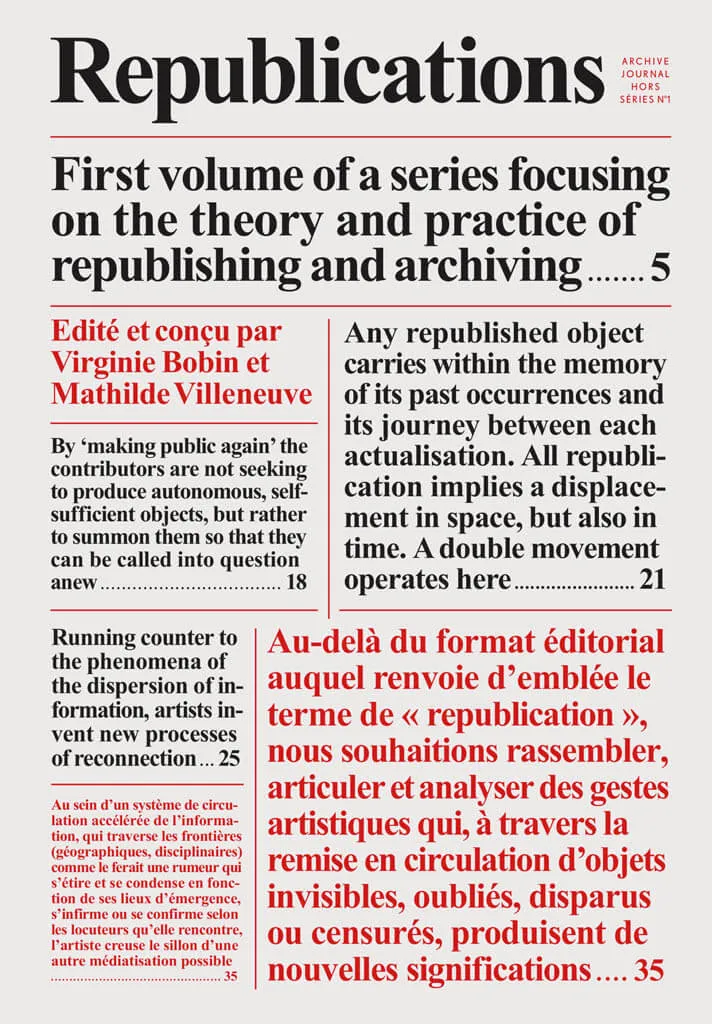
Cover of Republications

Archive Books

Republications

Virginie Bobin ed., Mathilde Villeneuve ed.

€18.00

Republications is the first volume of Archive Journal’s hors-séries. Each issue of the series is commissioned to authors whose research is close to the editorial line of the journal. For the inaugural issue Archive’s editors have invited French curators and art critics Virginie Bobin and Mathilde Villeneuve. Taking as a starting point the notion of ‘republication’, the contents of this publication have been compiled through a collective process over the course of multiple editorial meetings in Berlin, Aubervilliers and Paris between 2011 and 2012. The texts assembled in this volume have been written in English or in French.

Contributions by Mathieu Kleyebe Abonnenc, Lene Berg, Pauline Boudry, Renate Lorenz, Christophe Bruno, Foundland, Jeff Guess, Alexis Guillier, Rémy Héritier, Franck Leibovici, Sohrab Mohebbi, Julien Prévieux, Sally Price, Anna Théodoridès, Vassilis Salpistis, Marie Voignier.

Language: English

recommendations

Cover of Toward a Transindividual Self (2nd edition)

Archive Books

Toward a Transindividual Self (2nd edition)

Ana Vujanović, Bojana Cvejić

A book that examines the process of performing the self, distinctive for the formation of the self in Western neoliberal societies in the 21st century. It approaches the self from a transdisciplinary angle where political and cultural anthropology, performance studies and dramaturgy intersect.

Starting from their concern with the crisis of the social, which coincides with the rise of individualism, Vujanović and Cvejić critically untangle individualist modes of performing the self, such as possessive, aesthetic, and autopoietic individualisms. However, their critique does not make for an argument for collectivism as a socially more viable alternative to individualism. Instead, it confronts them with the more fundamental problem of ontogenesis: how is that which distinguishes me as an individual formed in the first place? This question marks a turning point in the study, where it steps back into the process of individuation, prior to, and in excess of, the individual. 

The process of individuation, however, encompasses biological, social, and technological conditions of becoming whose real potential is transindividual, or more specifically, social transformation. A ‘theater of individuation’ (Gilbert Simondon) captures the dramaturgical stroke by which the authors investigate social relations (like solidarity and de-alienation) in which the self actualizes its transindividual dimension. This epistemic intervention into ontogenesis allows them to expand the horizon of transindividuation in an array of tangible social, aesthetic and political acts and practices. As with every horizon, the transindividual may not be closely at hand; however, it is certainly within reach, and the book encourages the reader to approach it.

"Towards a Transindividual Self is an ambitious and capacious effort to theorize a new way to approach collectivity for political purposes through the lens of performance. Convinced that the current neoliberal conjuncture has only heightened a form of capitalist individualism that blocks notions of the social, the authors aim to show that a "transindividual formation of the self can bring about different courses of action and a more socially driven imagination." Transindividuation, they assure us, shows how "we form ourselves on the basis of interdependence, sharing, commonality, as well as indispensability of the individual as the agent of creativity/ knowledge, freedom, and change, who 'possibilizes' their own conditions of formation." 
— Professor Janelle Reinelt (University of Warwick), co-editor of Critical Theory and Performance (University of Michigan, 2006)

"Perhaps the most striking thing about this book is the manner in which it is able to engage with multiple discourses from political theory to aesthetics. In this way it both follows the ambitious scope of Simondon’s work on individuation, and expands into areas that Simondon did not cover, most notably politics and cultural politics, which is the book’s central concern. Rather than ask the question is the individual imagined or real, an effect of social relations or their distortion, the focus on the transindividual makes it possible to grasp individuation as a process: “Instead of pondering how the passage from one to many occurs, individuation permits us to immediately trace a bidimensional process in which both individual persons and the collectivities they form are altered. Another meaning of the crisis of the social has brought about a perfect slogan of such a process of transindividuation: ‘No one will be left alone in the crisis.” (…) Towards a Transindividual Self does a brilliant job of not only arguing for the importance and relevance for the transindividual as a concept for politics, performance, and the politics of performance, but of demonstrating a bold standard for political and aesthetic inquiry."
— Professor Jason Read (University of Maine), author of The Politics of Transindividuality (Brill, 2015)

Co-published by Oslo National Academy of the Arts, Sarma and Multimedijalni institut.

Cover of The Illusion of a Crowd

Archive Books

The Illusion of a Crowd

Clemens von Wedemeyer

Publication including the films Transformation Scenario, 70.001, and Faux Terrain, as well as a visual essay, a glossary and texts by Heike Geißler, Fanni Fetzer, and Franciska Zólyom.

“When I visited the Elias Canetti archive at the Zentralbibliothek Zurich, I was looking for manuscripts and sketches for his major work Crowds and Power (1960). I imagined that Canetti must have made drawings, as the behaviour of the various crowd types he identified was described in such detail. I hoped that these drawings would help me transfer the group behaviour he describes to virtual figures in an animated film.

The archive of manuscripts, arranged by Elias Canetti himself, was handed over to the Zurich library and contains the notes and sketches he completed during the development of Crowds and Power, a period of almost forty years. However, in this context I found no drawings—Canetti had only made graphic lists on various themes. So where did Canetti's precise descriptions of the scenes come from?”

Clemens von Wedemeyer (born 1974 in Göttingen, lives and works in Berlin) creates films, videos and media installations poised between reality and fiction, reflecting power structures in social relations, history and architecture.

Edited by Fanni Fetzer and Franciska Zólyom.
Texts by Heike Geißler, Fanni Fetzer, Franciska Zólyom.

Cover of Afghanistan

Archive Books

Afghanistan

Farid Rahimi, Luca Cerizza

Essays €21.00

Afghanistan is my father’s homeland. He was born in Kabul in 1945 and later moved first to France, then to Switzerland in the 1970s. In my mind, Afghanistan exists as a geography with blurred edges, something I feel the need to reconcile with. It’s a place I’ve only ever known through stories, a source of memories that, over time, have shifted and become distorted.

Contributors: Luca Cerizza, Farid Rahimi, Said Rahimi, Susanna Ravelli, Francesca Recchia, Zafar Sayan, and Dawood Tawana

Cover of Metropolitan Voids Agency

Archive Books

Metropolitan Voids Agency

Zasha Colah, Francesca Verga

Metropolitan Voids Agency is the first monographic publication dedicated to the collected works of artist Margherita Moscardini. The book recounts the work carried out by Moscardini spanning seventeen years, between 2008 and 2024, inviting a reading of her practice in its entirety as an investigation into ‘urban voids’: those which Moscardini has recognized and designated as voids, or those she has herself invented in the urban fabric.

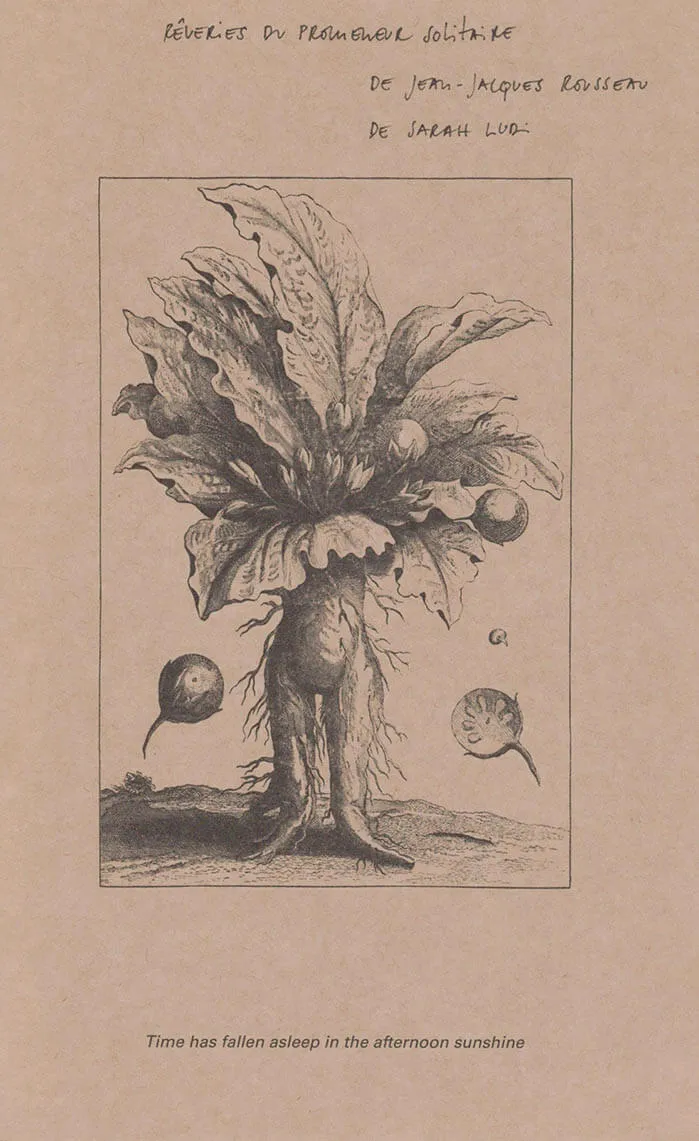
Cover of Mon Songe

Time has fallen asleep in the afternoon sunshine

Mon Songe

Vincent Dunoyer

For the project Time has fallen asleep in the afternoon sunshine a group of people/ performers memorize a book of their choice. Together they form a library collection consisting of living books. After years of learning by heart and reciting for readers, some of the books have now been written down from memory to create new editions, versions resulting from this process. This book is one of those books, chosen by one person, learned by heart and recited many times, and now written down again from memory. This edition is not a re-edition of the original text. It is a re-writing of the text after the process of reading, memorizing and reciting, with all the alterations that might have occured in the course of this process.

Cover of ZILCH

Infinitif

ZILCH

Maxime Le Bon

In banana boxes, Maxime Le Bon collects and stores a lot of documents in a jumble. Most of them are printed, cut out from newspapers, magazines, old publications, erratas and other fragments of texts. Added to this are drawings that he improvises - some of them torn or stained that he don't want to display or throw away. This collection of heterogeneous items is then being rearranged and slipped into plastic pockets where he stores them. Unstable and in constant change, this improbable archive grows with the years. It sedimented layers of experiences and constitutes this heterogeneous deposit from which can emerge all sorts of fragmentary narratives and accidental arrangements. The publication ZILCH brings together a selection of images from this extensive archive.

Cover of BRICKS FROM THE KILN #7

Bricks from the Kiln

BRICKS FROM THE KILN #7

Matthew Stuart, Harriet Moore and 1 more

Fiction €20.00

Guest edited by artist Helen Marten and literary agent Harriet Moore with Matthew Stuart, this volume of the journal considers what it means for a publication to be an allegorical container. A simple box in which to gather multiple things, an economical set of permutations — rational in one sense, yet defiantly flexible to move. Contributors were approached with an open invitation; some explored the multiplicities of containing or containers, while others filled the printed vessel with their own ongoing preoccupations. The following pages perform as envelope, bag, shell, net, fold, alarm, letter and instruction. There are holes to disappear within; smoke to knot and wind; shadows to unfold — a context that takes in and binds, finding new kinships from unforeseen proximities.

THE FIRE FLOWERS AND THE FLOWER LIGHTS UP –
Lucy Mercer
(spine)

WE SHALL GREET THE MOON AGAIN
Walter Price
(front cover)

BACK PAGES OF ALGIERS DIARIES 2018
Lydia Ourahmane
(inside front & inside back cover)

AN INTRODUCTION TO / NOTES ON / INSTRUCTION FOR THE FRONT NOVEL
Eliza Barry Callahan
(pp.1–16)

SATURDAY MORNING
Kathryn Scanlan
(pp.25–29)

KILLDEER
Jason Schwartz
(pp.33–38)

ALARMS AND EXCURSIONS
Rosmarie Waldrop
(pp.45–61)

"THE BATHROOM"
Najwa Barakat
(pp.67–76)

ARMY ROLLS, A CIRCUMSCRIPTION
Roy Claire Potter
(pp.81–91)

CONCHOMANIA
Felix Bernstein
(pp.95–109)

O-POEM
Line-Gry Hørup
(pp.113–129)

THIS MUSCLE
Cally Spooner
(pp.133–153)

STERLING PARK IN THE DARK
Susan Howe
(pp.159–179)

COCONUTTERY
Mathelinda Nabugodi
(pp.183–193)

YOUR SELF CONFIDENT BABY
Aurelia Guo
(pp.197–206)

BIOGRAPHY OF A NET: HOLDING A VOLUME
Daisy Hildyard
(pp.211–225)

A GUIDE TO THE POETRY OF LI HO
Eliot Weinberger
(pp.229–235)

WOMEN SMOKING
Charline von Heyl
(throughout & p.239)

INFRATHIN
Marcel Duchamp
(throughout & p.239)

THE MAZED WORLD
Rachael Allen
(bookmark insert)

UNTITLED
Helen Marten
(back cover)

Cover of Black Phoenix: Third World Perspectives on Contemporary Art and Culture

Primary Information

Black Phoenix: Third World Perspectives on Contemporary Art and Culture

Rasheed Araeen, Mahmood Jamal

Anthology €24.00

Facsimile compilation of the late-'70s journal on diasporic and colonial histories that paved the way for the British Black Arts Movement.

Published in three issues between 1978 and 1979, Black Phoenix: Journal of Contemporary Art & Culture in the Third World (the subtitle was changed to Third World Perspectives on Contemporary Art and Culture for its second and third issues) stands as a key document of its time. More than a decade after '60s liberation movements and the historic Bandung and Tricontinental Conferences that called for social and political alignment and solidarity to dismantle Western imperialism and (neo)colonialism, Black Phoenix issued a rallying call for the formation of a Third World, liberatory arts and culture movement on the eve of Margaret Thatcher's election in 1979.

Based in the UK, and both international and national in scope, Black Phoenix positioned diasporic and colonial histories at the center of an evolving anti-racist and anti-imperialist consciousness in late 1970s Britain—one that would yield complex and nuanced discourses on race, class and postcolonial theory in England in the decade that followed.

A precursor to the British Black Arts Movement that formed in 1982 (which encompassed such cultural practitioners as the Black Audio Film Collective and cultural studies theorist Stuart Hall), Black Phoenix proposed a horizon for Blackness beyond racial binaries, across the Third World and the colonized of the interior in the West.

This single-volume facsimile reprint gathers all three issues of the journal, which include contributions by art critics, scholars, artists, poets and writers, including editors Rasheed Araaen and Mahmood Jamal, Guy Brett, Kenneth Coutts-Smith, Ariel Dorfman, Eduardo Galeano, N. Kilele, Babatunde Lawal, David Medalla, Ayyub Malik, Susil Sirivardana and Chris Wanjala.