rile*books

Search books

Search books by title, author, publisher, keywords...

Cover of Rainbow Woman

Posture Editions

Rainbow Woman

Femmy Otten

€38.00

In her work, Dutch artist Femmy Otten (°1981) explores a very hybrid world of inspiration, ranging from sculptures from Greek antiquity and Italian painters of the quattrocento to American outsider art and contemporary art. She brings all these influences together in a precise yet unfathomable iconography.

The book Rainbow Woman shows mainly recent work, but also revisits a number of older works which Otten has regularly placed in a new context throughout her artistic practice and which have now also been given a new shape in the context of the exhibition in the Warande, Turnhout (01.08-07.11.2021).

Rainbow Woman shows Otten as a versatile painter, sculptor, draughtsman and performer. In ‘Donna Universale’, the art historian Leen Huet places Otten in a tradition of self-confident, female artists that Europe has known since the early Renaissance but who have only sporadically entered the history books as artistically accomplished artists. 

The book has many points of contact with the exhibition Rainbow Woman but can also be seen as a sequel to the artist’s book Slow Down Love (2016, nai).

Published in 2021 ┊ 136 pages ┊ Hardcover ┊ Language: English

recommendations

Cover of Screensaver Error

Posture Editions

Screensaver Error

Lisa Vlaemminck

Nº 49 / October 2022

In her work, Lisa Vlaemminck explores the boundaries of painting, creating an exciting, vibrating and disorienting universe. In her images, she questions very classical phenomena in painting, such as the landscape and the still life, by freezing them behind semi-transparent layers of paint. We catch a glimpse that feels familiar, but soon find that nothing is what it seems. Vlaemminck’s work oscillates between the microscopic and the interstellar, as well as the amorphous spaces in between. Image, material, shape, texture and form mutate into compositional playgrounds floating in a newly created universe where different laws and rules apply.

The book “Screensaver Error” is conceived as a symmetrical, folded stack of sheets with images of Lisa’s paintings and collages.
At the heart of the book is the sixty-metre long, worm-shaped textile sculpture, which runs like a stream through the book for many pages.
Dominique De Groen wrote an electrically charged shimmering poem tailored to the work. The introductory text was written by Simon Delobel.

In KIOSK, Lisa Vlaemminck presents a series of new paintings and a sixty-metre long textile sculpture that will occupy the various exhibition spaces. For the design of the fabric, Lisa worked patterns that form a long colour gradient.

At the end of the exhibition, the sculpture, Meat A Morph Hose, will be cut into 35 separate, new sculptures that will be offered as artworks at € 350 each. Each work is a part of the colour gradient and has a unique print. The proceeds will finance the book. Details: Printed cotton, latex spaghetti filling, the ends are closed with climbing rope
40 cm diameter x 130cmA signed copy of the book will also be delivered together with the work.
The sculptures can be collected from KIOSK at the book-launch: Sat. 26 November

The artist is reprented by gallery rodolphe janssen

Cover of sawing a plank is like going for a walk

Posture Editions

sawing a plank is like going for a walk

Kato Six

With texts by Phillip Van den Bossche, Filarowska and a conversation between Eva Wittocx and the artist (NL/EN)


Nº 48 / October 2022

sawing a plank is like going for a walk by Kato Six (b. 1986) is published on the occasion of Kato’s solo exhibition at M Leuven this autumn. This book encapsulates 10 years of her quest as an artist.


The work of Kato Six (b. 1986) balances between abstract and figurative art. She works on different themes which she develops into series or ensembles. Architecture, design, domesticity and utensils all act as important references. Starting there, she uses recognisable and everyday materials such as MDF, stone, plastic or textiles.
Kato wants to question certain affinities and let the viewer look at familiar objects or images from a different perspective. As a viewer, you feel connected to the object or image but the actual meaning or function no longer applies.

Some of my works refer to the domestic, especially the most recent ones, such as ‘Carpet Beater Carpet’ and ‘Striped Knitwear’. The invisible work done by “housewives”, but also by workers or maintenance staff, is certainly one of the themes addressed in ‘Carpet Beater Carpet’. The above works are textile works, created with so-called “soft skills”. In the arts, these “soft skills” are often attributed to female artists — women often being assigned a certain medium.
Kato Six in conversation with Eva Wittocx in “sawing a plank is like going for a walk”

Cover of Slow Mania

Futurepoem

Slow Mania

Nazareth Hassan

Poetry €22.00

Nazareth Hassan’s devastatingly brilliant Slow mania is a powerful document of senses and sense-making where estrangement and ugliness meets longing and beauty. The artist begins with a photographic sequence: two white-blue sky panels; a shattered glass storefront window; a street gutter clutching leaves, smashed straw sleeves and plastic lids; then snow holding a disassembled red stained chest of drawers. These are the writer’s plinths where form as waste is configured: “smoggy breath thru burnt-edged holes tracking acid mucous inside your home.” Slow mania provokes through enumerative structures, for instance, “screening bodies” who keep a sex club’s gates open only to some: “…197 mmm maybe lemme think / 151 yes / 162 yes / 197 ok yes, but keep your shirt on.” The poet deftly folds human intimacy into interspecies metaphor: “The rat torso twitches in agreement. Across / the street, the flies continue to starve,” where “…you’re lost in your own hole: what did you find?” Hassan attends to this painful search, bearing witness to the disturbingly exultant, offering a radical state of being, in and out of which the stunning and timely Slow mania lives and thrives. — Ronaldo V. Wilson

Slow mania is resistance to resolution, it’s pointillistic magic, it’s Seurat in Bed-Stuy: the tighter you zoom, the more undifferentiated beauty you encounter. It’s kinky (the kinked-up curls of somebody’s greased-up chops). It’s tender (bruised and brown, like the overripe fruit that haunts your summer kitchen waiting to be crumbled into a crumble). The colors are blurry, the edges are soft, the stakes are high, and everything—everything!—shimmers in the space between life and afterlife. Hassan’s gaze is a hot summer steam that sneaks into the skinniest, stinkiest crevices; the grimiest seams, the most miraculous cracks. Breathe into the abyss, that’s the invitation. Take it in, let it in. Be a wit(h)ness to every single being. — Steffani Jemison

This amazing book reads like a synesthetic performance, the only thing missing is the smell of sweat, of streets, of loss. A book of choreographed pages, scores, movements, image blur, hand-scribbles. The bleak, unsparing texts hidden among the materials turn out to be the record of sudden eruptions, violent street scenes, pick-up scenes, unclear dialogues, insults, self-debasing verbal injuries on repeat. The performers are racialized, sexualized, anonymized “persons,” “meats,” numbers, lovers, passers-by, all caught up in these dangerous yet desperately emotional and triggering dances at the limit. It will leave you raw, spaced-out, both roused and alarmed as though coming out of an intoxicating show, and wanting more. — Caroline Bergvall

Cover of Forms Of Life Of Forms

a.pass

Forms Of Life Of Forms

Rob Ritzen

FORMS OF LIFE OF FORMS brings artistic research into form – not merely as an aesthetic question but as a social and political one. Indeed, there are no politics without form! With Forms of Life, Rob Ritzen curated several “Moments” that assembled works, collective readings, and other references into a single installation. This publication reshuffles documentation of these “Moments” as a visual reflection of the trajectory of this research.

Rob Ritzen works as a curator with a background in philosophy. His curatorial practice is focusing on self-organized and cooperative formats. Consciously positioned at the margins of established institutions and outside of market-oriented spaces, his practice is placed in close association with communities of cultural practitioners. His initiatives are attempts to reconfigure the politics of making art and alternative forms of production and presentation.

Cover of I Want

Sternberg Press

I Want

Pauline Boudry/ Renate Lorenz

I Want reviews the eponymous duo's double-projection film installation examining issues of gender, sexuality and performativity—and inspired by the words of punk poetess Kathy Acker and convicted whistle-blower Chelsea Manning. This publication documents the major film installation I Want (2015) by collaborative artists Pauline Boudry and Renate Lorenz, which was presented at their 2015 solo exhibitions at Kunsthalle Zürich and Nottingham Contemporary.

The double-projection film installation is based on a script that borrows texts from American punk-poet Kathy Acker (1947-1997), as well as chats and materials by convicted whistle-blower Chelsea Manning that speak of her reasons for revealing nearly one million secret military and diplomatic documents through WikiLeaks, at the same time exposing her transgender identity to her superiors.

Through poetic gestures of appropriation and recombination, Boudry and Lorenz examine issues around gender, sexuality, the performance of identity, and the nature of collaboration. Alongside generous color documentation, written contributions by Gregg Bordowitz, Laura Guy, Dean Spade, and Craig Willse unpack and reflect upon both the historical context and contemporary significance of this multivalent work.

Cover of Reseeding the library, gleaning readership

Afternoon Editions

Reseeding the library, gleaning readership

Jeroen Peeters

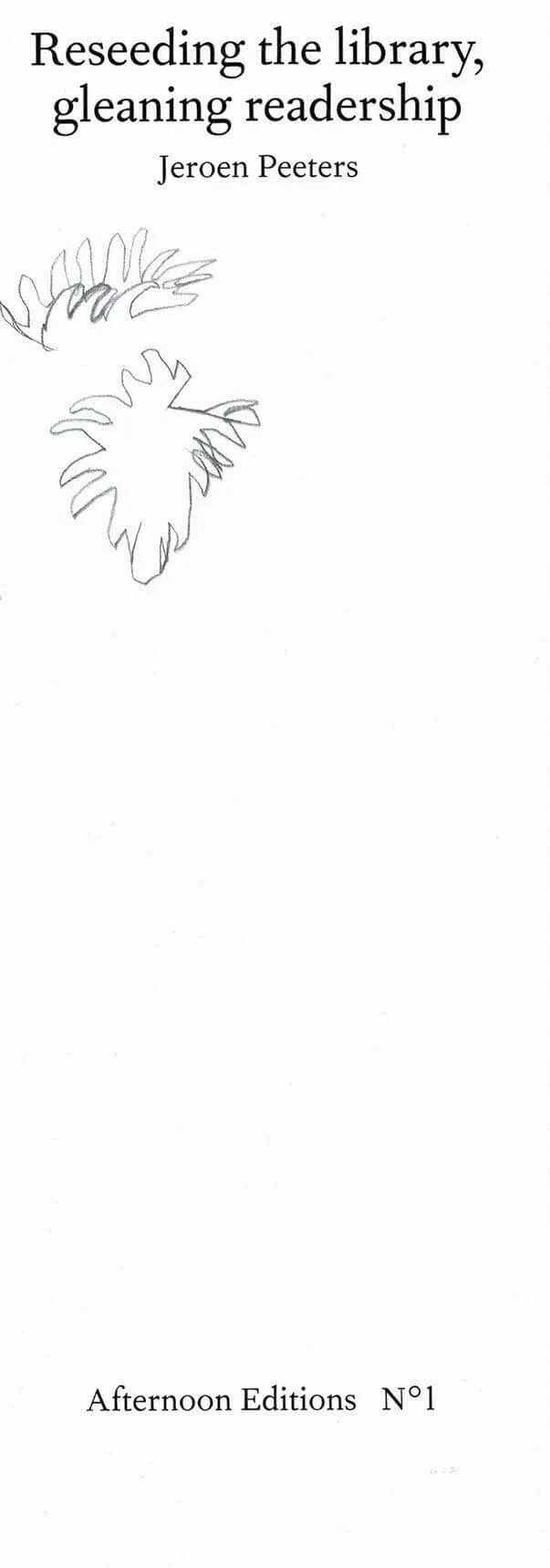
Afternoon Editions no. 1: an essay by Jeroen Peeters titled Reseeding the library, gleaning readership. In May 2017, Time has fallen asleep in the afternoon sunshine settled during three weeks in the Ravenstein Gallery in Brussels as part of the Kunstenfestivaldesarts. Invited as a writer in residence, Jeroen Peeters visited the library of living books on a daily basis and recorded his observations by hand in a notebook, which formed the basis for Afternoon Edition #1. Reseeding the library, gleaning readership is an essay on the seed library, on the dispersion of literature through wind, water and animals, on biodiversity and commoning at the heart of readership. On the cover a drawing by Wouter Krokaert of a Philodendron Xanadu. Published May 2018.

Cover of Metal Works

Lenz Press

Metal Works

Sidsel Meineche Hansen

A complete survey of the cast, forged, and fabricated metal sculptures made by Danish artist Sidsel Meineche Hansen since 2017.

The artist's practice addresses the industrial complex of virtual and robotic bodies and their relationship to labor in tech, pornography and gaming. While some sculptures were conceived as individual pieces, others were created with digital counterparts within installations that typically include CGI animation, documentary video, drawing and prints.

By presenting the metal works as stand-alone pieces, this book adheres to Meineche Hansen's concern with the material means of production, highlighting their concrete yet elusive nature. Several pieces in the publication are accompanied by poems written by artist Diego Marcon in response to the works. As an artist's project and an archival document, the publication echoes the tradition of documentary photography devoted to sculpture.

Sidsel Meineche Hansen (born 1981 in Denmark, lives and works in London) is a Danish artist. She produces exhibitions, interdisciplinary seminars and publications that foreground the body and its industrial complex, in what she refers to as a "techno-somatic variant of institutional critique". Meineche Hansen questions the body in the field of industrial representations: robotic or virtual bodies, and their relationship with the working world of industries of gaming, pornography, and new technologies. Her research-led practice has taken the form of woodcut prints, sculptures and CGI animations, often made by combining her own low-tech manual craft with outsourced, skilled digital labour.

Edited by Fredi Fischli and Niels Olsen.
Poems by Diego Marcon.