rile*books

Search books

Search books by title, author, publisher, keywords...

Cover of Radical Futurisms – Ecologies of Collapse / Chronopolitics / Justice to Come

Sternberg Press

Radical Futurisms – Ecologies of Collapse / Chronopolitics / Justice to Come

T.J. Demos

€19.00

What comes after end-of-world narratives: visions of just futurity and multispecies flourishing.

There is widespread consensus that we are living at the end—of democracy, of liberalism, of capitalism, of a healthy planet, of the Holocene, of civilization as we know it. In this book, drawing on radical futurisms and visions of justice-to-come emerging from the traditions of the oppressed—Indigenous, African-American, multispecies, anti-capitalist—as materialized in experimental visual cultural, new media, aesthetic practices, and social movements, T. J. Demos poses speculative questions about what comes after end-of-world narratives. He argues that it's as vital to defeat fatalistic nihilism as it is to defeat the false solutions of green capitalism and algorithmic governance.

How might we decolonize the future, and cultivate an emancipated chronopolitics in relation to an undetermined not-yet? If we are to avoid climate emergency's cooptation by technofixes, and the defuturing of multitudes by xenophobic eco-fascism, Demos argues, we must cultivate visions of just futurity and multispecies flourishing.

Published in 2023 ┊ 224 pages ┊ Language: English

recommendations

Cover of Tell Them I Said No

Sternberg Press

Tell Them I Said No

Martin Herbert

Essays €18.00

This collection of essays by Martin Herbert considers various artists who have withdrawn from the art world or adopted an antagonistic position toward its mechanisms (essays on Lutz Bacher, Stanley Brouwn, Christopher D'Arcangelo, Trisha Donnelly, David Hammons, Agnes Martin, Cady Noland, Laurie Parsons, Charlotte Posenenske, and Albert York).

A large part of the artist's role in today's professionalized art system is being present. Providing a counterargument to this concept of self-marketing, Herbert examines the nature of retreat, whether in protest, as a deliberate conceptual act, or out of necessity. By illuminating these motives, Tell Them I Said No offers a unique perspective on where and how the needs of the artist and the needs of the art world diverge.

2nd edition (2025).

Cover of Burn & Gloom! Glow & Moon!

Sternberg Press

Burn & Gloom! Glow & Moon!

Katrina Daschner

Monograph €19.00

Retrospective monograph: a journey through over two decades of intersectional and queering practices in film, performance, sculpture, community work, and textiles.

In Daschner's textile-based works, threads are minimal yet highly visible, akin to the pinch needed to wake up from a dream. These works—as well as her collages—merge with her confronting yet inviting image politics: she cuts and pastes stories of love and pleasure, violence and resilience, death and rebirth.
The written contributions reflect on Katrina Daschner as part of a hardworking generation of queer artists and makers who have been responding to the major conceptual shifts and gender upheavals happening in contemporary art since the 1990s, especially in New York and London. They highlight Katrina Daschner's longstanding line of intersectional queer interest that continues to undermine (neo-)liberal, heteropatriarchal conceptions of sexuality, gender, subjectivity, and relationships

Edited by Övül Ö. Durmuşoğlu.
Texts by Amelia Groom, Tim Stüttgen; foreword by Övül Ö. Durmuşoğlu; interviews by Rike Frank.

Cover of Aftershow

Sternberg Press

Aftershow

Pauline Boudry/ Renate Lorenz

Performance €25.00

A monograph / artists' book that engages with the recent film installations of Pauline Boudry / Renate Lorenz. Installation shots, research material, scripts, and film stills give an insight into the artists' investigation of performance in film and their dense net of references to experimental film, the history of photography, sound, and underground (drag) performances.

The book's title alludes to an interest in opaque events that are belated, left backstage or off-screen. A number of (fictitious) letters to friends and collaborators such as Sharon Hayes, Yvonne Rainer, Ginger Brooks-Takahashi, and Jack Smith place the work of Boudry & Lorenz in a context of debates around temporalities, activism, the archival, decolonizing practices, and queer histories. Published following the exhibition “Patriarchal Poetry” at the Badischer Kunstverein, September 27– November 24, 2013.

Cover of Film X Autochthonous Struggles Today

Sternberg Press

Film X Autochthonous Struggles Today

Nicole Brenez, Jonathan Larcher and 2 more

First global exploration of contemporary forms of filmmaking from political and cultural self-determination movements of Autochthonous communities and peoples.

Film X Autochthonous Struggles Today brings together for the first time filmmakers, activists, film curators, and scholars who share a common interest in filmmaking practices that emerge from and participate in the various situations of struggle that the Autochthonous/Indigenous/Native/Aboriginal/First Nations peoples and communities are involved in worldwide.

Starting with the Edison Studio's 1894 short films Buffalo Dance and Sioux Ghost Dance, representations of Autochthonous peoples have been part of cinema right from its inception. The vast majority of these representations, however, have not been produced by nor for Autochthonous peoples. In the wake of political and cultural self-determination movements of the 1960s and 1970s, and with the gradual democratization and accessibility of the tools of moving-image making, Autochthonous communities have displaced and renewed cinema's forms and means of production, increasingly reclaiming their right for self-representation by way of film and video.

Along with the vibrant forms of moving images arising from within the communities, close to their existential political concerns, filmmaking has also become a potent tool in Autochthonous struggles. This book answers the need to take a global look at the diverse ways of filmmaking that fight for land rights and against environmental injustice (Brazil, Morocco, Taiwan, USA), that resist neocolonial domination, economic and political exploitation (Japan, Philippines), that offer a counterpoint during low intensity or drawn-out armed conflicts (Colombia, Mexico), that invent strategies of counter information and representation (Australia, Canada, Russia, Samoa), and that strive for visibility.

Contributions by Myrla Baldonado, Mayaw Biho, Nadir Bouhmouch, Ricardo Matos Cabo, Carolina Canguçu, Amaranta Cesar, Karrabing Film Collective, Rupert Cox, Nicolas Défossé, Etienne De France, Sophie Gergaud, John Gianvito, David Harper, Aurélie Journée-Duez, Blackhouse Lowe, Caroline San Martin, Laura Langa Martínez, Isael Maxakali, Sueli Maxakali, Dan Taulapapa Mcmullin, Chie Mikami, Francisco Vázquez Mota, Omar Moujane, Marie Pierre-Bouthier, Perrine Poupin, Ariel Arango Prada, Beatriz Rodovalho, Roberto Romero, Jonathan Sims, Mercedes Vicente, Jamahke Welsh.

Cover of Up Your Ass

Sternberg Press

Up Your Ass

Valerie Solanas

Fiction €12.00

Valerie Solanas's rarely published, legendary play, Up Your Ass, explodes social and sexual mores and the hypocritical, patriarchal culture that produces them through her signature irreverence and wit, incisiveness and camp.

The play, whose full title is Up Your Ass Or From the Cradle to the Boat Or The Big Suck Or Up from the Slime, marches out a cast of screwy stereotypes: the unknowing john, the frothy career girl, the boring male narcissist, two catty drag queens, the sex-depraved housewife, and a pair of racialized pickup artists, among others. At the center is protagonist Bongi Perez—a thinly veiled Solanas—a sardonic, gender-bending hustler who escorts us through the back alleys of her street life. The fictionalized predecessor to SCUM Manifesto, the play shares the same grand, subversive, implicative language, equally spitting and winking, embracing the margins, the scum, and selling a trick along the way.

Valerie Solanas (1936-1988) is an American radical feminist intellectual, known for her SCUM Manifesto—a pamphlet with which she declares the power of women and imagines a political future through the margin—, and for having tried to assassinate Andy Warhol.

Edited by Leah Whitman-Salkin.
With a contribution by Paul B. Preciado.
Graphic design: Roxanne Maillet.

Cover of Ethical Portraits: In Search Of Representational Justice

Zero Books

Ethical Portraits: In Search Of Representational Justice

Hatty Nestor

Ethical Portraits investigates the representation of the incarcerated in the U.S. criminal justice system. Through interviews, creative non-fiction, and cultural theory, Hatty Nestor deconstructs a range of different prison portraiture.

Prisons systematically dehumanise the imprisoned. Visualised through mugshots and surveillance recordings, the incarcerated lose control of their own image and identity. The criminal justice system in the United States does not only carry out so-called justice in ways that compound inequality, it also minimises the possibility for empathetic encounters with those who are most marginalised. It is therefore urgent to understand how prisoners are portrayed by the carceral state and how this might be countered or recuperated. How can understanding the visual representation of prisoners help us confront the invisible forms of power in the American prison system? Ethical Portraits investigates the representation of the incarcerated in the United States criminal justice system, and the state's failure to represent those incarcerated humanely.

Through wide-ranging interviews and creative nonfiction, Hatty Nestor deconstructs the different roles of prison portraiture, such as in courtroom sketches, DNA profiling, and the incarceration of Chelsea Manning. Includes a foreword by Jackie Wang.

Hatty Nestor is a cultural critic and writer, published in Frieze, The Times Literary Supplement, The White Review and many other publications. She is currently completing a PhD at Birkbeck, University of London.

Cover of Routes/Worlds

Sternberg Press

Routes/Worlds

Elizabeth A. Povinelli

Essays €18.00

Elizabeth Povinelli's anthropology of the otherwise locates itself within forms of life that run counter to dominant modes of being under late settler liberalism. In these essays, she considers the emergence of new worlds and the extinguishment of old ones, seeking to develop a social imaginary that can sustain radical potentiality without turning a blind eye to our deep interdependence.

Cover of Mon musée de la Cocaïne

Éditions B42

Mon musée de la Cocaïne

Michael Taussig

L’or et la cocaïne sont les deux matériaux bruts de Mon musée de la Cocaïne. C’est au cours de leur transformation et raffinement que ces deux substances ramènent avec elles une histoire de l’oppression et de l’esclavage.

Dans ce livre, l’anthropologue australien Michael Taussig prend comme point de départ la proposition de bâtir un musée de la Cocaïne (qui serait l’image reflétée du musée de l’Or de la Banque de la République à Bogotá) et dresse un portrait sans concession de la vie des mineurs afro-colombiens aspirés dans le monde dangereux de la production de cocaïne au fin fond de la forêt tropicale, sur la côte pacifique de la Colombie. Il décrit la violence, la pauvreté, mais aussi les croyances qui surgissent des marais envahis de mangroves et des rivières tropicales qui, pendant plus de cinq cent ans, ont attiré, ruiné et décontenancé Amérindiens, orpailleurs, conquistadors et pirates, esclaves africains, ingénieurs russes et guérilleros marxistes.

Mon musée de la Cocaïne se présente comme un assemblage éclectique d’histoires et d’anecdotes, présenté comme autant de salles d’un hypothétique musée de la Cocaïne, au sein desquelles le lecteur est invité à déambuler, en croisant des références qui vont de Charles Dickens à Franz Kafka en passant par la poésie de Seamus Heaney.

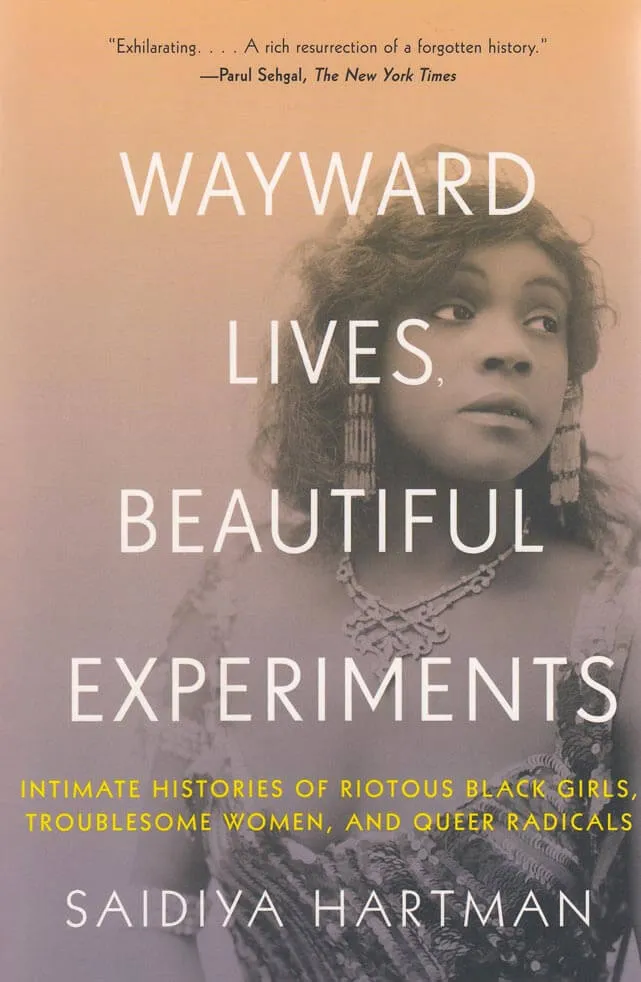
Cover of Wayward Lives, Beautiful Experiments

W. W. Norton & Company

Wayward Lives, Beautiful Experiments

Saidiya Hartman

Wayward Lives, Beautiful Experiments examines the revolution of black intimate life that unfolded in Philadelphia and New York at the beginning of the twentieth century. In wrestling with the question of what a free life is, many young black women created forms of intimacy and kinship indifferent to the dictates of respectability and outside the bounds of law. They cleaved to and cast off lovers, exchanged sex to subsist, and revised the meaning of marriage. Longing and desire fueled their experiments in how to live. They refused to labor like slaves or to accept degrading conditions of work. Here, for the first time, these women are credited with shaping a cultural movement that transformed the urban landscape. Through a melding of history and literary imagination, Wayward Lives, Beautiful Experiments recovers these women's radical aspirations and insurgent desires.

Cover of Qu'est-ce que le sexe ?

Diaphanes

Qu'est-ce que le sexe ?

Alenka Zupančič

La sexualité comme un problème proprement philosophique de la psychanalyse.

La satisfaction de parler contient en soi une clé de la satisfaction sexuelle (et non l'inverse) – une clé de la sexualité et de ses propres contradictions. Alenka Zupančič aborde la question de la sexualité comme un problème proprement philosophique de la psychanalyse – celle de Freud et de Lacan – et non celle des praticiens cliniciens tels que décrits par Lacan « orthopédistes de l'inconscient ». Que se passe-t-il, comme l'affirme Lacan, si nous pouvons obtenir exactement la même satisfaction que le sexe par la parole, l'écriture, la peinture, la prière ou autres activités ? Il ne s'agit pas d'expliquer la satisfaction que procure la parole en indiquant son origine sexuelle, mais bien de souligner que la satisfaction de parler est elle-même sexuelle.

Alenka Zupančič soutient que la sexualité est à la limite d'un « circuit court » entre ontologie et épistémologie. La sexualité et le savoir sont structurés autour d'une négativité fondamentale qui les unit au point de l'inconscient. L'inconscient (en tant que lien avec la sexualité) est le concept d'un lien inhérent entre l'être et la connaissance dans leur négativité même.

Alenka Zupančič est une philosophe lacanienne, spécialiste renommée de Nietzsche, professeure à l'European Graduate School / EGS et à l'Université de Nova Gorica, Slovénie. Elle est également research advisor et professeure à l'Institut de philosophie du Centre de recherche de l'Académie slovène des Sciences et des Arts. Avec Slavoj Žižek et Mladen Dolar, Alenka Zupančič est l'une des figures les plus incontournables de l'Ecole de psychanalyse théorique de Ljubljana dont les travaux s'intéressent aux relations entre sexualité, ontologie et inconscient, à la critique de la théorie du sujet et à l'exploration théorique du concept lacanien du Réel.