rile*books

Search books

Search books by title, author, publisher, keywords...

Cover of Not a Force of Nature

Futurepoem

Not a Force of Nature

Amy De'Ath

€21.00

If capital makes life a seething, complex nightmare for most people on the planet's surface, if "words do cleave the producer from the land," then what does all this dispossession feel like? Amy De'Ath turns poetry into a hot, potent, and highly funny form of criticism, in which social force is felt intimately, and voiced in the acid niceness of a work email. Amy's poems move like pieces of machinery in a cognitive amusement park, which spit you a thousand feet into the air but keep your viewpoint fixed on the same spot as before—what's different? "Land in Saskatchewan, land in Delhi," or "everything…that you want from women and gays." Not a Force of Nature makes me want to change everything. "Behold me I'm you now," Amy writes—we should be so lucky, to be thus transformed. — Kay Gabriel

Not a Force of Nature's expertly crafted poems explore the catastrophe we live among and speak through. They form a sort of feminist manifesto addressed to all forms of resistance. But also: here are love sonnets! This book is angrily precise and always a lot of fun. "No, you're a Canadianist!" — Kevin Davies

Not a Force of Nature is the kind of book that becomes possible only after rejecting the "we" evoked so often in contemporary literary culture—sometimes said to need poetry now more than ever, sometimes called community. Amy De'Ath's motley vision of solidarity, of "actual emboldened people," is way weirder, more lively, and possible. Nor do these poems content themselves, like the ghost of Marxist theory past, with pointing towards the contradictions that surround them. Do you remember email? Sonnets? Not a Force of Nature is like that, thrashing inside generic forms and always coming next: after the tendency of the rate of profit to fall, after Jane's abortion service, after the 1970s, 80s, and 90s, after Creeley, after Raworth, after Mayer, after the Xenofeminist Manifesto, after Pluto enters Aquarius. "There are still tactics like this roaming free," De'Ath writes. There are still these fervent lyric parries. Be with Not a Force of Nature now. — Stephanie Young

Through slips of verbal acuity, Amy De'Ath scrapes her way out of determinism to a world "made by hands," where our material relations are ours to make and break. History is long and history is short. History is translucent. De'Ath presents the Ferris wheel of capitalist production, where the subject lives once as worker, twice as commodity. Here, in these "concrete trousers," is a "totally liberated" working class poem turning everything into nothing as praxis. — Anahita Jamali Rad

Language: English

recommendations

Cover of Slow Mania

Futurepoem

Slow Mania

Nazareth Hassan

Poetry €22.00

Nazareth Hassan’s devastatingly brilliant Slow mania is a powerful document of senses and sense-making where estrangement and ugliness meets longing and beauty. The artist begins with a photographic sequence: two white-blue sky panels; a shattered glass storefront window; a street gutter clutching leaves, smashed straw sleeves and plastic lids; then snow holding a disassembled red stained chest of drawers. These are the writer’s plinths where form as waste is configured: “smoggy breath thru burnt-edged holes tracking acid mucous inside your home.” Slow mania provokes through enumerative structures, for instance, “screening bodies” who keep a sex club’s gates open only to some: “…197 mmm maybe lemme think / 151 yes / 162 yes / 197 ok yes, but keep your shirt on.” The poet deftly folds human intimacy into interspecies metaphor: “The rat torso twitches in agreement. Across / the street, the flies continue to starve,” where “…you’re lost in your own hole: what did you find?” Hassan attends to this painful search, bearing witness to the disturbingly exultant, offering a radical state of being, in and out of which the stunning and timely Slow mania lives and thrives. — Ronaldo V. Wilson

Slow mania is resistance to resolution, it’s pointillistic magic, it’s Seurat in Bed-Stuy: the tighter you zoom, the more undifferentiated beauty you encounter. It’s kinky (the kinked-up curls of somebody’s greased-up chops). It’s tender (bruised and brown, like the overripe fruit that haunts your summer kitchen waiting to be crumbled into a crumble). The colors are blurry, the edges are soft, the stakes are high, and everything—everything!—shimmers in the space between life and afterlife. Hassan’s gaze is a hot summer steam that sneaks into the skinniest, stinkiest crevices; the grimiest seams, the most miraculous cracks. Breathe into the abyss, that’s the invitation. Take it in, let it in. Be a wit(h)ness to every single being. — Steffani Jemison

This amazing book reads like a synesthetic performance, the only thing missing is the smell of sweat, of streets, of loss. A book of choreographed pages, scores, movements, image blur, hand-scribbles. The bleak, unsparing texts hidden among the materials turn out to be the record of sudden eruptions, violent street scenes, pick-up scenes, unclear dialogues, insults, self-debasing verbal injuries on repeat. The performers are racialized, sexualized, anonymized “persons,” “meats,” numbers, lovers, passers-by, all caught up in these dangerous yet desperately emotional and triggering dances at the limit. It will leave you raw, spaced-out, both roused and alarmed as though coming out of an intoxicating show, and wanting more. — Caroline Bergvall

Cover of The Nancy Reagan Collection

Futurepoem

The Nancy Reagan Collection

Maxe Crandall

Poetry €18.00

THE NANCY REAGAN COLLECTION is a response to growing up queer and trans under the rise of HIV-AIDS. Crossing genres and generations, this performance novel remixes the AIDS archive through an ever-spiraling politics and aesthetics of mourning. Alternating chapters offer up a narrative throughline composed of hallucinogenic episodes from the perspective of a nameless, grieving protagonist in the midst of the global carnage of the Reagan dynasty. Part revenge, part fantasy, the book experiments with poetic practices that challenge conceptions of memory and morality, activism and escapism, grief and beauty.

Maxe Crandall is a poet, playwright, and director. He is the author of the chapbooks Emoji for Cher Heart (Belladonna*, 2015) and Together Men Make Paradigms (Portable Press @ Yo-Yo Labs, 2014), and is the founder of the theater company Beautiful Moments in Popular Culture, which produces a poets theater series at the Stud in San Francisco. He has received fellowships from the Poetry Project, Poets House, Lambda Literary, and the Millay Colony for the Arts. Maxe is a lecturer in the Feminist, Gender, and Sexuality Studies Program at Stanford University.

Cover of The Autobiography of a Language

Futurepoem

The Autobiography of a Language

Mirene Arsanios

Poetry €22.00

Here the mirror image of the almost hallucinatory, heart-rending loss of the familiar is literary defamiliarization. Arsanios both mourns and blasts apart the notion of the mother tongue, reminding us that for each “mother tongue” at least another tongue is silenced. Desire propels her genre-defying writing, which grief notwithstanding still manages to tongue languages, and that is her genius. — Mónica de la Torre

Mirene Arsanios is the author of the short story collection The City Outside the Sentence (Ashkal Alwan). She has contributed essays and short stories to e-flux journal, Vida, The Brooklyn Rail, The Rumpus, and Guernica, among others. Arsanios co-founded the collective 98weeks Research Project in Beirut and is the founding editor of Makhzin, a bilingual English/Arabic magazine for innovative writing. She teaches at Pratt Institute and holds an MFA in Writing from the Milton Avery Graduate School for the Arts at Bard College. Arsanios currently lives in New York where she was a 2016 LMCC Workspace fellow, and an ART OMI resident in fall 2017. With Rachel Valinsky, she coordinated the Friday night reading series at the Poetry Project from 2017–19.

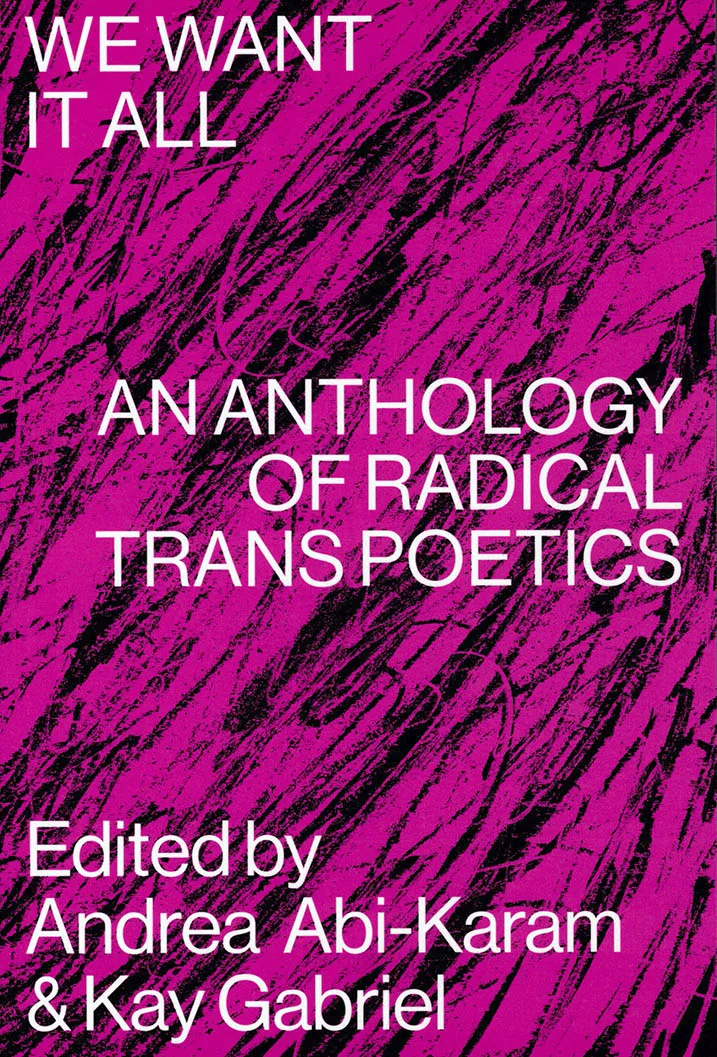
Cover of We Want It All: An Anthology of Radical Transpoetics

Nightboat Books

We Want It All: An Anthology of Radical Transpoetics

Kay Gabriel, Andrea Abi-Karam

Poetry €23.00

An anthology of formally inventive writing by trans poets against capital and empire.

With texts by: Andrea Abi-Karam, New York City Sam Ace, South Hadley, MA Bahaar Ahsan, Berkeley, CA jasper avery, Philadelphia, PA Ari Banias, Berkeley, CA Jo Barchi, Chicago, IL Joss Barton, St. Louis, MO Levi Bentley, Philadelphia, PA Jessica Bet, Baltimore, MA Rocket Caleshu, Los Angeles, CA Ching-in Chen, Seattle, WA listen chen, Vancouver, BC Faye Chevalier, Philadelphia, PA Cody-Rose Clevidence, Arkansas Miles Collins-Sibley, Easthampton, MA Valentine Conaty, New York City CA Conrad, Philadelphia, PA Jimmy Cooper, Rochester, MI Maxe Crandall, Oakland, CA José Díaz, Boston, MA Aaron El Sabrout, New Mexico Ian Khara Ellasante, Lewiston, ME Caelan Ernest, New York City, NY NM Esc, San Diego, CA joshua jennifer espinoza, Los Angeles, CA Logan February, Ibadan, Nigeria Ray Filar, Brighton, UK Nora Collen Fulton, Montreal, Canada Kay Gabriel, New York City Callie Gardner, Cardiff, Wales Jesi Gaston, Chicago, IL Harry Josephine Giles, Edinburgh, Scotland Aeon Ginsberg, Baltimore, MD Caspar Heinemann, Berlin, Germany Kamden Hilliard, Greenville, SC Stephen Ira, New York City Cyrée Jarelle Johnson, New York City Peach Kander, New York City Jayson Keery, Western, MA Evan Kleekamp, Los Angeles, CA Noah LeBien, New York City Ty Little, Richmond, VA Zavé Martohardjono, New York City Amy Marvin, Philadelphia, PA Natalie Mesnard, New York City Bianca Rae Messinger, Iowa City, IA Liam O'Brien, New York City Xandria Phillips, Madison, WI Rowan Powell, Santa Cruz, CA Nat Raha, Edinburgh, Scotland Holly Raymond, Philadelphia, PA Jackie S, New York City Trish Salah, Toronto, Canada Raquel Salas Rivera, Philadelphia, PA Mai Schwartz, New York City Kashif Sharma-Patel, London, UK Julian Talamantez Brolaski, Oakland, CA Charles Theonia, New York City Jamie Townsend, Oakland, CA Nora Treatbaby Laurel Uziell, London, UK Rachel Franklin Wood, Boulder, CO Clara Zornado Akasha-Mitra xtian w. and Anaïs Duplan, NYC.

Kay Gabriel is a poet and essayist. She's the author of Elegy Department Spring / Candy Sonnets 1 (BOAAT Press, 2017), the recipient of fellowships from Lambda Literary and the Poetry Project, and recently completed her PhD at Princeton University.

Andrea Abi-Karam is an arab-american genderqueer punk poet-performer cyborg, writing on the art of killing bros, the intricacies of cyborg bodies, trauma & delayed healing. Their chapbook, THE AFTERMATH (Commune Editions), attempts to queer Fanon's vision of how poetry fails to inspire revolution. Andrea's first book, EXTRATRANSMISSION (Kelsey Street Press, 2019), is a poetic critique of the U.S. military's role in the War on Terror.

Cover of Issue #60 - Gender Disarray

Movement Research Performance Journal

Issue #60 - Gender Disarray

Kay Gabriel, Amalle Dublon and 2 more

Periodicals €17.00

Under the direction of four contributing editors—Amalle Dublon, Kay Gabriel, Keioui Keijaun Thomas, and Anh Vo— we’ve assembled a new body of work by mostly trans and queer artists reflecting on the keyword “gender” and its relation to contemporary performance. Their work moves across multiple genres of writing, from analytic essays to poetry to performance scripts. 

“Read My Lips” is a phrase that will be familiar to longtime readers of the Movement Research Performance Journal—so familiar that the mere reference will bring to mind an image posted by the artist collective GANG, an image that lies at the heart of one of the journal’s most spectacular moments. Issue #3, with its focus “Gender Performance,” was published in 1991 amid that era’s Culture Wars, receiving almost immediately negative reception from government officials (the NEA threatened to withdraw funding from Movement Research) and many members of the dance community (who considered Issue #3 to be deliberately provoking the so-called “war,” intentionally taking a political position that some worried might comprise future funding of the field). In the thirty-three years since its publication, Issue #3 has developed a patina familiar to many artist-activist histories that are looked upon with romance and nostalgia, often by those for whom that history is only a fantasy (rather than a lived experience). 

Cover of A Queen in Bucks County

Nightboat Books

A Queen in Bucks County

Kay Gabriel

Poetry €18.00

An epistolary sequence about sex, exchange and social space set along the Northeast Corridor. 

In A Queen in Bucks County, our protagonist Turner, who both is and is not the writer, makes his pleasurable way through miserable space. Men "buy him things," lovers drive across state lines, users down volatile cocktails to see what happens, landlords turn tenants out, and Turner writes poetic tracts to friends about it. Part pornography, part novel, all love letter, A Queen in Bucks County is an experiment in turning language upside down to see what falls out.

2023 LAMBDA LITERARY AWARD FINALIST

Cover of Padam Padam: Collected Poems

Nightboat Books

Padam Padam: Collected Poems

Kevin Killian

Poetry €25.00

A posthumous celebration of the poet and provocateur Kevin Killian, Padam Padam pulses with camp, pop culture, and pleasure.

Kevin Killian—the puckish poet, playwright, novelist, scholar, and impresario of the Bay Area arts community—channeled the charisma of the pop stars. Pulled from his legendary corpus, and long out of print, the work collected here is the record of Killian’s life as a radical littérateur. In Argento Series, Killian conjures the horror, suspense, and cinematic imagery of director Dario Argento as he documents the AIDS epidemic in San Francisco. In Action Kylie, he revels in queer identity and the universal love of fandom. In Tweaky Village and Tony Greene Era, Killian elevates artists and friends to legendary status within his personal pantheon. And Elements, Killian’s wink at the periodic table, makes its U.S. debut. 

The collection features an introduction by Kay Gabriel, who writes of Killian’s “fabulous, permissive body of work, charming, filthy and smarmy at turns, with its retchable milk enemas and its devilish twists.”

Edited by Evan Kennedy & Jason Morris

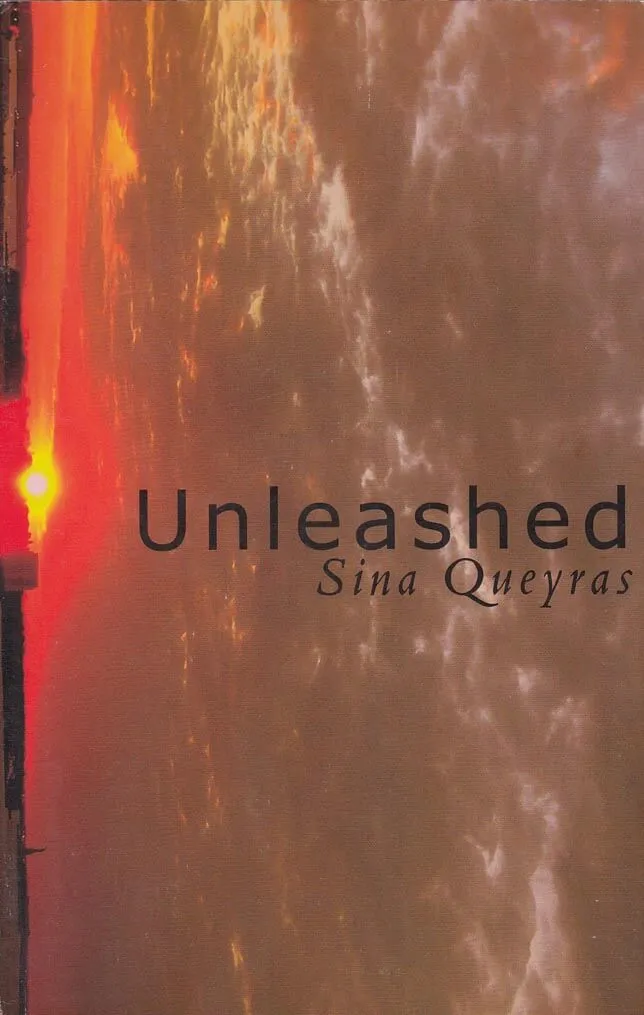
Cover of Unleashed

Book*hug Press

Unleashed

Sina Queyras

Poetry €20.00

05/09/04 Now she is blogging. Now she is sitting on the black couch listening to the sirens wail and the rain fall. Now she is thinking of oysters. Now she is wondering why this is worth sharing. Now she is thinking, how decipher what is worth reading? Who is to say? Sifters. She thinks we have become a nation of sifters. So began a three-year experiment in blogging. An experiment begun for many reasons—a way for an expat to keep in touch with fellow Canadian writers and artists, a way to come to terms with the increasing relevance of the internet in literary lives, and a way to figure out why, after decades of gains, women writers are still grossly underrepresented in critical dialogues.

With an afterword by Vanessa Place.

Cover of We Don’t Live Here Anymore

Giselle's Books

We Don’t Live Here Anymore

Tarren Johnson

Poetry €16.00

A fragmented reflection on movement, absence, and the unraveling of identity within the shifting landscapes of departure and return. Tarren Johnson explores the tension between private longing and public expression, where moments of love and vulnerability emerge in transient encounters.

Tarren Johnson grew up in North County San Diego, where she began dancing and writings a child. She continued her studies at CalArts in Los Angeles before moving to Europe, where she built a decade-long career in the performing arts. Her debut book of poetry, We Don’t Live Here Anymore, also serves as the foundation for the stage work of the same title.

Cover of Apparitions: (Nines)

Nightboat Books

Apparitions: (Nines)

Nat Raha

Poetry €18.00

Injecting the disruptive potential of collective action into the body of the poem, Nat Raha's invigorating experiment resuscitates Anglophone poetry.

Amidst the violence of capitalism and state and imperial power, there is Nat Raha's apparitions (nines) in its "charred golden minidress," ushering us into a space of grief and resistance, the embodiment and intimacy of queer, trans, and diasporic Black and brown people. Written as a series of "niners," a poetic form consisting of nine nine-syllable lines, apparitions (nines) is at once a brash and subversive rejoinder to the Anglophone sonnet, as well as an ode to beauty, collectivity, and tenderness which emerges from—and far surpasses—constraint.

"These poems are eccentric in the most literal sense, Raha’s writing pushing at the edges of the mainstream of poetry, presenting a punk, transfeminist revision of poetic norms. . . apparitions (nines) deserves to be read—for its insights and newness, and the studs of pleasure it doles out." - Lou Selfridge, Frieze

“Welcome the poems that split us open, ‘frequencies/ to be removed from the air.’ Nat Raha has sharpened the lines, their serrated letters leaving us marked, poems to touch again on the skin, feel our doom undo its direction for enduring solidarity; the best love.” - CAConrad

Dr Nat Raha is a poet and activist-scholar whose previous books of poetry include of sirens, body & faultlines (2018), countersonnets (2013), and Octet (2010). Her work has appeared in 100 Queer Poems (2022), We Want It All: An Anthology of Radical Trans Poetics (Nightboat, 2020), Liberating the Canon: An Anthology of Innovative Literature (2018), on Poem-a-Day, and in South Atlantic Quarterly, TSQ: Transgender Studies Quarterly, Transgender Marxism,and Wasafiri Magazin. With Mijke Van der Drift, she co-edits the Radical Transfeminism zine and has co-authored articles for Social Text, The New Feminist Literary Studies, and the book Trans Femme Futures: Abolitionist Ethics for Transfeminist Worlds. Nat completed her PhD in queer Marxism at the University of Sussex, and is Lecturer in Fine Art Critical Studies at the Glasgow School of Art.

Cover of Help

Tenement Press

Help

Steven Zultanski

Poetry €25.00

Death-obsessed, disengaged and overinvested—the four long poems assembled in Steven Zultanski’s Help theatricalise morbid fascinations, self-protective impulses, and unfocused desire. Help is, at its core, a set of conversations; the result of games played between friends that were then transcribed, edited, and embellished. Participants were asked to talk about loss, the death of acquaintances, secret hiding places, mislaid time, and unmet demands. The resulting poems read like meandering scripts for unrealised plays; incidental excavations of persona and place.

Somewhat reminiscent of Linda Rosenkrantz’s Talk (1968) or Alice Notley’s transcription poems of the 1970s, in Help the poet pretends to be a recording device, and the poem an act of remembering. Zultanski’s writing is at once skeletal and overstuffed, dryly unsentimental and yet dripping with melodrama. Help foregrounds its own contradictions in a collection that is at once both extremely personal and distinctly artificial.

Help brilliantly extends Steven Zultanski’s current phase of writing—looser, more documentary, more situational. In setting up explicit objects of inquiry and conversation—love, death, childhood—the book shows that to know these things is to also know our friends and ourselves. Sustained by an orchestration of relation and memory (and thus reality), affect here is modular, the product of what happens when we transform things by talking about them. A careful and astute experiment in writing and living.
 — Jennifer Soong

Cover of Cunt Norton

Tender Buttons Press

Cunt Norton

Dodie Bellamy

Erotica €18.00

In CUNT NORTON, the sequel to her unforgettable CUNT UPS, Dodie Bellamy "cunts" The Norton Anthology of Poetry (1975 edition), setting her text-ravenous cut-ups loose to devour the canonical voices of English literature. The texts that emerge from this sexual-linguistic encounter are monstrous, beautiful, unashamed: 33 erotic love poems ("the greatest fuck poem in the English language," according to Ariana Reines) that lust after the very aesthetic they resist. "These patriarchal voices that threatened to erase me—of course I love them as well," Bellamy writes. Even as CUNT NORTON dismembers the history of English poetry, "cunting" Chaucer and Shakespeare, Emerson and Lowell, it simultaneously allows new sexual members to arise and fill in the gaps, transforming the secret into the explicit, the classically beautiful into the wonderfully grotesque. Bellamy's cunted texts breathe life into literary "masters" with joy, honesty, hilarity, and insatiable passion.