rile*books

Search books

Search books by title, author, publisher, keywords...

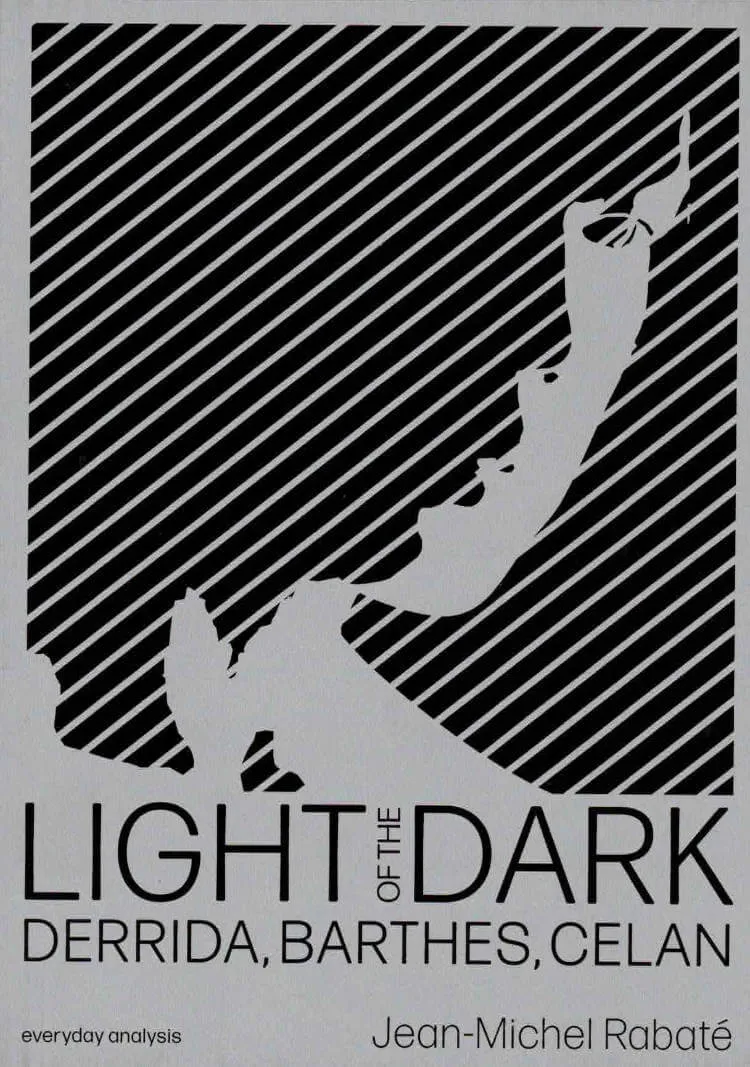
Cover of Light Of The Dark: Derrida, Barthes, Celan

Everyday Analysis

Light Of The Dark: Derrida, Barthes, Celan

Jean-Michel Rabaté

€10.00

Derrida’s essay “Aletheia” discusses the work of Japanese photographer Kishin Shinoyama. Reading Derrida, Rabaté investigates how, behind the classical concept of truth as a beautiful naked woman, Derrida argues that any photographic image tells the Truth, but a truth obscured as it comes to light: “nothing is more black than the visibility of light.” Staging a critical conversation with Roland Barthes’s theses in Camera Lucida and Paul Celan’s poems from Breathturn to Lightduress, Rabaté argues for a theoretical approach to truth that counters the prevailing truth-discourses of today. 
Published in 2025 ┊ 30 pages ┊ Language: English

recommendations

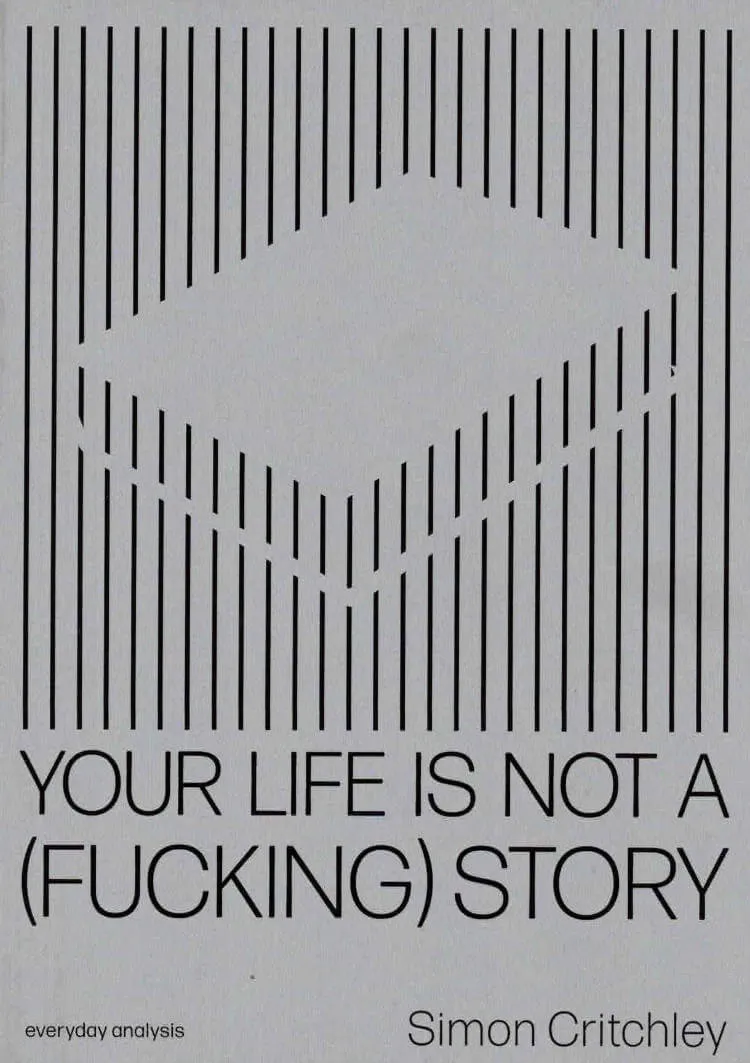
Cover of Your Life Is Not A (Fucking) Story

Everyday Analysis

Your Life Is Not A (Fucking) Story

Simon Critchley

Essays €9.00

In this new collected edition of his recent articles, Simon Critchley - one of the most important living philosophers - takes us through his reflections on death, questions of doubt and reason, the legacy of David Bowie, the nature of fear and empathy in a broken society and a critique of narrative identity - among other things. YOUR LIFE IS NOT A STORY explores the contemporary world and its psychological impact on us, offering us a way to see our situation different and resist its tricks and contrivances.

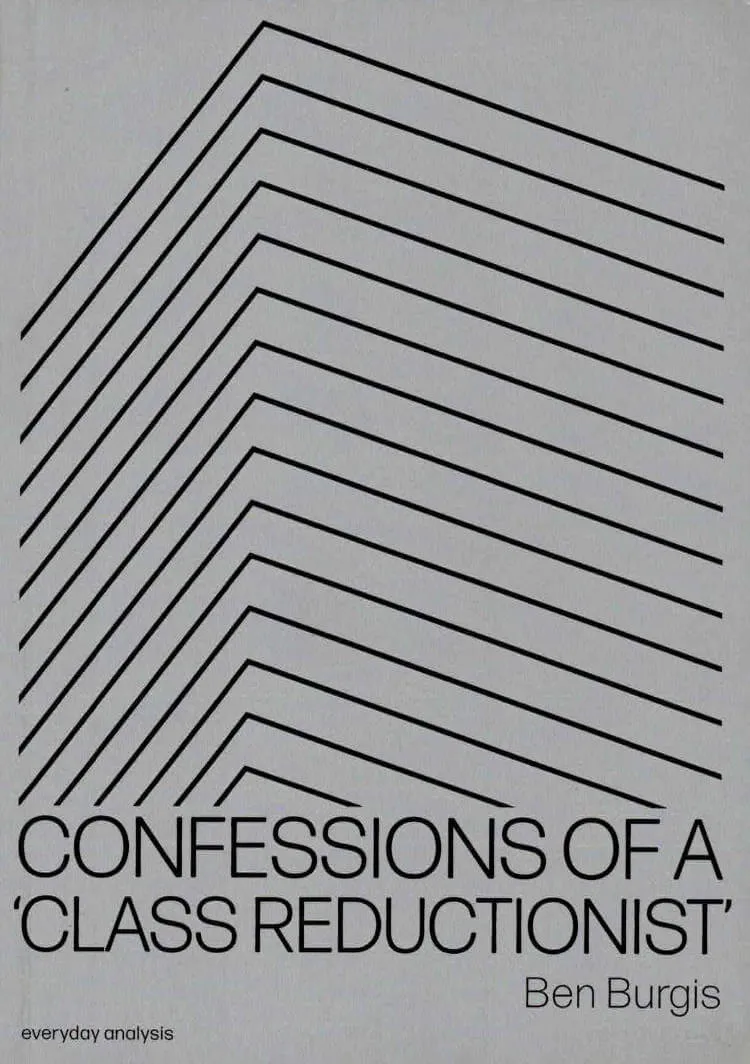
Cover of Confessions Of A Class Reductionist

Everyday Analysis

Confessions Of A Class Reductionist

Ben Burgis

Essays €11.00

In these essays, Ben Burgis criticizes fashionable radical-liberal identity politics and makes the case for universalism about rights and an unabashedly “class-first” approach to socialist political strategy. This may sound to some ears like a call for abandoning marginalized people. On the contrary, he argues, focusing on economic inequality empowers the victims of bigotry and retrograde social practices the resources and material security to stand up for themselves far more effectively than any diversity trainer or “anti-racism” consultant could represent their interests. As we face a rising tide of reactionary authoritarianism, it’s more important than ever to ditch the identitarian pieties of the recent past and think hard about how the Left can actually win.

Cover of The Completion

Everyday Analysis

The Completion

Franco 'Bifo' Berardi

Essays €10.00

In The Completion, legendary philosopher Franco 'Bifo' Berardi offers his analysis of cognitive automation and artificial intelligence. Of the possible worlds imagined in Silicon Valley and in the media discourse around tech boosterism, none will likely materialise. Instead, the unpredictable will intervene in the future of predictive technology. 

In this new edition, in a new venture for Everyday Analysis, Berardi's essay is accompanied by an introduction by Alfie Bown and a series of artworks and illustrations, new and historic- from Borges's labyrinths to the I-ching - offering a reading experience in the spirit of Berardi's work. 

Cover of Sounds Naughty

Everyday Analysis

Sounds Naughty

Karlo Pavlović

Essays €10.00

In this psychoanalytic pamphlet, Croatian philosopher Karlo Pavlović analyses the perversions of the day. Considering the topic of ASMR, a key example of what he calls the generalised deployment of subtle pornography, of depictions of sexuality "in gloves", he argues that society today should be understood through the blue balls phenomenon. This concept, developed playfully by Pavlović, explains that we are all perverts taking the logic of the drive to its extreme; if the whole point of the drive is not to attain its object, but rather, to circle around it, the perverse subject (as the subject of the present times) has, in fact, no problems with this whatsoever.

Karlo Pavlović is completing his PhD in Philosophy at The University of Ljubljana, supervised by Alenka Zupančič.

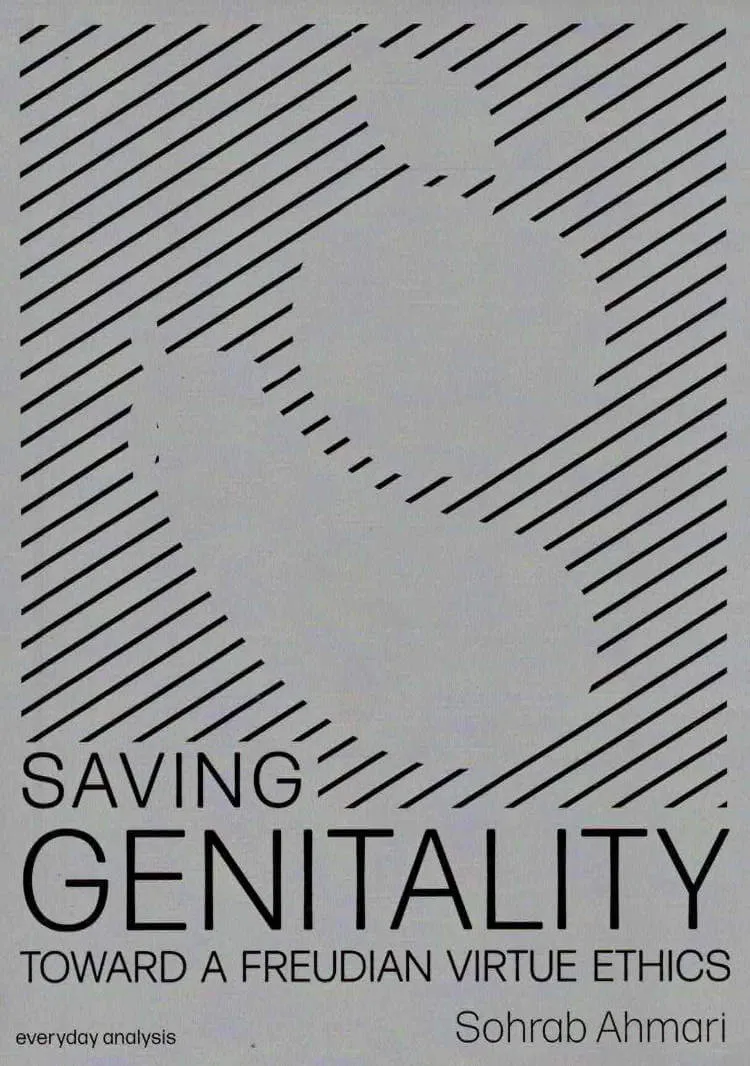
Cover of Saving Genitality: Toward A Freudian Virtue Ethics

Everyday Analysis

Saving Genitality: Toward A Freudian Virtue Ethics

Sohrab Ahmari

Essays €9.00

Western societies have dismantled many of the prohibitions that ringfenced errant sexual drives in Freud’s time. The psychoanalytic project describes people caught between two fundamental and contradictory principles: One a relentless sexual drive, the libido; the other our species’ collective need for social order and harmony. Part of this harmony, for true Freudians, is embedded in the binary mutuality of men’s and women’s bodies, which remains indispensable for society to reproduce itself, even in our sexually liberated age. In this essay, Ahmari revisits the idea of ‘genitality’ arguing that perhaps the "heteronormative" orthodox Freudians were right about some things after all.

Cover of The Almond

1080 Press

The Almond

Theadora Walsh

Essays €25.00

“Today is the day with the letter,” Celan writes to Bachmann on October 30, 1957. Theadora Walsh’s essay-poem, The Almond concerns, for I hesitate to write “about” or “is in relation to”, the love between Paul Celan and Ingeborg Bachmann. Two Austrian writers flung across Europe by the atrocities of the Holocaust, excavating the narrows of a language not theirs, or taken from them. An almond is the closest two people can be, and becomes the binding structural conceit of the book, two segments reaching across the blank page to each other, across history, time and language.

Cover of The History Of Breathing

Diaphanes

The History Of Breathing

Allison Grimaldi Donahue

Poetry €15.00

In the tradition of poets such as Charles Olsen, Alice Notley and Sappho, Allison Grimaldi Donahues poetry connects the history of breath and language with narratives about the discovery and loss of our own voice.

The Etruscan language knew no blank spaces, no breaks between words—its texture resembled an uninterrupted flow of speech; more singing than speaking, form rather than content. Only in the dictum of the pause, the meaningful fragmentation of the breath and the staccato of the Atemwende (Paul Celan) does language become comprehensible rhythmic expression.

In a world full of slogans and catchphrases, Allison Grimaldi Donahue defends the poetological demand of Sound over Content! The History of Breathing weaves linguistics and poetry, verse and song, meaning and sound into a dense narrative about breathing, rhythm, and the gaps in language that allow words to take on meaning in the first place.

Allison Grimaldi Donahue (born 1984 in Middletown, Connecticut, USA, lives and works in Bologna, Italy) works in text and performance exploring modes in which language and text can move between individual and collective experience. She is author of Body to Mineral and On Endings, and translator of Blown Away by vito m. bonito and Self-portrait by Carla Lonzi. She has given performances at Short Theatre, Almanac Turin, MACRO, MAMbo, Fondazione Giuliani, Kunsthalle Bern, Hangar Biccoca, and Flip Napoli.

Cover of Theory for Moving Houses

Wave Books

Theory for Moving Houses

Renee Gladman

Essays €22.00

You are asking me where I live and it’s making me think all these things about space, where I start and end in space and where space starts and ends in me and when, in space, I am a body and when I’m a book, in space.

So begins Renee Gladman's Theory for Moving Houses, and with these lines we are invited into a liminal space of imagination and investigation, as Gladman guides us through the architectures of her poetics. Foundational here is a sense of fluidity, a slippage of time, a devotion to “non-linear and hyper gestural movement,” a communal spirit. Gladman’s inquiry into her intersecting practices of writing and drawing reveals a deep commitment to uncertainty and “fictional knowing.” Yet again, Gladman upends traditional expectations of prose, as she leads us through landscape of her Ravicka series novels, ultimately surprising us with a novel within nonfiction. The latest volume in Wave’s Bagley Wright Lecture Series, Theory for Moving Houses is not only visionary in its contemplations but also is a virtuosic example of the ways in which language can shape utopian sites of possibility.

Cover of How to see palace pillars as if they were palm trees

Kayfa ta

How to see palace pillars as if they were palm trees

Hussein Nasseraddine

Essays €10.00

For so it happens that when the poets speak, objects appear closer to their own shadows. The poet's mouth fills up with horses and marble, and his verses start to shine like rivers. These rivers then turn back to flow through the very palace he is depicting. The poet's own words begin to weigh down on him, as though he were holding up a palace with his palms. Then he travels, and the palace is obliterated. Countries and nations change, and naught remains but what the poets had seen. Of what the poets had seen, naught remains but its image in anthologies. And when the libraries have been flooded or burned to the ground, nothing but the commentaries on those anthologies are left, and all that one finds in these commentaries is that which was appropriated and wrought a thousand times over. 

Hussein Nassereddine is a multidisciplinary artist. His work in installation, writing, video and performance originates from a practice around language that builds fragile monuments - some verbal, some sonic, some tactile - rooted in collective histories and resources of poetry, ruins, construction and image-making.

Translated from Arabic by Ben Koerber.

Cover of Imperfect Solidarities

Floating Opera Press

Imperfect Solidarities

Aruna D'Souza

Essays €18.00

Art, empathy and political solidarity.

Can empathy deliver political change? Does art that elicits emotional identification with others take us where we need to go? In Imperfect Solidarities, writer and art historian Aruna D'Souza offers observations pulled from current events as well as contemporary art that suggest that a feeling of understanding or closeness based on emotion is an imperfect ground for solidarity. Empathy—and its correlate, love—is a distraction from the hard work that needs to be done to achieve justice. Rather, D'Souza contends, we need to imagine a form of political solidarity that is not based on empathy, but on the much more difficult obligation of care. When we can respect the unknowability of the other and still care for and with them, without translating ourselves into their terms, perhaps we will fare better at building political bridges.

Aruna D'Souza is a writer and critic based in New York. She is a regular contributor to The New York Times and 4Columns.org, where she is a member of the editorial advisory board. Her writing has also appeared in The Wall Street Journal, CNN.com, Bookforum, Frieze, Momus, and Art in America, among other places. Her book, Whitewalling: Art, Race, and Protest in 3 Acts (Badlands Unlimited), was named one of the best art books of 2018 by The New York Times. She is the recipient of the 2021 Rabkin Prize for art journalism and a 2019 Andy Warhol Foundation Art Writers Grant.

Cover of The Refusalist International

Polity Press

The Refusalist International

Mikkel Bolt Rasmussen

Philosophy €16.00

The many mass protests that have taken place since 2011 have been characterised by an unmistakable need to challenge, overthrow and destroy the prevailing political representations without proposing new ones. The protests are not concerned with replacing the current government or leader with others, and thus getting a better version of what we already have. Instead, they refuse all leaders, including the most critical opposition leaders: these protests are about dismantling the need for leaders. More and more people are coming to the view that it is not possible to manage the many crises within the framework of the political institutions we have today. 

The new protests are political acts that are neither class struggle nor the establishment of an opposition to those in power. Rasmussen argues that we should understand these protests as the emergence of a new kind of revolutionary action that is as much an anthropological as a political transformation: it is an attempt to break free from all the traditional notions of how the social context that we call society and the nation-state is organised.

Cover of Aunonomic Reasoning

Black Sun Lit

Aunonomic Reasoning

Will Alexander

Poetry €18.00

Precipitous philosophies. Synaptic-nerve narrations. Syntactic spirals. Hyper-coiled horizons. Will Alexander’s mental range has arrived. An anomalous scripting of the word “automatic,” Aunonomic Reasoning is a whirlwind of lingual torrents triggered by creative mishearing that at once exposes the occupations of orthodox surrealism, summons a voice for the scathed populace of imperial affliction, and forges new paths of phonetic potentiality to mend semantic injury. Pushing prosaic margins beyond their boundaries, these texts take on the etymological condition of the essay as “attempt” with iridescent siege, prepositional frenzy, paratactic provocation, noetic disreckoning, and a critical demand to dismantle: all of which signatures of Alexander’s unilateral poetic innovations.