rile*books

Search books

Search books by title, author, publisher, keywords...

Cover of Lesbians in the City

Sinister Wisdom

Lesbians in the City

Julie R. Enszer ed.

€7.00

How do lesbians live in the city, whether they live in the city by themselves or within intentional community? How does the city change what being a lesbian means? Sinister Wisdom 117: Lesbians in the City explores these questions—and many more.

The issue features creative work by: Srestha Sen, Carina Julig, Roin Morigeau, t pomar, Rita Mookerjee, Margarita Meklina as well as SPORTS — a selection of work from the Southern Lesbian Feminist Activist Herstory Project, edited by Rose Norman and Merril Mushroom. Plus a great selection of new lesbian writing!

Language: English

recommendations

Cover of Celebrating the Michigan Womyn's Music Festival

Sinister Wisdom

Celebrating the Michigan Womyn's Music Festival

Sinister Wisdom

Sinister Wisdom 103: Celebrating the Michigan Womyn's Music Festival honors the forty-year legacy of the Michigan Womyn’s Music Festival (1976–2015). Sinister Wisdom 103: Celebrating the Michigan Womyn's Music Festival celebrates this embodiment of radical feminist separatist collaboration, transformational self-defined autonomous spaces, a commitment to sisterhood and matriarchal culture, and a musical city sprung from the earth for one week in the woods.

A collective of five womyn each with a deep connection to Fest operated by consensus to create this issue. Striving to represent a range of womyn’s voices, values, traditions, and experiences of Fest, the collective highlighted what Fest has meant to generations of womyn, documented its chronology, and bore witness to the power of this community. Sinister Wisdom 103: Celebrating the Michigan Womyn's Music Festival includes womyn from multiple races, geographies, sexualities, generations, and gender and other social identities. Just as Fest brought together womyn from various backgrounds, our collection includes a range of artistic experience, from seasoned authors and photographers to those womyn new to publishing.
Sinister Wisdom 103: Celebrating the Michigan Womyn's Music Festival remembers the transformations, possibilities, and hopes for spaces cultivating the ongoing empowerment of womyn.

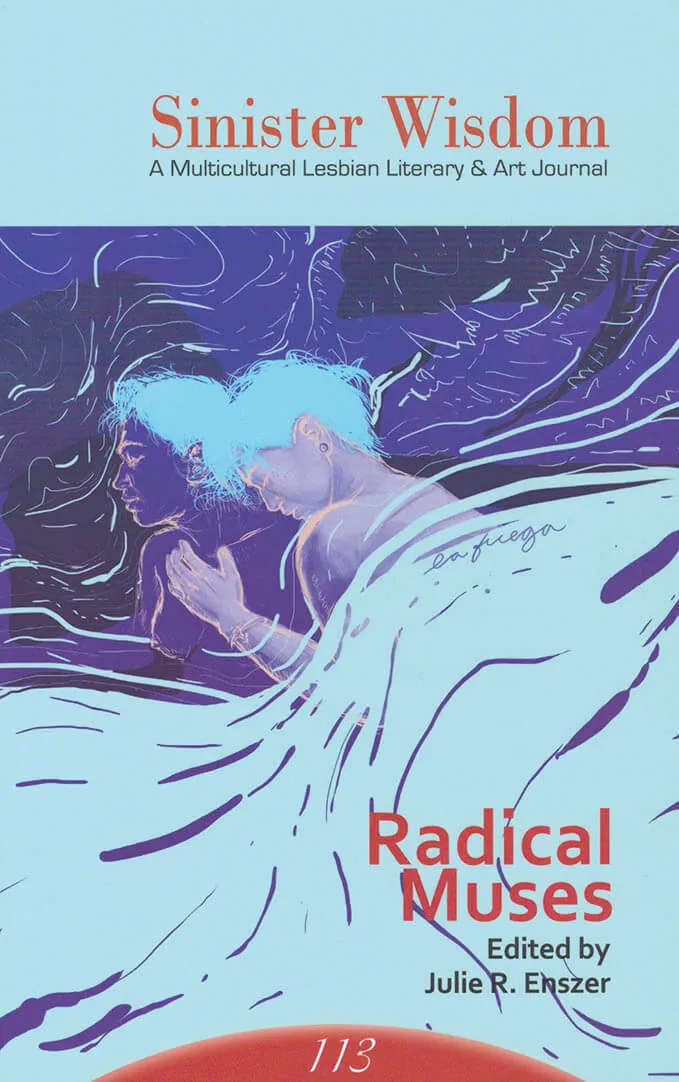
Cover of Radical Muses (Sinister Wisdom nr. 113)

Sinister Wisdom

Radical Muses (Sinister Wisdom nr. 113)

Julie R. Enszer

Sinister Wisdom 113: Radical Muses features an eclectic array of contemporary poetry, prose, and art by lesbians from around the world, including new work by: Andrea Assaf, Tara Shea Burke, Cheryl Clarke, Marina Chirkova, Estela González, Barbara Haas, Nancy E. Lake, Vi Khi Nao, H. Ní Aódagaín and much more!

Cover of The Letters of Audre Lorde and Pat Parker 1974-1989

the87press

The Letters of Audre Lorde and Pat Parker 1974-1989

Julie R. Enszer

Poets Audre Lorde and Pat Parker first met in 1969; they began exchanging letters regularly five years later. Over the next fifteen years, Lorde and Parker shared ideas, advice, and confidence through the mail. They sent each other handwritten and typewritten letters and postcards often with inserted items including articles, money, and videotapes.

The Letters of Audre Lorde and Pat Parker 1974-1989 gathers this unique correspondence in which Lorde and Parker discuss their work as writers as well as the intimate details of their lives, including periods when each lived with cancer. These letters are a rare opportunity to glimpse inside the minds and friendship of two great twentieth century poets.

Introduction by Mecca Jamilah Sullivan.

Cover of Herculine

Saga Press

Herculine

Grace Byron

Fiction €28.00

A “witty, often-chilling, compulsively readable” (Vogue) horror debut following a woman who seeks refuge at an all-trans girl commune only to discover that demons haunt her fellow comrades—and she’s their next prey!

Herculine’s narrator has demons. Sure, her life includes several hallmarks of the typical trans girl sob story—conversion therapy, a string of shitty low-paying jobs, and even shittier exes—but she also regularly debates sleep paralysis demons that turn to mist soon after she wakes and carries vials of holy oil in her purse. Nothing, though, prepares her for the new malevolent force stalking her through the streets of New York City, more powerful than any she’s ever encountered. Desperate to escape this ancient evil, she flees to rural Indiana, where her ex-girlfriend started an all-trans girl commune in the middle of the woods.

The secluded camp, named after 19th-century intersex memoirist Herculine Barbin, is a scrappy operation, but the shared sense of community among the girls is a welcome balm to the narrator’s growing isolation and paranoia. Still, something isn’t quite right at Herculine. Girls stop talking as soon as she enters the room, everyone seems to share a common secret, and the books lining the walls of the library harbor strange cryptograms. Soon what once looked like an escape becomes a trap all its own. 

While trying to untangle the commune’s many mysteries, the narrator contends with disemboweled pigs, cultlike psychosexual rituals, and the horrors of communal breakfast. And before long, she discovers that her demons have followed her. And this time, they won’t be letting her go.

Cover of How to Mend: Motherhood and Its Ghosts

Kayfa ta

How to Mend: Motherhood and Its Ghosts

Iman Mersal

Essays €10.00

In How to Mend: On Motherhood and its Ghosts, Kayfa ta’s 4th monograph, Iman Mersal navigates a long and winding road, from the only surviving picture of the author has with her mother, to a deep search through what memory, photography, dreams and writing, a search of what is lost between the mainstream and more personal representations of motherhood and its struggles. How to mend the gap between the representation and the real, the photograph and its subject, the self and the other, the mother and her child. 

Iman Mersal is an Egyptian poet and associate professor of Arabic Literature and Middle Eastern Studies in the University of Alberta, Canada.

Text: Iman Mersal
Editors: Maha Maamoun and Ala Younis
Translated from Arabic by Robin Moger
Co-publishers: Kayfa ta and Sternberg Press
Design: Julie Peeters
Size: 9.6 x 14.8 cm
Pages: 168 pages, Soft cover

Cover of HOOT nr. 9 — Moyra Davey & Sophie T. Lvoff

GUFO

HOOT nr. 9 — Moyra Davey & Sophie T. Lvoff

Sophie T. Lvoff, Moyra Davey

Periodicals €12.00

The 9th HOOT pops up for the winter 2022-23, but the conception of this issue started well over a year ago at our beloved Plage Avant (Traduttore, traditore’s studio, Marseille). 

We met Sophie T. Lvoff at many openings and art related events in Marseille these last few years, having a practice that appears mainly as photography, Gufo got curious about all the processes that she uses which involve sound, installation, writing… and more. She welcomed us in her studio of the city of Marseille where she recently settled.

We found out about the “trompe-l’œil” of this iconic checkered table, witnessed the installations of translucid and colored objects evolving on the sunny wall, and looked through her photographic chamber it’s called a large-format camera, but this is funny… For this issue, Sophie suggested to interview another artist, Moyra Davey, who also works in photography and writing, and appeared to have shared experiences too.

The topics of everyday life, intimacy that images embody in both their works, take another dimension as soon as their thoughts, voices and writing expand and express the entirety of their gestures.

This issue is the first interview between two native English-speaking artists, who have ties to the French language from childhood.

The penpals are the main characters of that encounter where we are very welcome to join in their very generous conversations. This is only an excerpt of a long and well referenced correspondence.

Cover of Read Me: Selected Works

Ugly Duckling Presse

Read Me: Selected Works

Holly Melgard

Essays €20.00

Read Me gathers the tools necessary to make sense of contemporary problems so ubiquitous they seem too big to name. Spanning a multiplicity of genres, media, and tonal registers, this book surveys Holly Melgard’s formally experimental poetic works produced between 2008 and 2023, including sound poems, essays on poetics, and books that exploit print on demand to, for example, counterfeit money. In often wildly comic turns of thought, Melgard’s work cleaves personal agency from automated defaults by mapping trauma and technocracy from the inside out.

From critical talks to fictional monologues, the poet translates into language the unremarkable torments of neoliberalization in the digital age.

Cover of Judith Namala: A Novella

CARA Center for Art, Research and Alliances

Judith Namala: A Novella

Serubiri Moses

Fiction €18.00

Judith Namala: A Novella, Serubiri Moses’s fiction debut, is an experiment in adaptation, storytelling, and translation as fictocriticism. Set in Uganda between the late 1970s and early 2000s, the book follows the domestic dramas of Judith Namala, a Black maid, and Esther Nambi, her Black madam. 

Unfolding across short vignettes, Moses’s innovative prose attends to the silences and opacities that mark the distances—and forced proximities—between two characters whose tense relationship is defined by class and social hierarchy. Hovering at the surface of these quiet scenes of servitude, the narrator offers an enigmatic model of interiority—grasped only in passing, where psychic geographies confront and sometimes, surprisingly, mirror one another. 

Drawing on cultural artifacts, art, film, and his own translation of lyrics from a Luganda popular music songbook, Moses spins a story of housework and labor that reaches across forty years of Ugandan history. Written in a unique style informed by oral tradition, folklore, criticism, and reportage, Judith Namala: A Novella is an intimate, domestic portrait that embraces the poetics of metaphor.

Judith Namala is a cinematic dressing-down of airs and manners: a collision of tradition, ritual, and other social parameters revealed through imperatives or hauntings. In a series of lyric portraits riffing off echoes of Annie John and Sula, poet-writer-curator Serubiri Moses exercises his multitalented explorations of text and artifacts, each image operating almost like a fetish. Here, the elite and extracted, the rural and cosmopolitan, are juxtaposed in suffocations of domesticity.
—Ladan Osman 

Through its innovative structure combining rich storytelling, history, and the writer’s own commentary, Judith Namala tells the story of a household in Uganda in which a young woman from the rural areas is employed as a maid. The story reveals the depth of injustice at the household level, where one woman’s child is abandoned, whilst the children of an elite Kampala household are over-mothered.
—Sitawa Namwalie 

Serubiri Moses is a Ugandan curator and writer living in New York City. He is the author of two poetry books, THE MOON IS READING US A BOOK and You Who Suffer Because You Love, Love Still More (pântano books, 2023 and 2025). His fiction has appeared in Lolwe and Ursula. Moses is a contributing editor at e-flux journal, and teaches at Hunter College and the Center for Curatorial Studies, Bard College. This is his first novel.

Editor: Rachel Valinsky
Copy Editor: Re’al Christian
Designer: Stoodio Santiago da Silva, Bárbara Acevedo