rile*books

Search books

Search books by title, author, publisher, keywords...

Cover of Fuel

Nightboat Books

Fuel

Rosie Stockton

€18.00

Traversing multivalent intimacies from the underworld of California’s Central Valley oil fields to the quotidian domestic and love’s painful retraction, Stockton’s poems articulate the blurry modes of extraction, fantasy, loss, gender, and labor as they interact and overlap in the shadow of environmental and personal collapse. Between gas station gifts, Venmo requests, and nocturnal love letters, Fuel unravels the self and violent systems of domination, longing for a togetherness that transcends its own ending.

In these poems, Stockton plunges into petrologic, long drives, the beginnings of ends—whatever enters into love between people and makes it so abstract, or common. In other words, its great subject is the edge, and Fuel is a book of horizons. - Benjamin Krusling

Rosie Stockton is the author of Permanent Volta (Nightboat Books 2021) which was the recipient of the Sawtooth Prize as well as being a finalist for the California Book Awards in Poetry and the Publishing Triangle’s Audre Lorde Award for Lesbian Poetry. Their poems have been published by Social Text Journal, VOLT, Jubilat, Apogee, Mask Magazine, Tripwire and WONDER PRESS. They hold an M.A. in Creative Writing from Eastern Michigan University and are currently a Ph.D. Candidate in the Gender Studies Department at UCLA. Rosie lives and works in Los Angeles.

Published in 2025 ┊ 92 pages ┊ Language: English

recommendations

Cover of Nothing at All

Nightboat Books

Nothing at All

Olivia Tapiero, Kit Schluter

Non-fiction €18.00

An atmospheric rumination on gendered violence, cosmic collapse, and colonialism.

From deep inside a black hole, comes Nothing at All—the space where everything collapses: form, genre, gender, and being. Olivia Tapiero’s poetic  and essayistic fragments overflow with lyric beauty as they explore how colonialism, illness, and desire intertwine amidst personal and collective suffering. Generations, geographies, and desires mingle, contaminating one another in these anarchic, insubordinate texts. Here, the written word disrupts foundations and nations, claiming its own survival.

Olivia Tapiero is a writer, translator and musician. She is the author Les murs (Robert-Cliche Award, Prix Senghor finalist), Espaces (2012), Chairs (2019), Phototaxie / Phototaxis (Nightboat Books, 2017 / 2021, Lambda Literary Awards finalist), and Rien du tout (2021, Grand Prix du livre de Montréal Finalist, Governor General’s Literary Awards finalist). She is editor-in-chief for the literary magazine Moebius, and has contributed poems and essays to various publications in Canada, France, and Korea. She has also translated works of contemporary authors such as Roxane Gay, Anne Boyer and Billy-Ray Belcourt. She lives between Marseille and Montréal.

Foreword by Anne Boyer.

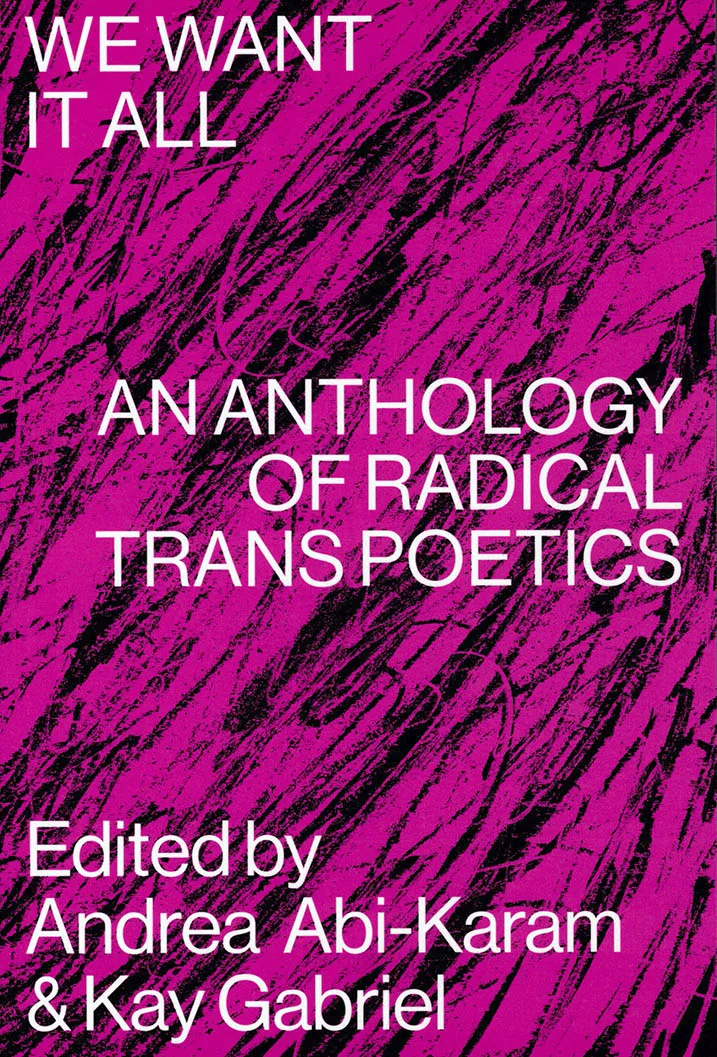
Cover of We Want It All: An Anthology of Radical Transpoetics

Nightboat Books

We Want It All: An Anthology of Radical Transpoetics

Kay Gabriel, Andrea Abi-Karam

Poetry €23.00

An anthology of formally inventive writing by trans poets against capital and empire.

With texts by: Andrea Abi-Karam, New York City Sam Ace, South Hadley, MA Bahaar Ahsan, Berkeley, CA jasper avery, Philadelphia, PA Ari Banias, Berkeley, CA Jo Barchi, Chicago, IL Joss Barton, St. Louis, MO Levi Bentley, Philadelphia, PA Jessica Bet, Baltimore, MA Rocket Caleshu, Los Angeles, CA Ching-in Chen, Seattle, WA listen chen, Vancouver, BC Faye Chevalier, Philadelphia, PA Cody-Rose Clevidence, Arkansas Miles Collins-Sibley, Easthampton, MA Valentine Conaty, New York City CA Conrad, Philadelphia, PA Jimmy Cooper, Rochester, MI Maxe Crandall, Oakland, CA José Díaz, Boston, MA Aaron El Sabrout, New Mexico Ian Khara Ellasante, Lewiston, ME Caelan Ernest, New York City, NY NM Esc, San Diego, CA joshua jennifer espinoza, Los Angeles, CA Logan February, Ibadan, Nigeria Ray Filar, Brighton, UK Nora Collen Fulton, Montreal, Canada Kay Gabriel, New York City Callie Gardner, Cardiff, Wales Jesi Gaston, Chicago, IL Harry Josephine Giles, Edinburgh, Scotland Aeon Ginsberg, Baltimore, MD Caspar Heinemann, Berlin, Germany Kamden Hilliard, Greenville, SC Stephen Ira, New York City Cyrée Jarelle Johnson, New York City Peach Kander, New York City Jayson Keery, Western, MA Evan Kleekamp, Los Angeles, CA Noah LeBien, New York City Ty Little, Richmond, VA Zavé Martohardjono, New York City Amy Marvin, Philadelphia, PA Natalie Mesnard, New York City Bianca Rae Messinger, Iowa City, IA Liam O'Brien, New York City Xandria Phillips, Madison, WI Rowan Powell, Santa Cruz, CA Nat Raha, Edinburgh, Scotland Holly Raymond, Philadelphia, PA Jackie S, New York City Trish Salah, Toronto, Canada Raquel Salas Rivera, Philadelphia, PA Mai Schwartz, New York City Kashif Sharma-Patel, London, UK Julian Talamantez Brolaski, Oakland, CA Charles Theonia, New York City Jamie Townsend, Oakland, CA Nora Treatbaby Laurel Uziell, London, UK Rachel Franklin Wood, Boulder, CO Clara Zornado Akasha-Mitra xtian w. and Anaïs Duplan, NYC.

Kay Gabriel is a poet and essayist. She's the author of Elegy Department Spring / Candy Sonnets 1 (BOAAT Press, 2017), the recipient of fellowships from Lambda Literary and the Poetry Project, and recently completed her PhD at Princeton University.

Andrea Abi-Karam is an arab-american genderqueer punk poet-performer cyborg, writing on the art of killing bros, the intricacies of cyborg bodies, trauma & delayed healing. Their chapbook, THE AFTERMATH (Commune Editions), attempts to queer Fanon's vision of how poetry fails to inspire revolution. Andrea's first book, EXTRATRANSMISSION (Kelsey Street Press, 2019), is a poetic critique of the U.S. military's role in the War on Terror.

Cover of Glove Money

Nightboat Books

Glove Money

Sophia Dahlin

Poetry €19.00

A hymn to perversity, a lyric pledge to desire and risk, Glove Money pages through the canon to “seed its sugar in your dreams.”

In this joyful and irreverent exploration of the role of poet-as lover, Sophia Dahlin plays Sappho, O’Hara, romantics and troubadours, assembling a self seaworthy of romance. With humor and a light touch, Glove Money dismisses bioessentialist gatekeeping and expands the lesbian imaginary.  

Cover of Permanent Volta

Nightboat Books

Permanent Volta

Rosie Stockton

Poetry €17.00

Permanent Volta is a book of poems about constraint and debt, as much as it is about excess, credit, loving luxury, and hating work. These are love poems about how queer intimacies invent political and poetic forms, how gender deviance imagines post-sovereign presents and futures.

Taking cues from Rosa Luxemburg's birdsongs and the syntax of invasive flowers, these poems strive to love lack. If history sees writers as tops and muses as bottoms, these poems are motivated by refusal, inversion, and evading representation. In Permanent Volta, the muses demand wages, and then they demand the world. Full of bad grammar, strange sonnets, and truncated sestinas, these poems are melancholy and militant, lazy and anti-state, greedy and collective.

Permanent Volta is for anyone motivated by the homoerotic and intimate etymology of comrade: one who shares the same room.

Cover of Apparitions: (Nines)

Nightboat Books

Apparitions: (Nines)

Nat Raha

Poetry €18.00

Injecting the disruptive potential of collective action into the body of the poem, Nat Raha's invigorating experiment resuscitates Anglophone poetry.

Amidst the violence of capitalism and state and imperial power, there is Nat Raha's apparitions (nines) in its "charred golden minidress," ushering us into a space of grief and resistance, the embodiment and intimacy of queer, trans, and diasporic Black and brown people. Written as a series of "niners," a poetic form consisting of nine nine-syllable lines, apparitions (nines) is at once a brash and subversive rejoinder to the Anglophone sonnet, as well as an ode to beauty, collectivity, and tenderness which emerges from—and far surpasses—constraint.

"These poems are eccentric in the most literal sense, Raha’s writing pushing at the edges of the mainstream of poetry, presenting a punk, transfeminist revision of poetic norms. . . apparitions (nines) deserves to be read—for its insights and newness, and the studs of pleasure it doles out." - Lou Selfridge, Frieze

“Welcome the poems that split us open, ‘frequencies/ to be removed from the air.’ Nat Raha has sharpened the lines, their serrated letters leaving us marked, poems to touch again on the skin, feel our doom undo its direction for enduring solidarity; the best love.” - CAConrad

Dr Nat Raha is a poet and activist-scholar whose previous books of poetry include of sirens, body & faultlines (2018), countersonnets (2013), and Octet (2010). Her work has appeared in 100 Queer Poems (2022), We Want It All: An Anthology of Radical Trans Poetics (Nightboat, 2020), Liberating the Canon: An Anthology of Innovative Literature (2018), on Poem-a-Day, and in South Atlantic Quarterly, TSQ: Transgender Studies Quarterly, Transgender Marxism,and Wasafiri Magazin. With Mijke Van der Drift, she co-edits the Radical Transfeminism zine and has co-authored articles for Social Text, The New Feminist Literary Studies, and the book Trans Femme Futures: Abolitionist Ethics for Transfeminist Worlds. Nat completed her PhD in queer Marxism at the University of Sussex, and is Lecturer in Fine Art Critical Studies at the Glasgow School of Art.

Cover of The Lesbian Body

Winter Editions

The Lesbian Body

Monique Wittig

LGBTQI+ €22.00

In this genre- and gender-breaking work of theory-fiction, legendary writer and cofounder of the 1970s French feminist movement Monique Wittig celebrates the body—lesbian, literary and defiantly political—and challenges the order of heterosexuality in literature. 

First published in French in 1973, The Lesbian Body mines the relationship between a lover and a beloved—also a writer and a text—to explore the ideological and historical constructions of the female subject. Organized according to the principle of montage, poetic passages are juxtaposed with anatomic lists that mark lesbian eros. Through expressions of joy, violence, and tenderness, the site of pleasure is celebrated. In her transfiguration of gender and its paradigms, Wittig transformed French vocabulary, feminizing grammar and lesbianizing myths. This edition brings the English translation of Wittig’s groundbreaking work back into circulation for the first time since the mid-1980s, revised according to the author's notes, and with an introduction by Paul B. Preciado.

The Lesbian Body is a fundamental work of lesbian existence. Wittig's applied vision is a state of natural delirium, a revolutionary excess of utopianism, refusal, and mutual self-creation. Revisiting it reveals how much passionate free thought has been lost, and simultaneously, how many of her tropes and discoveries have integrated into our collective consciousness.” — Sarah Schulman

“In this stunning new rendering of The Lesbian Body by the French author, theorist, activist and teacher, the late Monique Wittig, we are plunged into an imagined world of passionate violence and erotic lesbian mayhem intertwined in strikingly bold poetic images. Wittig, in the reach and volatility of her imagination, stands alongside such important American writers as Audre Lorde, Adrienne Rich, and Valerie Solanas, all of whose work deserves to be read again, or for the first time.” — Esther Newton

“To read the book is to be forced by Wittig into another grammar and happily contaminated by its strange forms. You will never think straight again.” — Jack Halberstam

“For me, Wittig opened up a sense of the world that had been, quite literally, unimaginable. She tore us apart.” — Judith Butler

“Together with Ursula Le Guin and Samuel R. Delany, Wittig is the first to design a nonbinary utopia, a world in which the binary categorization of sexes and genders will have ceased to exist.” — Paul B. Preciado

Introduction by Paul B. Preciado
Translated by David Le Vay

Cover of Your Silence Will Not Protect You

Silver Press

Your Silence Will Not Protect You

Audre Lorde

Poetry €18.00

With a preface by Reni Eddo-Lodge and an introduction by Sara Ahmed.
Audre Lorde (1934-92) described herself as ‘Black, lesbian, mother, warrior, poet’. Born in New York, she had her first poem published while still at school and her last the year she died of cancer. Her extraordinary belief in the power of language – of speaking – to articulate selfhood, confront injustice and bring about change in the world remains as transformative today as it was then, and no less urgent. This edition brings Lorde’s essential poetry, speeches and essays, including ‘The Master’s Tools Will Never Dismantle the Master’s House’, together in one volume for the first time.

Cover of The Gloria Anzaldúa Reader

Duke University Press

The Gloria Anzaldúa Reader

Gloria Anzaldua, AnaLouise Keating

A collection of published and unpublished writings of the groundbreaking Chicana writer and self-described "chicana dyke-feminist, tejana patlache poet, writer and cultural theorist" Gloria Anzaldua.

Gloria Anzaldúa (1942-2004) was a visionary writer whose work was recognized with many honors, including the Before Columbus Foundation American Book Award, a Lambda literary award, the National Endowment for the Arts Fiction Award, and the Bode-Pearson Prize for Outstanding Contributions to American Studies. Her book Borderlands/La frontera was selected as one of the 100 Best Books of the Century by Hungry Mind Review and the Utne Reader. AnaLouise Keating, Professor of Women's Studies at Texas Woman's University, is the author of Women Reading, Women Writing: Self-Invention in Paula Gunn Allen, Gloria Anzaldúa, and Audre Lorde; editor of Anzaldúa's Interviews/Entrevistas and EntreMundos/AmongWorlds: New Perspectives on Gloria Anzaldúa; and co-editor, with Anzaldúa, of this bridge we call home: radical visions for transformation.

AnaLouise Keating, Professor of Women's Studies at Texas Woman's University, is the author of Women Reading, Women Writing: Self-Invention in Paula Gunn Allen, Gloria Anzaldúa, and Audre Lorde; editor of Anzaldúa's Interviews/Entrevistas and EntreMundos/AmongWorlds: New Perspectives on Gloria Anzaldúa; and co-editor, with Anzaldúa, of this bridge we call home: radical visions for transformation.