rile*books

Search books

Search books by title, author, publisher, keywords...

Cover of Fuck Me Judith

After 8 Books

Fuck Me Judith

Claire Star Finch

€16.00

In Claire Star Finch’s first novel, love and the void question each other in action. 

Judith, an academic celebrity, and Wendy, a slightly less famous academic celebrity, fall in love. They break up. In her ensuing grief, Wendy finds herself in a pornographic, epistolary haze that slumps toward the narrative. Fueled by the only things that cut through the pain—sex and democratic theory—Wendy takes us along on her wild ride toward self-actualization. 

Claire Star Finch is a Paris-based experimental writer & performer. Their literary performances and hybrid ficto-theories are regularly presented in art spaces, both as part of their solo work and with the collective RER Q. Their research centers on themes like dildos and vomit, defining these objects as forms of emancipatory literary technologies.

They published in French the experimental fiction Crache dans ma bouche puis crache dans mon autre bouche (Les Petits Matins, 2024).

Design by Victoire Le Bars

Published in 2025 ┊ 168 pages ┊ Language: English

recommendations

Cover of New Address II. Stereotypical Artist

After 8 Books

New Address II. Stereotypical Artist

Tobias Kaspar

Photography €27.00

What is an artists’ life made of? From the home to the studio, from the studio to the gallery, from one exhibition to the next, from one place to another – a suite of moves and a list of addresses. Tobias Kaspar’s work sheds light on the ambivalent position of the artist, taken in a web of social and economic relations: in the second volume of New Address, he uses the tone of the diary, combined with the code of the moodboard, to document the side aspects of the life of a “stereotypical artist.”

The book gathers black & white photographs taken between 2018 and 2024, during the installation or the opening of exhibitions; at performances, dinners, parties; in different homes and rooms Kaspar has been living in; and in the course of daily activities. Contrary to an exhibition catalogue, projects by the artist such as his line of jeans, or his series of bronze sculptures made from disposable packaging, are thus shown “in the middle of affairs.”

An additional booklet opens with a short essay by artist Mikael Brkic, reflecting on the “behind the scenes” logics, followed by a letter penned by writer Leif Randt, and a text in which curator Kari Rittenbach discusses Tobias Kaspar’s work in relation to the economics and aesthetics of display and fashion. It concludes with a list of artworks in the order as they appear in the main book.

Published with the support of Erna und Curt Burgauer Stiftung, Pro Helvetia, Kultur Stadt Zürich.

Cover of Confidences / Production

After 8 Books

Confidences / Production

Ivan Cheng

Acting like an academic endpoint, cuneiform everything.

Conlan Eliseu is a vampire and an out-of-vogue fashion stylist who takes a job as an advisor at the Gatlin Finishing School, a three-year vocational program for talented teens in a theatre town. Human teen Doeke Schreyer wants to be a star and isn’t afraid of hard work. He just can’t seem to get it. Will his corporeal charms help him exceed the curse on his name, inherited from his adoptive parents?

Confidences / Production deals with the process of keeping the past alive, whether as image or restaging. It is the fourth instalment in Ivan Cheng’s Confidences series, which uses the figure of the vampire as shorthand for cultural movement. Following Confidences / Baseline, Confidences / Majority, and Confidences / Oracle, this new episode contains excerpts or elements from scripts by the artist, as well as documents and reflections on the tradition and transmission of theatre. 

Ivan Cheng (b. 1991, Sydney) produces films, objects, paintings and publications as anchors for the staging of complex and precarious spectacles. His background as a performer and musician form the basis for his using performance as a critical medium and questioning publics and accessibility. He holds an MFA in Critical Studies from Sandberg Instituut. His performances, works and writings have been recently presented at Hartwig Art Foundation, Amsterdam; Lafayette Anticipations, Paris; galerie Édouard Montassut, Paris; Villa Imperiale, Pesaro; OCTO, Marseille; Volksbühne Roter Salon, Berlin; gta Exhibitions, Zurich; and Mind Eater Festival, Oslo. In 2017 he initiated the project space bologna.cc in Amsterdam.

Confidences / Production is published in collaboration with Monash University Museum of Art | MUMA, Naarm/Melbourne, in conjunction with the presentation of the project, Ivan Cheng: NP in September 2024.

Cover of Les Voies du Paradis

After 8 Books

Les Voies du Paradis

Peter Cornell

Essays €16.00

Les Voies du Paradis rassemble ce qui subsiste d’une œuvre perdue : les seules notes de bas de page d’un texte manquant, laissées par un chercheur après son décès et éditées par Peter Cornell. Ces notes et leurs illustrations forment un ensemble incomplet, qui se donne ici à lire à travers ses manques. Un fil – d’Ariane ? – se tisse entre les diagrammes, les figures de spirales et de labyrinthes – de Cesare Ripa à Ernst Josephson et Robert Smithson, des Templiers aux spirites et aux surréalistes – qui parcourent le texte et se font écho, comme les éléments d’une énigme ou des figures ésotériques. Le « Paradis » dont il est question ici, c’est le rêve de la connaissance absolue, la saisie de l’ordre caché des choses, à laquelle aspirent autant poètes et artistes que mystiques et scientifiques…

Paru en Suède en 1987, Les Voies du Paradis y a acquis la réputation d’un livre culte. Peter Cornell y propose une perspective inédite sur les liens entre art, littérature, spiritualité et occultisme, dans un texte à mi-chemin de l’essai et de la fiction, de l’érudition et de la mystification. La volonté de savoir y est mise en scène comme une quête prise au piège de l’irrationnel ; les notes s’assemblent par logique associative, programme éclectique qui tente encore de retrouver un centre perdu – comme les algorithmes auxquels est confiée aujourd’hui la tâche fantasmée de mettre en ordre les connaissances humaines.

Cover of Biography of a Fiction

After 8 Books

Biography of a Fiction

Isadora Neves Marques

Poetry €16.00

Biography of a Fiction collects poems written between 2020 to 2025. These poems were written in a diaristic way, mostly in short form, while working on larger pieces, some of which also collected here or elsewhere. What started, seemingly, as notes on reproductive desire, gender, and sexuality soon matured into a meditation on the role of fiction in the exercise of writing (and idealizing) a biography, including the thorny aspect of artistic license and the uses of one’s own life and of others.

Cover of The Premise of a Better Life

After 8 Books

The Premise of a Better Life

Sam Pulitzer

An artist's book by New York-based author and artist Sam Pulitzer (born 1984), The Premise of a Better Life combines photographs with ethical and existential questions addressed to the viewer, in an allegory of the contemporary condition. These photographs of everyday things, ambiguous details, nondescript landscapes and cityscapes were mostly taken in New York, although the city appears as the pale reflection of a model city.

Each picture is accompanied by a question: "Can you afford yourself?" "Are you waiting for a moment that just won't come?" "If you knew then what you know now, would it make a difference?" "Do you trust happiness?" The montages offer a complex, personal, at times satirical image of the present age.

An original essay by Pulitzer unfolds the project's philosophical and political issues, notably discussing a key reference for the project, Ernst Bloch's The Principle of Hope.

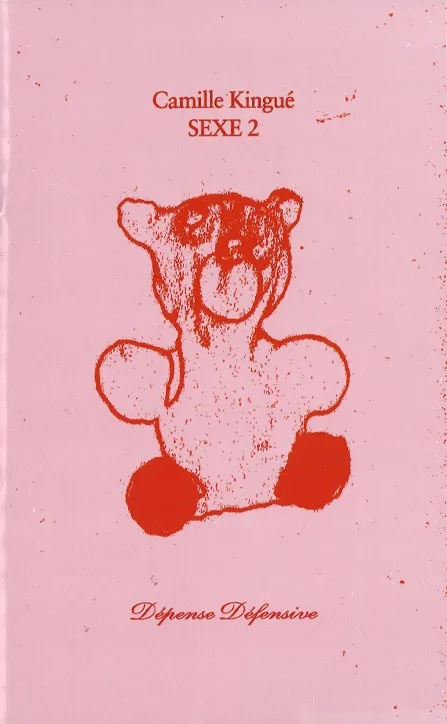
Cover of Sexe 2

Dépense Défensive

Sexe 2

Camille Kingué

Poetry €12.00

Confession sur le désir (l’action et l’objet du), les liens de mutualité et de résistance, Sexe 2 alterne prose et versification en 27 fragments numérotés à l’adresse plus ou moins dure, plus ou moins sincère, plus ou moins formulée car plus ou moins éloignée du Toi et du Je. Camille Kingué s’attache à révéler, à voir quelque chose à travers son image réelle et virtuelle, agrandie et rétrécie, droite et renversée, déployant une recherche des principes de l’amour (l’amour comme amour, pourquoi est ce qu’il y a de l’amour) où la métaphysique et la compréhension de soi – donc de l’autre – n’ont jamais été aussi sexy.

Claire Star Finch, dans la magnifique préface qu’iel signe au début de l’ouvrage, écrit : « Après avoir lu tous les livres de Kingué, je ne sais pas si je crois en “l’amour”, que ce soit en tant que substantif absolu ou en tant que proto-résidu de tout ce que “le sexe” peut signifier. Mais je crois définitivement qu’il faut l’écrire. » Définitivement.

Cover of Tongue Ring: Issue 01

Tongue Ring

Tongue Ring: Issue 01

Aodhan Madden, Claire Star Finch

Periodicals €13.12

Oh oh this is the first issue of Tongue Ring, a journal of experimental writing in English & French, with original contributions and translations of texts* by Ariana Reines*, CAConrad*, Camille Kingué, Kaur Alia Ahmed*, Rafael Moreno, Taos Bertrand, and Théo Robine-Langlois*. 

Vous voyez, c’est ça mon genre. Je ne sais pas ce que c’est. 
Mais c’est mon genre. J’ai cet esprit en moi—qui est très ému
par la féminité. Je pourrais me mettre à pleurer. Je veux poser
mon manteau par terre pour la laisser marcher dessus
—Ariana Reines

Premier numéro de la nouvelle revue fantastique et bilingue (FR + EN) d’écriture expérimentale Tongue Ring, avec des contributions originales ainsi que des traductions* de textes de Ariana Reines*, CAConrad*, Camille Kingué, Kaur Alia Ahmed*, Rafael Moreno, Taos Bertrand, and Théo Robine-Langlois*. 

Cover of You Must Believe in Spring

Hajar Press

You Must Believe in Spring

Mohamed Tonsy

Fiction €18.00

Twenty years after she first chanted in Tahrir, Hanan’s son is living under military rule in Egypt. Though he is both a disciple of the national Sufi institute and a swimmer representing the Armed Forces, proximity to power cannot undo his revolutionary birthright: like his mother and grandmother before him, Shahed is an undercover rebel.

When a general arrives at the Sufi institute looking for help with a military assignment, Shahed accepts, all while concealing his own plans for resistance. The mission takes him behind the walls of a prison town, inside a secret army barracks in the Sinai desert, and deep into the murky waters of the past.

As he wades through his mother’s repressed memories and the state’s repressed histories, Shahed grapples with the traumas of the revolution and the weight of authoritarian rule, searching for new ways to revolt for freedom.

Mohamed Tonsy is a queer Egyptian writer and ceramicist. Formerly an architect and a triathlete representing the Egyptian Triathlon Federation, he completed a PhD in Creative Writing at the University of Edinburgh. His writing has appeared in Mizna and Epoch Press and was shortlisted in MFest’s 2021 Short Story Competition. You Must Believe in Spring is his first book.