rile*books

Search books

Search books by title, author, publisher, keywords...

Cover of Everybody's Autobiography

Exact Change

Everybody's Autobiography

Gertrude Stein

€17.50

In 1937, Gertrude Stein wrote a sequel to The Autobiography of Alice B. Toklas, but this darker and more complex work was long misunderstood and neglected. An account of her experiences in the wake of having authored a bestseller, Everybody's Autobiography is as funny and engaging as The Autobiography of Alice B. Toklas, but it is also a meditation on the meaning of success and identity in America.

Language: English

recommendations

Cover of Immemory: Gutenberg Version

Exact Change

Immemory: Gutenberg Version

Chris Marker

Filmmaker, photographer, writer and traveler  Chris Marker (1921-2012) never respected boundaries between genres. His landmark 1962 film La Jetée is almost entirely stills, its one moving image as thrilling as the Lumières’ films must have been for their original audiences. Each of Marker’s films (including the widely celebrated Sans Soleil) stretched the definition of the art, merging at times with the essay, political manifesto, personal letter, even computer game. 

In Immemory, Chris Marker originally used the format of a CD-ROM to create a multi-layered, multimedia memoir. The reader investigates “zones” of travel, war, cinema, and poetry, navigating through image and text as if physically exploring Marker’s memory itself. The result is a veritable 21st-century Remembrance of Things Past, an exploration of the state of memory in our era. With it, Marker both invented a literary form and perfected it. And yet the digital format he chose for his experiment was quickly rendered obsolete.

Immemory: Gutenberg Version reinvents this unique work for the printed page, a project the author dreamed up, titled, and developed with Exact Change before his death. Now finally realized, Immemory: Gutenberg Version brings this seminal work by Chris Marker into the present and future via a time-tested, durable format of the past — the book.

Edited & with an Introduction by Isabel Ochoa Gold

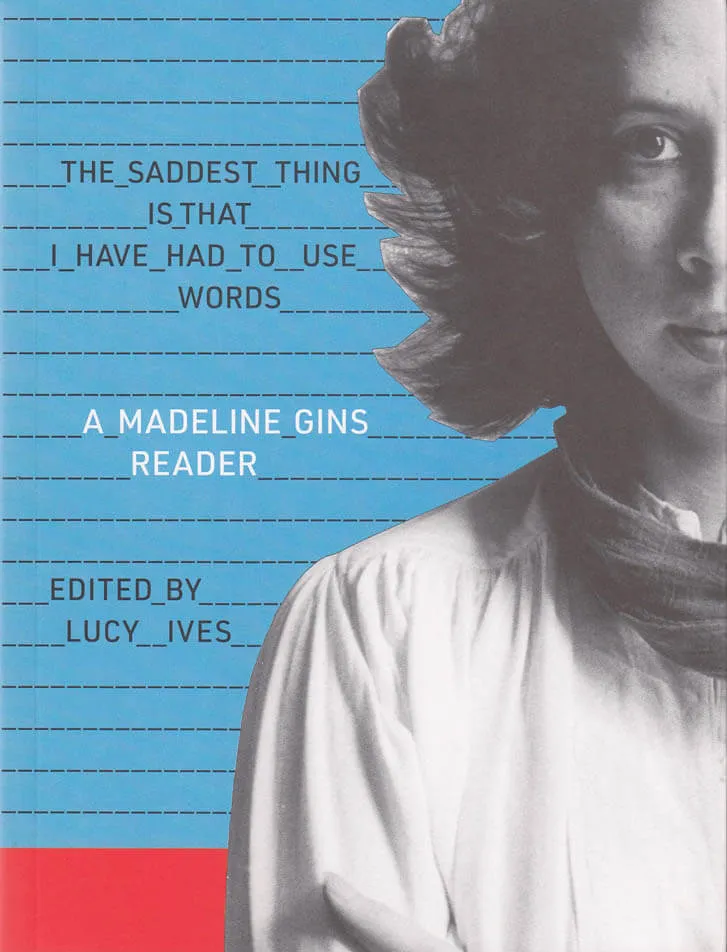
Cover of The Saddest Thing Is That I Have Had to Use Words: A Madeline Gins Reader

Siglio Press

The Saddest Thing Is That I Have Had to Use Words: A Madeline Gins Reader

Madeline Gins

Poetry €28.00

Poet, philosopher, speculative architect and transdisciplinary artist, Madeline Gins is well known for her collaborations with her husband, the artist Arakawa, on the experimental architectural project Reversible Destiny, in which they sought to arrest mortality by transforming the built environment. Yet, her own writings — in the form of poetry, essays, experimental prose and philosophical inquiries — represent her most visionary and transformative work. Like Gertrude Stein before her, Gins transfigures grammar and liberates words. Like her contemporaries in conceptual art, her writing is attuned to the energized, collaborative space between reader and page.

The Saddest Thing Is That I Have Had to Use Words: A Madeline Gins Reader is a revelatory anthology, edited and with an introduction by the writer and critic Lucy Ives. It brings never-before-published poems and essays together with a complete facsimile reproduction of Gins' 1969 masterpiece, WORD RAIN (or A Discursive Introduction to the Intimate Philosophical Investigations of G, R, E, T, A, G, A, R, B, O, It Says), along with substantial excerpts from her two later books What the President Will Say and Do!! (1984) and Helen Keller or Arakawa (1994). Long out of print or unpublished, Gins' poems and prose form a powerful corpus of experimental literature, one which is sure to upend existing narratives of American poetics at the close of the 20th century.

Edited by Lucy Ives. 

Cover of The Autobiography of H. LAN Thao Lam

Dorothy, a publishing project

The Autobiography of H. LAN Thao Lam

Lana Lin

Fiction €19.00

Situated between memoir, social criticism, and conceptual art, The Autobiography of H. Lan Thao Lam is an incisive response to a modernist classic and an affecting exploration of the poetics and politics of our times. "We are supposed to know where we are with biography and autobiography, they are the literary equivalents of the portrait and the self-portrait," writes Jeanette Winterson about Gertrude Stein's 1932 classic, The Autobiography of Alice B. Toklas. By narrating her own story from the perspective of her partner, Stein invented a literary form that was both intimate and uncanny, blurring lines of authority and identity as it winds through a story of two women living and loving together through a tumultuous moment in history. Almost a century later, experimental filmmaker and artist Lana Lin has resurrected Stein's project to tell another story of queer love, life, and artistic collaboration in a differently discordant age. At heart a candid chronicle of her partner Lan Thao's life journey from Vietnam during the war and her own troubled history as a gender-queer Taiwanese American, Lin's Autobiography draws in subjects as varied as photography, tropical fruit, New York real estate, and queer theorist Eve Sedgewick's eyeglasses, weaving a landscape of living that is also a critical investigation of race and gender in our time. 

Lana Lin is a writer, artist, and filmmaker based in New York and Connecticut. She is the author of the book Freud's Jaw and Other Lost Objects: Fractured Subjectivity in the Face of Cancer and film and video works including The Cancer Journals Revisited. Her various works and collaborative projects (with Lan Thao Lam as "Lin + Lam") have exhibited at festivals and art and educational spaces throughout the world, including the Museum of Modern Art, Whitney Museum, and New Museum, New York; The National Gallery of Art, Washington, D.C.; Gasworks, London; the Taiwan International Documentary Festival and Taiwan Film and Audiovisual Institute, New Taipei City; Arko Art Center, Korean Arts Council, Seoul; and the 2018 Busan Biennale. Having had three years of psychoanalytic training before dropping out, she sometimes still dreams of becoming a psychoanalyst one day.

Cover of The Wedding Dress

University of California Press

The Wedding Dress

Fanny Howe

Poetry €28.00

In times of great uncertainty, the urgency of the artist's task is only surpassed by its difficulty. Ours is such a time, and rising to the challenge, novelist and poet Fanny Howe suggests new and fruitful ways of thinking about both the artist's role and the condition of doubt. In these original meditations on bewilderment, motherhood, imagination, and art-making, Howe takes on conventional systems of belief and argues for another, brave way of proceeding. In the essays "Immanence" and "Work and Love" and those on writers such as Carmelite nun Edith Stein, French mystic Simone Weil, Thomas Hardy, and Ilona Karmel—who were particularly affected by political, philosophical, and existential events in the twentieth century—she directly engages questions of race, gender, religion, faith, language, and political thought and, in doing so, expands the field of the literary essay. A richly evocative memoir, "Seeing Is Believing," situates Howe's own domestic and political life in Boston in the late '60s and early '70s within the broader movement for survival and social justice in the face of that city's racism.

Whether discussing Simone Weil, Gertrude Stein, Meister Eckhart, Saint Teresa, Samuel Beckett, or Lady Wilde, Howe writes with consummate authority and grace, turning bewilderment into a lens and a light for finding our way.

Cover of Wrap, History and Syncope

Varamo Press

Wrap, History and Syncope

Isabel de Naverán

Non-fiction €12.00

18 July 1936, Bayonne. After hearing the news of the Fascist uprising, the Spanish dancer and bailaora Antonia Mercé y Luque, known as La Argentina, suffers a syncope and dies in fateful synchrony with the Second Republic. History, and the artist’s body, have been seized and broken by the event.

In close dialogue with images and historical documents, Isabel de Naverán pursues the reverberations of that shock and how it resonates with collective pain and artistic translations (by Federico García Lorca, Gertrude Stein, Kazuo Ohno and others). How does history affect and move through bodies? How do living bodies carry and pass on cultural legacy and collective memory? What do these complex movements reveal about the present? Wrap, History and Syncope is an affective journey that invites the reader into tracing and revisiting other bodies, to ultimately dance their difference and multiplicity for oneself.

Isabel de Naverán is a writer and researcher. Concern with the passage and use of time is the backbone of her work, which focuses on bodily transmission and the examination of the concept of historical time by way of ephemeral and fugitive practices. She holds a PhD in art from the University of the Basque Country.  

Translation from Spanish: Toni Crabb
Graphic design: Michaël Bussaer

Cover of The Gender of Sound

Silver Press

The Gender of Sound

Anne Carson

Human history is filled with unacceptable sounds: high-pitched voices, gossip, talkativeness, hysteria, wailing and ritual shouts. Who makes them? Those deviant from or deficient in the masculine ideal of self-control: women, catamites, eunuchs and androgynes all fall into this category. 

From the myths of antiquity to Margaret Thatcher via Sigmund Freud and Gertrude Stein, The Gender of Sound charts the gendering of sound in Western culture. Carson invites us to listen again, and in doing so to reimagine our conceptions of human order, virtue and selfhood.

Putting a door on the female mouth has been an important project of patriarchal culture from antiquity to the present day. Its chief tactic is an ideological association of female sound with monstrosity, disorder and death.

Cover of When My Body Was A Clinched Fist

Black Lawrence Press

When My Body Was A Clinched Fist

Enzo Silon Surin

Poetry €17.00

"Back in the day when KRS-One intoned —The Bridge is over!— he did not prefigure a poet from Queens of the fierce attitude and intellectual magnitude of Enzo Silon Surin. WHEN MY BODY WAS A CLINCHED FIST gives the Heisman to such a refrain with lyrical power-packing poetics that settles the score with a succinct— Not! No the Bridge is not over, for Surin's Queens is alive and well and under the gaze of a master observer who eulogizes lives that though at times are battered have always mattered.

Enzo Silon Surin's poems get you caught up in the deeply personal experiences of growing and visceral all-encompassing knowing from an acute witness of every breath and follicle of Black life from palm trees, sand and sea to street corner projects, suburban houses and fistfuls of black water. Surin writes about the confused and disconnected, trigger happy wannabes trapped by outdated notions of masculinity, the cracked head crackheads all held in the clutch of society's clinched fist through which the trauma that comes with being of color, addicted, broke, lost and tossed, is itself a clinched fist of black bodies caught in the Russian nesting doll America's clinched fists make.

WHEN MY BODY WAS A CLINCHED FIST is an elegy for 'the premature exits.' It is a blues for the black-on-black black and blue. Surin yields his pen like a microscopic scalpel whereby an autopsy of possibility is performed to un-clinch the remarkable bone gristle poetry in these unflinching heart-wrenching pages."—Tony Medina

Enzo Silon Surin, Haitian-born poet, educator, speaker, publisher and social advocate, is the author of two chapbooks, A Letter of Resignation: An American Libretto (2017) and Higher Ground. He is the recipient of a Brother Thomas Fellowship from The Boston Foundation and is a PEN New England Celebrated New Voice in Poetry. Surin's work gives voice to experiences that take place in what he calls "broken spaces" and his poems have appeared in numerous publications including Crab Orchard Review, Origins, Transition Magazine/Jalada, Interviewing the Caribbean, jubilat, Soundings East, The BreakBeat Poets: New American Poetry in the Age of Hip-Hop, and sx salon. Surin holds an MFA in Creative Writing from Lesley University and is currently Professor of English at Bunker Hill Community College and founding editor and publisher at Central Square Press. His debut full-length poetry collection is WHEN MY BODY WAS A CLINCHED FIST (Black Lawrence Press, 2020).

Cover of After Delores

Arsenal Pulp Press

After Delores

Sarah Schulman

A new edition of Sarah Schulman's acclaimed 1988 novel, a noirish tale about a no-nonsense coffee-shop waitress in New York who is nursing a broken heart after her girlfriend Dolores leaves her; her attempts to find love again are funny, sexy, and ultimately even violent. After Delores is a fast-paced, electrifying chronicle of the Lower East Side's lesbian subculture in the 1980s.

Sarah Schulman is the author of sixteen books, including the novels The Mere Future, The Child, Rat Bohemia, and Empathy (all from Arsenal Pulp Press) and the recent nonfiction works The Gentrification of the Mind: Witness to a Lost Imagination and Israel/Palestine and the Queer International. She was also co-producer with Jim Hubbard of the feature documentary United in Anger: A History of ACT UP and is co-director of the ACT UP Oral History Project. She lives in New York, where she is Distinguished Professor of English at City University of New York (College of Staten Island) and a Fellow at the New York Institute for the Humanities at NYU.