rile*books

Search books

Search books by title, author, publisher, keywords...

Cover of Anarcadia

Veer2

Anarcadia

Dominic Hand

€13.00

An epic poem in miniature, Anarcadia attempts to navigate the stark disintegration of the very world from which it’s made, mapping a catastrophe that seems both on its way and already occurring. Offering a collage of collapsing fragments – whirling ‘like bitstreams / in a blizzard’ – this sequence freefalls through a landscape of freak storms and surveillance satellites, ‘bio- / metric insects’ and ‘full- / body scanner[s]’, ‘leaving nothing left / undamned’. Continuing the sleek work of the previous collections, Hand’s command of language generates a livable terrain, humming with echoes of the pastoral tradition – from Sidney to Shelley, from Geoffrey Hill to J.H. Prynne. Hand’s poetry renders ‘an animate / climate’, through which we are forced to face the debris of a system that has failed us and a planet we, in turn, have failed. Nevertheless, the poet shows us a glimpse of the future. At the heart of Anarcadia is something of a love poem, revealing beauty in the art of losing, a way to ‘Re-salvage / sylvan camouflage / out of obscure selvage’, attempting a recovery. ‘Rife with hybrid vigour’, this book confirms Dominic Hand to be a poet of singular, clear-sighted vision, unafraid to see things as they are, ‘risking / bewilderment’.
– Rowland Bagnall

Published in 2025 ┊ 50 pages ┊ Language: English

recommendations

Cover of Working Museum

Veer2

Working Museum

Ziddy Ibn Sharam

Poetry €13.00

"In Spring and All, William Carlos Williams figures imagination as the springing off point to greater connection with the world and its gentle motions. ‘It is spring,’ he writes: ‘life again begins to assume its normal appearance as of “today.” Only the imagination is undeceived.’ Embracing the haecceity of the everyday and allowing the imagination to make silent and surprising connections are ways to withhold the deceptiveness of relying on old habits of thinking and writing. 

Ziddy Ibn Sharam’s Working Museum begins with another quotation from Spring and All: ‘There is not confusion – only difficulties’, and the sequence offers delicate, poetical examinations how the confusions and frustrations of interpersonal communication are beneficent difficulties to be embraced and considered in gentle depth. This is a gorgeous sequence of poems, offering generous, gracious and graceful glimpses of a family’s birthday pilgrimage to Amberley Museum and Heritage Centre in Sussex. Working Museum is a tour de force of delicate poetry of feelings and feeling through feelings in a world of wordless connections and contacts, navigating the liminal but intimately understood spaces between two brothers and their family. In these poems, 

Sharam is trying to be still in language, as smiles, touches and profound intimacies are exchanged. Observing and being in his brother’s presence during this special time of spring, Sharam re-learns to experience, to become ‘plugged’ in, as he writes, to new ‘switchboards’ of sensation, thought and poetic possibility. The ‘old machines’ of mental expectation and habit are, in the presence of his other-sensing brother, found wanting for the appreciation of his ‘intellect just as it is’. Here, Sharam learns to ‘do things minimally’ and to revel in the ‘seismic proportions’ of the apparently mundane. Sharam and his readers are offered a space to share in a brother’s beautifully vivid world and are privileged to witness a profound, ‘beginning, // again." - Gareth Farmer

Cover of LllOovVee - Forbid me my love

Veer2

LllOovVee - Forbid me my love

Aodán McCardle

Poetry €13.00

It is right and necessary to be speaking with strangers. There are islands, backroads and cliffs of wet inked worded sea ridgelines where aodán McCardle’s work emerges concrete and lyric as a chant of delicately provoking permutations. forbid me my love, the first part of this beautiful book, is poetry as poiesis or making. By means of a series of concrete meditations, McCardle takes us where he, or perhaps the words themselves, unknit, erase, appear and disappear. Wor(l)ds of the size of terrorist and bomb are subject to a system of alterations that end up shooting lovebombs from the page as if love could become an error in the system. The second part of the book, LllOovVee, starts closer to verse. Reading it, one can almost hear aodán’s delicate Irish voice, but any easy reading gets explosively interrupted by the scanned handwritten, scribbled and scratched lines that open another set of permutations, one about what is behind us, how to be there here and what is it to be there then now, in the making, in the ear and in the eye with this revealing poetry.
 - Martín Gubbins 

Aodán McCardle is a performance poet, artist, & tattooist. In this book he combines all three artistic expressions into a performance. These poems are audacious. A poetic trajectory worthy of reading aloud.

Cover of And most of all I would miss

Veer2

And most of all I would miss

Mira Mattar

Poetry €13.00

Picture a pencil curved, implausibly, parabolically. An implement bending back on itself (core straining) so as to be drawing the surest line, even as its eraser-end is simultaneously rubbing that graphite out. What remains almost never was: mark as memorial to foreclosure. Examined from a certain angle, the un-line flickers in and out of thereness. On registration, it lives, it goes forth. Sub rosa, it knows never to clear its throat. It has learnt to calibrate its signature; it can evade infra-red. Propelling itself through the narrowest channels, it proceeds with resolve, flayingly. Mattar’s And most of all I would miss the shadows of the tree’s own leaves cast upon its trunk by the orange streetlight in the sweet blue darks of spring is taut as writing can be. The tone she makes sound is singular and desperately (gloriously) intent.
- Sarah Hayden

Piercing and lucid in its exposition of atmospheric violence and total erasure, Mira Mattar gets to the grain of how the languages of selfhood, mediated but also inhibited by the force of the ‘un-universal’, become complicit in forming the sovereign imperative to self-determination, ‘oh arrogant ambition / to transform / you & keep myself / plumed’, through the reproduction of a ‘contested field / of meaning’, one both marked by the lure and ruse of psychic stability as the real fantasy of occupation, and immanent to concrete, unknown modes of personal resistance and collective recovery thread like a ‘rope / in a knot in a line / of knots’, an inherited ‘excess of memory / mostly portal.’ Mattar carefully gleans in its undecidability, given over to moments of precarious decision without ties or duplicity.
- James Goodwin

Cover of SIXFINGERAFTERWARDS

Veer2

SIXFINGERAFTERWARDS

William Rowe

Poetry €13.00

William Rowe, the poet, and eminent translator of Latin American poetry from Vallejo to Raul Zurita & others presents his latest book of poems, Sixfingersafterwards, in six sections. The title word ‘afterwards’, which refers to a large part of the first section of poems takes inspiration from an Ayahuasca session. According to Freud, Afterwardness or Nachtraglichkeit as originally harmless memory can later be re-experienced as traumatic through the lens of new mature understanding. The Marxists view the capitalist state as inherently connected to a ‘death culture’ where the pursuit of profit overrides the human life, turning the system into a form of a vampirism that consumes the living labour. All the sections are written with a deep commitment, elaborating a painful truth in a remarkable open poetic sensitivity. Our language ravaged by ‘vampirism’ where ‘Language itself seemed to form death communiques.’  Other sections are about love, ‘when my daughter says she loves me very much.’  Or a section of Quechua poems translated by Rowe, which shed light on the extensive range of his writing and interconnectedness of his creativity. The poems in this collection leave nothing out of the traumatic pain from capitalism nor its ‘dark dark shine of money.

I dreamt of Rowe, reading these poems to the track called Walking on the ceiling, by the late Chicago blues guitarist, who played with six fingers. I renamed it to Walking the ceiling toward eternity, to honour the Sixfingersafterwards. A must-read!
- Ulli Freer

Cover of Ends

Veer2

Ends

Lotte L.S.

Poetry €13.00

Lotte L.S.’s ‘selected poems’ (the scare quotes and lower case are important), which begin and end with standardised gaps produced by hitting the tab key with prefabricated empty space symbolising other gaps produced by other textual means, also associates those standardised gaps, these absences, wit acts of what she calls ‘seeing’, meaning seeing as self-seeing; a seeing that is often impossible to distinguish from blindness. The second line of her book ‘she could not see to see’, is modified by its last: ‘o         I am so thankful for the seeing’; and the rhyme across distance upholds, if only just, a transitio in grammatical person, a transition in grammar that may also be, or that may represent, though these verbs too are contested—‘she went (an unconvincin verb: went)’—that may also be or represent a transition in experienced subjecthood The suggestion anyway is of development, passage, narrative; of motion towards completion; though the development is no way self-explanatory, and it is punctuated by double takes.
— from Danny Hayward's Preface: A note on Ends

Cover of Of · The · Abyss

Materials

Of · The · Abyss

J.H. Prynne

Poetry €12.00

A sequence of ten poems; in separated continuance, an outcry that ventriloquises and manifests languages of exclusion and yet with dogged persistence protests them. 

“Oh strike the light, float the boat, for sake of common peril they are fallen away as gathered up in sight of lamentable in- difference and will go down against us”. 
Cover of Incubation: a space for monsters

Kelsey Street Press

Incubation: a space for monsters

Bhanu Kapil

Poetry €23.00

New edition of this long out of-print classic of diasporic literature, featuring a forward by Eunsong Kim, an afterword by Emgee Dufresne, and new endnotes by Bhanu Kapil.

Incubation: a space for monsters is a formally innovative, hybrid-genre book that incorporates poetry and prose. Set in a shifting narrative environment, where human bodies, characters, and text are neither one thing nor another, this fragmentary-diaristic text journeys through the spaces in-between. Originally published in America in 2006 by Leon Works, and out of print for the last seven years, this is the first time this seminal text has been available in the UK.

Following protagonist Laloo – Cyborg, girl, mother, child, immigrant, settler – on a roadtrip through American landscapes, genre styles, and form, Incubation creates radical space for what is ‘monstrous’. Appropriating iconic American tropes, and the structure of Jack Kerouac’s On the Road, Incubation explores the challenges faced by immigrants in attaining such notions of freedom in so hostile an environment. In this fragmentary document there is a celebration in the cobbling together of lives; global in scope, with an intimate focus on interior voice, this landmark text evidences the early innovations and talents of this T.S. Eliot prizewinning author.

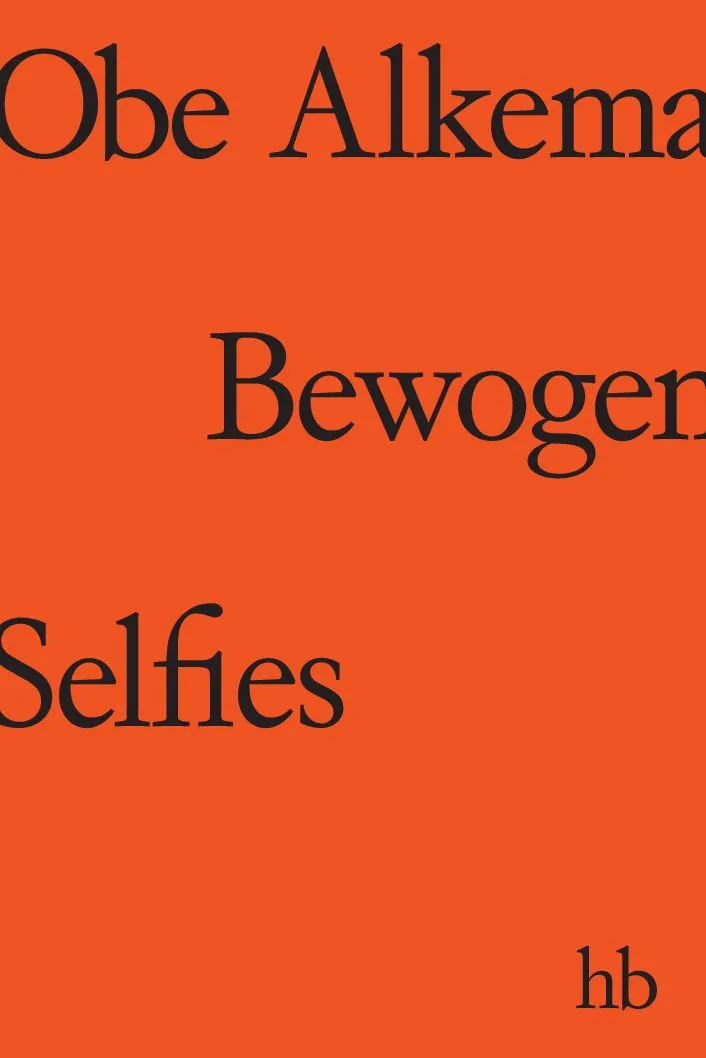
Cover of Bewogen selfies

het balanseer

Bewogen selfies

Obe Alkema

Poetry €24.50

In Bewogen selfies onderzoekt Obe Alkema de verhouding tussen landschap en herinnering. Wat treft hij aan bij terugkeer naar belangrijke plaatsen uit zijn geheugen? Wat herinnert hij zich niet, maar Google wel? Is er een gedenkschrift te puren uit zijn metadata?

Memoires, rechtstreeks verteld en met omwegen, uit eerste hand en van horen zeggen. Archieven en herinneringen eisen spreektijd, houden het niet meer droog of worden tot spreken gebracht. Wat hebben ze eigenlijk te melden? Ze lopen helemaal leeg, net als Alkema zelf. Een leven zoals zovele, poedelnaakt en geretoucheerd, vol zin en onzin.

Cover of Comeback Death

Krupskaya Books

Comeback Death

Jennifer Soong

Poetry €21.00

Comeback Death, Jennifer Soong's third book, weaves its registers of what Soong names as "dread, gender, sarcasm, sublimation of pain, fruit, ambition, and fecundity" through an English which is not only polyvocal but uncannily porous. Its languages (English, Russian, German, ancient Greek) underscore a perverse pastoral range that somehow bridges Oxford, New Jersey, and Lesbos. With a ferocity both musical and analytic, Soong's third book offers an unprecedented set of tonalities for immense architectures of feeling.

"In Comeback Death, Jennifer Soong dramatizes one of the key problems of our time, and indeed any time, which is how to reorganize the (negative) affects structuring intersubjectivity and thus conditioning our capacity to act in a common interest among others."—Thom Donovan

Cover of Bonbons à l'anis

Brook

Bonbons à l'anis

Cecilia Pavón

Poetry €18.00

Un fabuleux recueil – le premier publié en français – de poèmes et récits de l'autrice argentine Cecilia Pavón, préfacé par Chris Kraus (écrivaine dont Pavón a par ailleurs traduit des livres en espagnol).

« Cette traduction n'aurait pu voir le jour si je n'avais pas développé pendant quelques temps une obsession quasi malsaine pour l'Argentine. Cherchant à Buenos Aires les traces de lieux proches de Shanaynay que j'avais co-dirigé à Paris, je découvris au hasard sur internet l'existence d'un espace nommé Belleza y Felicidad et dirigé par Fernanda Laguna et Cecilia Pavón. Bien avant l'émergence de l'artist-run space en Europe, les deux femmes créèrent un lieu associant art et littérature. Lors d'un voyage à Buenos Aires, j'eus l'opportunité de rencontrer Cecilia Pavón qui lors d'une conversation sur l'écriture et la poésie, me proposa de traduire Licorice Candies en français. Sa poésie fut autant révélatrice qu'émancipatrice, à la fois par sa singularité et sa simplicité. Elle écrit ce qu'elle voit et ce qu'elle vit. Elle parle de certains quartiers de Buenos Aires, de ses amis, d'elle, d'un vélo qu'elle a perdu, de Timo. Il me semble qu'elle écrit comme elle parle d'amour, d'erreurs et de sexe ». Marion Vasseur Raluy, traductrice

The first collection of texts published in French by the Argentinian artist and poet.

Preface by Chris Kraus.

Translated from the English and Spanish by Marion Vasseur Raluy, Rosanna Puyol Boralevi and Mona Varichon.

Cover of Curious Affinities

Hajar Press

Curious Affinities

Sophie Chauhan

Poetry €18.00

How much distance and difference can intimacy hold? How much proximity and likeness does it require? What can we learn from its capacities? And what could we salvage from its limits?

Curious Affinities unravels the risks and possibilities brought forth by unconventional styles of intimacy. Across kinship, friendship, romance and community, the threads of social relation are entangled by race, class and queerness in unexpected and generative ways, as we find ourselves rent to shreds and stitched back together in the name of common feelings.

In rousing poetry and incisive prose, Sophie Chauhan reflects on the bonds and boundaries that govern our collective ways of life and wonders how they might be reimagined.

Sophie Chauhan is a London-based writer and researcher, born in the UK and raised in Naarm (Melbourne). She is completing a PhD in Race, Ethnicity and Postcolonial Studies at University College London. Her academic, creative and organising work converge around her interest in anti-capitalist, queer and decolonial approaches to radical coalition-building.