Books
Books
Spanish editions

I Remember Nightfall
Marosa di Giorgio, Jeannine Marie Pitas
I Remember Nightfall, the first comprehensive collection of Uruguayan poet Marosa di Giorgio’s work to be published in English translation, is made up of her first four book-length poems: The History of Violets (1965); Magnolia (1968); The War of the Orchards (1971); and The Native Garden is in Flames (1975). Di Giorgio’s writing transforms everything it touches—a lily, a head, a hare, a ghost, a porcelain cup. All becomes beautifully and violently intertwined, dead and alive. Boundaries are blurred: an eagle drinks tea with a mother, a flower puts on the longest pearl necklace or kills you. Di Giorgio’s obsessive, magical gardens serve as a stage for the ongoing encounter of nature and the supernatural. These serial prose poems explore memory, family relationships, erotic desire, and war, animating a world that is always on the verge of explosion.
Marosa di Giorgio was born in Salto, Uruguay, and raised on her family’s farm. Di Giorgio (1932-2004) is one of the most prominent Uruguayan poets of the twentieth century. She began writing in her childhood and published her first book of poems at the age of twenty-two. She then went on to publish a total of fourteen books of poetry, three collections of short stories, and one novel. While some critics have categorized her as a surrealist, she herself denied membership in any literary movement or school. Although she was relatively unknown outside the Southern Cone during her lifetime, she is now becoming more and more widely read throughout Latin America and Europe.
This is a bilingual edition, with cover art by Basil King.

First Meeting
Santiago de Paoli, Martina Panelli
First Meeting is the first monograph on Argentinian artist Santiago de Paoli. Covering de Paoli’s oeuvre from his early, experimental projects to his most recent explorations, the book delves into his innovative approach of painting on unconventional materials, from plaster to bread, felt to canvas, aluminum to wool, and socks to fur. It features newly commissioned essays by Fernanda Brenner, and Mariano Mayer, as well as a conversation between Christian Rattemeyer and the artist.
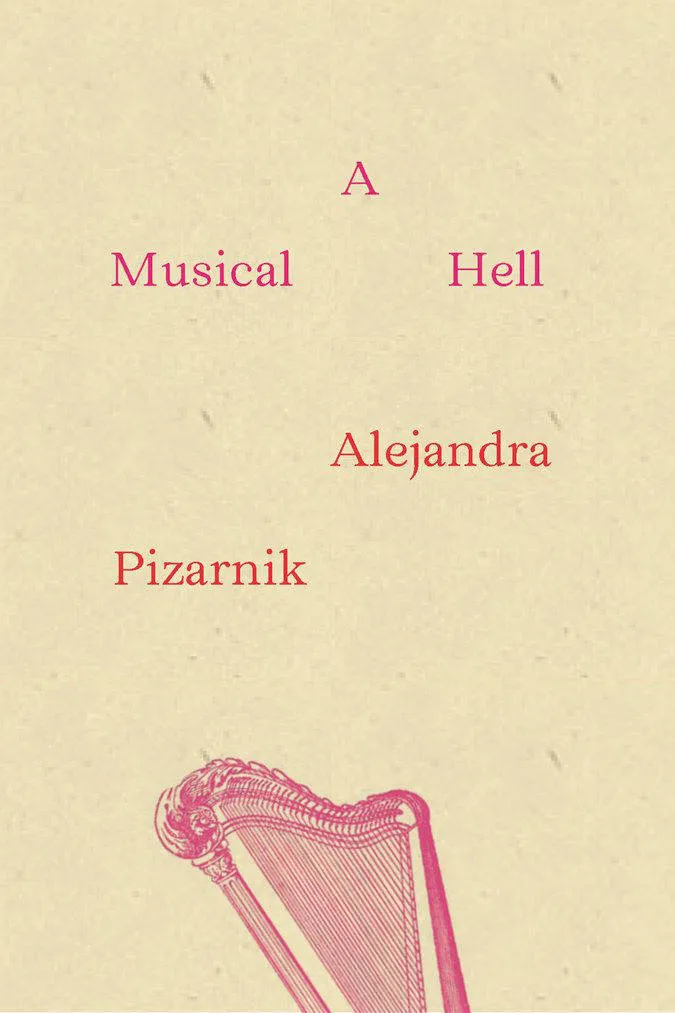
A Musical Hell
Alejandra Pizarnik, Yvette Siegert
“An aura of legendary prestige surrounds the work of Alejandra Pizarnik,” writes César Aira. Her last collection to be published before her suicide in 1972, A Musical Hell is the first book of poems by Pizarnik to be published in its entirety in the U.S. Pizarnik writes at the edge of poetic impossibility, opening with a blues singer, expanding into silence, and closing into a theater of shadows and songs of the drowned.

Red Seed: Poems for Luno
Cruz Alejandra Lucas Juárez, Wendy Call and 1 more
Through a voice at once intimate and collective, Lucas Juárez expands the powerful presence of Tutunakú roots to open up territories and to interweave desirous bodies, dream relationships, and the memories of women ancestors. This beautiful translation by Wendy Call and Whitney DeVos, in a precious handmade edition, affirms the trilingual (Tutunakú, Spanish and English) as an ethical strategy of listening to and translating the world. Red Seed collects twelve poems of women's sexualities and spirits in which body, language and territory are political spaces that Indigenous memory expands within and renews.
—Maricela Guerrero, author of The Dream of Every Cell

God Is a Bitch Too
María Paz Guerrero, Camilo Roldán
God Is a Bitch Too is the accelerated and acidic English-language debut of Colombian poet María Paz Guerrero. In this chapbook, god is needy, Latin American, and an overweight woman. No one asks god to dance. Someone speaks, someone tries: “One is the measure of their body.”
God Is a Bitch Too is #13 in the Señal series for contemporary Latin American poetry in bilingual editions.

49 Venezuelan Novels
Sebastian Castillo, Elisa Díaz Castelo
This new bilingual edition of Sebastian Castillo's long-out-of-print first book reintroduces a classic of American microfiction and features a translation into Spanish by acclaimed Mexican author Elisa Díaz Castelo.
Forty-nine pages of unique and surreal micro-fiction, Sebastian Castillo’s 49 Venezuelan Novels is a magical book with a new story on every page. Full of depth and imagination, Castillo uses imagery in a simple yet intense way. From stories of fish markets to spiteful violins, it almost seems that these novels are snippets of family stories long passed down, just now put to paper. With the nature of a born storyteller, Sebastian Castillo provides the readers of this fantastic read with gorgeous stories that define micro-fiction.

Theory of the Voice and Dream
Liliana Ponce , Michael Martin Shea
Obsessing on the relationship between creation and absence, Argentine poet Liliana Ponce presents an unsettling meditation on body, language, and self. For the first time in English, this edition brings together Ponce’s serial poems from the closing years of the twentieth century, the widely anthologized Theory of the Voice and Dream and Fudekara, a shorter sequence written in response to a Japanese calligraphy course. In these major works, Ponce questions the nature of writing itself, of how to write when to write today is an emptiness, or when mouth and voice cannot find each other. Breaking with Argentine poetic conventions, Ponce charts a new model for poesis—oneiric, embodied, and urgent. As she says, I write so I don’t have to speak, so I don’t have to watch.

The Chroma Series
The Chroma Series lists elements of reality and systematically changes their color to evoke monochrome universes. The resulting poems may be conceived as mental films where quick-change art coexists with nonsense and politics.

Bodies Found in Various Places
Elvira Hernández, Daniel Borzutzky and 1 more
The first anthology of Elvira Hernández’s poetry translated into English brings the award-winning contemporary Chilean poet's work of love, survival, persistence, disturbance, amazement, and delight to a new audience.
Elvira Hernández has occupied a marginal position in the Chilean poetic scene for decades, her quiet but mordant voice looking inward and outward, ironizing the circumstances of life that have brought us to this critical point in society. As recently as 2018, her work has become more visible after receiving the Jorge Teillier National Poetry Award (2018), the Pablo Neruda Ibero-American Poetry Award (2018), and the National Literature Prize (Chile 2024). With this belated recognition of her work has come an interest in studying her unique poetic language, with new critical books forthcoming from Spanish and Latin American publishers. Bodies Found in Various Places collects poems written from 1981-2016, providing readers with a curation of texts that show why Hernández is one of the most vital Latin American poets writing today.
"Elvira Hernández wrote her poem “The Chilean Flag” after she herself had been detained and tortured by the dictatorship for not complying with its lies. While Chileans were trained to look the other way, to go quiet by this terror, Elvira Hernández wrote a poem that could not be printed. Yet, the poem escaped like a prisoner and began circulating in Xeroxes, from hand to hand, until ten years later it was finally printed in Buenos Aires. In Elvira Hernández’s poetry, each line restores the right of words to speak. Each word becomes a healer, a prayer for a wounded, enslaved humanity forced to obey the rule of profit over life."— Cecilia Vicuña, author of Spit Temple

Licorice Candies
Cecilia Pavón, Jacob Steinberg
Licorice Candies collects short stories and poems written during the author’s most experimental and frenzied phase. The backdrop shifts from barren plazas in Buenos Aires to basement parties in Berlin. “I wished that, by continually moving horizontally, in a straight line, my body would touch Germany…that you could reach Berlin from Buenos Aires in a second without any planes that all the coolest cities in the world were each a continuation of the next: Lima, Buenos Aires, Berlin.” The medium through which these desires manifest is the Internet. The Internet—a ubiquitous force that becomes the notebook for the author’s poetry: typo-ridden love letters the grammarless confessions of a polyglot a geography that bends to the author’s will, making everything closer, more intimate.
Translated from Spanish by Jacob Steinberg

Nine Ways to Cry
Cecilia Pavón, Jacob Steinberg
Cecilia Pavón has been a defining figure of the Argentine cultural scene since the 1990s. She is the author of over 10 volumes of poetry, 3 short story collections, and an anthology of blog posts, and was co-founder of the legendary art gallery and publishing press Belleza y Felicidad. Nine Ways to Cry collects Cecilia Pavón’s complete poetry published from 1999 to 2012 in one bilingual volume for the first time, including A Hotel With My Name, Licorice Candies, and other beloved classics.
Prefaced by a loving foreword from contemporary US poet Dorothea Lasky, this collection serves as the definitive introduction to the poetry of a living legend. She currently lives in Buenos Aires.
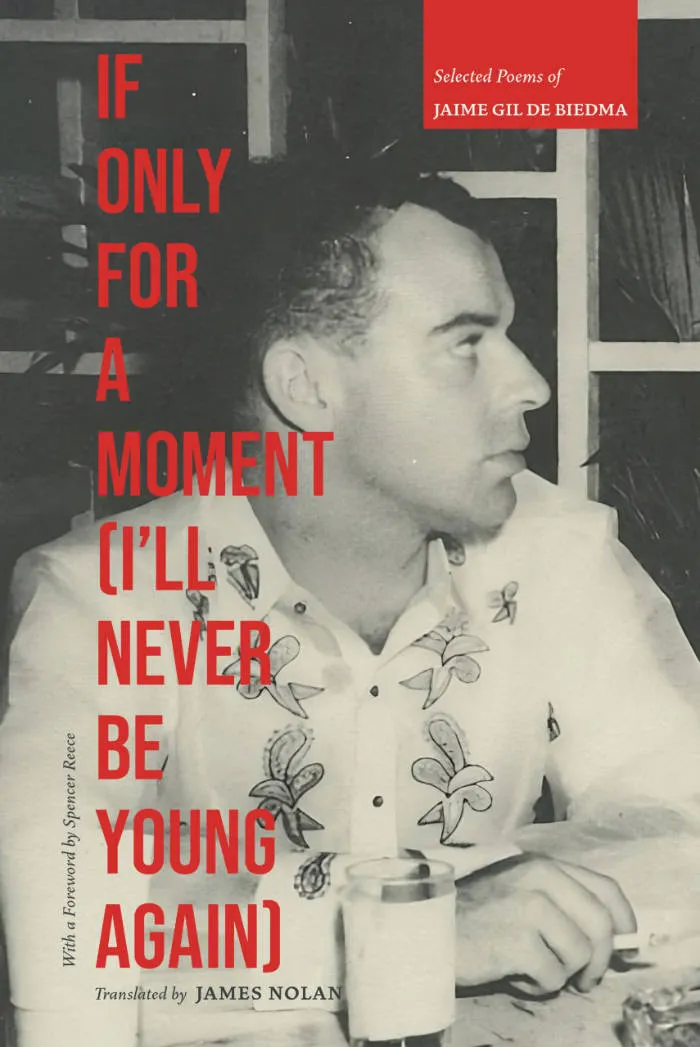
If Only For a Moment (I’ll Never Be Young Again)
Jaime Gil de Biedma, James Nolan
Jaime Gil de Biedma is the most original and influential among the poets known as the ‘50’s Generation in Spain, and is considered the greatest Spanish poet to emerge in the second half of the 20th century. His life and literary career were bracketed almost entirely by the rise and fall of Generalissimo Francisco Franco, notorious for the suppression of literature. Born in 1929, Gil de Biedma was six years old when García Lorca was murdered in Granada at the outbreak of the Civil War, and his collected poems, Las personas del verbo, first appeared in 1975, the year Franco died. What is surprising is that Gil de Biedma was a leftist, homosexual poet from the Catalan capitol, Barcelona – all of Franco’s favorite things – who not only published books of autobiographical poetry in Spain but was known as a poet of social conscience as well as erotic lyricism. Like other Spanish poets of his time, he chose his words carefully. Gil de Biedma died of AIDS in 1990.
If Only For a Moment (I’ll Never Be Young Again) consists of an extensive bilingual selection of Gil de Biedma’s poetry, including all of his most well-known work. The book additionally consists of a Foreword by Spencer Reece, Jaime Gil de Biedma’s short essay “I wanted to be the poem,” and two different essays on Gil de Biedma and the art of translation by James Nolan, the volume’s translator.
![Cover of [45-120]](https://rile.space/storage/3794/conversions/01K7RPFBTZPK0NE1VQTCYB68XK-webp.webp)
[45-120]
Personal space is understood as the distance between 45 and 120 cm that surrounds a person. This bilingual anthology brings together the work of eighteen contemporary poets who take this intimate measurement as a starting point to challenge its apparent rigidity and explore how political, social, sexual, racial, class, and accessibility factors shape it. Beyond a simple physical distance, personal space also becomes a stage where desire draws and negotiates the boundaries between the inside and the outside.
The publication contains contributions by Samuel Ace, Justin Chin, Kyle Dacuyan, Rhea Dillon, Tracy Faud, Elijah Jackson, Taylor Johnson, Nadia Marcus, Park McArthur, Nat Raha, Joan Retallack, Trish Salah, Juan de Salas, María Salgado, Assotto Saint, Cedar Sigo, S*an D.Henry-Smith, Nayare Soledad, Perla Zúñiga.
Bilingual edition, edited by Juf.
JUF (Bea Ortega Botas and Leto Ybarra) explores the relationship between poetry, contemporary art, and theatricality through the organization of performances, readings, and exhibitions. They also publish online texts and a PDF series as an extension of their curatorial and research practice. Currently based between Madrid and New York.

Deer Book/Libro Venado
Inspired initially by Jerome Rothenberg’s translation Flower World Variations, which Cecilia Vicuña first encountered in 1985, Deer Book brings together nearly forty years of the artist’s poetry, “poethical” translations, and drawings related to cosmologies and mythologies surrounding the deer, and sacrificial dance in cultures around the world.
Woven like one of her quipu installations, Vicuña’s texts—which include original compositions in Spanish as well as English translations by Daniel Borzutzky—become meditations on translation, not just of the sacred nature of this animal but on how our understandings of ceremony and ritual are transformed, by this ongoing process. Taken as inspiration rather than conundrum, the impossibility of translation opens up poetic possibilities for Vicuña as she continues her lifelong exploration into the nature of communication across eras and distant lands, languages and shared symbols within Indigenous spiritualities.

Dolce Stil Criollo Issue 5: Extraordinarily Apotropaic
Dolce Stil Criollo’s fifth issue, "Extraordinarily Apotropaic," aims to rethink reality in its current ordinary form by discovering and creating charms and rituals for changing it into one where there is less harm. The issue features poems in multiple languages; a map of dreams; a video game-turned-manga; a section that functions as a kineograph; a collaboration with the Huni Kuin people; and more. We also curated a collective project, “Cinema of Hope,” which brings together 11 moving image artists in search of the apotropaic moment, caught on film.
The cover of our fifth issue features one of five “santinho” inserts. Designed like prayer cards, they contain a collaged portrait of a musical artist (Pivaratu, Pivete Nobre, Iya, Swatch, Devil Gremory) on the recto and the rap lyrics they wrote in response to our theme on the verso.
Contributors include Andrés-Monzón Aguirre, Aykan Safoğlu, Azul Caballero Adams, Belinda Zhawi, Daniel Machado, Daniel Moura, Devil Gremory, Enorê, Esvin Alarcón Lam, Gabriel Massan, Hick Duarte, Itamar Alves, Iya, Jennifer Pérez, Jesse Cohen, Johan Mijail, Juan Pablo Villegas, Kasra Jallilipour, Kent Chan, Keratuma (Mileidy Domicó), Laura Huertas Millán, Lucía Melií, Lucía Reissig & Bernardo Zabalaga, Maria Thereza Alves, Masha Godovannaya, Mayada Ibrahim, Najlaa Eltom, NIna Djekić, Ophelia S. Chan, Pivaratu, Pivete Nobre, Ricardo Pinheiro (Ganso), Roberto Tejada, Sofía Córdova, Sofía Gallisá Muriente, Swatch, Thales Pessoa, and Thiago Martins de Melo.
Languages: Spanish, Portuguese, English, Japanese and Arabic

La condición postnatural
What is postnature? How to understand the socio-climatic crisis and where to look for new narratives for a desirable future? What is the relationship between contemporary ecology and artistic practices? The postnatural condition is a speculative glossary of terms and images, of stories and materials, an unfinished archive of intertwined thoughts. This book, which includes theoretical texts, situated examples, and artistic projects, presents a critical view of the modern Western conception of the "natural" and proposes new perspectives and resonances. Mixing affective philosophies, minor anthropologies, critical historical revisions, minimal histories, narratives, and stories on the margins, it seeks to proliferate a kaleidoscopic vision around ecology in an increasingly deteriorating world, inviting us to imagine and propose other worlds to come from respect, empathy, and coexistence.
Texts by Gabriel Alonso & Clara Benito with collaborators: Paloma Villalobo, Valentín Bansac, Nicolás Sánchez, Fionn Duffy, Aitor Frías, Andra Lena, Pop Juri, Geerts Dana, Lorenzo Galgó, Maria Morata, Valeria Mata, Maya Pita-Romero, Lily Chishan Wong, Sina Sohrab, Davide Marcianesi, Preethisakana Mathiseka, Alessandro Pasero, Anna Raffaghello, Ludmila Secchin, Federico Dopazo, Alba Noguera.

Ana Mendieta - Search for Origin
G. Gourbe, C. Guardiola Bravo and 2 more
Devoted to Cuban-born American artist Ana Mendieta (1948–1985), this monograph appears with an exhibition at Museo de Arte Contemporáneo de Castilla y León, which brings together around 100 works from over fifteen years of production (1968–1985). The exhibition explores how the artist never ceased to reinvent herself through political and vibrant contemporary work, developing an original, ephemeral sculptural language, at times performative in act and informed by her research into primitive myths and rock art. It reveals her relationship to the visible and invisible, her way of rendering the unspeakable intelligible through traces of the body and its relation to nature.

Oostende
Oostende is a book about displacement and the sometimes-overwhelming internal monologue we live with. In between poetry, diary and novel, the book reflects on Zicari’s life in Buenos Aires and Belgium, as he navigates work fragility, friendship, sex and love, migration and the fiction laying behind everyday actions and life changing decisions.
Zícari's portrayal of his private life is far from the domain of the concrete, instead he ventures into the uncontrollable production of fantasies that sustain his inner discourse. It is around this dichotomy between the real and the imaginary, the tension between the experienced and the illusion, that Martín Zícari builds a book sustained in orality and proximity.
Martín Zícari, PhD, is a writer and producer based in Brussels. He has published poetry collections such as "Oostende" (Paripé Books, Madrid, 2023), "Del Príncipe Azul al Hombre Invisible en una Semana" (Editorial Municipal de Rosario, Argentina, 2018), and "Pequellpu" (LUMA Foundation, Switzerland, 2015), as well as the short novel "Scalabritney" (Entropia, Argentina, 2014), among others. His research has been featured in scientific journals such as Performance Research, Memory Studies, and the Journal of Latin American Cultural Studies.

Daytime Noir
Daytime Noir is a limited edition artists book by Laida Lertxundi, designed by Gabrielle Pulgar and released by Artspace Aotearoa on the occasion of Scores for Transformation, the third in the cycle of exhibitions that orbit the question “where does my body belong?” The book includes new writing by Laida Lertxundi, Ren Ebel, and Luna Miguel.
Drawing on two recent 35mm films Autoficción (2020) and Inner Outer Space (2021) as well as recent works on paper, the pubilcation explores the parameters of what it takes to run an artistic practice navigating the many facets of a full life: parenting, teaching, exhibiting, working. The full colour, hand stitched book presents us with ‘film stills’ that come alive when we, as readers, engage with its physical form.
The publication is an edition of 100.

Making Kin
Institute for Postnatural Studies
When we practice becoming with another’s experience, we practice empathy. When we embody collectiveness, we understand ourselves as a whole and therefore feel no separation. What would it be like to inhabit a body without limits or definition? Which words and meanings make us feel like “non-animals”? The literary genre of xeno fiction proposes an exercise of ethological research and imagination, placing our body inside another’s perspective. This publication convenes writers and non-writers that have experimented with animal embodiment to create literary works and visual interpretations that explore different ways to experience “otherness.” In this volume of the Making Kin series, we focus on non-human animals and hybrid bodies.
Authors: Zoë De Luca Legge, Esther Merinero, Eva Piay, John Kazior, Jorge de la Cruz, Marianne Hoffmeister Castro , Luca E. Lum, Anonymous, Paula Proaño Mesías, Laura Dominguez Valdivieso, Adèle Grégorie, Morgan Wood

Saborami
First published in 1973, two months after the military coup in Chile, Cecilia Vicuña's SABORAMI is a document of the times and the way in which history can change art. It is filled with the urgent hope that art, too, can change history. Put together when Vicuña was just twenty-five years old, the poems, paintings, and objects of SABORAMI enact a complex and multidimensional conversation. The meanings of the works (which were created over a seven year period) shifted radically after the events of September 11, 1973. Their meanings continue to shift and resonate in light of political events today. This recreation of the original SABORAMI is published with a new afterword Vicuña wrote especially for this edition.
Cecilia Vicuña is a poet, visual artist, and filmmaker born in Santiago de Chile. The author of twenty books of poetry, she exhibits and performs widely in Europe, Latin America, and the United States. Her multidimensional works begin as a poem, an image or a line that morphs into a film, a song, a sculpture or a collective performance.

The Posttraumatic Newspaper vol.1 Inhale, Exhale
The Posttraumatic is a newspaper created by creatives and artists. [eng, cast, cat]
Why a newspaper? The project believes that a newspaper is an important link between our social reality (built over the centuries by three-headed monsters and the occasional fairy godmother) and the individuals who live in it, because it is an essential communication element and because its content is a fucking drama almost always.
When Ulrich Beck, a literate man, assures us that “the media does not respond to the inspiration of the enlightenment but to that of the market and capital” we can only read the news with a distrustful and defenseless frown. Uncle Sam manipulates us to his likings and we satisfy our appetites by feasting on his words as if they were cocaine-coated cookies that only serve to fatten the need to win over arguments at our neighbor’s dinner-table conversations. We do not know if the information we swallow is invented, bought, if they are news clippings curated by a 4channer´s paranoid imagination, or if it is an objective, absolute, eternal truth.
Based on these fatalistic, dramatic and somewhat depressing theories on news and their consumption, 39 artists were contacted and each one was granted with a space, a sort of an article, to do whatever they wanted with it. It has not been intended to generate any specific ideological discourse and there is no gift flag.
With Contributions by: Escif, Ampparito, Aida Gómez, Mas Siedentop, Jofre Oliveras, Flavita Banana, Helen Bur, Michael Beitz, Biancoshock, Milu Correch, Luce, Marta Aguilar, Jan Vorman, Igor Ponosov, Ana Vilamú, Vas Ban Wieringen, Gigi Ei, Vlady, Val Rovatti, Octavi Serra, Nicolás Garcia, Valentina and the Electic Post and Others.

Under Current
Companion reader for Under Current, an exhibition and film by Alice dos Reis. With 'Blue Carbon' by Holly Childs, 'Hydrofeminism: Or, On Becoming a Body of Water' by Astrida Neimanis, 'King Tide' by Sophia Al-Maria, 'Notes on a Dotted Red Wave' by Danea Io, 'Smart Oceans, Alien Times: Octopi Engineering' by Bogna M. Konior, 'To a Current's Ear' by Alice dos Reis and more. Bilingual edition (Spanish-English).