Publishing Practices
Publishing Practices

OEI #92-93 Lettrist Corpus: The Complete Magazines (1946–2016)
Frédéric Acquaviva, Jonas J. Magnusson and 1 more
“Un livre qui fera date. Deux ans de recherches, 512 pages, 1.361 illustrations en quadrichromie, 119 revues lettristes parues de 1946 à 2016 pour un total de 1.200 ouvrages décrits (avec la couverture et le sommaire de chaque numéro). Qui d’autre que les éditeurs suédois de OEI (Jonas J. Magnusson et Cecilia Gronberg) aurait pu sortir ce travail anthologique? Personne!” — www.mauricelemaitre.org
“The ‘unreasonable’ idea for this ‘catalogue raisonné’ came to me as an attemps to draw up a complete inventory of all the journals and periodicals of the Lettrist group, from its birth until today. Because the lifespan of the Lettrist movement has exceeded that of all the other avant-garde movements, we are undoubtedly in front of the most immense corpus ever produced in terms of magazines, coverin a period from 1946 to 2016. It presents more than a hundred different titles with more than one thousand items and hundreds of authors. . . . I hope that this comprehensive work will give the reader an opportunity to understand the different paths of the Lettrist groups and the many areas addressed, if not shaken, beyond the books of Isidore Isou and Maurice Lemaître. Since other Lettrists have published relatively few monographic books, and very little outside their own magazines, OEI #92-93 is a unique database for most of the Lettrist texts that we can access, also making it possible for new readers to come across Lettrism.”
— from Frédéric Acquaviva’s introduction
Design by Fält

OEI #86/87 Publishing Practices, Publishing Poetics
Tobi Maier, Cecilia Grönberg and 1 more
Once more, an astonishing issue of OEI – a thrilling, compelling, stimulating feast of ideas regarding publishing and the book: the perfect big companion to read and hug in bed while the virus spreads outside.
Bringing together contributions from circa 130 publishing structures, publishing communities, magazines, small press endeavors, artists, poets, writers, editors, theoreticians, curators, scholars, and art bookstores, OEI # 86–87 reflects upon the challenges, pressures and possibilities of publishing and creating publics in different contexts and places in a time of far-reaching – economical, medial, political, social, technological – transformations.
The potential and the versatility of publishing open it to a diversity of practices and approaches in the arts, but as an eminently social form of art, a collective or micro-collective work with shared responsibilities, it is also a never-ending process of “crafting a variegated approach to how you create, publish, distribute, and build a social ecosystem around your efforts”, of trying to “build up and strengthen the community around these printed forms” (Temporary Services).
It is the conviction of OEI #86–87 that print has the power to play an important part in the construction of social spaces, of a social world. As Benjamin Thorel puts it in one of the essays in the issue, “conceiving of the dynamics of publishing as making publics as well as making things public is not a pun – insofar as the artists/publishers encompass, beyond the book itself, its possible ‘lives’, imagining the different spaces, and the different people, amongst whom a publication will circulate.” This is what Michael Warner has called “a public [as] poetic worldmaking”, implying “that all discourse or performance addressed to a public must characterize the world in which it attempts to circulate, projecting for that world a concrete and livable shape, and attempting to realize that world through address.”
This is also, as stressed by Annette Gilbert and others, what can make publishing such an active force, a force co-constituting texts and publications and publics. Indeed, with Michalis Pichler, it is tempting to say that in publishing as practice – perhaps more than in any other art field – “artists have been able to assert the aesthetic value of their own socio-politically informed concerns and to engage, often under precarious conditions, in cultural activities fully aligned with their political values.”
OEI #86–87 also includes sections on and with contemporary poetry from Canada; Fluxus publishing; Krister Brandt/Astrid Gogglesworth; Kalas på BORD (Öyvind Fahlström); Lars Fredrikson; Claude Royet-Journoud’s poetry magazines; Carl Einstein; Gail Scott; Ållebergshändelser; OEI #79: edit/publish/distribute!; “det offentligas försvinnande” and many many other things. [publisher’s note]
Design by Konst & Teknik

On the Self-Reflexive Page II
Originally published in 2010, ‘On the Self-Reflexive Page’ is part artist’s book and part essay, part literary excavation and part typographical miscellany. For this second incarnation of Louis Lüthi’s anthology of thematically arranged pages, the original material has been significantly expanded and revised. Like its predecessor, the new version proposes a typology of nonverbal elements found in novels, short stories, and essays. In each of the pages reproduced here, the prose is interrupted by one of these nonverbal elements, from black or blank pages, drawings or collages, photographs or film stills, to fragments of text or visual poems that are distinct from a conventional page layout.

I Was More American than the Americans
Sylvère Lotringer, Donatien Grau
A personal take on French Theory by one of the people who invented it.
In the mid-1970s, Sylvère Lotringer created Semiotext(e), a philosophical group that became a magazine and then a publishing house. Since its creation, Semio-text(e) has been a place of stimulating dialogue between artists and philosophers, and for the past fifty years, much of American artistic and intellectual life has depended on it. The model of the journal and the publishing house revolves around the notion of the collective, and Lotringer has rarely shared his personal journey: his existence as a hidden child during World War II; the liberating and then traumatic experience of the collective in the kibbutz; his Parisian activism in the 1960s; his time of wandering, that took him, by way of Istanbul, to the United States; and then, of course, his American years, the way he mingled his nightlife with the formal experimentation he invented with Semiotext(e) and with his classes. Since the early 2010s, Donatien Grau has developed the habit of visiting Lotringer during his trips to Los Angeles; some of their dialogs were published or held in public. This book is an entry into Lotringer's life, his friendships, his choices, and his admiration for some of the leading thinkers of our times. The conversations between Lotringer and Grau show bursts of life, traces of a journey, through texts and existence itself, with an unusual intensity.

A Poetics of the Press: Interviews with Poets, Printers, & Publishers
The publication of Donald Allen's The New American Poetry in 1960, as well as the Vancouver and Berkeley poetry conferences, sparked a poetic renaissance. It was an era rich in exploration and innovation that articulated a new relationship between form and content. Simultaneously, American artists began working with the book as a creative medium that rivaled the European tradition of the early twentieth century.
This book is the first collection of interviews with some of the pioneers working at the intersection of the artists book and experimental writing that continues to this day.
Includes interviews with Keith & Rosmaie Waldrop, Tom Raworth, Lyn Hejinian, Alan Loney, Mary Laird, Jonathan Greene, Alastair Johnston, Johanna Drucker, Phil Gallo, Steve Clay, Charles Alexander, Annabel Lee, Inge Bruggeman, Matvei Yankelevich, Anna Moschovakis, Aaron Cohick, and Scott Pierce. Co-published with Cuneiform Press.

Publishing as Practice
Publishing as Practice centers on the work of three contemporary artists/book publishers who have developed fresh ways of broaching the political in publishing.
This book documents a residency program at Ulises—a curatorial platform based in Philadelphia—that explores publishing as an incubator for new forms of editorial, curatorial and artistic practice. Over the course of two years, three participants (Hardworking Goodlooking, Martine Syms/Dominica, and Bidoun) activated Ulises as an exhibition space and public programming hub, engaging the public through workshops, discussions, and projects.
Hardworking Goodlooking is a design and publishing imprint working primarily out of the Philippines. Dominica is an imprint run by artist Martine Syms dedicated to exploring Blackness as a topic, reference, marker, and audience in visual culture. Bidoun, a non-profit organization and magazine, focuses on art and culture from the Middle East and its diasporas. Each organization approached their residency at Ulises in a unique way, bringing a new understanding of what it means to practice publishing.
Edited by Kayla Romberger, Gee Wesley, Nerissa Cooney, Lauren Downing, and Ricky Yanas, Publishing as Practice features a preface by David Senior, Head of Library and Archives at the San Francisco Museum of Modern Art, and Ulises Carrión’s 1975 publishing manifesto “The New Art of Making Books.” Publishing as Practice also includes writing from Clara Balaguer, Hardworking Goodlooking, Martine Syms/Dominica, Bidoun, Lauren Downing, Kayla Romberger, and Gee Wesley alongside interviews, excerpts, and documentation from each residency.

No-ISBN عن النشر الذاتي
Leo Findeisen, Agnes Blaha and 1 more
What role will self-publishing play in the 21st century? Will the new kind of book printing develop to become an alternative to electronic communication? How is it possible to distinguish subversive gestures and New Biedermeier?
NO-ISBN – On Self-publishing investigates extraordinary books that withdraw from the international book trade. A register contains 1,800 items that have three features in common: they are recent, printed on paper, and circulate without an ISBN. This is the first Arabic edition produced within the context of the exhibition How to maneuver: Shape-shifting texts and other publishing tactics, with the support of Warehouse421, Abu Dhabi.
NO-ISBN – On Self-publishing provides an outline of media history from 15th century book printing to the present time, a schedule of micro- and fanzine fairs from four continents and manifestos of historical and current avant-gardes. They are interspersed with texts about the international boom of artists´ books, written by protagonists of self-publishing. This first, richly illustrated reader offers an apparatus to discover a new, yet uncharted terrain.
Arabic edition.

Revue Faire n°26: Production Process
In 2008, English Graphic Designer James Goggin ran a two-day workshop with design students at the Hochschule Darmstadt in Germany. The object which resulted gradually took on the appearance of a photo album, a typeface specimen, and a color chart. On the cover, the phrase “Dear Lulu, Please try and print these line, color, pattern, format, texture and typography tests for us” is clearly addressed to the online print platform for which this book was proposed as a test.
Ten years later, the offer has become more diverse and the success of such online platforms is undeniable—indeed the phenomenon has spread well beyond the field of publishing. While some bemoan unfair competition for printers, others, professionals and amateurs, see in it a freedom to print and distribute relatively well finished objects at low cost.
The possibilities of these systems of production, are multiple but nonetheless limited, and this obviously raises the question of a possible standardization of forms and formats. However, when it comes to Print On Demand, it seems that the issue is not so much the materiality of an object (the choice of format, paper or a particular manufacture) but rather the actual existence of this object itself, outside of usual channels of production and distribution.

shelf documents: art library as practice
How can art libraries be generative resources and sites of action for all who identify as queer, as women, as Black, as Indigenous, as people of colour? What does it mean to consider the art library as a collective practice that spans multiple scales? In shelf documents artists, writers, curators, teachers, and librarians reflect on their engagements with books, libraries and art-library-as-practice.
Between a reader, an artist’s book, a project documentation and a catalogue, shelf documents might recall a pamphlet, a roadmap, or a recipe book that doesn’t tell you what to do. It is a book that gets mis-shelved.
With drawings by Heide Hinrichs
Edited by Heide Hinrichs, Jo-ey Tang and Elizabeth Haines, and designed by Sara De Bondt.
shelf documents: art library as practice features contributions by Sara De Bondt, Rachel Dedman, Elizabeth Haines, Heide Hinrichs, Laura Larson, Samia Malik, Melanie Noel, Marisa C. Sánchez, David Senior, Jo-ey Tang, Ersi Varveri and Susanne Weiß.
Published by Track Report, Antwerp and b_books, Berlin.
Published in January 2021

Literary Activism
Literary Activism – activism that revisits and interrogates an idea of literature – emerges from a radically altered landscape for both publishing and academia, where market pressures are effecting changes – on language, on the measuring of value, on the concept of influence – we might struggle to recognise.
Taking in the roles of writer, critic, translator, academic and publisher, the essays in this volume follow no single line of enquiry. Rather, they offer the beginnings of an analysis of the literary world at a certain moment of globalization, while also questioning whether a literary world exists and, if it does, where its boundaries lie.
The collection moves in many directions – from Arun Kolatkar and his near-heroic refusal of both market place and reputation; to Derek Attridge, who argues for a form of affirmative criticism which positions the critic as a ‘lover of the text’; while, from Amsterdam, Dubravka Ugrešić reflects on life in a literary ‘out of nation zone’, adrift in a territory where intellectual protest has been stripped of ideological impetus and subsumed by the voraciousness of the market.
Taken together, these essays initiate a series of conversations about who reads what and why, about the practice of writing and criticism at this particular contemporary moment, and about the activities and institutions that shape an understanding of what literature is and what it can do.
Literary Activism, edited by Amit Chaudhuri, features writing from Derek Attridge, Tim Parks, Dubravka Ugrešić, Laetitia Zecchini, Peter D. Macdonald, Saikat Majumdar, Jamie McKendrick, and Swapan Chakravorty, with an afterword by Jon Cook.

The First Books of David Henderson and Mary Korte: A Research
In 1967, the first books of two poets were published by small presses on opposite coasts of the USA: David Henderson's Felix of the Silent Forest and Mary Norbert Korte's Hymn to the Gentle Sun. In this essay, poet, scholar, educator, and publisher Iris Cushing looks at the context of these supposedly minor poets, and through research and conversation with Korte, Henderson, and Diane di Prima, reconstructs the role of small presses in the countercultural resistance of the late 1960s.
Iris Cushing is a poet, scholar, educator and founding editor for Argos Books, an independent poetry press. She is the author, most recently, of THE FIRST BOOKS OF DAVID HENDERSON AND MARY NORBERT KORTE: A RESEARCH (Ugly Duckling Presse, 2020), and Into the Long Long Time: How Mary Korte Saved the Trees (Ink Cap Press, 2019). Her poems and critical writings have appeared in numerous publications, including the Boston Review, Fence, and the Academy of American Poets Poem-A-Day series, and her poetry collection WYOMING (Furniture Press Books, 2014) won the 2013 Furniture Press Poetry Prize. She has edited three chapbooks for the Lost & Found Poetics Documents Initiative: Diane di Prima: Prometheus Unbound as a Magickal Working (Series VIII, 2019), Bobbie Louise Hawkins: The Sounding Word, and Judy Grahn: Selections from Blood, Bread and Roses (Series VI, 2016). A doctoral candidate in English at the CUNY Graduate Center, Iris is currently at work on a biographical dissertation titled Pierce and Pine: Diane di Prima, Mary Norbert Korte and the Question of Matter and Spirit.

Copy This Book
This book is an artist’s guide to copyright, written for makers. Both practical and critical, this book will guide you through the concepts underlying copyright and how they apply in your practice.
How do you get copyright? For what work? And for how long? How does copyright move across mediums, and how can you go about integrating the work of others? Because they get copyright too!
Copy this Book will detail the concepts of authorship and original creation that underlie our legal system. This way, it will equip you with the conceptual keys to participate in the debate on intellectual property today.
This sharp and useful book shines a light on the rights of all artists to protect—and share—their work. Eric Schrijver has produced an essential guide for navigating the new Commons and the old laws of copyright control.
— Ellen Lupton, curator and critic
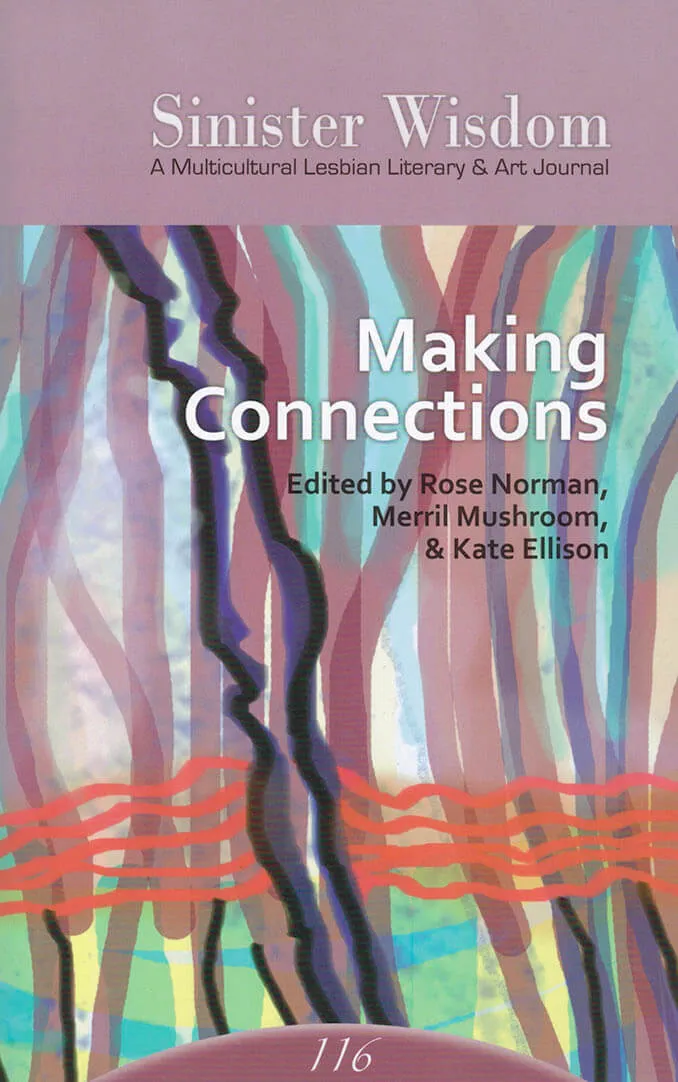
Making Connections
Kate Ellison, Merril Mushroom and 1 more
Making Connections is the fifth issue of Sinister Wisdom's series of work edited by the Southern Lesbian Feminist Activist Herstory Project, documenting the vital lesbian-feminist activism that proliferated in the US South during the 1970s, 1980s, and 1990s. Making Connections details the extensive networking of lesbian booksellers, publishers, writing groups, and newsletter through engaging interviews, first person narratives, and innovative graphic timelines.

The Feminist Bookstore Movement
From the 1970s through the 1990s more than one hundred feminist bookstores built a transnational network that helped shape some of feminism's most complex conversations. Kristen Hogan traces the feminist bookstore movement's rise and eventual fall, restoring its radical work to public feminist memory. The bookwomen at the heart of this story—mostly lesbians and including women of color—measured their success not by profit, but by developing theories and practices of lesbian antiracism and feminist accountability.
At bookstores like BookWoman in Austin, the Toronto Women's Bookstore, and Old Wives' Tales in San Francisco, and in the essential Feminist Bookstore News, bookwomen changed people's lives and the world. In retelling their stories, Hogan not only shares the movement's tools with contemporary queer antiracist feminist activists and theorists, she gives us a vocabulary, strategy, and legacy for thinking through today's feminisms.
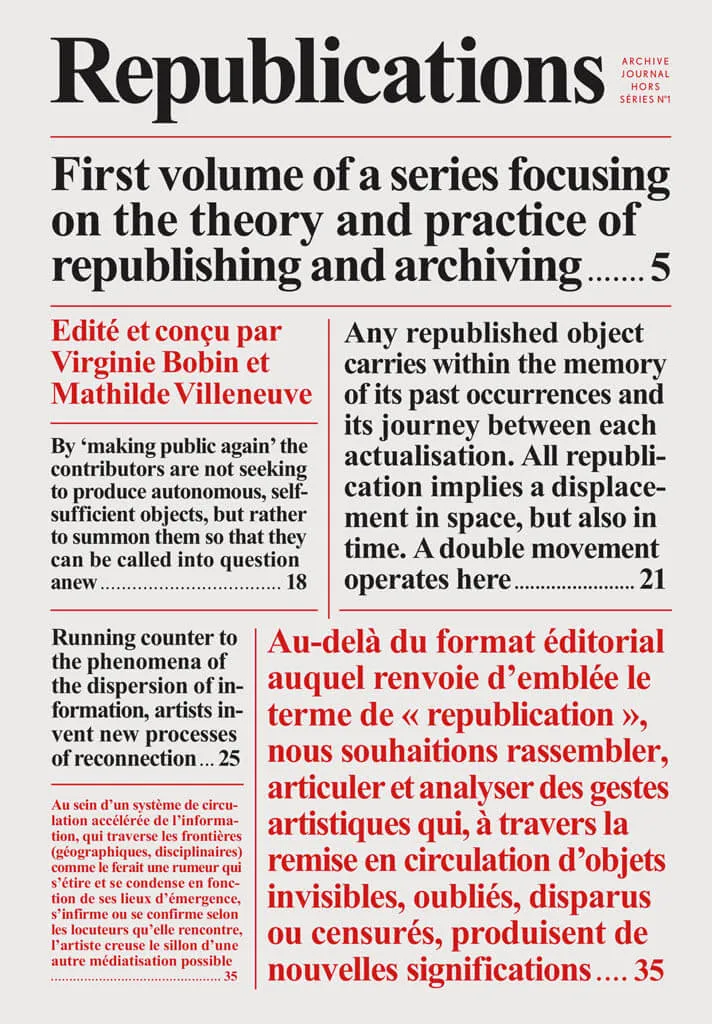
Republications
Virginie Bobin, Mathilde Villeneuve
Republications is the first volume of Archive Journal’s hors-séries. Each issue of the series is commissioned to authors whose research is close to the editorial line of the journal. For the inaugural issue Archive’s editors have invited French curators and art critics Virginie Bobin and Mathilde Villeneuve. Taking as a starting point the notion of ‘republication’, the contents of this publication have been compiled through a collective process over the course of multiple editorial meetings in Berlin, Aubervilliers and Paris between 2011 and 2012. The texts assembled in this volume have been written in English or in French.
Contributions by Mathieu Kleyebe Abonnenc, Lene Berg, Pauline Boudry, Renate Lorenz, Christophe Bruno, Foundland, Jeff Guess, Alexis Guillier, Rémy Héritier, Franck Leibovici, Sohrab Mohebbi, Julien Prévieux, Sally Price, Anna Théodoridès, Vassilis Salpistis, Marie Voignier.