Facsimile & Reprints
Facsimile & Reprints

Black Art Notes
A prescient document of art-industry and museum critique from Black artists and writers.
A collection of essays edited by artist and organizer Tom Lloyd and first published in 1971, Black Art Notes was a critical response to the Contemporary Black Artists in America exhibition at the Whitney Museum, but grew into a "concrete affirmation of Black Art philosophy as interpreted by eight Black artists," as Lloyd notes in the introduction.
This facsimile edition features writings by Lloyd, Amiri Baraka, Melvin Dixon, Jeff Donaldson, Ray Elkins, Babatunde Folayemi, and Francis & Val Gray Ward. These artists position the Black Arts Movement outside of white, Western frameworks and articulate the movement as one created by and existing for Black people. Their essays outline the racism of the art world, condemning the attempts of museums and other white cultural institutions to tokenize, whitewash and neutralize Black art, and offer solutions through self-determination and immediate political reform. While the publication was created to respond to a particular moment, the systemic problems that it addresses remain pervasive, making these critiques both timely and urgent.

Yvonne Rainer Work 1961-73
It goes without saying that a dance is a dance and a book about dance is a book. Though they may meet at the intersection of Art and Good Intentions, I find myself greedy. I have a longstanding infatuation with language, a not-easily assailed conviction that it, above all else, offers a key to clarity. Not that it can replace experience, but rather holds a mirror to our experience, gives us distance when we need it. So here I am, in a sense, trying to 'replace' my performances with a book, greedily pushing language to clarify what already was clear in other terms. But, alas, gone. This has seemed one good reason to compile a book out of the remains of my performances, letting the language fall where it may. Let it be said 'She usually makes performances and has also made a book.' -Yvonne Rainer
Forty-five years after its publication, Primary Information brings Yvonne Rainer's classic book back into print in an exact facsimile.
In 1974, Yvonne Rainer published Work 1961-73, an illustrated catalog of her performance works up to that point. In these years, as the art world turned toward minimalism, Rainer and her Judson Dance Theater colleagues were engaged in a parallel, and equally radical, redefinition of dance. Stripping dance of its pomp and self-serious virtuosity, they created what dancer and choreographer Pat Catterson has called "the people's dance." Or, as Rainer put it, instead of the "overblown plot" of traditional dance, she explored the "obvious" alternative: "stand, walk, run, eat, carry bricks, show movies, or move and be moved by some thing other than oneself."
Work 1961-73 chronicles the years when Rainer found herself and her work at the heart of a revolution in dance, performance and art. Written in Rainer's wonderful frank, funny and perceptive prose, and illustrated with photographs, handwritten scores, sketches, press articles and ephemera, Work 1961-73 is a period document and an instruction manual, an archive and a manifesto.
A sought-after, rare classic, Work 1961-73 is brought back into print in a true facsimile edition by Primary Information; the only change is the small addition of new notes at the back of the book.
One of the most influential artists of her generation, dancer, choreographer and filmmaker Yvonne Rainer (born 1934) was a founding member of Judson Dance Theater in New York City and a leading figure in the development of minimalist and postmodern dance.

Cover to Cover
A long-awaited facsimile of Michael Snow's legendary artist's book, a classic of conceptualism
For years an out-of-print rarity, Canadian artist, filmmaker and musician Michael Snow's (born 1928) classic 1975 artist's book Cover to Cover is available once again, in this facsimile edition. Unconstrained by discipline, Snow famously remarked that his sculptures were made by a musician, his films by a painter. Flipping through Cover to Cover, which is composed entirely of photographs in narrative sequence, one might describe it as a book made by a filmmaker. Each individual page features a distinct moment, seen from one perspective on the front, and from a diametrically opposed angle on the back, occasionally pivoting between interior and exterior spaces. Midway through the book, the images are inverted such that the volume must be turned upside-down to be looked at right-side up. The result is an elegant, disorienting study in simultaneity. With this work, wrote Benjamin H.D. Buchloh, "Michael Snow has challenged the reader's/viewer's notion of a book, indeed one's very notion of perception."

A Documentary Herstory of Women Artists in Revolution
A rare, ever-relevant compendium of texts and manifestos from women artists on gender and race issues in cultural institutions
Originally published in 1971, A Documentary HerStory of Women Artists in Revolution documents the efforts of W.A.R., a loose group of women artists, filmmakers, writers and cultural workers organized around advancing the place of women in the art world. Members of W.A.R. included Juliette Gordon, Sara Saporta, Therese Schwartz, Muriel Castanis, Cindy Nemser, Dolores Holmes, Betsy Jones, Silvia Goldsmith, Jan McDevitt, Lucy Lippard, Grace Glueck, Poppy Johnson, Brenda Miller, Faith Ringgold, Emily Genauer, Agnes Denes, Doloris O'Kane and Jacqueline Skiles.
Active from 1969 to 1971, W.A.R. was founded as the women's caucus of the Art Workers' Coalition (AWC). AWC mobilized around anti-war protest and anti-racist action, also campaigning for artists' rights and wages, the decentralization of museums across NYC boroughs, more diverse exhibition programming and the restructuring of management within cultural institutions.
This facsimile publication of A Documentary HerStory of Women Artists in Revolution gathers manifestos, statements and declarations by W.A.R. members; articles and reports about gendered and racialized discrimination in the arts; pro-abortion flyers and protest ephemera; and grant applications and reports detailing the founding of the Women's Interart Center in spring 1970, W.A.R.'s brick-and-mortar studio, workshop and exhibition space. It also reproduces documentation of key actions including the 1970 Art Strike Against Racism, Sexism, Repression and War, and correspondence with officials at the Whitney Museum, the Guggenheim Foundation and the Museum of Modern Art, among others.
This publication takes as its source the second edition of the publication, which was published in 1973. The edition was chosen because it features a preface and addendum with retrospective reflections on the history and activities of W.A.R.

Sonnet(s)
A lost gem of permutational conceptualism from a key figure in artist's book culture, available again
Known internationally as one of Mexico's most important conceptual artists, Ulises Carrión (1941-89) played a decisive role in defining and conceptualizing the genre of the artists' book through his manifesto, The New Art of Making Books (1975), which he wrote soon after the 1972 publication of SONNET(S) and his move from Mexico City to Amsterdam, where he opened the legendary bookshop gallery, Other Books and So, the first space dedicated exclusively to artists' publications and an important precursor to such artists' book hubs as Printed Matter.
One of Carrión's earliest bookworks, SONNET(S) represents a landmark shift in the artist's output from poetry to artists' books. Here, Carrión takes a single poem by Dante Gabriel Rossetti through 50 typographic and procedural permutations. This republication is supplemented by new essays on Carrión's bookworks by contemporary artists, writers, and scholars from Mexico, Europe and the US.
Published March 2021

the she said dialogues
A reprint of the intersectional black feminist classic by the late poet and performer Akilah Oliver.
In her original author's note to the 1999 edition, Akilah Oliver writes,"What I am trying to do in these poems is investigate the non-linear synapses between desire, memory, blackness (as both a personal identity and a non-essentialist historical notion), sexuality and language." the she said dialogues: flesh memory proves to be not only still timely twenty years later, but essential reading for understanding intersectional politics and poetics in our current moment.
Akilah Oliver was born in St. Louis and grew up in Los Angeles. She was the author of two books of poetry: A Toast in the House of Friends (2009) and the she said dialogues: flesh memory (1999), which received a PEN Beyond Margins award. Her chapbooks include A Collection of Objects (2010), a(A)ugust (2007), The Putterer's Notebook (2006), and An Arriving Guard of Angels, Thusly Coming to Greet (2004). Oliver collaborated with a range of artists and musicians, such Tyler Burba, Anne Waldman, and Rasul Siddik; a notable performer, Oliver founded the feminist performance collective Sacred Naked Nature Girls in the 1990s. She was a member of the Belladonna* collaborative and a PhD candidate at the European Graduate School.

In Alphabetical Order
Facsimile of the seminal magazine created by Ulises Carrión and Cres, originally published in 1978. In this photographic book—one of very few of Carrion's entire practice—the author is very critical about his own affiliation with the mail art movement. The book presents a series a photographs of his calling card filing box, which the author juxtaposes with witty and poignant captions.
“This book of mine is partly real facts and partly fantasy. The real fact is that I love lists of names, card indexes, information retrieval systems, that sort of thing. No wonder I have an archive at home, the Other Books and So Archive, which includes a collection of artist's books.”
Ulises Carrión (1941-1989) is one of the most important figures of Mexican conceptual art. His 1975 manifesto The New Art of Making Books help defined artist's books as an autonomous artistic genre. His work includes numerous artist's books—which was then designated as bookworks—but also video art, sound arts, performance and mail art.

In The Shadow Of Forward Motion
David Wojnarowicz's In the Shadow of Forward Motion was originally published as a photocopied zine/artist's book to accompany an exhibition of the same name at PPOW Gallery in 1989. Despite its meager print run of just 50 copies, the publication has garnered a legendary status, and for good reason.
In it we find, for the first time, Wojnarowicz's writing and visual art, two mediums for which he is renowned, playing off each other in equal measure. We glimpse the artist's now iconic mixed-media works, with motifs of ants, locomotives, money, tornados and dinosaurs, juxtaposed with journal-like texts or "notes towards a frame of reference" that examine historical and global mechanisms of power symbolized through the technology of their times.
Wojnarowicz uses the fractured experience of his day-to-day life (including dreams, which he recorded fastidiously) to expose these technologies as weapons of class, cultural and racial oppression. The artist's experience living with HIV is a constant subject of the work, used to shed light on the political and social mechanisms perpetuating discrimination against not only himself, but against women and people of color, who faced additional barriers in their efforts to receive treatment for the illness. Rooted in the maelstrom of art, politics, religion and civil rights of the 1980s, the book provides a startling glimpse into an American culture that we have not yet left behind. Félix Guattari provides an introduction.
Painter, photographer, writer, filmmaker, performance artist, songwriter and activist, David Wojnarowicz was born in Redbank, New Jersey, in 1954 and died of AIDS in New York in 1992. The author of five books—most famously Close to the Knives: A Memoir of Disintegration—Wojnarowicz attained national prominence as a writer and advocate for AIDS awareness, and for his stance against censorship.

The Films of Doris Wishman
Some thirty years ago, the artist Peggy Ahwesh began to cultivate a fascination with the films of Doris Wishman, the prolific director behind grindhouse gems like Nude on the Moon (1961), Bad Girls Go to Hell (1965), and Let Me Die a Woman (1977), among many others. By that time, a number of Wishman titles had been released by VHS label Something Weird, and she had been profiled by Andrea Juno in the RE/Search compendium Incredibly Strange Films, granting her a small but fervent cult following. In the early ’90s, Ahwesh heard from musician Tom Smith that the elusive auteur was working at a sex shop in Florida. Determined to meet the doyenne of the skin flick in the flesh, Ahwesh flew down from New York with fellow filmmaker M.M. Serra in 1994 to surprise Wishman at the Pink Pussycat Boutique in Coconut Grove, Miami.
The fruits of this encounter would go into the making of The Films of Doris Wishman, a one-issue zine produced by Ahwesh in 1995, featuring collages drawn from Wishman ephemera given to Ahwesh in Florida, and writings on Wishman by Blossom Lefcourt, programmer Joel Shepard, filmmaker Keith Sanborn, and Ahwesh herself. “The films,” Ahwesh notes “offer the prerequisite weirdness of the genre, but they have a seedy underlying resonance of the fear of and hostility toward women in our world, which Doris describes in her own profound and tawdry way.”
Inpatient Press and Light Industry's new publication includes a complete facsimile of the original zine—long unavailable—as well as the heretofore unpublished transcript of Ahwesh, Serra, and Smith’s 1994 video interview with Wishman at the Pink Pussycat, plus a brief essay on Wishman by Ahwesh, which first appeared in the Village Voice. Experimental cinema and exploitation pictures would seem to exist at opposite ends of film's outer reaches, but every so often, as with Ahwesh and Wishman, their stars align.

Letters to Jill
The reprint of Pati Hill's 1979 book, composed of images and texts by Hill through which she intended to contextualize and explain her working methodology to Jill Kornblee, her New York gallerist.
Published on occasion of Pati Hill's first posthumous solo exhibition at Kunstverein München in 2020.
Pati Hill (1921, Ashland, Kentucky – 2014, Sens, France) left behind an artistic output spanning roughly 60 years and encompassing various disciplines. Untrained as an artist, she began to use the photocopier as an artistic tool in the early 1970s and continued to do so until her death, leaving behind an extensive oeuvre that explores the relationship between image and text. In addition to this comprehensive body of xerographic work, she published four novels, a memoir, several short stories, artists books, and poetry. Drawing also became an essential part of her practice.
By using the copier—a machine that was stereotypically linked to secretarial work and thus to feminized labor—to trace everyday objects such as a comb, a carefully folded pair of men's trousers, or a child's toy, Hill developed an artistic practice that programmatically translated invisible domestic labor into a visual and public language. Through her use of this reproductive apparatus, she created a model of artistic production that critically opposes the convention of individual expression as well as the supposed neutrality of technologically produced images.

Notes on Choreography
On the occasion of Merce Cunningham's centennial comes this edition of his classic and long-out-of-print artist's book Changes: Notes on Choreography, first published in 1968 by Dick Higgins' Something Else Press. The book presents a revealing exposition of Cunningham's compositional process by way of his working notebooks, containing in-progress notations of individual dances with extensive speculations about the choreographic and artistic problems he was facing.
Illustrated with over 170 photographs and printed in color and black and white, the book was described by its original publisher as "the most comprehensive book on choreography to emerge from the new dance ... [which] will come to stand with Eisenstein's and Stanislavsky's classics on the artistic process." By the time these notebooks were published, Cunningham had already led the Merce Cunningham Dance Company for 15 years, and had collaborated with Cage and others on milestones such as Variations V (1966) and RainForest (1968), the latter with Andy Warhol, David Tudor and Jasper Johns.
Along with his essay collection Dancing in Space and Time (1978), Changes is one of the most significant publications on Cunningham's enduring contributions to dance, which developed through collaboration with John Cage to incorporate formal innovation with regard to chance, silence and stillness.
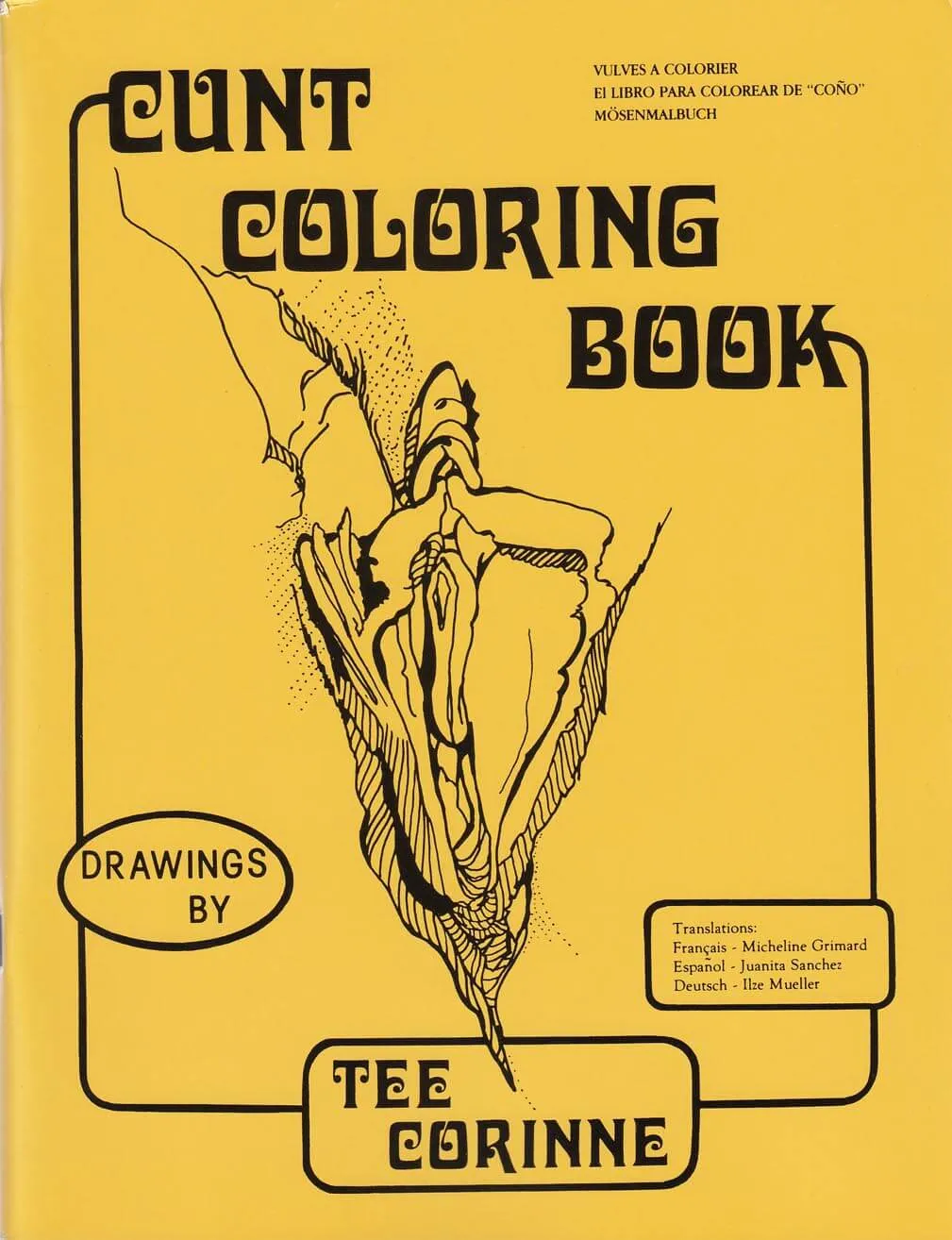
Cunt Coloring Book
Over three dozen c**ts of every size and description for you to color. Originally used for a sex-education class. Crayons not included. First published in 1975 by lesbian activist and artist Tee Corinne.
"In 1973 I set out to do drawings of women’s genitals for use in sex education groups. I wanted the drawings to be lovely and informative, to give pleasure and affirmation. I organized the drawings into a coloring book because a major way we learn to understand the world, as children, is by coloring. As adults many of us still need to learn about our external sexual anatomy." —Tee Corinne
Tee Corinne was born November 3rd, 1943 and grew up in St. Petersburg, Florida. Her mother, also an artist, introduced her to the creative principles and techniques that would serve her all her life. She received a B.A. in printmaking and painting from the University of South Florida, then went on to get an M.F.A. in drawing and sculpture at Pratt Institute, graduating in 1968. Afterwards she taught for many years, traveled through Europe, and finally became enmeshed in the back-to-the-land movement and communal living. After nearly ten years of marriage to a man she referred to as her "best friend," Corinne came out of the closet amidst severe depression in 1975. The strength to accomplish this difficult effort would later propel her to heights and achievements that would distinguish her as "one of the most visible and accessible lesbian artists in the world." From the mid-1960’s to the day she died Corinne created, published, and exhibited her art and writing around the world. She was a co-facilitator of the Feminist Photography Ovulars and a co-founder of The Blatant Image, A Magazine of Feminist Photography. She was the author of one novel, three collections of short stories, four books of poetry and numerous arts publications. In 1980, she was one of ten selected artists invited to have their work exhibited in the Great American Lesbian Art Show. The world lost Tee Corinne to cancer in 2006.

The New Woman's Survival Catalogue
Kirsten Grimstad, Susan Rennie
Originally published in 1973, The New Woman's Survival Catalog is a seminal survey of the second-wave feminist effort across the US. Edited by Kirsten Grimstad and Susan Rennie in just five months, The New Woman's Survival Catalog makes a nod to Stewart Brand's influential Whole Earth Catalog, mapping a vast network of feminist alternative cultural activity in the 1970s.