rile*books

Search books

Search books by title, author, publisher, keywords...

Cover of The Author as Producer of Nothing

Rab-Rab Press

The Author as Producer of Nothing

Peter Gidal

€14.00

The first publication of a lost 1978 text by Peter Gidal—one of the most influential experimental filmmakers ever.

The book includes the first publication of Peter Gidal's text from 1978, with a new introduction. Gidal in this dense theoretical essay deals with the limits of language and representation in the practice of experimental filmmaking and writing. Gidal's lost text The Author as Producer of Nothing will give a new insight into the theoretical and political context to experimental film practices.
The afterword by Sezgin Boynik discusses in detail the political contradictions of Gidal's filmic non-objectivity.

"The process of the film's making deals with devices that result in demystification or attempted demystification of the film process. But by 'deals with' I do not mean 'represents'. In other words, such films do not document various film procedures, which would place them in the same category as films which transparently document a narrative, a set of actions, etc. Documentation, through usage of the film medium as transparent, invisible, is exactly the same when the object being documented is some 'real event', some 'film procedure', some 'story', etc. An avant-garde film defined by its development towards increased materialism and materialist function does not represent, or document, anything. The film produces certain relations between segments, between what the camera is aimed at and the way that 'image' is presented. The dialectic of the film is established in that space of tension between materialist flatness, grain, light, movement, and the supposed reality that is represented. Consequently a continual attempt to destroy the illusion is necessary."—Peter Gidal

Peter Gidal (born 1946 in New York) is an influential British film theorist and avant-garde filmmaker, associated with the English "Structural/Materialist" movement (along with Malcolm Le Grice notably). He has published in numerous magazines (Studio International, Screen, October, Undercut) and is the author of several books, including Andy Warhol: Films and Paintings (1971), Materialist Film (1988) and Understanding Beckett: A Study of Monologue and Gesture in the Works of Samuel Beckett (1986).

Published in 2021 ┊ 96 pages ┊ Language: English

recommendations

Cover of Biting the Hand – Traces of Resistance in the Art & Language diaspora

Rab-Rab Press

Biting the Hand – Traces of Resistance in the Art & Language diaspora

Paul Wood

€30.00

Extensive survey of the politically outward-looking Conceptualism emerging from Art & Language in the UK. Especially considering its critique of the norms of Modernist art practices in contemporary art, particularly practices of art education.

Edited, compiled and introduced by Paul Wood, Biting the Hand: Traces of Resistance in the Art & Language diaspora is about a dissident formation of artists active in the UK in the 1970s and 80s.

The book tells the story of artists engaging with a critique of then-contemporary modernist art education, who have embarked on a series of theoretical investigations which became increasingly politicised under the pressures of an evolving social crisis. Increased racism, unemployment and attacks on the organised working class all raised questions about how a critical art might respond.

By the late 1970s, these radical artists, mostly in the orbit of the Art & Language group, were producing posters and leaflets for a wide range of left-wing causes, as well as analyses of the politics of art and design education and the role of cultural ideology in maintaining consensus. In the 1980s, as Thatcherism tightened its grip, those involved went their separate ways into areas as diverse as media work, trade unionism, health and education.

Biting the Hand has three parts: a retrospective introduction setting the formation in its historical context, and two annotated documentary sections presenting examples of the work as both text and image, written and edited by Paul Wood.

It also includes a foreword by Sezgin Boynik, publisher, and an afterword by Ann Stephen, curator and art historian, further expanding on the book's subject.

For many years Paul Wood worked for the Art History Department of the Open University. His publications from that period include Conceptual Art (2000), Western Art and the Wider World (2013), and the four-volume anthology Art in Theory (1990-2020), co-edited with Charles Harrison and others.

Edited, compiled and introduced by Paul Wood.
Foreword by Sezgin Boynik; afterword by Ann Stephen.

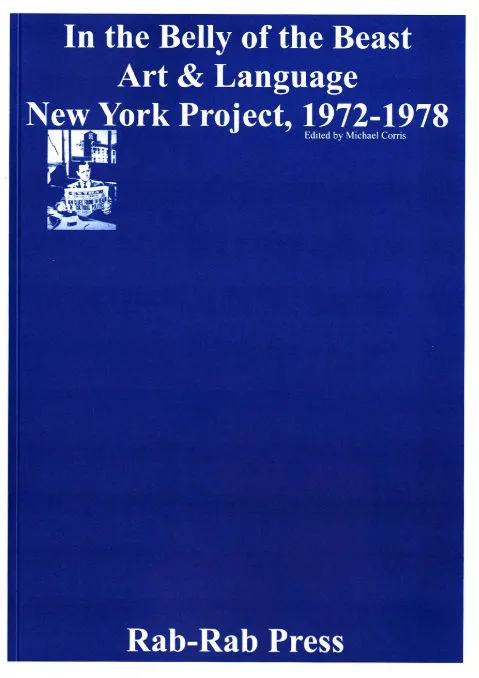
Cover of In the Belly of the Beast – Art & Language New York Project 1972-1978

Rab-Rab Press

In the Belly of the Beast – Art & Language New York Project 1972-1978

Art & Language

Edited by Michael Corris, the expanded edition of In the Belly of the Beast: Art & Language New York Project 1972-1978 is a survey of the tumultuous years of the political Conceptualism in the mid-seventies New York.

Artists have always experimented with politics, either by organizing themselves or uniting in support of a broader political movement. Today, "activist art" is taught in universities, supported by foundations, and featured in museums and international exhibitions. Is this the only possible way?

In the Belly of the Beast tells a different story, of the work of politically engaged artists and the conflicts they experienced. It is the history of artists wishing to continue working within the boundaries of the artworld and those who were intent on establishing new ideological and class relationships with activists to build a political party.

During the 1970s in New York, the Art & Language collective pioneered institutional critique; published a Marxist-influenced journal; agitated against racism and sexism in museums; challenged the cultural imperialism of international exhibitions; and forged a framework for a socialist organization of artists. This new edition includes previously unpublished documents illuminating the contradictions and disputes that lay at the center of the organization and practices of Art & Language and left-wing groups, such as the Anti-Imperialist Cultural Union and the Artists' Meeting for Cultural Change, mobilizing artists in New York at the time.

The new and expanded edition of In the Belly of the Beast features an extensive interview with Michael Corris, who annotated a collection of previously unavailable documents from the period, including manuscripts, pamphlets, transcripts, and letters.

Art & Language is the name of a group of English artists who choose to work collectively, and the title of a magazine that they founded in 1968. Proposing a critical analysis of the relations between art, society, and politics, Art & Language marks, even in its name, the importance of the “textual turning point” in the 1960s.

Since 1976, Art & Language's project has continued, through Mel Ramsden and Michael Baldwin, with the literary and theoretical collaboration of Charles Harrison. Working with very varied mediums, from painting to rock, these co-founders of Conceptual art remain, even today, attached to observing the consequences of what they themselves call the “depressing collapse of modernism.”

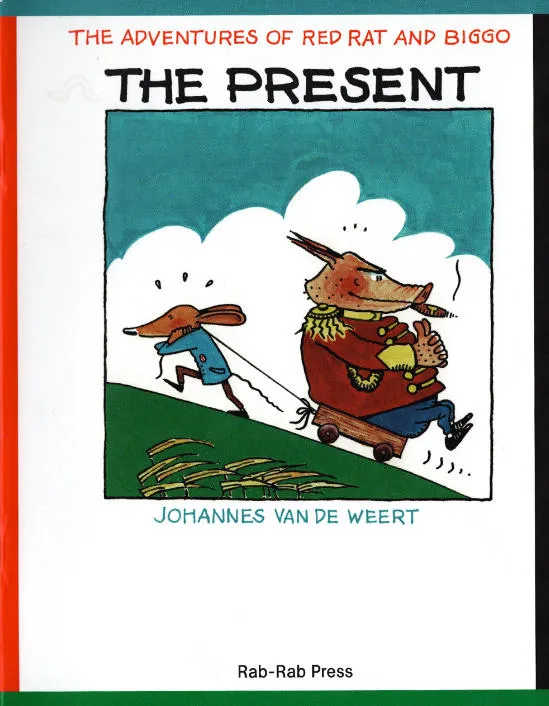
Cover of The Adventures of Red Rat and BIGGO – The Present

Rab-Rab Press

The Adventures of Red Rat and BIGGO – The Present

Johannes van de Weert

A children's book by Johannes van de Weert, a veteran of the punk underground (Rondos, The Ex, Red Rat, Raket).

The Adventures of Red Rat and BIGGO – The Present is a remake of Bram konijn en Piet de muis [Bram the Rabbit and Piet the Mouse], a 1982 children's book by Johannes van de Weert, a veteran of the Dutch punk underground who played with Rondos and The Ex, and who was the force behind Red Rat and Raket editions.
The Present is a 2010 remake telling the story of a bully pig who terrifies a poor rat on a daily basis. After a while, the rat falls ill with fear and has to stay in bed. The lonely, evil pig has no one to play with and becomes depressed. The pig gives the rat a present—a bunch of beautiful flowers—and all is well. Now the two can play together.
The 2010 remake, featuring different characters and intended for a North Korean audience, was never published. The 2025 English version opens with an introduction by Van de Weert, telling a bizarre story of a failed political career and an absurd vaudeville class struggle behind the seemingly harmless educational children's book.

Johannes van de Weert was a cartoonist active in the Rotterdam punk and squatter's movements of the 1980s. He was a singer with the punk band De Rondos and he started self-publishing small comic booklets in the late 1970s. He created his character "Redrat" for the fanzine Raket in 1980. The character soon became an icon for the squatter's movement.

Cover of Rab-Rab, Issue 5

Rab-Rab Press

Rab-Rab, Issue 5

Rab-Rab

Essays €27.00

The fifth issue of Rab-Rab: Journal of Political and Formal Inquiries in Art includes stories about nation traitors, fierce masses, socialist women struggles, love-forms, psychedelic counter-revolutionaries, workers unions, Brecht fiddlers, jazz surrealism, Soviet trains, and anti-fascism.

Among the contributors to the fifth issue are Anna Thew, Yehuda Safran, Peter Gidal, Cana Bilir-Meier, David Black, Marjo Liukkonen, Alejandro Pedregal, Peter Hallward, Minna Henriksson, and Jyrki Siukonen.

It has also two extensive dossiers. One dedicated to Franklin Rosemont is presented by Joe Feinberg and is introducing some unpublished and difficult to find texts parallel with writings of T-Bone Slim and Joe Hill. The other dossier on Robert Linhart is presented by Tevfik Rada, and it includes a translation of a chapter from Linhart's book on productivism, an article against Western bourgeois dissidents, and an interview with him.

Cover of About Narration – Materials, Comments, Interventions

Rab-Rab Press

About Narration – Materials, Comments, Interventions

Ingemo Engström, Harun Farocki

Published in collaboration with Harun Farocki Institut, this book unpacks About Narration [Erzählen], a 1975 essay film directed by Ingemo Engström and Harun Farocki.

Edited and introduced by Sezgin Boynik and Tom Holert, this book focuses on About Narration [Erzählen] directed by Ingemo Engström and Harun Farocki.
It includes the film's script alongside the historical documents related to its making and Farocki's previously unpublished theoretical and programmatic essay on the film. The publication also includes a retrospective essay by Ingemo Engström on the film's political and artistic background.

Volker Pantenburg's detailed elaboration of the conditions of its making, alongside Boynik and Holert's concluding remarks, further contextualizes the film. The interview with Cathy Porter on Larisa Reisner, a heroine of About Narration, gives an overview of the life of a militant writer who inspired Engström and Farocki.

Edited and introduced by Sezgin Boynik and Tom Holert.

Cover of Foundlings

Argos Arts

Foundlings

Orla Barry

Foundlings, a video film, was shot near Wexford, in the south east of Ireland where she grew up. This visual poem without a particular narrative and full of autobiographical elements is set at a very slowed down pace. Floating images and heavy voices are central to the associative strategy that is at work here. The images allow one to listen to a hypnotic voice, while at the same time allowing the eyes to wander... to daydream... to travel over drawn out time. The images are country images, images of repetitive calm, the kind of calm one finds between awake and asleep. The speed of the sea sets the pace, regular yet irregular. The images are inhabited by people who cannot speak. Who are busy doing nothing, except passing time. Silent brothers and sisters of the sea.

The soundsculpture Unsaid, a joint work by Orla Barry and Portuguese artist Rui Chafes (1964), is very opposite to the film. The film is full of open spaces and bright colours. The sculpture is black, closed and claustrophobic and on top of that it is housed in a narrow tower five meters tall. The visitor has to take place on a rather unconventional chair and put his head in a closed off sphere, surrounding himself by darkness and leaving him with his own heartbeat. A voice addresses the visitor directly on highly intimate terms. The seating is hard and uncomfortable. One has to be strong to experience this piece that is a perpetual struggle between body and mind.

At the occassion of Barry’s show argos editions published Foundlings, a combined artist book and catalogue that can be ordered through argos. The book includes a DVD.

Orla Barry (1969) is an artist who centres her practice on language, written and spoken. Her work is strongly poetic and lyrical, crossing a wide variety of media. Barry was born in Ireland, and the rhythm of her phraseology, the pictorial and narrative vernacular on which she draws, somehow evokes her homeland’s topography, climate and literary heritage. At argos the artist presented two new works.

Cover of Au fort les âmes sont

Mucem

Au fort les âmes sont

Laure Prouvost

Exclusive works designed by Laure Prouvost for her carte blanche at the Mucem in Marseille, a series of immersive and poetic installations in the heart of Fort Saint-Jean, photographed by Raphaël Massart for this cut-out book, between an artist's book and an exhibition catalogue, accompanied by drawings and critical texts.

For the Mucem, Laure Prouvost has created a series of immersive installations in the heart of Fort Saint-Jean. Repurposed everyday objects, glass sculptures, sound mirages, and underwater videos shot in the depths of the calanques and around Frioul compose a sensitive and poetic universe. Between fiction and reality, the artist invites visitors on a sensory journey where everything is transformed: forms, narratives, and life itself.
The book was conceived as a visual journey leading from the Old Port of Marseille to Fort Saint-Jean and into the very heart of each work. To recreate this encounter between artist Laure Prouvost and the Mucem, there is a constant dialogue between the exterior—the sea, the stone of the fort—and the interior—the intimacy of the installations that unfold in the air, in the bowels of the earth, and underwater... Designed in close collaboration with the artist, the book captures this moment through photographic work carried out especially by Raphaël Massart and an evocative form designed by the artist: like a book that also floats in the Mediterranean. To accompany this visual unfolding, a booklet embedded in the heart of the book contains texts by Hélia Paukner, curator of the exhibition, and Mathilde Roman, art historian.

Published on the occasion of the eponymous exhibition at the Mucem, Marseille, in 2025.

Cover of Snaturamenti

Light Cone

Snaturamenti

Flatform

A workbook by Flatform on displacement, conceived and curated by Giuliana Prucca.

The book is published under four different covers and with four different layouts, randomly distributed.

Founded in 2006 and based in Berlin and Milan, Flatform is a video and media arts collective, at the border between experimental cinema and contemporary art, that creates time-based works, film events, and installations, most of which revolve around landscape and biopolitics. Distributed by Light Cone in Paris and by Video Data Bank in Chicago, works by Flatform have competed in major film festivals including Cannes, Rotterdam, Venice, Toronto, and have been shown worldwide in art venues such as Centre Pompidou, Haus der Kulturen der Welt, Hirshhorn Museum, MAXXI Museum, Eye Filmmuseum, Wexner Center for the Arts and Garage Center for the Arts.

Co-published by Light Cone and Avarie.

Cover of A conversation, Nick Zedd & Marie Canet

Goswell Road

A conversation, Nick Zedd & Marie Canet

Marie Canet, Nick Zedd

“What happened to my book?”

This was the last email we received from Nick, in December 2021. A short, concise demand, which we responded to, telling him that the transcription was coming soon and that Marie was finalising the introduction. Little did we know, what Nick surely already knew: he was dying. The urgency should have given it away, but Nick was always blunt in our email exchanges.

Nick passed away on February 27th, 2022. We regret not getting the transcription to him while he could still edit it, so this book in your hands remains an unabridged testament.

The only thing he did edit were his final words, in an unsolicited email in September 2021:

“I was thinking about when you asked me if I had any final words, that it would be better to have me say: Freedom or death. At the crossroads. With a key.”

So we leave you with this; a homage to the legendary founder of the Cinema Of Transgression - a brilliant artist, a sharp mind, a loving father, a kind revolutionary, a boot stamping on the face of modernity forever, an underground phenomenon.
Nick Zedd, rest in peace.

[Note by the publisher.]

With a foreword by Goswell Road. Includes a conversation with Nick Zedd, and the manifesto 'Cinema of Transgression'.

Softcover (11 cm x 18 cm)
84 Pages
75 copies
Language : English

Cover of Last Movies

Tenement Press

Last Movies

Stanley Schtinter

A publication, durational artwork, and moving-image experience, Schtinter’s debut collection, Last Movies, is an alternative account of the first century of cinema according to the films watched by  a constellation of its most notable stars shortly  before (or at the time of) their deaths.

An extensive and exhaustive research project—a holy book of celluloid spiritualism and old canards—Schtinter questions and reconfigures common knowledge to recast the historic column inches of cinema’s mythological hearsay into a thousand-yard stare. 

Via a series of interlinked vignettes, here we’ve a book in which Manhattan Melodrama, directed by W.S. Van Dyke and George Cukor, is seen by American gangster John Dillinger, only for him to be gunned down by federal agents upon leaving the cinema. In which George Cukor watches The Graduate and dies thereafter. In which Bette Davis—given her break by Cukor—watches herself in Waterloo Bridge (the 1940 remake Cukor had been meant to direct), before travelling to France and failing to make it back to Hollywood. In which Rainer Werner Fassbinder watches Bette Davis in Michael Curtiz’s 20,000 Years in Sing Sing, and suffers the stroke that kills him. In which John F. Kennedy watches From Russia with Love at a private ‘casa-blanca’ screening prior to the presidential motorcade reaching Dealey Plaza; in which Burt Topper’s War is Hell exists only in a fifteen-minute cut, considering this is as much as Lee Harvey Oswald would have seen at the Texas Theatre in the wake of JFK’s killing.