rile*books

Search books

Search books by title, author, publisher, keywords...

Cover of Girls Like Us #7 - Body

Girls Like Us

Girls Like Us #7 - Body

Marnie Slater ed., Katja Mater ed., Sara Kaaman ed., Jessica Geysel ed.

€8.00

120 pages exploring the body and bodies, inside out and outside in. Bodies that dance and move. Bodies making waves. Body double. Bodies at work and working with the body. Using the body as an instrument. The body as medium and massage of touch and being touched. The single, singular body as the very basis for a ‘we’.

Interviews with image ingenue K8 Hardy, filmmaker Babette Mangolte, writer Jina Khayyer and documentarist Mariah Garnett. Essays by Derica Shields and Crystal Campell. Plus 7 Q&A's with healers, herbalist and modern witches. Beautiful bodily artists series and last but not least – horoscopic aphrodisiacs.

Language: English

recommendations

Cover of Girls Like Us #6 - Secrets

Girls Like Us

Girls Like Us #6 - Secrets

Jessica Geysel, Sara Kaaman and 2 more

A secret can be a private space for self-creation – or a shared site of pleasure.

We explore secrets in a plethora of forms and contexts. From layered accounts of mediaeval ecstasy to the unexplored sensory experience of smell. From camouflaged play to queer readings of astrological charts and the hidden history of house music. From a very analog point of view to the outskirts of the internet.

Cover of A Book Knot Book

Body Text

A Book Knot Book

Sara Kaaman

Performance €20.00

A Book Knot Book is a 208 pages long performance, the first from the research and publishing initiative Body Text. In this study of language in action systems of meaning-making crash, sparkle and swoon. In a playful voice over A Book Knot Book self-reflects on the materialities and choreographies of publishing, reading and writing. With guest stars in fragments; Monique Wittig, Yvonne Rainer, Cristina Rivera Garza, Amiri Baraka, Will Rawls, David Abram, Thich Nhat Hanh and more. 

Edited and designed by Sara Kaaman. Published with the support of Stockholm University of the Arts.

Cover of  Terrassen – Privilege: An Yvonne Rainer Filmography

At Last Books

Terrassen – Privilege: An Yvonne Rainer Filmography

Terrassen

Published as appendix to the Yvonne Rainer Retrospective (November 6-28 2024), organised by Terrassen at Palads Cinema, Copenhagen.

Yvonne Rainer (b. 1934), one of the great American artists of her generation, revolutionised dance and choreography in the 1960s. Yet over the course of two decades - from the early 1970s to the mid-1990s - Rainer also directed seven feature films, each intensely discursive and consistently inviting critical reflection. Radically diverse and impossible to categorise, her films carve out their own space between documentary, fiction, performance, and the avant-garde. For decades, these films have been difficult to access, and when shown, they were often confined to small monitors in large museum settings. Now, newly restored in 4K, they were presented in a retrospective by Terrassen in 2024 - the first of its kind in Denmark. 

The retrospective culminated in the publication of a new Yvonne Rainer filmography, with contributions from Babette Mangolte, Ursula Andkjær Olsen, Mira Adoumier, Emily Wardill, Emily LaBarge, Amelia Groom, Valérie Massadian, Iman Mohammed, Frida Sandström and Yvonne Rainer herself.

Cover of Natural Enemies Of Books: A Messy History Of Women In Printing And Typography

Occasional Papers

Natural Enemies Of Books: A Messy History Of Women In Printing And Typography

Sara Kaaman, Maryam Fanni and 1 more

Natural Enemies of Books is a response to the groundbreaking 1937 publication 'Bookmaking on the Distaff Side', which brought together contributions by women printers, illustrators, authors, typographers, and typesetters, highlighting the print industry’s inequalities and proposing a takeover of the history of the book. Edited by feminist graphic design collective MMS, the publication includes newly commissioned essays and poems, conversations with former typesetters Inger Humlesjö, Ingegärd Waaranperä, Gail Cartmail, and Megan Downey, and reprints of the original book and other publications.

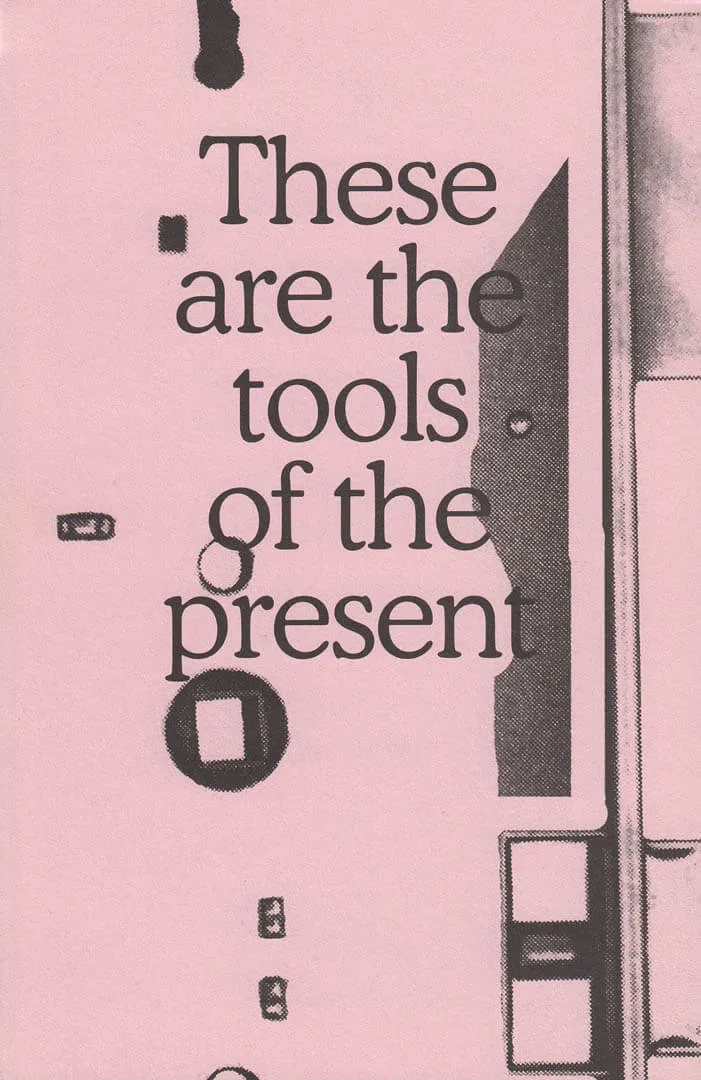
Cover of These are the tools of the present

Mophradat

These are the tools of the present

Mai Abu ElDahab, November Paynter and 1 more

This publication comprises a series of interviews with contemporary artists, musicians, and writers who are in dialogue with Beirut and Cairo. While not purporting to be an overview of the art scenes in these cities, this book begins to draw a picture of how artists think about what it means to be active in the contexts of these cities. It offers insight into the circumstances that structured these artists’ stories, and the often accidental influences that have shaped how their practices have developed.

Cover of Still Life 4

Self-Published

Still Life 4

Hamish MacPherson

STILL LIFE is an online and printed zine about relationships and configurations in which one person is still while others are not. Or where one person is passive and others are active. It’s about how we put ourselves in other people’s hands. Or how we are put in other people’s hands. It’s about care and power and vulnerability and agency. And other things not so clearly named. It’s about the different kinds of knowledge that people have about their own and other people’s bodies. And the kind of philosophical and political understandings woven into that knowledge.

Cover of Love in a F*cked-Up World

Algonquin Books

Love in a F*cked-Up World

Dean Spade

LGBTQI+ €20.00

Around the globe, people are faced with a spiraling succession of crises, from the pandemic and climate change-induced disasters to the ongoing horrors of mass incarceration, racist policing, endemic gender violence, and severe wealth inequality. Many of us feel mobilized to organize and collectively combat these issues on both a personal and political level, often dedicating our lives to the forwarding of progressive ideas and the daunting goal of trying to bend the world toward justice.

But even those of us who long for change seem to have trouble when it comes to interpersonal relationships. Too often we think of our political values as outward-facing positions again dominant systems of power. Rarely, if ever, do we pursue the same kind of justice close to home, in our personal connections. Many activist projects and resistance groups fall apart because people treat each other poorly, trying desperately to live out the cultural myths about dating and relationships that we are fed from an early age.

How do we divest from the idea that one romantic partner will be the solution to all our problems? How do we separate our expectations of love from the troubling dynamics left to us by our parents? How do we bring our best thinking about freedom and justice into step with our desires for healing and connection?

Lifelong activist and educator Dean Spade dares us to decide that our interpersonal actions are not separate from our politics of liberation and resistance. Love in a F*cked-Up World is a resounding call to action and a practical manifesto for how to combat cultural scripts and take our relationships into our own hands, preparing us for the work of changing the world.

Cover of Tar Hollow Trans: Essays

University Press of Kentucky

Tar Hollow Trans: Essays

Stacy Jane Grover

Essays €22.00

"I've lived a completely ordinary life, so much that I don't know how to write a transgender or queer or Appalachian story, because I don't feel like I've lived one.... Though, in searching for ways to write myself in my stories, maybe I can find power in this ordinariness."

Raised in southeast Ohio, Stacy Jane Grover would not describe her upbringing as "Appalachian." Appalachia existed farther afield—more rural, more country than the landscape of her hometown.

Grover returned to the places of her childhood to reconcile her identity and experience with the culture and the people who had raised her. She began to reflect on her memories and discovered that group identities like Appalachian and transgender are linked by more than just the stinging brand of social otherness.

In Tar Hollow Trans, Grover explores her transgender experience through common Appalachian cultural traditions. In "Dead Furrows," a death vigil and funeral leads to an investigation of Appalachian funerary rituals and their failure to help Grover cope with the grief of being denied her transness. "Homeplace" threads family interactions with farm animals and Grover's coming out journey, illuminating the disturbing parallels between the American Veterinary Association's guidelines for ethical euthanasia and the World Professional Association for Transgender Health's guidelines for transgender care.

Together, her essays write transgender experience into broader cultural narratives beyond transition and interrogate the failures of concepts such as memory, metaphor, heritage, and tradition. Tar Hollow Trans investigates the ways the labels of transgender and Appalachian have been created and understood and reckons with the ways the ever-becoming transgender self, like a stigmatized region, can find new spaces of growth.

Cover of Issue #60 - Gender Disarray

Movement Research Performance Journal

Issue #60 - Gender Disarray

Kay Gabriel, Amalle Dublon and 2 more

Under the direction of four contributing editors—Amalle Dublon, Kay Gabriel, Keioui Keijaun Thomas, and Anh Vo— we’ve assembled a new body of work by mostly trans and queer artists reflecting on the keyword “gender” and its relation to contemporary performance. Their work moves across multiple genres of writing, from analytic essays to poetry to performance scripts. 

“Read My Lips” is a phrase that will be familiar to longtime readers of the Movement Research Performance Journal—so familiar that the mere reference will bring to mind an image posted by the artist collective GANG, an image that lies at the heart of one of the journal’s most spectacular moments. Issue #3, with its focus “Gender Performance,” was published in 1991 amid that era’s Culture Wars, receiving almost immediately negative reception from government officials (the NEA threatened to withdraw funding from Movement Research) and many members of the dance community (who considered Issue #3 to be deliberately provoking the so-called “war,” intentionally taking a political position that some worried might comprise future funding of the field). In the thirty-three years since its publication, Issue #3 has developed a patina familiar to many artist-activist histories that are looked upon with romance and nostalgia, often by those for whom that history is only a fantasy (rather than a lived experience). 

Cover of Radical Muses (Sinister Wisdom nr. 113)

Sinister Wisdom

Radical Muses (Sinister Wisdom nr. 113)

Julie R. Enszer

Sinister Wisdom 113: Radical Muses features an eclectic array of contemporary poetry, prose, and art by lesbians from around the world, including new work by: Andrea Assaf, Tara Shea Burke, Cheryl Clarke, Marina Chirkova, Estela González, Barbara Haas, Nancy E. Lake, Vi Khi Nao, H. Ní Aódagaín and much more!