rile*books

Search books

Search books by title, author, publisher, keywords...

Cover of Girls Like Us #2 — Issue 2

Girls Like Us

Girls Like Us #2 — Issue 2

Marnie Slater ed., Katja Mater ed., Sara Kaaman ed., Jessica Geysel ed.

€8.00

The second issue of the Amsterdam lesbian arts quarterly with newly appointed co-editor Vela Arbutina at the helm.

Features include Vava Dudu and Theo Mercier, Tavi Gevinson and Diane Pernet, Keren Cytter and Dafna Maimon, Lauren Flax and Lauren Dillard, Kaisa Lassinaro, Matthew Lutz-Kinoy, Leilah Weinraub, Benjamin A. Huseby, Eline McGeorge, Janis Pönisch, Anie Stanley, Andrea Ferrer, Devrim Bayar.

Language: English

recommendations

Cover of A Book Knot Book

Body Text

A Book Knot Book

Sara Kaaman

Performance €20.00

A Book Knot Book is a 208 pages long performance, the first from the research and publishing initiative Body Text. In this study of language in action systems of meaning-making crash, sparkle and swoon. In a playful voice over A Book Knot Book self-reflects on the materialities and choreographies of publishing, reading and writing. With guest stars in fragments; Monique Wittig, Yvonne Rainer, Cristina Rivera Garza, Amiri Baraka, Will Rawls, David Abram, Thich Nhat Hanh and more. 

Edited and designed by Sara Kaaman. Published with the support of Stockholm University of the Arts.

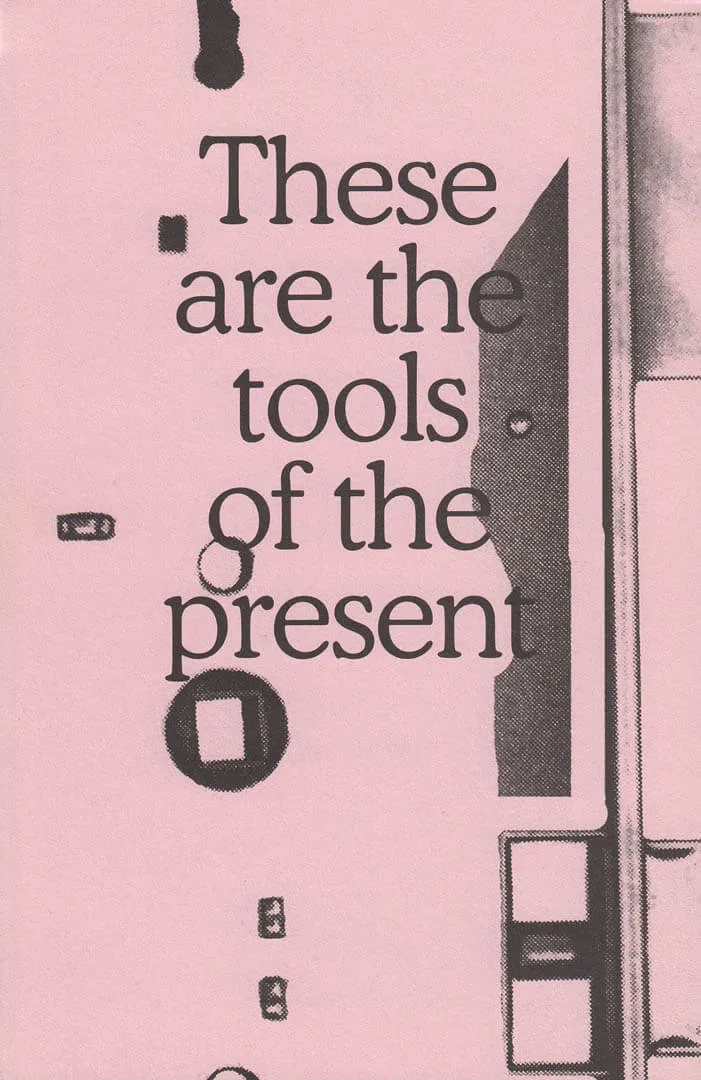
Cover of These are the tools of the present

Mophradat

These are the tools of the present

Mai Abu ElDahab, November Paynter and 1 more

This publication comprises a series of interviews with contemporary artists, musicians, and writers who are in dialogue with Beirut and Cairo. While not purporting to be an overview of the art scenes in these cities, this book begins to draw a picture of how artists think about what it means to be active in the contexts of these cities. It offers insight into the circumstances that structured these artists’ stories, and the often accidental influences that have shaped how their practices have developed.

Cover of Girls Like Us #6 - Secrets

Girls Like Us

Girls Like Us #6 - Secrets

Jessica Geysel, Sara Kaaman and 2 more

A secret can be a private space for self-creation – or a shared site of pleasure.

We explore secrets in a plethora of forms and contexts. From layered accounts of mediaeval ecstasy to the unexplored sensory experience of smell. From camouflaged play to queer readings of astrological charts and the hidden history of house music. From a very analog point of view to the outskirts of the internet.

Cover of Two Intersecting Loops of Silence

Futura Resistenza

Two Intersecting Loops of Silence

Katja Mater

Two Intersecting Loops of Silence is a 10-inch experimental vinyl that turns silence into rhythm and time into matter. Side A features two silent grooves that create a mechanical ticking when played, while Side B animates a clock-like etched drawing as the record spins. Numbered edition of 200 with hand-printed, unique etching covers. Each copy a one-of-a-kind artwork.

Cover of Fous Moi La Paix

Goswell Road

Fous Moi La Paix

Vava Dudu

Goswell Road presents Fous Moi La Paix a book of drawings by multidisciplinary artist Vava Dudu. Vava made 37 exclusive drawings for the publication, which launched at Paris Ass Book Fair 2024 at Palais de Tokyo. The drawings are offset with her texts, poems and several images of her iconic clothing and accessories.

"The multidisciplinary artist Vava Dudu refuses to follow convention: she draws and writes poetry, makes clothes and accessories, and builds furniture and guitars. She asserts her position as an outsider in contemporary art by stating that she “prefers extremes to the middle ground.” Her work as an independent stylist goes hand in hand with her activity as a singer in La Chatte, an electro-zouk punk new wave band founded in 2013 with Stéphane Argillet and Nicolas Jorio, aka “Nikolu.” Her underground artistic world, which joyously combines text and image, is expressed through various media.

Vava Dudu was born in 1970 in Paris, where she lives and works."

Text from Lafayette Anticipations website

Cover of Love Me Tender

Semiotext(e)

Love Me Tender

Constance Debré

LGBTQI+ €18.00

A novel of lesbian identity and motherhood, and the societal pressures that place them in opposition. 

The daughter of an illustrious French family whose members include a former Prime Minister, a model, and a journalist, Constance Debré abandoned her marriage and legal career in 2015 to write full-time and begin a relationship with a woman. Her transformation from affluent career woman to broke single lesbian was chronicled in her 2018 novel Play boy, praised by Virginie Despentes for its writing that is at once "flippant and consumed by anxiety."  

In Love Me Tender, Debré goes on to further describe the consequences of that life-changing decision. Her husband, Laurent, seeks to permanently separate her from their eight-year old child. Vilified in divorce court by her ex, she loses custody of her son and is allowed to see him only once every two weeks for a supervised hour. Deprived of her child, Debré gives up her two-bedroom apartment and bounces between borrowed apartments, hotel rooms, and a studio the size of a cell. She involves herself in brief affairs with numerous women who vary in age, body type, language, and lifestyle. But the closer she gets to them, the more distant she feels. Apart from cigarettes and sex, her life is completely ascetic: a regime of intense reading and writing, interrupted only by sleep and athletic swimming. She shuns any place where she might observe children, avoiding playgrounds and parks "as if they were cluster bombs ready to explode, riddling her body with pieces of shrapnel."  

Writing graphically about sex, rupture, longing, and despair in the first person, Debré's work is often compared with the punk-era writings of Guillaume Dustan and Herve Guibert, whose work she has championed. As she says of Guibert: "I love him because he says I and he's a pornographer. That seems to be essential when you write. Otherwise you don't say anything." But in Love Me Tender, Debré speaks courageously of love in its many forms, reframing what it means to be a mother beyond conventional expectations.

Cover of MAKAN #3 / Synthetic Agencies

Think Tanger

MAKAN #3 / Synthetic Agencies

Hicham Bouzid, Ali T. As'ad

Periodicals €18.00

Building on the foundations of the first two issues, Synthetic Agencies invites a rethinking [and unthinking] of the assumptions, polarities, and discontents surrounding the notion of agency. Traditionally defined in Western thought as the capacity to act and effect change, agency is inseparable from questions of power and the often invisible structures through which power operates. The various contributions interrogate how agency is produced, constrained, or distributed through the systems of knowledge, design, and governance that shape our built environments, technologies, media, and cultures. They were are invited to right (as much as write on) agency, reflecting on how it operates across different scales and contexts, and imagining alternative worlds or configurations. Ultimately, Synthetic Agencies understands agency not as a fixed attribute but as a contested lens through which we might read, reshape, or resist the conditions of the present.

With contributions by Amine Houari, Driss Ksikes, Fehras Publishing Practices, Hamed Sinno, Helga Tawil-Souri, Lada Hršak, Mayada Madbouly, Myriam Ababsa, Nzinga Biegueng Mboup, Ola Hassanain, Omer Shah, OPPA, Salma Barmani, Samia Henni, Tarek El-Ariss, Zaidoun Hajjar.

Cover of Dysphoria Mundi: A Diary of Planetary Transition

Graywolf Press

Dysphoria Mundi: A Diary of Planetary Transition

Paul B. Preciado

LGBTQI+ €22.00

A revolutionary book tracing the collapse of the paradigms that have organized the world for centuries. 

In Dysphoria Mundi, Paul B. Preciado, best known for his 2013 cult classic Testo Junkie, has written a mutant text assembled from essays, philosophy, poetry, and autofiction that captures a moment of profound change and possibility. Rooted in the isolation of the COVID-19 pandemic, and taking account of the societal convulsions that have ensued, Preciado tries to make sense of our times from within the swirl of a revolutionary present moment.

The central thesis of this monumental work is that dysphoria, to be understood properly, should not be seen as a mental illness but rather as the condition that defines our times. Dysphoria is an abyss that separates a patriarchal, colonial, and capitalist order hurtling toward its end from a new way of being that, until now, has been seen as unproductive and abnormal but is in fact the way out of our current predicament.

With echoes of visionaries such as William S. Burroughs and Kathy Acker, Preciado’s theoretical writing is propelled by lyric power while providing us with a critical toolbox full of new concepts that can guide our thinking and our transition, cognitive emancipation, denormalization, disidentification, “electronic heroin,” digital coups, necro-kitsch. Dysphoria Mundi is Preciado’s most accessible and significant work to date, in which he makes sense of a world in ruins around us and maps a joyous, radical way forward.